The difference between a miserable first whitewater experience and an addictive one usually comes down to the kayak, not your skill level. Inflatable beginner whitewater kayaks rated for Class III–IV rapids now start at under $300 and weigh as little as 22 lbs — light enough to carry yourself and stable enough to survive your first real flip.
| Photo |
Top Pick

|
Versatile
|
Budget

|
Best Value

|
Best for Reliability

|
|---|---|---|---|---|---|
| Product | Driftsun Rover 120 Inflatable Whitewater Kayak | Sea Eagle 380X Explorer Inflatable Kayak Pro Package | Sea Eagle SE300X Explorer Inflatable Kayak Pro Package | Advanced Elements AdvancedFrame Sport Inflatable Kayak | INTEX Excursion Pro K1 Inflatable Fishing Kayak |
| Weight | 22 lbs | 40 lbs | 30 lbs | 26 lbs | 37 lbs |
| Capacity | 300 lbs | 750 lbs | 400 lbs | 300 lbs | 220 lbs |
| Self bailing | ✓ | ✓ | ✓ | ✗ | ✗ |
| Whitewater rating | Class III–IV | Class IV | Class IV | Class II | Class II |
| Buy Now | Check Price → | Check Price → | Check Price → | Check Price → | Check Price → |
Quick Tips
Start on Class I–II water and work up; most beginner kayaking accidents happen when paddlers overestimate their current skill level on their very first outing.
Inflate the floor chamber first and to its maximum rated PSI — a soft floor is the #1 cause of instability in inflatable kayaks on moving water.
Remove the tracking skeg before entering any whitewater; it's designed for flat water only and will fight you in current when you need to turn fast.
Wear your PFD the entire time on the water, not just near rapids — foot entrapment in shallow current is a greater risk than most beginners realize.
Driftsun Rover 120 Inflatable Whitewater Kayak
Best for solo beginners hitting Class III–IV rapids
Driftsun Rover 120 Inflatable Whitewater Kayak
Best for solo beginners hitting Class III–IV rapids
What we like
- At 22 lbs it's significantly lighter than most competitors, making solo carry from the parking lot to the put-in genuinely easy.
- High-pressure drop-stitch floor inflates to 6 PSI and creates a rigid paddling platform that feels far more like a hard-shell than a typical inflatable.
- Seven self-bailing drain ports shed cockpit water fast enough to keep you stable through back-to-back Class III drops.
- Ships as a complete package with padded seat, aluminum paddle, hand pump, and travel backpack — no separate purchases needed to get on the water.
What we don't
- The included aluminum paddle is functional but heavy; most paddlers upgrade to fiberglass within a season.
- At 8.5 feet it's short and maneuverable but tracks poorly on long flatwater stretches compared to longer kayaks.
- 220 lbs paddler capacity leaves little margin for larger riders or those who carry a lot of gear.
The Rover 120 is built specifically for a single paddler on moving water — the rocker profile is aggressive enough to spin out of trouble in current, and the drop-stitch floor stiffens the hull to a degree that genuinely surprises first-time inflatable paddlers. You can be on the river 6 minutes after pulling into the parking lot.
This is the right kayak if you're a solo paddler under 200 lbs who wants to progress from Class II to Class III this season. If you're paddling with a partner or need flat-water tracking for longer floats between rapids, the 380X handles both better.
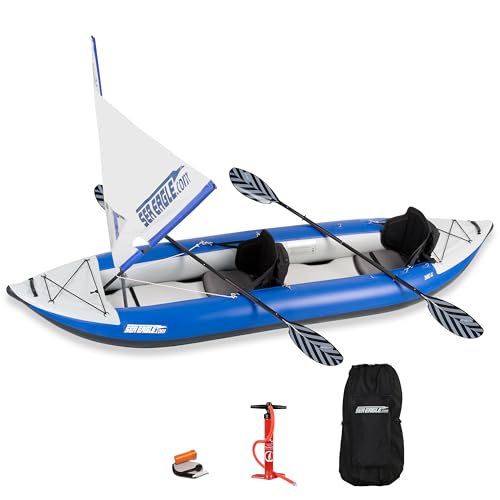
Sea Eagle 380X Explorer Inflatable Kayak Pro Package
Best for couples or paddlers who want one kayak for everything
Sea Eagle 380X Explorer Inflatable Kayak Pro Package
Best for couples or paddlers who want one kayak for everything
What we like
- 750 lb capacity means it paddles solo or doubles as a tandem without losing stability — uncommon versatility in one boat.
- 16 self-bailing drain valves shed whitewater faster than any other kayak in this category, keeping the cockpit clear even in sustained Class IV.
- 1000-denier reinforced PVC with quadruple-overlapped seams bounces off submerged rocks without flinching — this material handles actual abuse.
- Includes two tall-back seats and two paddles in the Pro Package, so both paddlers are fully equipped from day one.
What we don't
- At 40 lbs it requires two people to carry comfortably from a distant parking area to the water.
- The 12'6" length makes it significantly harder to maneuver in technical whitewater compared to shorter river kayaks.
- Pro Package pricing puts it well above entry-level budget — this is a serious investment for a beginner.
The 380X earns its price by doing things cheaper kayaks can't: it handles Class IV rapids solo or in tandem, tracks beautifully on flatwater lakes, and its 1000-denier hull bounces off river rocks instead of absorbing them. Most beginners who buy this kayak stop thinking about an upgrade years earlier than owners of budget alternatives.
Buy this if you're paddling with a partner or want a single kayak that transitions from whitewater rivers to lake camping trips without compromise. If you're always going solo and mostly focused on river skills, the 300X is the same hull technology at smaller size and lower cost.
Sea Eagle SE300X Explorer Inflatable Kayak Pro Package
Best for solo paddlers who want Class IV capability without the tandem size
Sea Eagle SE300X Explorer Inflatable Kayak Pro Package
Best for solo paddlers who want Class IV capability without the tandem size
What we like
- Class IV rating in a 9'10" hull means it maneuvers in tight technical lines that the longer 380X simply can't thread.
- The removable 4-inch drop-stitch floor at 10 PSI creates a hull so rigid that experienced paddlers mistake it for a hard-shell at first glance.
- 16 drain valves and a 3-chamber safety design mean the kayak stays afloat and draining even if one chamber takes damage mid-river.
- 30 lbs makes it manageable for a single paddler to carry to remote put-ins without help.
What we don't
- 400 lb capacity is generous for solo use, but the hull's short length means it won't ever be a comfortable flatwater cruiser on long lakes.
- Pro Package is a significant step up in price from the Rover 120 and the performance gap takes real skill to feel.
- Sea Eagle ships direct and delivery timelines can be longer than Amazon Prime for some regions.
The 300X is essentially the 380X shrunk down for solo paddling — same 1000-denier PVC construction, same 16-valve self-bailing system, but in a shorter hull that turns faster in technical water. It's the most capable solo inflatable kayak on this list for a paddler who knows they want to progress to serious Class IV water.
Choose this over the Rover 120 if you're a heavier paddler, want Class IV confidence from the start, or plan to use the kayak on coastal surf as well as rivers. Skip it if you need tandem capacity or mostly paddle Class II water where the price jump isn't justified by performance difference.
Advanced Elements AdvancedFrame Sport Inflatable Kayak
Best for beginners splitting time between rivers and flatwater
Advanced Elements AdvancedFrame Sport Inflatable Kayak
Best for beginners splitting time between rivers and flatwater
What we like
- Built-in aluminum ribs in the bow and stern create a defined shape that tracks dramatically better than frameless inflatables on flatwater stretches.
- At 26 lbs it's one of the lightest kayaks on this list and packs into a bag small enough to check as airline luggage.
- The large cockpit opening makes entry and exit genuinely easy, which matters enormously when you're learning wet exits on a moving river.
- 3-layer PVC construction provides solid puncture resistance for a kayak in this price range.
What we don't
- No self-bailing drain ports — not appropriate for Class III or above where water entry is sustained and fast.
- The aluminum rib frame adds structure but also means longer setup time compared to pure inflatables.
- 300 lb capacity leaves little room for larger paddlers carrying gear on overnight river trips.
The AdvancedFrame Sport is the kayak for the beginner who's going to spend 60% of their time on flat or slow-moving water and 40% on Class I–II rivers — it handles the flatwater better than any dedicated whitewater inflatable on this list, and its aluminum rib structure gives it a defined hull feel that pure inflatables can't match. You're getting touring kayak performance at inflatable convenience.
This is the right pick if you want a versatile day paddler more than a dedicated whitewater machine. If your river has consistent Class III rapids, upgrade to one of the self-bailing options — the AdvancedFrame Sport's lack of drain ports becomes a real limitation once water starts entering the cockpit regularly.
INTEX 68303EP Excursion Pro K1 Inflatable Kayak Set
Best for first-timers who want to try whitewater before committing to a higher price
INTEX 68303EP Excursion Pro K1 Inflatable Kayak Set
Best for first-timers who want to try whitewater before committing to a higher price
What we like
- Under $160 all-in with paddle and pump makes this the lowest barrier to entry for any paddler testing whitewater for the first time.
- Two removable skegs — one long for deep flatwater tracking, one short for shallow rivers — give meaningful versatility at this price point.
- 3-ply SuperStrong PVC construction holds up better than typical budget inflatables and resists minor rock scrapes on Class I–II water.
- The integrated GoPro/smartphone mount is a genuine bonus for paddlers who want to document early river sessions.
What we don't
- 220 lb weight capacity is the tightest on this list — heavier paddlers or those carrying gear will be over the limit.
- No self-bailing ports means water accumulates in the cockpit on any rapid with splash; bring a bilge pump or sponge.
- At 37 lbs it's the heaviest kayak on this list despite being the smallest, due to the denser PVC construction.
The Excursion Pro K1 is exactly what it looks like: a no-frills, budget-friendly inflatable that handles calm rivers and lakes well enough to teach you whether you actually like whitewater before spending serious money. It won't embarrass you on Class I–II water and it comes with everything you need in the box.
Buy this if you're under 200 lbs, mostly floating Class I rivers, and genuinely unsure whether kayaking will stick as a hobby. Once it does stick — and it usually does — the upgrade path to the Driftsun or Sea Eagle will feel completely justified.
What to Look For
Look for a rocker profile — the upward curve at the bow and stern — which is the single most important feature for whitewater maneuverability. Without it, a kayak will plow into waves and pin against obstacles rather than riding up and over them.
Self-bailing drain ports are non-negotiable for Class II water and above. Open the valves before hitting rapids and the cockpit drains itself; close them on flat stretches to stay dry.
Kayaks without this will fill with water and become dangerously heavy fast. Weight capacity matters more than most beginners assume.
A kayak loaded at 80–90% of its rated max capacity becomes sluggish and low in the water, making it harder to control in current. Choose a kayak where you plus any gear lands under 70% of the stated max.
Who Should Skip This
If your goal is Class IV or V whitewater from day one, you need professional instruction and a hard-shell river kayak — none of the inflatables here are a substitute for that. These kayaks are also not ideal for paddlers over 250 lbs unless specifically noted, as weight capacity directly affects how the hull sits in fast water.
What the Community Actually Uses
On r/whitewater, the recurring advice for beginners is to rent before buying and take at least one guided lesson on moving water before solo paddling. The thread consensus leans heavily toward inflatable kayaks for first-timers — the stability margin and storage convenience win out over tracking performance at this stage.
Quick Picks — In Case You've Already Decided
Sea Eagle 380X Explorer Inflatable Kayak Pro Package
Check Price on AmazonFrequently Asked Questions
Can a beginner use a whitewater kayak on a lake?
Yes — most inflatable whitewater kayaks work fine on flatwater. Close the self-bailing drain ports and attach the tracking skeg if included, and the kayak will track reasonably straight for casual lake paddling.
What class of rapids should a beginner start on?
Class I or II is the right starting point — moving water with small waves and no serious obstacles. Class III introduces stronger current and requires basic paddle bracing skills. Never attempt Class IV without prior instruction.
Are inflatable kayaks safe for whitewater?
High-quality inflatable kayaks with drop-stitch floors and 1000-denier PVC are genuinely safe for Class III–IV whitewater. They're actually more forgiving than hard-shells for beginners because they bounce off rocks rather than wrapping around them.
Do I need a spray skirt for a beginner whitewater kayak?
For Class I–II water, no. For Class III and up, a spray skirt prevents water from swamping the cockpit on waves and is strongly recommended. Self-bailing inflatables reduce this risk but don't eliminate it entirely.
How long does an inflatable whitewater kayak last?
A quality 1000-denier PVC inflatable kayak with proper care — rinsing after use, storing out of UV — typically lasts 5 to 10 years of regular paddling. The valves and seams are the most common failure points to inspect annually.
Buying Guide
You need a kayak that forgives mistakes before it demands skill. For beginners, that means high primary stability, self-bailing drain ports for fast water, and a rocker profile that lets you spin out of trouble without paddling strength.
Weight matters too — you'll be hauling this to the put-in alone.