The range printed on most budget radios is a lab number measured over flat water with zero obstacles—in real forest terrain, you'll get 20–30% of that at best. These five options have verified real-world range through trees and elevation, starting under $50 for a pair.
| Photo |
Top Pick

|
Versatile

|
Budget

|
Best Value

|
Best for Reliability
|
|---|---|---|---|---|---|
| Product | Rocky Talkie Mountain Radio (2-Pack) | Midland GXT1000VP4 GMRS Handheld Radio (2-Pack) | Motorola Talkabout T800 Two-Way Radios (2 Pack) | DEWALT DXFRS800 Heavy Duty Walkie Talkies (2 Pack) | Retevis RT22 Walkie Talkies (2 Pack) |
| Range | FRS 2W max | GMRS 5W max | FRS 35-mile claimed | FRS 2W max | FRS 2W max |
| Weight | 4.9 oz per radio | 8.5 oz per radio | 7.2 oz per radio | 12.35 oz per radio | 3.8 oz per radio |
| License | ✗ | Yes (GMRS) | ✗ | ✗ | ✗ |
| Waterproof | ✓ | ✓ | ✓ | ✓ | ✗ |
| Buy Now | Check Price → | Check Price → | Check Price → | Check Price → | Check Price → |
Quick Tips
FRS radios cap at 2 watts by law — any FRS radio claiming 35+ mile range is measuring in open sky, not on your trail.
GMRS radios need an FCC license ($35 for 10 years) and cover your whole family — worth it if you're buying a GMRS set.
Actual usable range in dense forest is typically 1–2 miles for FRS and 3–5 miles for a good GMRS radio — plan accordingly.
Rechargeable batteries drain faster in cold — if you're hunting below freezing, carry AA alkaline backup or pick a radio that supports both.
Rocky Talkie Mountain Radio (2 Pack)
Best for backcountry hiking and mountaineering
Rocky Talkie Mountain Radio (2 Pack)
Best for backcountry hiking and mountaineering
What we like
- Carabiner attachment is climbing-rated and clips directly to a pack strap without the dangling holster problem common to other radios.
- Lithium-ion battery holds a 4-day charge even in sub-freezing temperatures where NiMH rechargeables lose 30–40% capacity.
- Shatterproof LED screen and thermoplastic body survive the kind of drops and impacts that crack standard radio housings.
- Compact enough to actually fit in a chest pocket rather than riding awkwardly on a belt clip.
What we don't
- FRS-only means you're legally capped at 2 watts — solid range for most hiking but not competitive with licensed GMRS radios in wide open terrain.
- Higher price per pair than every other FRS option here, which stings if you need 4+ radios for a large group.
- No AA battery backup — when the built-in lithium pack dies with no power source, the radio is done.
When your group splits across a ridgeline or into a canyon, you need a radio that was actually designed for that environment rather than one that was rebranded from a business comms product. The Rocky Talkie's carabiner clip, cold-weather battery, and no-fuss two-button interface are built for exactly the moment most radios fail you.
This is the right pick if you're solo-hiking or in a pair, doing technical terrain, or going out in shoulder season when temperature swings can kill a standard battery mid-trip. If you need four or more radios for a larger group, the per-unit cost becomes the argument against it.
Midland GXT1000VP4 GMRS Two-Way Radio (2 Pack)
Best for family camping and larger groups on GMRS
Midland GXT1000VP4 GMRS Two-Way Radio (2 Pack)
Best for family camping and larger groups on GMRS
What we like
- 50 channels with 142 privacy codes gives you 3,124 channel combinations — essential when camping near other groups on the same frequencies.
- GMRS power output means real-world range of 3–5 miles through moderate tree cover, which is genuinely useful for spread-out family camping.
- NOAA Weather Scan + Alert will automatically flag incoming severe weather even when you're not actively monitoring — a real safety feature, not a checkbox.
- Value pack includes rechargeable batteries, desktop charger, boom mic headsets, and belt clips — nothing extra to buy out of the box.
What we don't
- GMRS license required to operate legally — it's cheap and easy but still an extra step that FRS users don't face.
- Heavier than backpacking-specific radios and the bulk shows when you're trying to move light.
- JIS4 splash resistance is adequate for rain but not for water crossings or full submersion.
The Midland GXT1000VP4 is the radio that r/GMRS recommends as the entry point into licensed two-way communication for a reason: it gives you 5 watts of legal power and a full kit at a price that doesn't require a second thought. You'll actually reach across the campground, across the lake, and through the treeline to where your group is fishing.
Get this if you're camping with family or a group of 4–6 people and want radios that everyone can use without reading a manual. Skip it if you're ultralight hiking solo — the weight and bulk are built for basecamp convenience, not for strapping to a pack all day.
Motorola Talkabout T800 Two-Way Radios (2 Pack)
Best for groups who want app-connected location sharing
Motorola Talkabout T800 Two-Way Radios (2 Pack)
Best for groups who want app-connected location sharing
What we like
- Bluetooth-connected Motorola Talkabout app adds location sharing, group messaging, and offline maps — features no other FRS radio in this category offers.
- IPX4 splash resistance handles rain and trail conditions confidently without requiring special handling.
- Dual power option accepts both NiMH rechargeable packs and AA alkaline batteries so you always have a backup option in the field.
- 22 channels with privacy codes and NOAA weather alerts included at a mid-range price point.
What we don't
- App connectivity is only useful if every person in your group has a smartphone and the app installed — coordination overhead that defeats the point on a simple trip.
- FRS-capped at 2 watts despite the 35-mile marketing claim — real-world range through trees is comparable to any other FRS radio, not better.
- Older Micro-USB charging rather than USB-C means a separate cable if you've standardized your kit.
If your group keeps losing each other and voice alone isn't solving it, the T800's location-sharing app is the feature that actually changes your day — it works entirely over radio frequencies without cell service, so it functions where your phone doesn't. It's a genuinely different use case from pure push-to-talk radios.
Buy this if you're coordinating a medium-sized group across complex terrain and want a map showing where everyone is, not just a voice channel. If you just need solid radio communication without the app layer, the Midland GXT1000VP4 gives you more power for the same money.
DEWALT DXFRS800 Heavy Duty Walkie Talkies (2 Pack)
Best for overlanders and hunters who need drop-proof durability
DEWALT DXFRS800 Heavy Duty Walkie Talkies (2 Pack)
Best for overlanders and hunters who need drop-proof durability
What we like
- IP67 rated — fully submersible to 1 meter for 30 minutes, which is a higher water resistance standard than any other radio in this list.
- Shock resistant to 2-meter drops with anti-slip housing designed for people who work in environments where radios regularly hit the ground.
- 18-hour battery life with battery-saving mode active — longest runtime in this roundup by a meaningful margin.
- Backed by a limited lifetime warranty, which no other radio here can match.
What we don't
- Heaviest radio in this roundup at 12.35 oz — noticeably heavy on a pack for all-day hiking even though it earns that weight in durability.
- FRS-only with 2 watts — the durability is exceptional but the radio power is the same as any other license-free option.
- Designed primarily for job sites, so the interface and form factor reflect that — less elegant for outdoor recreation than the Rocky Talkie.
The DEWALT DXFRS800 exists for one thing: not breaking. IP67 waterproofing, 2-meter drop resistance, anti-slip housing, and an 18-hour battery make this the radio you reach for when the conditions are genuinely harsh and a dead or broken radio creates a real problem.
It's overbuilt in the best possible way. Get this if you're hunting in wet lowland terrain, overlanding where gear takes regular abuse, or need radios that can be handed off between crew members all day without babying them.
If weight matters because you're hiking, the Rocky Talkie gives you better pack integration at nearly half the weight.
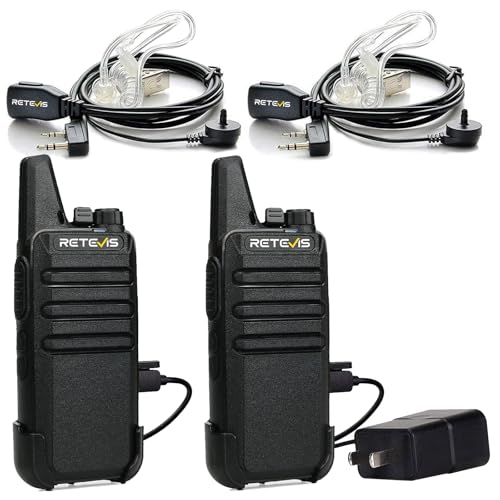
Retevis RT22 Walkie Talkies (2 Pack)
Best budget pick for casual day hikes and family outings
Retevis RT22 Walkie Talkies (2 Pack)
Best budget pick for casual day hikes and family outings
What we like
- Lightest radio in this roundup at 3.8 oz — genuinely pocket-sized and easy to hand a child without them feeling encumbered.
- USB charging and VOX hands-free operation included at a price point where most competing radios drop these features.
- License-free FRS with 16 channels and CTCSS privacy codes — compatible with most other FRS radios in the same family if you need to add units.
- Low enough cost to buy 4+ pairs for a large group without the budget conversation becoming painful.
What we don't
- No meaningful water resistance — rain exposure risks damaging the radio, which rules it out for anything more than mild weather day hiking.
- 1000mAh battery runs about 10 hours in mixed use — shorter than every other radio here and not enough for a full overnight trip.
- Build quality reflects the price: plastic housing and clip feel lightweight in a way that signals fragility rather than portability.
For a day hike on a marked trail where your group just needs to stay connected within a mile, the RT22 does the job at a price that makes it disposable if it gets damaged. It's honest about what it is — a budget FRS radio that works in fair conditions for casual use.
Buy this if you're camping with kids who lose or break things, doing a single-day group activity where range requirements are low, or just want to test whether radios actually improve your group's coordination before investing in a premium pair. Pass on it entirely if you're heading into wet weather or remote terrain where communication is a safety dependency.
What to Look For
Power output is the single most important spec that manufacturers bury. FRS radios are legally capped at 2 watts, while GMRS radios can push up to 5 watts — that difference is the real reason a GMRS unit outperforms an FRS unit through trees, not because of any antenna magic.
Waterproofing ratings matter more than most buyers expect. JIS4 or IPX4 handles splashes and rain fine for most hiking, but if you're hunting in swampy terrain or kayak camping, you want IP67 — which means full submersion survival.
Battery life and type is where people get burned in the field. A rechargeable-only radio is a liability on a 5-day backcountry trip with no power source.
Look for radios that accept both rechargeable packs and standard AA batteries so you always have a backup option.
Who Should Skip This
If your group rarely separates by more than a mile on maintained trails, any of these five will work — you don't need the premium picks. Skip the GMRS options if you're not willing to get the FCC license, even though it's cheap and easy.
If you're overlanding and primarily communicating vehicle-to-vehicle, a mobile GMRS unit mounted in the cab will outperform any of these handheld options.
What the Community Actually Uses
On r/Ultralight and r/CampingandHiking, the walkie talkie conversation always comes back to two frustrations: inflated range claims and dead batteries at the worst moment. The Rocky Talkie gets mentioned regularly for its carabiner clip and cold-weather battery performance.
On r/GMRS, the Midland GXT1000VP4 is a perennial recommendation as the entry point into licensed GMRS — cheap enough to test the ecosystem before upgrading.
Quick Picks — In Case You've Already Decided
Frequently Asked Questions
Do I need a license to use a walkie talkie for hiking?
For FRS radios, no license is needed at all — they're fully legal out of the box. GMRS radios require an FCC license ($35 fee, covers your whole family for 10 years). Most budget hiking radios are FRS; check the listing before buying.
What does real-world range actually look like in the forest?
Expect 1–2 miles for FRS radios in dense tree cover and 3–5 miles for a good GMRS radio. The 35-mile figures you see on packaging are measured over open water with line-of-sight — they're not dishonest, they're just irrelevant to trail use.
What's the difference between FRS and GMRS?
FRS (Family Radio Service) is license-free and capped at 2 watts of transmit power. GMRS (General Mobile Radio Service) allows up to 5 watts and requires an FCC license, but that license is inexpensive and covers your entire household.
Can different brands of walkie talkies talk to each other?
Yes, as long as they share channels and privacy codes — most FRS radios use the same 22-channel standard. GMRS radios can also communicate with FRS radios on the shared FRS/GMRS channels, which gives you flexibility across brands.
How do I keep my radios working in cold weather?
Lithium-ion and lithium polymer batteries handle cold far better than NiMH rechargeables. Keep the radio in an inside pocket when not in use, and always carry AA alkaline spares if your radio supports them — alkaline batteries outperform rechargeables below freezing.
Buying Guide
You need to decide two things before picking: FRS or GMRS, and battery type. FRS needs no license and works fine for most hikers.
GMRS gives you more power but requires an FCC license. After that, match the radio to your terrain—dense forest kills range faster than anything, so power matters more than claimed distance.