Losing radio contact with your partner on the back side of a ridge is not a gear problem — it's a radio selection problem. The five options below cover every mountain hunting scenario from solo stalks under two pounds to 5-watt GMRS setups that punch through canyon walls, starting at $50.
| Photo |
Top Pick

|
Versatile
|
Budget

|
Best Value
|
Best for Reliability

|
|---|---|---|---|---|---|
| Product | Rocky Talkie Mountain Radio (2-Pack) | Rocky Talkie Expedition 5 Watt Radio (2-Pack) | Midland GXT3000 GMRS Two-Way Radio (2-Pack) | Motorola Talkabout T600 H2O (2-Pack) | Cobra ACXT1035R FLT (2-Pack) |
| Range | Up to 30 miles (FRS) | Up to 40 miles (GMRS) | Up to 50 miles (GMRS) | Up to 35 miles (FRS) | Up to 37 miles (FRS) |
| Weight | 5.6 oz each | 7.2 oz each | 9.6 oz each | 8.8 oz each | 9.1 oz each |
| License | ✗ | Yes (GMRS) | Yes (GMRS) | ✗ | ✗ |
| Waterproof | IP56 | IP67 | ✗ | IP67 | IPX7 |
| Buy Now | Check Price → | Check Price → | Check Price → | Check Price → | Check Price → |
Quick Tips
Test your radios on the actual terrain before the hunt — ridgelines and canyons kill range fast; a 35-mile spec can shrink to 2 miles in a canyon.
Set a check-in schedule before you split — every 30 or 60 minutes — so a missed call means something specific instead of just static.
Use privacy codes to clear channel noise in high-use areas like national forests during rifle season, not to actually keep others from hearing you.
Carry alkaline backup batteries for any radio that supports them — lithium rechargeables fail faster in sub-freezing temps above treeline.
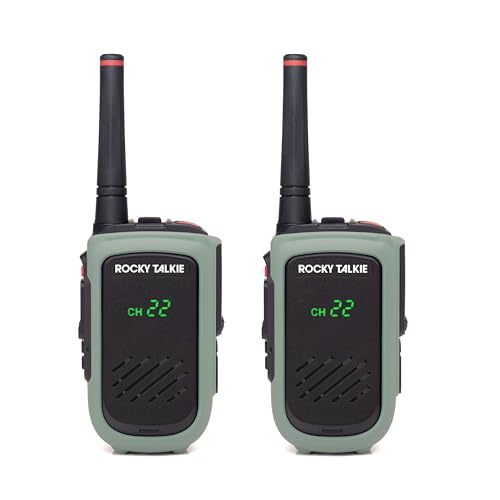
Rocky Talkie Mountain Radio (2-Pack)
Best for backcountry hunters who move fast and climb hard
Rocky Talkie Mountain Radio (2-Pack)
Best for backcountry hunters who move fast and climb hard
What we like
- Carabiner attachment keeps it on your pack strap where you can actually reach it mid-stalk.
- 4-day battery life on a lithium-ion pack means you're not rationing transmissions on a 5-day backcountry elk hunt.
- Shatterproof LED screen survives the falls that kill normal radio displays.
- 5-button interface works with gloves on — no fumbling with tiny controls at 6 AM in the dark.
What we don't
- IP56 rating handles splashes and snow but is not rated for submersion — a full creek crossing could be a problem.
- FRS power cap (2W) limits canyon-to-canyon performance compared to GMRS options.
- Higher per-unit cost than big-box consumer radios of similar range.
Rocky Talkie built this radio specifically for people moving in mountain terrain — the carabiner clips to a pack shoulder strap so the radio is accessible while you're glassing, not buried at the bottom of your bag where it's useless. That attachment system alone sets it apart from every consumer radio that came in a blister pack.
This is the right pick for solo hunters meeting a partner on opposite sides of a drainage, or any backcountry situation where you need a radio that survives the mountain rather than just the parking lot. If you need repeater access or serious canyon-punching power, step up to the Expedition 5W.
Rocky Talkie Expedition 5 Watt Radio (2-Pack)
Best for canyon country and long ridge-to-ridge splits
Rocky Talkie Expedition 5 Watt Radio (2-Pack)
Best for canyon country and long ridge-to-ridge splits
What we like
- 5-watt GMRS output punches through canyon walls and ridge breaks where 2-watt FRS units lose signal.
- IP67 waterproofing handles full submersion — creek crossings and surprise snowstorms are non-events.
- 5-day battery life on a lithium pack covers the full length of most backcountry hunts without a recharge.
- Repeater-capable on GMRS channels so you can use fixed repeaters to extend range in states that have them.
What we don't
- Requires an FCC GMRS license ($35/10 years) — minor but a real step compared to FRS.
- Most expensive option in this roundup by a significant margin.
- Heavier than the FRS Mountain Radio — noticeable on ultralight setups tracking every ounce.
The jump from 2-watt FRS to 5-watt GMRS is the difference between maybe reaching your partner over a ridge and reliably reaching them. In canyon-heavy country — Nevada, Utah, Colorado, Wyoming — that wattage gap is the entire ballgame when you're a mile apart vertically.
This is the pick for serious hunters doing multi-day backcountry splits in technical terrain, or any group where someone regularly ends up in a drainage while the other is on the ridge. The GMRS license is a $35 one-time cost that unlocks meaningfully better performance.
Midland GXT3000 GMRS Two-Way Radio (2-Pack)
Best for group hunts and drive-in camp setups
Midland GXT3000 GMRS Two-Way Radio (2-Pack)
Best for group hunts and drive-in camp setups
What we like
- 50-channel GMRS with repeater capability gives a large group the channel separation needed to run multiple sub-groups without cross-talk.
- 142 privacy codes keep your hunting group's channel clear during high-traffic periods in public land.
- Dual-power support (lithium-ion rechargeable + alkaline backup) is critical insurance for cold early-season mornings.
- SOS siren and NOAA weather scan are practical safety features for remote public land hunts.
What we don't
- No IP waterproof rating — splash resistance only, which is a real limitation in wet mountain conditions.
- Bulkier form factor than the Rocky Talkie options — less practical on a technical backcountry pack.
- Heavier per unit than purpose-built mountain radios.
The GXT3000 is the right tool for a 4–6 person group hunt where base camp is a truck or wall tent and people are splitting into sub-groups across a valley. The 50-channel GMRS and repeater capability handle large-group coordination better than any 22-channel FRS radio can.
Pass on this for serious backcountry packing — the lack of IP waterproof rating is a real issue above treeline. This is a drive-in elk camp and ATV-country radio, not a technical drainage radio.
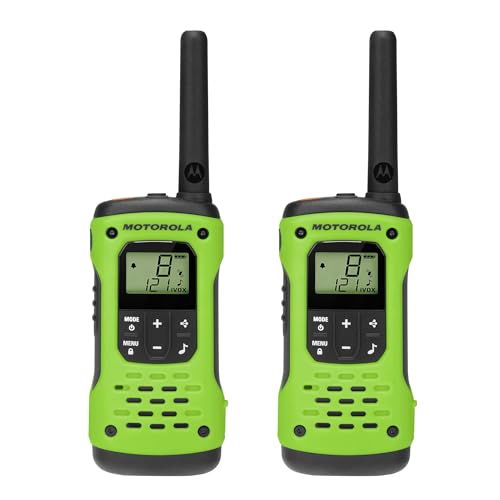
Motorola Talkabout T600 H2O (2-Pack)
Best for hunters who want waterproofing without the price
Motorola Talkabout T600 H2O (2-Pack)
Best for hunters who want waterproofing without the price
What we like
- IP67 waterproofing at this price point is rare — it floats and survives submersion, not just rain.
- Dual-power (NiMH rechargeable or AA alkaline) means you're never stuck with a dead radio in the field.
- VOX hands-free mode is useful when your hands are occupied field-dressing or glassing.
- Red LED flashlight mode preserves night vision at dawn stands — a specific and genuinely useful detail.
What we don't
- FRS power limit (2W) means real-world range in canyon terrain is shorter than the 35-mile spec suggests.
- Heavier and bulkier than purpose-built mountain radios — the Rocky Talkie options are noticeably lighter.
- NiMH battery packs only provide up to 9 hours — a short multi-day hunt will need recharging or spare AAs.
The T600 delivers IP67 waterproofing and dual-power flexibility at a price that makes equipping a whole hunting party practical. The floating design and water-activated flashlight are genuine field features, not marketing — if it goes in the river, it comes back to you.
This is the smart pick for hunters who want serious waterproofing on a budget, or anyone outfitting a group where buying five radios at Rocky Talkie prices isn't realistic. The FRS power cap is the only real limitation, and it's a regulatory ceiling, not a build quality issue.
Cobra ACXT1035R FLT (2-Pack)
Best for hunters who want IP67 and floating for under $60
Cobra ACXT1035R FLT (2-Pack)
Best for hunters who want IP67 and floating for under $60
What we like
- IPX7 waterproof with floating design — the orange core makes it easy to retrieve from a creek.
- Rewind-Say-Again feature replays the last 20 seconds of incoming audio, useful in noisy conditions.
- NOAA weather alert and VOX hands-free both present at this price point.
- 22 channels with 121 privacy codes handle most hunting situations without interference.
What we don't
- Heavier and more consumer-grade feeling than purpose-built mountain radios.
- No alkaline battery backup option — if the rechargeable dies remotely, you're done.
- FRS 2-watt limit is the same regulatory ceiling as every other FRS radio, meaning range in broken terrain is limited.
The Cobra ACXT1035R is the lowest cost of entry to get a floating, IPX7-waterproof radio with VOX and NOAA in your hands. For a hunter who wants to try radio communication without committing to the Rocky Talkie price point, this is the honest starting point.
If you end up hunting serious backcountry terrain more than once a season, you'll likely outgrow it and want more battery life and lighter weight. But for a weekend rifle hunt where the group stays in loose sight range and you need a radio that can survive the weather, this holds up.
What to Look For
Weight and attachment matter more than most hunters expect. A radio you clip to your pack and forget about gets used.
One you have to dig for doesn't. Real-world range in mountain terrain is nothing like the open-field spec.
Look for radios with higher wattage output or repeater capability if your group regularly splits across ridges. Waterproofing rating tells you how the radio handles weather, not just rain.
IP67 means full submersion up to a meter — the floor you want for elk country where creek crossings and snowstorms are routine.
Who Should Skip This
If you only hunt private flat farmland with line-of-sight between stands, any basic FRS radio works and you don't need to spend more than $50. If your group never splits more than a half-mile apart in open terrain, the range-focused options here are overkill for your situation.
What the Community Actually Uses
On r/hunting, the radio conversation comes up every fall — usually from someone who lost contact during a push hunt when one person went over a ridge. The recurring advice: skip the consumer blister-pack radios and get something with a carabiner attachment or steel clip that actually stays on your pack.
GMRS vs FRS is debated constantly, but the hunters doing serious backcountry work almost universally land on GMRS for anything past day-hiking distance.
Quick Picks — In Case You've Already Decided
Frequently Asked Questions
Do I need a license for a two-way radio for hunting?
FRS radios require no license and cover most hunting scenarios. GMRS radios require an FCC license ($35 for 10 years) but offer higher wattage and repeater access — worth it for backcountry elk and mule deer country where range is critical.
What's the actual usable range in mountain terrain?
Plan for 20–30% of the advertised range in broken terrain. A radio rated for 35 miles open-field might give you 3–5 miles ridge-to-valley. GMRS radios at 5 watts perform significantly better in terrain than 2-watt FRS units.
Can FRS and GMRS radios talk to each other?
Partially — GMRS and FRS share channels 1–7 and 15–22, so a GMRS radio can communicate with an FRS radio on those shared channels. GMRS-only channels (8–14 high-power, 23–30) require both radios to be GMRS.
How do cold temperatures affect battery life?
Lithium-ion batteries lose 20–30% capacity at 0°F and can fail entirely at extreme cold. If you hunt above treeline in late season, carry alkaline backups for any radio that supports dual power, or keep the radio warm inside your jacket between uses.
What's the difference between waterproof ratings on hunting radios?
IPX4 handles rain and splashes. IP54 adds dust resistance. IP67 means submersible to 1 meter for 30 minutes — the standard you want for creek crossings and heavy snowstorms. IP68 goes deeper but is rare in FRS/GMRS handhelds.
Buying Guide
You need a radio that survives the mountain, not just your driveway. Weight, waterproofing, and real-world range in broken terrain matter more than the max-range number on the box.
Pick FRS if you want zero paperwork. Pick GMRS if you want actual power and repeater access on longer splits.