The radio failing mid-convoy isn't a range problem — it's a wattage problem, and the fix is a vehicle-mounted GMRS radio, not a better walkie-talkie. The Midland MXT575 runs 50 watts — that's 10x what a bubble-pack handheld puts out — and it retails between $130 and $180.
| Photo |
Top Pick

|
Versatile
|
Budget

|
Best Value

|
Best for Reliability

|
|---|---|---|---|---|---|
| Product | Midland MXT575 MicroMobile GMRS Radio | BTECH Mobile GMRS-50X1 50-Watt GMRS Radio | Radioddity DB20-G GMRS Mobile Radio | Retevis RA86 GMRS Mobile Radio | Midland MXT275 MicroMobile GMRS Radio |
| Noaa weather | ✓ | ✓ | ✓ | ✓ | ✓ |
| Power output | 50W | 50W | 20W | 20W | 15W |
| Antenna mount | Magnetic NMO | External NMO | Magnetic (included) | Magnetic (included) | Magnetic NMO (detachable) |
| Repeater capable | ✓ | ✓ | ✓ | ✓ | ✓ |
| Buy Now | Check Price → | Check Price → | Check Price → | Check Price → | Check Price → |
Quick Tips
Always pick repeater-capable — if your group ever splits across a ridgeline, simplex-only radios become useless
Mount the antenna on the roof, not the hood — every inch of roof height adds real-world range
Get a GMRS license before you transmit — it's $35 for 10 years and covers your whole household
Match channels with your convoy before you leave — scrambling through menus at a trail junction wastes everyone's time
Midland MXT575 MicroMobile GMRS Radio
Best for serious overlanding convoys needing maximum legal power
Midland MXT575 MicroMobile GMRS Radio
Best for serious overlanding convoys needing maximum legal power
What we like
- 50 watts is the legal GMRS maximum — it punches through canyon walls and dense tree cover that kills lower-power radios
- Fully integrated control mic means the radio body can be stashed under the seat, keeping your dash clean
- Repeater capable on 8 channels, so you can use hilltop relay stations to extend range past line-of-sight
- Compatible with all Midland FRS/GMRS handhelds, so passengers on foot can stay in the loop
What we don't
- Requires a separate antenna mount — the included magnetic base is convenient but not ideal for serious off-road vibration
- 50-watt power draw needs a solid 12V connection; a loose cigarette lighter plug causes intermittent issues
- No display on the radio body itself — all channel info is on the mic, which takes a session to get used to
When your convoy is stretched across a ridgeline and the lead truck disappears around a switchback, 15 watts stops working and 50 watts doesn't — that's the entire argument for the MXT575, and it holds up every time terrain gets serious. This is the radio for anyone running 3 or more vehicles through off-road terrain where staying coordinated matters.
If you drive solo or run flat two-lane, the MXT275 at a third of the price covers you.
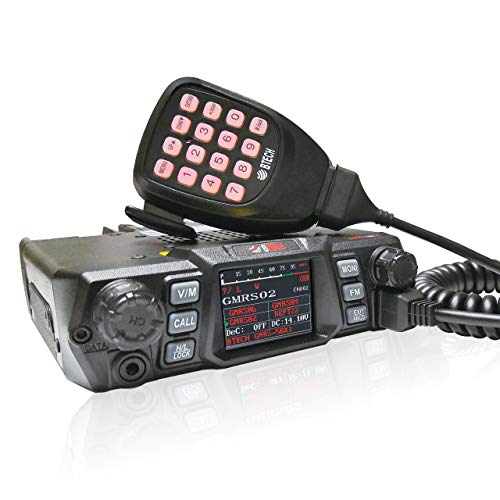
BTECH Mobile GMRS-50X1 50-Watt GMRS Radio
Best for tech-forward users who want programming flexibility
BTECH Mobile GMRS-50X1 50-Watt GMRS Radio
Best for tech-forward users who want programming flexibility
What we like
- CHIRP compatible for easy computer programming — set up all your channels in minutes instead of fumbling through menus at the trailhead
- Dual-band scanning receiver picks up VHF and UHF traffic beyond GMRS, useful for monitoring additional frequencies on the trail
- Pairs directly with BTECH GMRS-V1 handhelds on the same channel list for seamless vehicle-to-foot comms
- 50 watts matches the MXT575 at a lower entry price, with more programmability out of the box
What we don't
- No integrated control mic — the separate mic-and-head design takes more dashboard space than MicroMobile-style units
- Programming via CHIRP is a bonus for tech users but an extra step that intimidates radio newcomers
- Less polished install experience than Midland — hardware and documentation are functional but no-frills
The GMRS-50X1 matches the MXT575 watt-for-watt at 50 watts but gives you CHIRP programming support, which means you can set up repeater channels, custom names, and scan groups on a laptop instead of button-mashing through a mic display on a dirt road. Pick this over the Midland if you'll be programming multiple radios across a group or if you want dual-band scanning capability — skip it if you just want to plug in and go without touching software.
Radioddity DB20-G GMRS Mobile Radio
Best for first-time buyers wanting plug-and-go vehicle comms
Radioddity DB20-G GMRS Mobile Radio
Best for first-time buyers wanting plug-and-go vehicle comms
What we like
- Cigarette lighter plug means zero hardwiring — you're transmitting within five minutes of opening the box
- Driver-friendly mic has all controls integrated on the handset, so you never need to reach for the radio body while moving
- 500 programmable channels with display sync shows channel name, frequency, and number simultaneously — no guesswork mid-drive
- 9 customizable repeater channels included, so you're not blocked from relay station access even at this price point
What we don't
- 20 watts means noticeably shorter range in heavy terrain compared to 50-watt units — works well in moderate conditions
- Included magnetic antenna is a starting point; upgrading to an NMO roof mount makes a real range difference
- Build quality on the mic cable feels less premium than Midland — worth reinforcing the connector before a hard trip
The DB20-G is what you buy when you want a real vehicle-mounted GMRS radio — not a toy walkie-talkie — but you're not ready to spend $150 or hardwire anything into your truck. It plugs into your 12V socket and works with every other GMRS radio your group is running.
Right choice for solo drivers, casual convoy users, or anyone buying their first mobile GMRS unit to figure out what they actually need. Not the right tool when your lead vehicle is 3 ridgelines ahead of you.
Retevis RA86 GMRS Mobile Radio
Best for jeep and truck owners wanting dual speakers and mic gain control
Retevis RA86 GMRS Mobile Radio
Best for jeep and truck owners wanting dual speakers and mic gain control
What we like
- Adjustable mic gain lets you dial in sensitivity so wind noise and engine roar don't drown out your voice on long transmissions
- Dual speakers deliver noticeably louder audio than single-speaker units — you won't miss a call at highway speed with the windows down
- CHIRP compatible, so you can load channels from a laptop the same way you'd set up the BTECH models
- Magnetic antenna base attaches to any roof panel with no drilling — moves between vehicles in under a minute
What we don't
- 20-watt power output hits the same terrain limits as the DB20-G — not a canyon-buster like the 50-watt units
- Programming via CHIRP is an extra step and the cable is sold separately if you want to go that route
- Less brand recognition than Midland means fewer community forum guides when troubleshooting
The RA86 earns its spot for anyone running an open-top or loud vehicle where audio quality matters as much as range — the dual speakers and mic gain control are details that the DB20-G skips entirely, and on a loud trail with the top down, you'll notice the difference. Pick the RA86 over the DB20-G if you spend time in noisy environments.
Skip it in favor of the MXT575 or GMRS-50X1 if raw wattage through rough terrain is the priority.
Midland MXT275 MicroMobile GMRS Radio
Best for drivers who want a name-brand upgrade from handhelds without the 50W price
Midland MXT275 MicroMobile GMRS Radio
Best for drivers who want a name-brand upgrade from handhelds without the 50W price
What we like
- Midland's MicroMobile form factor is the cleanest vehicle install in the category — radio body stashes out of sight, mic runs everything
- 15 watts is enough for open terrain, moderate hills, and convoy use where vehicles stay within a few miles of each other
- Full compatibility with Midland's FRS/GMRS handhelds means your whole group can mix handhelds and vehicle radios on the same channel
- NOAA weather scan and alert is built in — the radio will wake and alarm you when severe weather hits your area
What we don't
- 15 watts is half the power of the MXT575 — range drops noticeably in canyon or forest terrain where signal has to work harder
- No CHIRP support — programming happens through the mic buttons, which is manageable but slower than a computer
- Detachable magnetic antenna works well for casual use but needs upgrading to an NMO roof mount for serious range
The MXT275 is the answer when someone asks 'I want a real vehicle radio from a real brand at a real price' — it's $50 less than the MXT575, 35 watts less powerful, and exactly right for flat terrain, highway convoys, and weekend overlanders who aren't crossing serious ridgelines. Get this over the DB20-G if brand reliability and the MicroMobile form factor matter to you.
Step up to the MXT575 if your route involves canyons or dense forest where 15 watts starts to break up.
What to Look For
Wattage determines how far your signal travels through terrain, not open-air distance claims. A 50-watt radio doesn't go 10x farther than a 5-watt handheld on a flat road, but it does stay connected when you're separated by a ridge or a canyon wall that kills lower-power signals entirely.
Repeater compatibility is the feature you don't know you need until you're the last vehicle through a gap and the lead truck has already rounded a mountain. If your convoy runs 3 or more vehicles across varied terrain, repeater-capable is non-negotiable — it's the difference between coordinating and guessing.
Install method matters more than most buyers realize. A cigarette-lighter plug gets you running in five minutes but limits antenna placement; a hardwired install with a roof-mounted antenna is more work upfront but delivers noticeably better range on terrain where it counts.
Who Should Skip This
If you're driving solo and just want weather alerts and the occasional check-in with a nearby friend, a $30 handheld GMRS pair covers you fine — a vehicle-mounted radio is overkill. These radios also require a GMRS license to transmit legally, so if you want zero paperwork, FRS handhelds don't need one.
Anyone driving mostly city or highway with no off-road or convoy use will find a phone mount and a data plan does the job better.
What the Community Actually Uses
On r/overlanding, the standing advice is to skip handhelds for vehicle comms entirely — the thread that comes up most is 'why can't my lead truck hear me' and the answer is almost always wattage and antenna placement, not radio brand. The community has largely settled on GMRS over CB for new builds, with Midland and BTECH getting the most consistent real-world recommendations from members who've actually tested on trail.
Quick Picks — In Case You've Already Decided
Frequently Asked Questions
Do I need a license to use a GMRS radio in my vehicle?
Yes — GMRS requires an FCC license to transmit legally. It's $35 for a 10-year license and covers your entire immediate family, so one purchase goes a long way. You apply online through the FCC's licensing portal in about 10 minutes.
What's the real difference between GMRS and CB for vehicle use?
GMRS runs on UHF frequencies, which handle terrain better and allow much higher legal power limits (up to 50 watts vs CB's 4-watt cap). CB is license-free and universally understood on the highway, but GMRS wins for off-road and convoy use where range through terrain is the priority.
Can a vehicle-mounted GMRS radio talk to standard walkie-talkies?
Yes — GMRS mobile radios are compatible with GMRS and FRS handheld radios on the shared channels. Handhelds on those channels will hear your vehicle radio clearly, though your higher-wattage transmission will reach farther than their reply.
What does 'repeater capable' actually mean in practice?
A repeater is a fixed station (often on a hilltop or tower) that receives your signal and rebroadcasts it at higher power, dramatically extending range. Repeater-capable radios can access these stations; simplex-only radios can't. For convoy use in serious terrain, repeater support is a real advantage.
Is a cigarette lighter install good enough or do I need to hardwire?
A cigarette lighter install is fine for testing and casual use — it's how most people start. Hardwiring gives you a cleaner install, a dedicated fuse, and the ability to route a roof-mounted antenna properly, which improves real-world range more than most spec upgrades will.
Buying Guide
You need a vehicle-mounted GMRS radio, not a handheld. For driving, wattage is everything — 15 watts gets you through light terrain, 50 watts punches through canyons and forest roads.
Pick repeater-capable if your convoy splits across ridgelines. Skip FRS entirely.
Budget $80 for entry, $150 for serious range.