Losing your group on a forest road isn't a coverage problem — it's a radio problem, and the right GMRS setup solves it completely. The Midland MXT575 runs 50 watts of legal output and can hold a clear line through canyon walls and tree canopy where every phone in your convoy shows no signal.
| Photo |
Top Pick

|
Versatile
|
Budget

|
Best Value

|
Best for Reliability

|
|---|---|---|---|---|---|
| Product | Midland MXT575 MicroMobile GMRS Radio | BTECH Mobile GMRS-50X1 50-Watt GMRS Radio | Midland MXT275 MicroMobile GMRS Radio | Radioddity DB20-G GMRS Mobile Radio | Midland GXT1000VP4 GMRS Handheld Radio (2-Pack) |
| Channels | 15 GMRS + 8 repeater | 256 programmable | 15 GMRS + 8 repeater | 500 programmable | 50 GMRS |
| Waterproof | ✗ | ✗ | ✗ | ✗ | ✓ |
| Output power | 50W | 50W / 20W / 5W | 15W | 20W | 5W |
| Repeater capable | ✓ | ✓ | ✓ | ✓ | ✓ |
| Buy Now | Check Price → | Check Price → | Check Price → | Check Price → | Check Price → |
Quick Tips
Get your GMRS license before you buy — it's a $35 FCC fee that covers your whole household for 10 years and unlocks repeater access that can double your range in mountains.
Mount your antenna as high as possible on the vehicle; a roof-mount adds 30–40% effective range over a mirror or hood mount in canyon terrain.
Pre-program a shared channel with your group before you leave the trailhead — fumbling through menus mid-trail when someone is off-road is the exact moment you need instant communication.
Pair a vehicle-mounted mobile unit with GMRS handhelds so scouts on foot can stay on the same network as the rigs — FRS handhelds can't reach GMRS mobiles reliably.
Midland MXT575 MicroMobile GMRS Radio
Best for full convoy communication on serious terrain
Midland MXT575 MicroMobile GMRS Radio
Best for full convoy communication on serious terrain
What we like
- 50 watts is the maximum legal GMRS output — you're running the most powerful setup the FCC allows.
- All controls live in the mic head, so the base unit hides under a seat without any dashboard clutter.
- NOAA weather scan runs in the background and triggers an alert automatically when a severe warning drops for your area.
- Compatible with all Midland FRS and GMRS handhelds, so your walking scouts stay on the same network as the rigs.
What we don't
- Requires a hardwired 12V install — no cigarette lighter option means a longer setup before your first run.
- The included magnetic-mount antenna is fine for testing but you'll want an upgraded NMO roof mount for serious trail use.
- No Bluetooth or app connectivity for those who want remote monitoring from a phone.
When your buddy's rig disappears around a switchback and you key up to dead air, the MXT575 is the fix — 50 watts punches through canyon walls and tree canopy that kills every phone in your convoy. This is the right radio if you run organized group trips, multi-vehicle overlanding, or any route where separating from your group has real consequences.
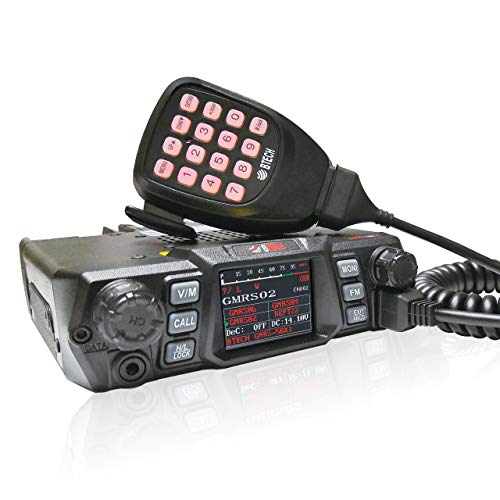
BTECH GMRS-50X1 50-Watt GMRS Mobile Radio
Best for power users who want full channel control
BTECH GMRS-50X1 50-Watt GMRS Mobile Radio
Best for power users who want full channel control
What we like
- Selectable 50W/20W/5W output lets you conserve battery or reduce interference in close-range convoy situations.
- 256 fully programmable channels with CHIRP software support means you can load every repeater on your planned route before leaving home.
- Dual-band scanning receives VHF and UHF simultaneously, letting you monitor emergency services or local traffic while running your group channel.
- Large LCD with selectable text colors stays readable in bright sunlight or cab-dark conditions.
What we don't
- Programming via CHIRP requires a specific FTDI cable that doesn't come in the box — budget an extra $15 for it.
- The menu system has a steeper learning curve than Midland's simplified interface.
- Styling is utilitarian at best — it's a tool, not a conversation piece.
The BTECH gives you the same 50-watt ceiling as the Midland MXT575 but hands you the keys to the full channel stack — every repeater you can load, every privacy tone, every power level under your thumb. Pick this over the Midland if you run varied routes, hit multiple repeater systems, or want to geek into radio setup; pick the Midland if you want simple plug-and-play with a cleaner install.
Midland MXT275 MicroMobile GMRS Radio
Best for two-vehicle runs and lighter overlanding rigs
Midland MXT275 MicroMobile GMRS Radio
Best for two-vehicle runs and lighter overlanding rigs
What we like
- Same mic-head design as the MXT575 — all controls in hand, base unit out of sight under a seat.
- 15 watts is more than enough for two-vehicle runs on most trail systems, reaching 5 to 10 miles in broken terrain.
- Fully compatible with the MXT575 on shared channels, so upgrading one rig in your group doesn't strand anyone on a different system.
- Magnetic mount antenna makes for a genuinely easy install if you're not ready to drill a roof hole.
What we don't
- 15 watts will hit a wall in deep canyon terrain with multiple vehicles — the 50-watt models meaningfully outperform it at range.
- No NOAA weather scan, which the MXT575 includes — a real miss on multi-day backcountry runs.
- Not the right choice if your group already runs 50-watt radios and you need to match their output.
Two rigs, one trail, and you want to know when the lead vehicle has stopped before you round the corner — the MXT275 handles that at a fraction of the flagship price. Skip it if your runs involve three or more vehicles or you frequent routes where you rely on repeaters for extended range; step up to the MXT575 for that.
Radioddity DB20-G GMRS Mobile Radio
Best for budget-first installs and first-time GMRS buyers
Radioddity DB20-G GMRS Mobile Radio
Best for budget-first installs and first-time GMRS buyers
What we like
- Cigarette lighter plug power means zero hardwiring — you're broadcasting within five minutes of unboxing.
- Display Sync shows channel name and frequency simultaneously, eliminating the guesswork of which channel the group is actually on.
- 500 programmable channels is overkill for most users but means you'll never run out of space loading regional repeaters.
- 20 watts outperforms any handheld radio significantly and handles typical two-vehicle weekend runs without strain.
What we don't
- Cigarette lighter power delivery is less stable than a hardwired 12V connection and can drop during high-draw moments.
- Build quality is noticeably lighter than Midland units — this is a budget radio and it feels like one.
- At 20 watts you're leaving meaningful range on the table compared to 50-watt options, especially in canyon terrain.
If you've never run a vehicle-mounted radio and want to know what the fuss is about before spending $200, the DB20-G is the exact right entry point — plug it into your cigarette lighter and you're on the air. Graduate to a hardwired 50-watt unit once you're hooked; treat this as the radio that converts you, not the one you run forever.
Midland GXT1000VP4 GMRS Handheld Radio (2-Pack)
Best for scouts on foot who need to stay on the convoy channel
Midland GXT1000VP4 GMRS Handheld Radio (2-Pack)
Best for scouts on foot who need to stay on the convoy channel
What we like
- JIS4 waterproof rating handles rain and stream crossings without a case or bag — just clip it and go.
- Repeater capable, so a scout walking a line 2 miles out can still ping the convoy through local infrastructure.
- Two radios in the box means both a driver and a hiker or spotter can hold a unit from one purchase.
- SOS siren is a meaningful safety feature when a trail walker gets separated in low-visibility terrain.
What we don't
- 5 watts is the ceiling for handhelds — effective range in forest is 1 to 3 miles without repeater access.
- Rechargeable battery packs need overnight charging, and AA backup is available but burns through cells fast at full power.
- Not a replacement for a vehicle-mounted radio in a serious convoy — this is a supplement, not a primary communication system.
When your spotter walks a ridge to check the line or your co-driver scouts a crossing on foot, these handhelds keep them on the exact same channel as your rig's mounted GMRS radio. Don't buy these as your only radio — buy them as the second layer of your system once you have a 15 to 50-watt mobile unit installed.
What to Look For
Wattage is the single most important spec for off-road use. Legal GMRS mobile radios top out at 50 watts — that's where the Midland MXT575 sits, and anything under 15 watts will struggle in broken terrain with vehicle bodies in the way.
Repeater compatibility turns a local 10-mile radio into a 30-mile network. Most established trail systems and public lands have GMRS repeaters on specific channels — a repeater-capable radio accesses that infrastructure for free once you have your license.
Install matters as much as the radio itself. A cigarette-lighter plug works for testing, but a hardwired 12V connection with a proper antenna mount will outlast any temporary setup and give you consistently better audio in moving vehicles.
Who Should Skip This
Skip vehicle-mounted GMRS radios entirely if your group runs a single vehicle and you only need person-to-person trail communication — a pair of quality GMRS handhelds is simpler and cheaper for that use case. Also skip this category if you run international trails in Canada or Mexico, where US GMRS licensing does not apply and you'll need a different radio solution.
What the Community Actually Uses
On r/overlanding, the consensus has shifted hard toward GMRS and away from CB over the last few years — the repeater network has grown enough that GMRS now offers better coverage on popular routes like the Rubicon and Ouray. The sub has a standing wiki on antenna setups and repeater directories worth reading before you buy.
Quick Picks — In Case You've Already Decided
Frequently Asked Questions
Do I need a license to use a GMRS radio off-road?
Yes. GMRS requires an FCC license that costs $35 and covers your entire household for 10 years. You can use the radio before the license arrives, but technically you need it to transmit legally. It's one of the easiest license applications the FCC offers — no test required.
What's the real-world range of a 50-watt GMRS mobile radio?
In open terrain, 20 to 40 miles is realistic with a good antenna. In canyon or forest terrain with significant obstruction, expect 3 to 8 miles simplex — using a repeater in the same terrain can push that to 20 or 30 miles. Manufacturer range claims always assume flat open land with no obstructions.
Can GMRS mobile radios talk to handheld walkie-talkies?
Yes, with conditions. GMRS mobiles can talk to other GMRS handhelds on shared channels. They cannot talk to standard FRS-only handhelds on GMRS-only channels — but most GMRS mobiles share the lower FRS/GMRS shared channels, so basic communication is possible with almost any modern handheld.
Is CB radio still worth it for off-road use?
CB has a loyal following on specific trail systems and among truckers, and some organized runs still use it as a default. But GMRS offers significantly better audio quality, higher power output, and a growing repeater network. Most new overlanders starting fresh should default to GMRS over CB in 2024.
What antenna should I pair with a GMRS mobile radio?
For most rigs, a 6dB gain whip antenna with an NMO roof mount gives the best performance-to-hassle ratio. Midland's MXTA26 is well-matched to their mobile units. Avoid magnetic-mount antennas for permanent installs — the connection degrades over time from vibration and trail dust.
Buying Guide
You need a mounted GMRS radio, not a walkie-talkie. Handheld FRS radios top out at 2 watts and die in terrain.
GMRS mobile units run 15 to 50 watts and mount to your rig's power. Match wattage to your group size — 15 watts handles two vehicles, 50 watts runs a full convoy with margin.