The right kayak trolling motor doesn't just move you — it keeps you locked on structure while your hands stay on the rod. The five motors below cover every kayak setup from 10-foot flatwater rigs to 14-foot offshore bruisers, starting at under $90.
| Photo |
Top Pick
|
Versatile
|
Budget

|
Best Value

|
Best for Reliability
|
|---|---|---|---|---|---|
| Product | Minn Kota Endura C2 30lb Transom-Mount Trolling Motor | Newport Vessels Kayak Series 36lb Transom Trolling Motor | MotorGuide Xi3 Saltwater Kayak Trolling Motor 55lb | Minn Kota Kayak Terrova Bow-Mount Trolling Motor with GPS | PEXMOR 55lb Electric Trolling Motor |
| Thrust | 30 lb | 36 lb | 55 lb | 55 lb | 55 lb |
| Mount type | Transom | Transom | Bow | Bow | Transom |
| Shaft length | 30 in | 24 in (kayak-specific) | 36 in | 36 in | 30 in |
| Saltwater rated | ✗ | ✓ | ✓ | ✗ | ✓ |
| Buy Now | Check Price → | Check Price → | Check Price → | Check Price → | Check Price → |
Quick Tips
Use the general rule: you need roughly 2 lbs of thrust per 100 lbs of total weight (kayak, gear, angler) to perform well in wind or current.
A 24-inch kayak-specific shaft like the Newport Kayak Series keeps your prop at the correct depth without the motor head sticking up awkwardly above the gunwale.
Deep cycle marine batteries (AGM or LiFePO4) outlast regular lead-acid options by hours — budget for a quality battery before you budget for the motor.
Mount your motor on the starboard (right) side of the transom to keep your dominant casting hand clear and avoid tangling lines with the shaft.
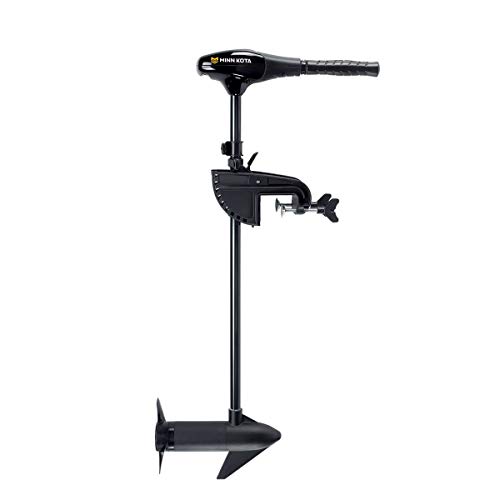
Minn Kota Endura C2 30lb Transom-Mount Trolling Motor
Best for smaller kayaks on freshwater lakes
Minn Kota Endura C2 30lb Transom-Mount Trolling Motor
Best for smaller kayaks on freshwater lakes
What we like
- Indestructible composite shaft is lifetime-guaranteed by Minn Kota — it flexes on rock strikes instead of snapping.
- 5 forward / 3 reverse speed settings give you precise control at slow trolling speeds without hunting for the right setting.
- Lever lock bracket adjusts to 10 positions and releases quickly when you need to stow the motor in a hurry.
- Push-to-test battery meter on the motor head tells you remaining charge without looking at a separate gauge.
What we don't
- Freshwater only — stainless and zinc hardware on saltwater-rated motors is a meaningful difference, not a technicality.
- 30lb thrust is the minimum for comfortable performance; load a 12-foot kayak with gear and you'll feel it in any kind of wind.
- No digital maximizer (battery efficiency tech) — that's an Endura Max upgrade, and it matters on long days.
If you're fishing calm lakes on a kayak under 12 feet, this is the motor that belongs on your transom — it's the best-selling freshwater trolling motor in the world for a reason, and the lifetime shaft warranty means you're not nursing an expensive repair after your first rock strike. This is the right motor if you launch on protected freshwater and don't need GPS or wireless features.
If you're running bigger water, fighting consistent wind, or fishing saltwater, step up — the 30lb limit will frustrate you quickly.
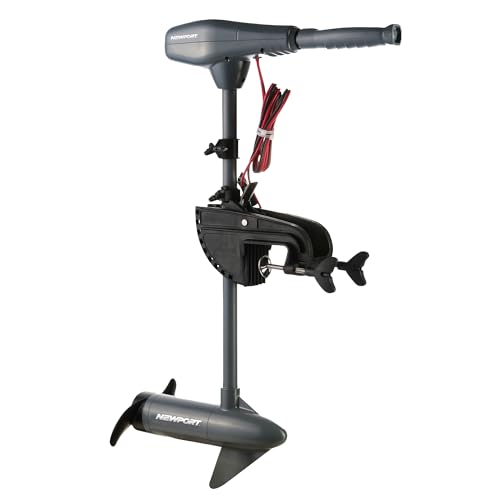
Newport Vessels Kayak Series 36lb Trolling Motor
Best for saltwater kayak fishing with a kayak-specific shaft
Newport Vessels Kayak Series 36lb Trolling Motor
Best for saltwater kayak fishing with a kayak-specific shaft
What we like
- 24-inch kayak-specific fiberglass shaft puts the prop at exactly the right depth on low-sided kayaks without the motor head riding awkwardly high.
- Fully saltwater-rated with corrosion-resistant magnesium, zinc, and stainless steel hardware — safe to fish bays, inlets, and tidal flats.
- 5-point LED battery indicator gives you a real-time read on remaining charge so you're never caught out in open water.
- 5.5-foot battery cables allow flexible battery placement for better weight distribution front-to-back on the kayak.
What we don't
- 36lb thrust is still a light-duty rating — sufficient for most kayaks in calm conditions, but challenged by sustained headwinds or heavy loads.
- No digital power management, so it draws full current at speed — battery drain is less efficient than motors with variable-draw technology.
- The control head is not waterproof, so splash management and post-saltwater rinse-down are required after every outing.
If you're fishing saltwater — flats, tidal creeks, coastal bays — the Newport Kayak Series solves the two biggest problems in one: a 24-inch shaft engineered for kayak gunwale height, and full saltwater hardware that won't corrode into a paperweight after one season. Pick this over the Minn Kota C2 if you ever fish salt, tidal water, or brackish estuaries.
If you're freshwater only on a longer or heavier kayak, the 55lb options below will serve you better.
MotorGuide Xi3 55lb Saltwater Kayak Trolling Motor
Best for serious fishing in wind, current, and open water
MotorGuide Xi3 55lb Saltwater Kayak Trolling Motor
Best for serious fishing in wind, current, and open water
What we like
- Wireless remote control is included out of the box — no expensive add-on needed to steer from anywhere on the kayak.
- Pinpoint GPS anchor mode holds position with three times more accuracy than standard GPS anchors, even in current and wind.
- SecureStep stow-and-deploy system lets you raise and lower the motor from a seated position — a genuine safety feature on a tipping-prone kayak.
- 40% quieter than leading competitors per MotorGuide's own testing — meaningful when bass are spooking and you're easing into shallow structure.
What we don't
- Significant price jump over transom-mount options — the GPS and wireless features are the cost, and they're only worth it if you actually fish structure or open water.
- Bow mounting requires drilling or a dedicated bow plate on your kayak — not a bolt-on installation for most sit-on-top fishing kayaks.
- At 55lb thrust with a 36-inch shaft, this is a larger motor that adds meaningful weight to the bow — balance management matters.
The Xi3 Kayak exists for one specific angler: the one fishing open bays, tidal flats, or reservoir structure where holding position in wind is the difference between landing fish and chasing them all day. Wireless GPS anchor, quiet operation, and one-step stow from a seated position are all things you want when you're on a tilting kayak in moving water.
This is not a budget buy and it's not for casual paddlers. If you're fishing slow-moving flatwater where you never fight current, a fraction of the price gets you there — this is for the angler who's already outgrown a transom mount.
Minn Kota Kayak Terrova 55lb Bow-Mount GPS Trolling Motor
Best for anglers who want Spot-Lock GPS on a dedicated kayak motor
Minn Kota Kayak Terrova 55lb Bow-Mount GPS Trolling Motor
Best for anglers who want Spot-Lock GPS on a dedicated kayak motor
What we like
- Spot-Lock GPS anchor holds your exact position with Minn Kota's most trusted GPS system — accurate to within a few feet even in wind and current.
- Bluetooth micro remote and One-Boat Network app give you full motor control from your phone or the included handheld remote.
- Digital Maximizer delivers up to 5x longer battery life by drawing only the power you need — a full day of fishing on a single charge is realistic.
- Designed specifically for kayaks with a 36-inch shaft sized for bow mounting on fishing kayaks — not a boat motor shoehorned onto a kayak.
What we don't
- Freshwater only — the Riptide Kayak Terrova is the saltwater version and sells at a separate (higher) price point.
- Bow mounting requires compatible kayak hardware or a dedicated mounting plate — confirm compatibility with your specific kayak model before buying.
- Top-tier price makes this a considered purchase; if you fish calm protected water without current, the GPS features won't earn their cost.
The Kayak Terrova is what you buy when you've decided GPS anchor mode isn't optional — fishing current seams, river bends, or lake points where position control decides whether you're catching or drifting. Spot-Lock holds your kayak like a digital anchor while your hands stay on the rod.
This is a freshwater-only investment for the angler who fishes the same productive structures repeatedly and wants to dial position with a button push. Saltwater anglers need the Riptide version; casual paddlers should stay a few tiers down.
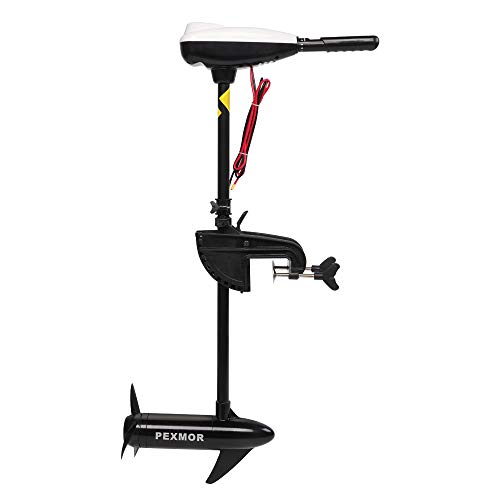
PEXMOR 55lb Electric Trolling Motor
Best budget option for larger kayaks that need more thrust
PEXMOR 55lb Electric Trolling Motor
Best budget option for larger kayaks that need more thrust
What we like
- 55lb of thrust at a budget price point — more power than most entry-level motors for the same or less money.
- 10-LED battery indicator gives a detailed charge reading compared to the simpler 4- or 5-point meters on pricier motors.
- Three-blade prop with anti-tangle design is effective in weedy water, and spares are easy to source for the size.
- Adjustable 6-inch telescoping handle and 8-speed control (5 forward / 3 reverse) are standard quality at this price.
What we don't
- Build quality doesn't match Minn Kota or Newport at comparable price — bracket and hardware are reinforced nylon, not the machined aluminum of name-brand motors.
- Saltwater-coated rather than saltwater-rated — rinse after every coastal use, and expect shorter longevity than stainless-hardware motors.
- Limited warranty and customer support infrastructure compared to established brands; keep your receipt.
The PEXMOR delivers 55lb of thrust for close to what you'd pay for a 30lb name-brand motor — and if you're on a tight budget running a 12–14 foot kayak, that math matters. It won't outlast a Minn Kota and the bracket won't inspire confidence, but it moves water and it shows up at the right price.
Buy this if budget is the hard constraint and you're fishing relatively calm freshwater or occasionally rinsing after saltwater use. If you're fishing hard regularly or in serious conditions, spend up — the name-brand motors earn their premium in durability over two or three seasons.
What to Look For
Thrust rating determines how well the motor handles your loaded kayak in real conditions — wind, current, and chop all fight you on the water. A 30lb motor is fine for calm flatwater on a lightweight kayak, but underpowered anything beyond that.
Shaft length affects prop depth and motor head clearance on a low-sided kayak. Kayak-specific 24-inch shafts are engineered for this — a standard 30- or 36-inch transom mount can work but often sits awkwardly high.
Freshwater vs. saltwater construction is a real difference, not a marketing label.
Saltwater-rated motors use stainless steel, magnesium, and zinc hardware to resist the corrosion that destroys aluminum components within a season.
Who Should Skip This
Skip a kayak trolling motor if you're paddling small ponds or protected flatwater where wind and current aren't a factor — a motor adds weight and complexity you won't need. Anglers who car-top their kayak solo should also weigh the battery situation carefully: a 50Ah AGM battery adds 30+ pounds before you've touched the motor itself.
What the Community Actually Uses
On r/kayakfishing, the motor questions come up constantly — and the consensus is almost always the same: match thrust to your kayak's loaded weight, buy a bigger battery than you think you need, and don't cheap out on the mount. Members there frequently recommend the Minn Kota Endura series for entry-level setups and the MotorGuide Xi3 or Minn Kota Terrova for anyone fishing structure or open water where GPS anchor mode pays off.
Quick Picks — In Case You've Already Decided
Minn Kota Endura C2 30lb Transom-Mount Trolling Motor
Check Price on AmazonNewport Vessels Kayak Series 36lb Transom Trolling Motor
Check Price on AmazonFrequently Asked Questions
What size trolling motor do I need for a kayak?
For kayaks under 12 feet, 30–36lb of thrust handles most conditions. For 12- to 16-foot kayaks, especially loaded with gear and a heavier angler, go 55lb. Always factor in your fully loaded weight — kayak, battery, tackle, and yourself.
Can I use a regular boat trolling motor on a kayak?
Technically yes, but standard transom motors have 30- to 36-inch shafts that sit too high on a low-sided kayak, causing cavitation and awkward steering. Kayak-specific models use shorter shafts (24 inches) designed for correct prop depth on a kayak gunwale.
What battery do I need for a kayak trolling motor?
A 12V deep cycle marine battery in the 50–100Ah range is the standard starting point. AGM batteries handle vibration well and are spill-proof. LiFePO4 lithium batteries cost more upfront but weigh significantly less — a real factor when you're loading a kayak.
Is a trolling motor legal on a kayak?
In most US states, yes — but a motorized kayak is typically classified as a motorized vessel, which may require registration and a life jacket for every passenger. Check your specific state regulations before heading out, as rules vary considerably.
Transom mount vs. bow mount — which is better for a kayak?
Transom mounts are simpler and cheaper, pushing the kayak from the stern — they work well for most anglers. Bow mounts pull from the front, giving better maneuverability and making GPS anchor features more effective, but they require a mounting plate on the bow and cost significantly more.
Buying Guide
Match thrust to kayak length: 30–36lb handles kayaks under 12 feet, 55lb handles 12–16 feet. Shaft length matters too — a 24-inch kayak-specific shaft sits lower to the water than a standard 30-inch.
For saltwater, you need stainless and corrosion-resistant hardware. For serious fishing, GPS anchor mode is worth every dollar.