The right solar generator ships with matched panels — so you're not spending three hours cross-referencing voltage tables before your trip. Five of the best all-in-one bundles currently available span 1,056Wh to 2,304Wh and charge fully in as little as 43 minutes combined AC and solar.
| Photo |
Top Pick

|
Versatile
|
Budget
|
Best Value

|
Best for Reliability

|
|---|---|---|---|---|---|
| Product | EcoFlow DELTA 2 Max Solar Generator with 220W Solar Panel | Jackery Solar Generator 2000 Pro with SolarSaga 200W Panel | BLUETTI Solar Generator AC200P with 2× SP200 Solar Panels | Anker SOLIX C1000 Solar Generator with 200W Solar Panel | Goal Zero Yeti 1500 Solar Generator with Nomad 200 Panel |
| Battery | LFP 3,000 cycles | NMC cylindrical UL-certified | LFP 3,500 cycles | LFP InfiniPower | LFP 4,000 cycles |
| Capacity | 2,048Wh | 2,160Wh | 2,000Wh | 1,056Wh | 1,505Wh |
| Solar input | 1,000W max | 400W max (6× 200W panels) | 700W max (MPPT) | 600W max | 900W max |
| Recharge time | 0–80% in 43 min (AC+solar) | Full charge in 2 hrs via AC | 3–3.5 hrs via 700W solar | Full charge in 58 min via AC | 0–80% in under 1 hr via AC |
| Buy Now | Check Price → | Check Price → | Check Price → | Check Price → | Check Price → |
Quick Tips
Run your fridge load at 45W average for 24 hours to benchmark how much capacity you actually consume before buying.
Panel wattage is only useful if the station's solar input ceiling matches — confirm max PV input watts before assuming faster recharge.
LFP (LiFePO4) batteries hold voltage more consistently across the discharge curve than NMC, which means your fridge compressor runs cleaner near empty.
Parallel charging — solar plus AC simultaneously — is the real fast-charge trick most people miss; look for stations that support both inputs at once.
EcoFlow DELTA 2 Max Solar Generator with 220W Solar Panel
Best for fast solar recharge at basecamp
EcoFlow DELTA 2 Max Solar Generator with 220W Solar Panel
Best for fast solar recharge at basecamp
What we like
- 1,000W max solar input ceiling means you can throw four 220W panels at it and actually use that wattage.
- LFP chemistry rated to 3,000 cycles gives you over a decade of daily use before degradation becomes noticeable.
- X-Boost mode lets you run appliances up to 3,400W despite a 2,400W inverter — covers most overlanding tools.
- EcoFlow app gives you real-time consumption data and lets you set charge limits to protect long-term battery health.
What we don't
- The 220W panel bundle is the entry point — two panels are needed to approach the listed recharge speeds in real conditions.
- At roughly 48 lbs for the station alone, it's a two-person lift if you're loading it into a truck bed daily.
- X-Boost smart power mode doesn't work with all high-wattage appliances — check your specific device compatibility.
The DELTA 2 Max's real differentiator is that 1,000W solar input ceiling — most 2,000Wh stations cap at 400–600W PV, which creates a ceiling on how fast you can recover a full discharge in a single afternoon of sun. With AC and solar running simultaneously, the 43-minute 0–80% charge time is achievable, which means you can top off during lunch and run a fridge through the night without anxiety.
This is the pick for overlanders or van lifers who are off-grid for 4+ days and running a compressor fridge plus device loads. If you're doing weekend warrior trips where you can plug in before heading out, the cheaper Jackery covers you fine.
Jackery Solar Generator 2000 Pro with SolarSaga 200W Panel
Best for reliable all-in-one simplicity
Jackery Solar Generator 2000 Pro with SolarSaga 200W Panel
Best for reliable all-in-one simplicity
What we like
- 2,160Wh capacity in a single unit covers a 45W fridge plus device charging for a full 24-hour cycle with capacity to spare.
- UL safety certification and cylindrical NMC cells matching EV battery standards give it a strong safety track record.
- 60-second setup with the included SolarSaga panel — unfold, connect, done, with no compatibility troubleshooting.
- 5-year extendable warranty is the longest coverage in this category by a meaningful margin.
What we don't
- NMC chemistry is rated to roughly 1,000 cycles versus 3,000+ on LFP competitors — shorter lifespan for daily users.
- 400W max solar input ceiling means you can't meaningfully stack panels beyond two 200W units.
- Heavier than competitors at a similar price point — the station alone exceeds 43 lbs.
Jackery's 2000 Pro is the most straightforward buy in this category — the SolarSaga panel plugs directly into the station with a single cable, the app is optional rather than required, and the 5-year warranty is a hard argument when comparing total cost of ownership. The 2,160Wh capacity is genuinely useful: it runs a 45W compressor fridge for roughly 40 hours on a full charge before panel input even factors in.
Choose this over the EcoFlow if you want proven reliability and a longer warranty rather than the fastest possible solar recharge speed. If you're running heavy loads daily and need that 1,000W solar input ceiling, the DELTA 2 Max earns its price premium.
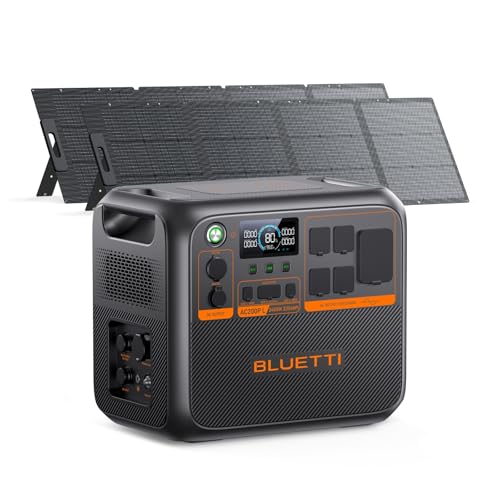
BLUETTI Solar Generator AC200P with 2× SP200 Solar Panels
Best for high solar input on a mid-range budget
BLUETTI Solar Generator AC200P with 2× SP200 Solar Panels
Best for high solar input on a mid-range budget
What we like
- 700W max solar input is significantly higher than Jackery at this price point — you can run three panels and actually use the extra wattage.
- LFP chemistry with 3,500-cycle rating means this outlasts NMC competitors by years under heavy daily use.
- Two 200W SP200 panels included in the bundle deliver 400W combined — usable recharge in 5–6 hours without added purchases.
- Six AC outlets handle more simultaneous loads than most competitors in this class.
What we don't
- The AC200P station is heavy at 60.6 lbs — the heaviest unit in this roundup by a significant margin.
- No app-controlled charge limiting — you manage battery health manually without the smart features competitors offer.
- Panel efficiency at 23.5% trails the EcoFlow bundle's 25% rating in low-light conditions.
The AC200P's 700W solar input ceiling is the spec that earns its place here — for the price, no competitor lets you stack that much panel wattage and actually use it to recover 2,000Wh in an afternoon. The two included SP200 panels are genuinely high-efficiency monocrystalline cells, not the lower-grade panels some brands include to hit a price point.
This is the pick for stationary basecamp setups where weight isn't a daily concern but solar self-sufficiency is. If you're moving camp every day and need to carry the station, the 60-lb weight will wear on you — the Anker or EcoFlow bundles are meaningfully lighter.
Anker SOLIX C1000 Solar Generator with 200W Solar Panel
Best for ultrafast AC recharge between trips
Anker SOLIX C1000 Solar Generator with 200W Solar Panel
Best for ultrafast AC recharge between trips
What we like
- 58-minute full AC recharge is the fastest wall-to-full time in this roundup — useful when you have an outlet between trips.
- LFP InfiniPower battery is rated to withstand 3,000+ cycles without meaningful capacity loss.
- SurgePad technology delivers 2,400W output from a 1,800W inverter — runs appliances that would trip smaller stations.
- 200W IP67-rated panel included in the bundle is waterproof and rated for 4-angle positioning — more usable in varied terrain.
What we don't
- 1,056Wh capacity is the smallest in this roundup — only covers about 22 hours of fridge runtime before needing recharge.
- 200W panel alone takes roughly 5–6 hours to fully recharge the station in ideal conditions.
- No expandable battery option — capacity is fixed, unlike EcoFlow and BLUETTI competitors.
The SOLIX C1000 earns its spot for buyers who want LFP reliability and genuine fast charging at a price that leaves budget for other gear. The 58-minute wall recharge means you can top it up during dinner before heading out the next morning — most competing stations take 2+ hours.
This is the right pick for weekend campers or van lifers who can plug in every few days and aren't running sustained multi-day off-grid loads. If you're going 5+ days without shore power, step up to the BLUETTI or EcoFlow for the extra capacity headroom.
Goal Zero Yeti 1500 Solar Generator with Nomad 200 Panel
Best for long-term durability and US-based support
Goal Zero Yeti 1500 Solar Generator with Nomad 200 Panel
Best for long-term durability and US-based support
What we like
- 4,000-cycle LFP rating is the highest in this roundup — the longest stated lifespan of any battery in this comparison.
- IPX4 weather resistance means it handles rain and splashing without needing a cover or shelter during use.
- Goal Zero's US-based customer support team has over 10 years of field-tested product history behind them.
- 140W USB-C output is best-in-class for charging laptops and camera systems directly without an inverter.
What we don't
- The included Nomad 200 panel recharges the Yeti 1500 in 9–18 hours solo — you'll need a second panel for practical daily recovery.
- Heavier aluminum chassis adds durability but puts total system weight above lighter competitors at similar capacity.
- No X-Boost or SurgePad equivalent — appliances drawing above the 2,000W inverter rating won't run, no exceptions.
The Yeti 1500's 4,000-cycle LFP battery and IPX4 weather resistance set it apart for buyers thinking in 5–10 year terms rather than just the first camping season. The aluminum chassis survives jobsite and overlanding abuse that would dent or crack plastic-bodied competitors.
Choose this if you want a station you'll still be running in 2032 and don't need the fastest solar recharge speed to get there. If you need to recover a full charge in one afternoon of sun without adding a second panel, the EcoFlow DELTA 2 Max is the better fit.
What to Look For
Battery capacity tells you how long you can run your gear, but solar input ceiling tells you how fast you can recover it. If the station caps solar input at 400W but you're running two 200W panels, you're not charging any faster than one.
Battery chemistry matters more than most buyers realise. LFP cells survive 3,000+ cycles to 80% capacity — that's roughly 8–10 years of daily use versus 500 cycles on older NMC chemistry.
Panel efficiency determines how much real estate you need to hit your wattage target. A 23–25% efficient monocrystalline panel delivers meaningfully more watts per square foot than a 20% panel in the same partial-cloud conditions.
Who Should Skip This
If your power needs are limited to phones and a laptop for a weekend trip, a full 2,000Wh solar generator bundle is overkill — a 300–500Wh station with a single 100W panel will do it for half the money and weight. This guide targets people running a 12V compressor fridge, lighting, and device charging for 3+ days off-grid, or anyone wanting a grid backup that actually recharges itself between outages.
What the Community Actually Uses
On r/overlanding, the recurring complaint isn't 'which station is best' — it's 'I bought the station and then had to figure out which panels actually work with it.' The thread consensus has shifted hard toward buying matched bundles: you know the MPPT controller is tuned for those panels, the cable spec is correct, and the recharge math on the listing is actually achievable with what's in the box.
Quick Picks — In Case You've Already Decided
EcoFlow DELTA 2 Max Solar Generator with 220W Solar Panel
Check Price on AmazonJackery Solar Generator 2000 Pro with SolarSaga 200W Panel
Check Price on AmazonFrequently Asked Questions
Do I need to buy solar panels separately from my power station?
Not if you buy a bundle — these kits include matched panels designed to hit the station's MPPT input specs. Buying separately is fine but requires you to verify open-circuit voltage and max current compatibility yourself.
What's the difference between LFP and NMC batteries in a solar generator?
LFP (LiFePO4) lasts 3,000+ charge cycles versus roughly 500 for older NMC chemistry, making it significantly more cost-efficient over time. LFP also runs cooler and holds voltage more steadily during heavy discharge.
Can I run a compressor fridge off a 1,000Wh solar generator?
Yes — a 12V compressor fridge draws roughly 40–55W average, meaning 1,000Wh gives you approximately 18–22 hours of runtime. With a 200W panel in decent sun, you'll recover most of what the fridge consumes by midday.
How do I know if a solar panel is compatible with my power station?
Check the station's max solar input wattage and open-circuit voltage (OCV) range. Your panel's OCV must fall within that range, and total panel wattage shouldn't exceed the station's PV ceiling. Bundle kits handle this for you.
Is it safe to charge a solar generator indoors?
Yes — unlike gas generators, these produce zero emissions and run quietly, making them completely safe for indoor use. The panels obviously need to be outside or near a window, but the station itself can sit inside.
Buying Guide
You need capacity that covers your actual loads — fridge, lights, phone charging — plus enough panel wattage to recover it by midday. Match battery chemistry to how long you'll hold a charge between uses.
LFP lasts 3,000+ cycles. Factor total system weight if you're moving camp daily.