Most solar generators cap out at 120V, which is exactly why your dryer, well pump, and air conditioner won't budge when the grid goes down. These five machines run true 120V/240V split-phase output — the same dual voltage your home panel uses — and the strongest starts at 6000W continuous with a 9000W surge.
| Photo |
Top Pick

|
Versatile

|
Budget

|
Best Value
|
Best for Reliability

|
|---|---|---|---|---|---|
| Product | EF EcoFlow DELTA Pro 3 Portable Power Station | BLUETTI Apex 300 Portable Power Station | Anker SOLIX F3800 Portable Power Station | Jackery Solar Generator 5000 Plus Portable Power Station | OSCAL PowerMax 6000 Solar Generator |
| Voltage | 120V/240V simultaneous | 120V/240V simultaneous | 120V/240V simultaneous | 120V/240V simultaneous | 120V/240V simultaneous |
| Capacity | 4096Wh (expandable to 48kWh) | 2764.8Wh (expandable to 58kWh) | 3840Wh (expandable to 26.9kWh) | 5040Wh (expandable to 60kWh) | 3600Wh (expandable to 57.6kWh) |
| Ac output | 4000W continuous (6000W X-Boost) | 3840W continuous (7680W surge) | 6000W continuous (12000W paired) | 7200W continuous (14400W paired) | 6000W continuous (9000W surge) |
| Solar input | Up to 3600W | 2400W (6400W with SolarX 4K) | Up to 2400W | Up to 3000W | Up to 2400W |
| Buy Now | Check Price → | Check Price → | Check Price → | Check Price → | Check Price → |
Quick Tips
Confirm the unit outputs simultaneous 120V and 240V — some only toggle between voltages and cannot run both at once.
Size for continuous watts, not surge: your well pump or AC unit needs sustained power, not just a startup spike.
Pair with a transfer switch or smart panel to integrate whole-home backup without rewiring your breaker box.
Solar input wattage determines how fast you recharge — 2400W+ input keeps a 4kWh battery viable across a full day of partial sun.
EF EcoFlow DELTA Pro 3 Portable Power Station
Best for whole-home backup with expandable capacity
EF EcoFlow DELTA Pro 3 Portable Power Station
Best for whole-home backup with expandable capacity
What we like
- True simultaneous 120V/240V output powers your dryer and fridge at the same time without toggling.
- Expands from 4kWh to 48kWh with extra batteries — scales from weekend backup to multi-day whole-home coverage.
- X-Boost technology pushes continuous output to 6000W, enough to run a 3-ton central AC or 1HP well pump.
- 10ms UPS switchover protects sensitive electronics like NAS systems and medical devices from any gap in power.
What we don't
- At roughly 127 lbs the unit requires two people or a hand truck to move any real distance.
- Full solar charge with included 800W input takes 8+ hours — you need to add panels to get reasonable recharge times.
- App-dependent features like smart scheduling require a Wi-Fi connection, which defeats the purpose during extended outages.
If your outage scenario includes a well pump, central AC, or a medical device that can't gap — this is the unit built for that. The DELTA Pro 3 delivers 4000W continuous at true 120V/240V split-phase, expandable to 6000W via X-Boost, and the 10ms switchover is fast enough to protect equipment that can't handle even a brief power interruption.
This is the choice for someone who wants to run their house close to normal during a multi-day outage, not just keep the fridge cold. If you just need to power a few essentials and don't need the expansion ecosystem, the Anker F3800 gives you more raw watts for less money.
BLUETTI Apex 300 Portable Power Station
Best for RV and off-grid living with modular expansion
BLUETTI Apex 300 Portable Power Station
Best for RV and off-grid living with modular expansion
What we like
- Simultaneous 120V/240V output from a single unit — no pairing or hub required.
- Black Start capability restarts the system from zero using only solar, with no grid power needed at any point.
- Second-gen LiFePO4 chemistry rated for 6000+ cycles — roughly 17 years of daily use before hitting 80% capacity.
- Industry-lowest 20W idle loss means lights and routers running in standby drain the battery 3x slower than competing units.
What we don't
- 3840W continuous output is lower than the Anker F3800 and Jackery 5000 Plus — not enough for a 2-ton+ central AC on its own.
- The B300K expansion battery is sold separately, and the full modular ecosystem gets expensive quickly.
- 2764.8Wh base capacity is the smallest in this group — sufficient for RV use but tight for whole-home coverage.
The Apex 300 is the best choice for RV life and extended off-grid living where solar recharge is your primary energy source, not a wall outlet. The 2400W built-in solar input (expandable to 6400W with accessories) and Black Start capability mean you can operate entirely independently of the grid — including restarting the system from zero after a deep discharge.
Choose this over the EcoFlow if you're building an RV or cabin setup where modularity and solar efficiency matter more than peak wattage. Skip it if you need to run a central AC or a heavy well pump — the 3840W continuous ceiling isn't enough for those loads.
Anker SOLIX F3800 Portable Power Station
Best for raw output power and direct EV charging
Anker SOLIX F3800 Portable Power Station
Best for raw output power and direct EV charging
What we like
- 6000W continuous AC output is the highest of any single portable unit in this roundup — handles central AC and heavy shop tools.
- NEMA 14-50 port enables direct EV charging at up to 6000W without any adapter or grounding accessory.
- Operates at a measured 45dB under full load — quieter than most desktop fans and safe for indoor bedroom use.
- Pairs with a second F3800 for 12,000W total output and double capacity — a rare expandable option at this power tier.
What we don't
- Heavier than the competition at 133 lbs — meaningful if you need to transport it between locations frequently.
- Solar input tops out at 2400W, which is adequate but not exceptional for a unit of this capacity.
- Premium price puts it at the top end of the portable category — overkill if your largest load is under 3500W.
The F3800 delivers the highest single-unit continuous output in this category — 6000W at true 120V/240V — and the NEMA 14-50 port means you can charge an EV directly without digging up adapters. If your backup scenario includes a large central AC, a shop compressor, or vehicle charging, this is the only portable unit that handles all three without a workaround.
Buy the F3800 if raw output ceiling is your primary requirement and you're willing to pay for it. If you don't need 6000W and want better solar recharge efficiency, the EcoFlow DELTA Pro 3 or BLUETTI Apex 300 make more sense.
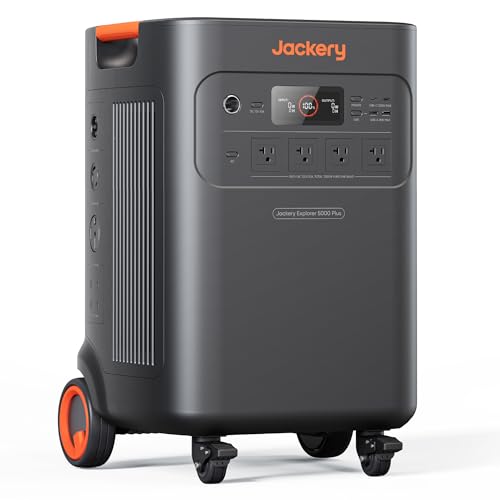
Jackery Solar Generator 5000 Plus Portable Power Station
Best for whole-home backup with the largest base capacity
Jackery Solar Generator 5000 Plus Portable Power Station
Best for whole-home backup with the largest base capacity
What we like
- Largest base capacity in this group at 5040Wh — powers a typical home for 24+ hours before needing recharge.
- 7200W continuous output at 120V/240V handles central AC, dryers, and water heaters simultaneously without X-Boost tricks.
- 0ms UPS online mode keeps sensitive devices running with zero perceived gap during power transitions.
- Pairs with a Smart Transfer Switch to manage 12 circuits at 120V or 6 circuits at 240V without an electrician.
What we don't
- Starting price is the highest in this roundup — the capacity and output justify it, but the upfront cost is a real barrier.
- At 130+ lbs it's not something you're moving without a dolly — treat it as a semi-permanent installation.
- Solar recharge from 0–100% takes 2+ hours only under ideal conditions with full solar array attached.
The 5000 Plus is the option for someone who wants to run their home close to normally — not just keep critical loads alive — during a multi-day outage. At 5040Wh base and 7200W continuous output, it's the only single unit in this roundup that can simultaneously power a dryer, refrigerator, and HVAC circuit without a calculation.
This is the buy-once option for homeowners who want genuine whole-home backup expandable to 60kWh, not a stopgap. If you're building a mobile or RV setup, the Anker F3800 or BLUETTI Apex 300 will serve you better at a lower entry price.
OSCAL PowerMax 6000 Solar Generator
Best budget 240V option with surprisingly fast recharge
OSCAL PowerMax 6000 Solar Generator
Best budget 240V option with surprisingly fast recharge
What we like
- 6000W continuous output at 120V/240V at a price point well below every other unit in this category.
- Fastest recharge time in the roundup — 0–100% in 1.44 hours via combined 2200W AC and 2400W solar input.
- 14 output ports including four AC outlets, dual 100W USB-C, Anderson output, and car charger in one unit.
- Eight-layer safety BMS and 3500-cycle LiFePO4 battery rated for 25 years of daily use.
What we don't
- OSCAL is a newer brand with less third-party review history than EcoFlow, Jackery, or Anker — harder to validate long-term reliability.
- App and smart features are more limited than the premium options — less useful for time-of-use billing or peak shaving.
- Suitcase-style wheeled design handles better in flat environments — less convenient on rough outdoor terrain.
The PowerMax 6000 is the entry point for true 240V portable backup — 6000W continuous, simultaneous split-phase output, and the fastest AC+solar recharge time in this roundup, all for roughly half the price of the Anker or EcoFlow. If your use case is home emergency backup and you don't need the smart panel integration or brand-name peace of mind, the specs here genuinely compete with units costing twice as much.
This is the right pick for budget-conscious homeowners who need 240V capability for outage preparedness and can live without the premium ecosystem. If brand track record and long-term software support matter to you, spend the extra money on the Anker F3800 or EcoFlow DELTA Pro 3.
What to Look For
True split-phase output matters more than the 240V label. A generator that claims 240V but only toggles voltage can't power your dryer and fridge simultaneously — verify the listing shows simultaneous 120V/240V delivery and look for a dedicated NEMA 14-50 or L14-30 outlet.
Battery capacity sets your outage window, not your peak wattage. A 3600Wh unit running a 600W fridge covers six hours; add a sump pump or HVAC and that window shrinks fast — calculate your actual load before buying.
Fast recharge is what separates a backup unit from a one-night stand. Solar input above 2400W means you can realistically top off on a sunny day; anything below 800W solar input turns a multi-day outage into a waiting game.
Who Should Skip This
If you only need to charge phones, run a CPAP, or power a 120V camp kitchen, you're spending three to five times more than necessary on 240V capability you'll never use — a 1000Wh unit handles all of that for a fraction of the cost. Skip this category if your largest appliance is under 1800W and runs on standard household outlets.
What the Community Actually Uses
On r/SolarDIY and r/homeautomation, the recurring question isn't which brand — it's whether a given unit delivers true split-phase or simulated 240V. The consensus there is to verify NEMA port type before buying and to treat any unit without a NEMA 14-50 as a 120V machine regardless of what the spec sheet says.
EcoFlow and BLUETTI come up most often as proven options for home integration.
Quick Picks — In Case You've Already Decided
Frequently Asked Questions
What does 240V split-phase actually mean for home backup?
Your home panel distributes two 120V legs that combine to 240V for large appliances — split-phase output replicates that. A solar generator with true split-phase output can power both your 240V dryer and your 120V refrigerator simultaneously, just like the grid does.
Can I plug a solar generator directly into my house panel?
Only with a proper transfer switch or interlock kit installed by an electrician. Plugging directly into an outlet without a transfer switch risks backfeeding the grid, which is dangerous for utility workers and can damage the generator itself.
How long will a 4000Wh solar generator run my home essentials?
A fridge (150W), five LED lights (50W total), phone charging (50W), and a router (20W) draws roughly 270W — giving you about 14 hours. Add a window AC unit at 1200W and runtime drops to around 3 hours.
Is a 240V solar generator safe to use indoors?
Yes — unlike gas generators, solar generators produce no carbon monoxide and can be used indoors safely. Most 240V units in this category operate at 30–50dB under load, quieter than a normal conversation.
Do I need a special solar panel to charge a 240V generator?
No — the voltage output and the solar input are separate systems. Any compatible solar panel within the generator's input voltage range (typically 12–150V) will work, regardless of the AC output voltage the unit produces.
Buying Guide
You need true split-phase 240V output, not a marketing label. Check for NEMA 14-50 or L14-30 ports and confirm simultaneous 120V/240V delivery.
Match continuous watts to your biggest load — not surge — and size battery capacity for your expected outage window. LiFePO4 chemistry lasts longer.