Most portable power stations cap out at 120V and leave your dryer, well pump, or RV pedestal unpowered — the right solar generator with native 120V/240V dual output fixes that without a transfer switch headache. The five units below range from $1,400 to over $3,500 and deliver between 3,000W and 7,200W of true dual-voltage output, verified on Amazon.
| Photo |
Top Pick

|
Versatile

|
Budget

|
Best Value

|
Best for Reliability
|
|---|---|---|---|---|---|
| Product | EF EcoFlow DELTA Pro 3 Portable Power Station | Anker SOLIX F3800 Portable Power Station | BLUETTI Apex 300 Portable Power Station | Jackery Explorer 2000 Plus Portable Power Station | Jackery Solar Generator 5000 Plus Portable Power Station |
| Voltage | 120V / 240V native | 120V / 240V native | 120V / 240V simultaneous | 240V via parallel pairing | 120V / 240V native |
| Capacity | 4,096Wh | 3,840Wh | 2,764.8Wh | 2,042.8Wh | 5,040Wh |
| Ac output | 4,000W (6,000W X-Boost) | 6,000W continuous | 3,840W (7,680W surge) | 3,000W continuous | 7,200W continuous |
| Solar input | Up to 1,600W | Up to 1,200W | Up to 2,400W | Up to 1,000W | Up to 3,000W |
| Buy Now | Check Price → | Check Price → | Check Price → | Check Price → | Check Price → |
Quick Tips
Calculate your single largest appliance's starting wattage (not running) — that's the floor your generator output must clear, often 1.5–2x the running watts.
LFP (LiFePO4) batteries tolerate 3,000–6,000 cycles before hitting 80% capacity; standard lithium-ion hits that threshold at 500–800 cycles — worth the premium if this is a long-term investment.
Pair with the largest solar array you can afford: 400–800W of panels cuts typical recharge time from 8+ hours to under 4 hours in direct sun.
If you need 240V for a dryer or well pump, confirm the unit has a NEMA 14-50 or L14-30 outlet — not just dual-voltage capability through a hub that requires additional purchase.
EF EcoFlow DELTA Pro 3 Portable Power Station
Best for whole-home 240V backup without a second unit
EF EcoFlow DELTA Pro 3 Portable Power Station
Best for whole-home 240V backup without a second unit
What we like
- Native 120V/240V output without needing a fusion box or second unit — one purchase, full dual-voltage coverage.
- X-Boost technology pushes usable output to 6,000W, enabling appliances rated up to that threshold to run reliably.
- Expandable to 48kWh with additional battery packs, making it the most scalable option in this category.
- IP65-rated battery pack with automotive-grade LFP cells and a 5-year warranty covers long-term reliability.
What we don't
- At roughly 110 lbs, it's not something you're repositioning without help or a hand truck.
- Solar input maxes at 1,600W, which is lower than the Anker SOLIX F3800 for the same price tier.
- The 240V outlet requires the included AC cable — it's not a standard wall plug configuration.
The DELTA Pro 3 is the cleanest solution in this category because it delivers true 120V/240V from a single unit — no second station, no fusion box, no extra spend. If you're powering a dryer, well pump, or central AC off-grid or during an outage, you plug in and go.
This is built for the homeowner or overlander who wants a single serious unit that handles the full house load, not someone buying a first solar generator for camping. If you only need 120V, it's more machine than you need.
Anker SOLIX F3800 Portable Power Station
Best for high-wattage appliances and EV charging at 240V
Anker SOLIX F3800 Portable Power Station
Best for high-wattage appliances and EV charging at 240V
What we like
- 6,000W continuous AC output is the highest single-unit rating in this roundup — handles central AC, dryers, and power tools simultaneously.
- NEMA 14-50 port allows direct EV charging without grounding adapters, a unique feature among solar generators.
- Expandable to 26.9kWh with six battery packs, and dual-unit configurations hit 12,000W output.
- Industrial-grade wheels and dual carry handles make repositioning a 155 lb unit manageable solo.
What we don't
- Heavier and bulkier than the EcoFlow DELTA Pro 3 despite slightly less battery capacity.
- Solar input (1,200W max) lags behind competitors at this price — faster recharge requires a wall or generator connection.
- App and firmware updates have had mixed reviews for reliability in the first year of ownership.
The SOLIX F3800's 6,000W continuous output is the real differentiator — it's the unit to reach for when you need to run multiple high-draw appliances at the same time without worrying about tripping the inverter. The EV charging port is a genuine convenience that most competitors don't offer.
Choose this over the DELTA Pro 3 if raw output wattage matters more than solar recharge speed, or if you're charging an EV off-grid. Go with the DELTA Pro 3 if you want faster solar recharge or a lighter chassis.
BLUETTI Apex 300 Portable Power Station
Best for simultaneous 120V and 240V output in one unit
BLUETTI Apex 300 Portable Power Station
Best for simultaneous 120V and 240V output in one unit
What we like
- Simultaneous 120V and 240V output — you can run both voltage loads at the same time without toggling or reconfiguring.
- 2,400W solar input is the highest in this roundup, cutting recharge time dramatically when paired with a large panel array.
- Modular design allows expansion with B300K battery packs for up to 11kWh of total capacity.
- Black start capability means it can self-restart from zero charge using solar input — useful during extended outages.
What we don't
- Lower base capacity (2,764.8Wh) than the EcoFlow and Anker options means shorter runtime per charge cycle.
- BLUETTI's customer service reputation is inconsistent — response times for support requests vary widely.
- The 3,840W continuous output is sufficient for most loads but won't handle a central AC and dryer at the same time.
The Apex 300 is the most efficient solar charger in this lineup — 2,400W of panel input is unusually high for a unit at this price, and if you're relying on solar rather than grid power for daily recharges, that difference is measurable. The simultaneous 120V/240V output is also rare and useful in RV setups where both voltages run at once.
This is the right pick for the serious van-lifer or RV owner who prioritizes fast solar recharge and dual-voltage flexibility over raw output wattage. If you need 6,000W continuous, step up to the Anker.
Jackery Explorer 2000 Plus Portable Power Station
Best mid-weight entry point to expandable 240V power
Jackery Explorer 2000 Plus Portable Power Station
Best mid-weight entry point to expandable 240V power
What we like
- Expandable from 2kWh to 24kWh with up to five battery packs, giving it long-term scalability few competitors match at this price.
- Two units linked in parallel deliver 240V/6,000W output — the most affordable path to true split-phase power in this list.
- ChargeShield fast charging technology charges the unit from 0 to 80% in under 2 hours via AC.
- At 64 lbs, it's the lightest standalone unit in this roundup and handles solo moves without a hand truck.
What we don't
- Native 240V requires a second Explorer 2000 Plus — single-unit use is 120V only, which may surprise buyers expecting dual-voltage out of the box.
- 1,000W max solar input is the lowest in this roundup, making solar-only recharges slower than competitors.
- 3,000W continuous output rules out central AC and similar high-draw appliances without the parallel configuration.
The Explorer 2000 Plus is the entry point for buyers who want a path to 240V without spending $2,500+ upfront. One unit handles all your 120V loads today; a second unit added later unlocks full 240V/6,000W capability.
That upgrade path is genuinely useful if your power needs might grow. This is the pick for someone outfitting a van or small cabin who wants 120V reliability now and a clear upgrade path later — not for anyone who needs 240V on day one from a single unit.
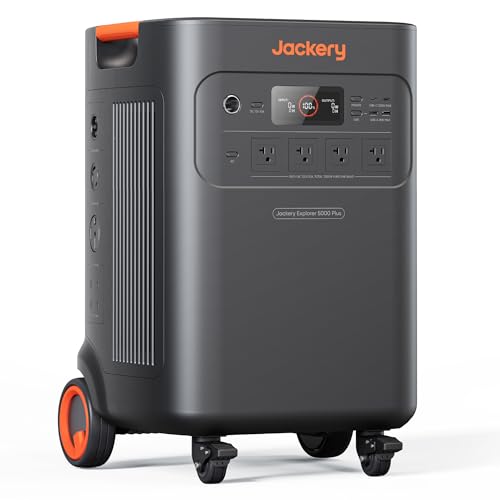
Jackery Solar Generator 5000 Plus Portable Power Station
Best for whole-home backup with the highest output in its class
Jackery Solar Generator 5000 Plus Portable Power Station
Best for whole-home backup with the highest output in its class
What we like
- 7,200W continuous AC output is the highest in this roundup — capable of running an electric oven, dryer, and refrigerator simultaneously.
- 3,000W solar input means a full recharge in roughly 2–3 hours with a 3kW panel array — fastest solar recovery here.
- Expandable to 60kWh total capacity, making it the most future-proof option for whole-home backup applications.
- 0ms UPS mode automatically switches to stored power during outages — no perceptible interruption to connected devices.
What we don't
- At the top of the price range, it's a significant investment — the EcoFlow DELTA Pro 3 delivers comparable 240V output at a lower price point.
- Physical footprint is large and the unit is not easily moved without the included wheels on flat surfaces.
- Solar panels are not included at base price — total system cost rises substantially with panel and transfer switch additions.
The Jackery 5000 Plus is for buyers who want the most output available in a single portable unit. 7,200W continuous at 120V/240V, 3,000W solar input, and 60kWh expandability put it in a category most competitors can't match without pairing two stations.
If the price gap between this and the DELTA Pro 3 makes you hesitate, it should — the EcoFlow handles 90% of home backup use cases for less money. Buy the 5000 Plus if your loads are genuinely large (whole-home critical circuits) or if you're planning to expand capacity aggressively over time.
What to Look For
Native 120V/240V output is the first filter. Some generators reach 240V only by connecting two units in parallel via a fusion box — that works, but means buying two units.
Generators with a single built-in dual-voltage inverter (like the EcoFlow DELTA Pro 3 and Anker SOLIX F3800) are cleaner and more cost-effective for most buyers. Continuous output wattage determines what you can run simultaneously.
A 3,000W unit handles most home circuits. A 6,000–7,200W unit powers central AC, large power tools, and a dryer at the same time — but costs more and weighs considerably more.
Solar input capacity is what separates a true off-grid unit from a backup-only unit. Look for at least 800W–1,200W of solar input if you plan to run loads while recharging during daylight.
Lower solar input means you're stuck waiting for a grid connection to top off.
Who Should Skip This
If you only need 120V output for camping devices, phones, and laptops, you're paying a large premium for 240V capability you'll never use — a mid-tier 120V-only unit at half the price will serve you better. If portability is the priority and you're hiking or backpacking to your site, none of these units are practical; they range from 60 to over 110 lbs.
What the Community Actually Uses
On r/vandwellers and r/solar, the recurring advice is to verify the outlet type before buying — not just the advertised voltage. Several popular units achieve 240V only when two stations are daisy-chained, which surprises buyers who expected single-unit dual-voltage.
The DELTA Pro 3 and SOLIX F3800 come up most often as the units that deliver 240V natively without add-ons.
Quick Picks — In Case You've Already Decided
Frequently Asked Questions
What's the difference between 220V and 240V on these generators?
In the US, 220V and 240V refer to the same split-phase power delivery — both terms describe the dual-leg 120V+120V configuration used for appliances like dryers and well pumps. When manufacturers list either rating, they're describing the same outlet type.
Can I run my dryer directly from one of these solar generators?
Yes, if the unit has a NEMA 14-50 outlet and your dryer's starting wattage falls under the generator's continuous output. Electric dryers typically draw 5,000–7,500W — the Anker SOLIX F3800 (6,000W) and Jackery 5000 Plus (7,200W) are the safest fits. Check your dryer's nameplate before assuming.
How long does it take to recharge these with solar panels?
It depends on battery size and panel wattage. A 4,000Wh unit with 800W of solar takes roughly 5–6 hours in direct sun. Most of these units support 800W–2,400W of solar input, so larger panel arrays cut that time significantly. Pairing with the maximum supported panel wattage is always the better investment.
Are these safe to use indoors during a power outage?
Yes. Unlike gas generators, these produce zero emissions and are safe to operate indoors. LFP battery chemistry is also thermally stable and doesn't off-gas the way older lithium-ion cells can. Keep them in a ventilated area as a best practice, but there's no carbon monoxide risk.
Do I need an electrician to use the 240V output for home backup?
For connecting to home circuits through a transfer switch or inlet box — yes, a licensed electrician is required. For direct plug-in use of 240V appliances via a NEMA 14-50 cord, no electrician is needed. Running a dryer or AC unit on an extension cord plugged directly into the generator is perfectly safe.
Buying Guide
You need a unit with native 120V/240V output — not a workaround. Check continuous wattage against your highest-draw appliance first, then battery capacity for runtime.
LFP chemistry outlasts lithium-ion by thousands of cycles. Solar input wattage determines how fast you recharge off-grid.
Expandability matters if your power needs might grow.