The right solar generator doesn't run out at 11pm when your fridge is still running — it's sized correctly for the load you're actually carrying. Five models between $500 and $1,900 cover every use case from weekend van trips to week-long basecamp hunts, with LFP batteries rated for 3,000+ cycles.
| Photo |
Top Pick

|
Versatile

|
Budget

|
Best Value

|
Best for Reliability
|
|---|---|---|---|---|---|
| Product | EcoFlow Delta 2 Max Portable Power Station | Jackery Explorer 2000 Plus Portable Power Station | BLUETTI AC200L Portable Power Station | Anker SOLIX C1000 Portable Power Station | Goal Zero Yeti 1500 Portable Power Station (6th Gen) |
| Capacity | 2,048Wh (expandable to 6,144Wh) | 2,042Wh (expandable to 24kWh) | 2,048Wh (expandable to 8,192Wh) | 1,056Wh (expandable to 2,112Wh) | 1,516Wh |
| Ac output | 2,400W (3,400W X-Boost) | 3,000W continuous | 2,200W (4,800W surge) | 1,800W (2,400W SurgePad) | 2,000W (3,500W surge) |
| Solar input | 1,000W max | 1,000W max | 900W max | 600W max | 600W max |
| Battery type | LFP — 3,000 cycles | LFP — 4,000+ cycles | LFP — 3,500 cycles | LFP — 3,000 cycles | Li-ion NMC — 500 cycles |
| Buy Now | Check Price → | Check Price → | Check Price → | Check Price → | Check Price → |
Quick Tips
Calculate your daily watt-hour draw before buying — add up every device and multiply by hours used per day to size capacity correctly.
Match AC output wattage (not capacity) to your highest-draw appliance; a fridge with 150W surge needs at least 300W continuous output headroom.
LFP (LiFePO4) batteries last 3,000–4,000 cycles versus 500 for standard lithium-ion — always confirm battery chemistry before purchasing.
Solar input ceiling determines how fast you recharge off-grid; 900W input fills a 2,000Wh unit in about 3 hours of direct sun with the right panels.
EcoFlow DELTA 2 Max
Best for fast charging and long-term reliability
EcoFlow DELTA 2 Max
Best for fast charging and long-term reliability
What we like
- Charges from 0–80% in just 43 minutes via combined AC+solar input — fastest in class under $1,100.
- LFP battery rated for 3,000 cycles translates to roughly 10 years of daily use before hitting 80% capacity.
- X-Boost mode pushes effective output to 3,400W, running appliances beyond the standard 2,400W inverter ceiling.
- Expandable to 6,144Wh with two add-on batteries, so you can grow the system without buying a new unit.
What we don't
- Heavier than the Anker SOLIX C1000 at around 50 lbs — not ideal for backpack-adjacent setups.
- The app is required to unlock some advanced charging modes, which is an extra step some users find annoying.
- Add-on expansion batteries cost $500–700 each, making the expandable system expensive to build out.
When your power station dies at 11pm and the fridge is still running, you don't need more capacity — you need faster recovery, and the DELTA 2 Max's 43-minute 0–80% charge means a morning wall outlet or a peak solar window gets you back in business before the food situation becomes critical. This is the right pick if you're running a two-person overlanding or van life rig with a 12V fridge, a CPAP, and occasional power tool use.
Skip it if you're only running USB devices and a light — the Anker SOLIX C1000 does that job for $400 less.
Jackery Explorer 2000 Plus
Best for long basecamp stays with expandable capacity

Jackery Explorer 2000 Plus
Best for long basecamp stays with expandable capacity
What we like
- 3,000W continuous AC output is the highest in this roundup — capable of running a portable AC unit or large power tools without breaking a sweat.
- Expandable all the way to 24kWh with five add-on battery packs, giving basecamp setups genuine multi-day autonomy.
- ChargeShield technology extends battery longevity by 50% over standard fast-charge cycles, protecting your investment.
- Charges 0–80% via wall outlet in 1.3 hours — second fastest in this guide after the EcoFlow DELTA 2 Max.
What we don't
- Heaviest unit in this guide at approximately 62 lbs — vehicle-only deployment in practice.
- Expansion battery packs add substantial cost per kWh compared to the EcoFlow ecosystem.
- The full 24kWh expandable system requires purchasing multiple additional battery units at significant total investment.
If you're running a hunting basecamp with multiple people, a chest freezer, lights, and a phone-charging station for a week-plus, the 3,000W output and 24kWh expansion ceiling of the Explorer 2000 Plus makes it the only pick in this price range that actually scales to real group demands. This is for stationary base power, not portable convenience — if you're moving camp daily or carrying this in and out of a tent, the weight will grind you down fast.
Truck bed or trailer only.
BLUETTI AC200MAX
Best for RV and van builds needing maximum port flexibility
BLUETTI AC200MAX
Best for RV and van builds needing maximum port flexibility
What we like
- Ships with a 30A RV TT-30 outlet built in — the only unit in this roundup that plugs directly into an RV's shore power port.
- 15 total output ports including dual wireless charging pads, dual USB-A, two DC 5521 ports, and a 12V/30A DC output for vehicle-style accessories.
- Expandable to 8,192Wh with two B300 battery modules, covering multi-day off-grid use without recharging.
- 4,800W surge capacity handles hard-starting appliances that trip units with lower peak ratings.
What we don't
- 900W solar input ceiling is the lowest of the 2,000Wh units here — slower solar recharge on extended off-grid deployments.
- Heavier than the EcoFlow DELTA 2 Max at roughly 61 lbs, limiting portability.
- No built-in X-Boost-style output amplification — what you see on the label (2,200W) is what you get.
The AC200MAX earns its spot in a permanent van or RV build because no other unit in this price range gives you a TT-30 RV outlet, dual wireless charging pads, and 15 output ports on a single unit — it's designed to be the central hub of a built system, not a portable generator you move around. If you're doing a proper van conversion or want to hardwire a power system into a truck camper, this is the most integration-friendly pick.
If you want the fastest solar recharge or best output for the dollar, the EcoFlow DELTA 2 Max wins that comparison.
Anker SOLIX C1000
Best value for solo weekend overlanders
Anker SOLIX C1000
Best value for solo weekend overlanders
What we like
- Charges to full in 58 minutes from a wall outlet — the fastest charge-to-full time of any unit in this roundup.
- 15% smaller than comparable 1kWh units, making it genuinely vehicle-portable without a dedicated cargo commitment.
- SurgePad technology delivers 2,400W peak output, handling hard-starting appliances that would trip a standard 1,800W inverter.
- Anker app gives real-time watt monitoring and customizable charging speed without requiring a subscription.
What we don't
- 1,056Wh base capacity runs a compressor fridge for roughly 18–24 hours — tight for a full weekend without solar.
- 600W solar input ceiling means a full recharge from panels takes 2–3 hours in ideal conditions, which rarely happen in practice.
- Expansion battery adds $300–400 to the total investment, pushing it close to the EcoFlow DELTA 2 Max price territory.
For a solo overlander running a small 12V fridge, a phone, and a laptop on a 2–3 night trip, the SOLIX C1000 is genuinely the best value in this category — you get LFP longevity, 1,800W output, and 58-minute wall charging in a package that doesn't take over your cargo area. Skip it if you're running two people, a full-size compressor fridge, or planning 4+ nights without power hookups — the capacity math doesn't work and you'll be rationing from day two.
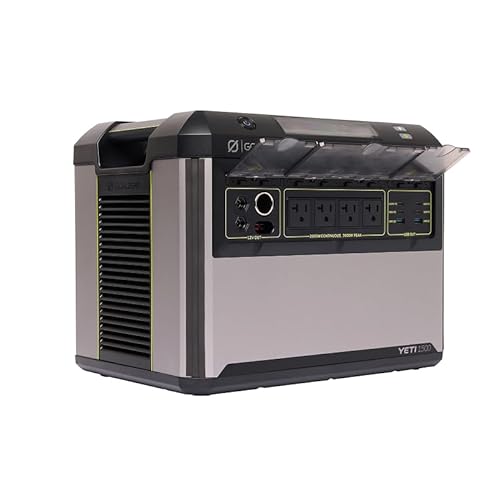
Goal Zero Yeti 1500X
Best for proven durability and ecosystem integration
Goal Zero Yeti 1500X
Best for proven durability and ecosystem integration
What we like
- Anodized aluminum enclosure is the most durable build of any unit in this roundup — survives vehicle vibration and rough camp handling without flex or creak.
- Goal Zero's Yeti-Ready ecosystem lets you hardwire the 1500X to compatible lights, coolers, and accessories via HPP port.
- 2,000W pure sine wave inverter with 3,500W surge handles the widest range of appliances of any unit at this capacity.
- Established brand with US-based support and a decade-long product track record — fewer unknowns on a long-term investment.
What we don't
- NMC battery chemistry provides only ~500 cycles versus 3,000+ on the LFP units in this guide — significantly shorter total lifespan.
- 600W solar input is shared with the Anker SOLIX C1000 but on a unit with 50% more capacity — recharge times are long off-grid.
- At this price point, it competes against the EcoFlow DELTA 2 Max which offers faster charging, more capacity, and better battery chemistry.
The Yeti 1500X earns a spot here for one reason: if you want a tank-built unit from a brand with a decade of track record and a real ecosystem of compatible accessories, nothing else in this guide matches the physical construction quality or the Goal Zero accessory integration depth. But go in clear-eyed — the NMC battery will degrade faster than every LFP unit in this guide, and at this price range you're paying a brand premium over raw specs.
Buy it if ecosystem lock-in or build quality is your top priority; pass if pure performance-per-dollar is what you're optimizing for.
What to Look For
AC output wattage is more important than capacity for most buyers. A unit with 2,000Wh but only 1,500W output can't run a portable AC, a large inverter fridge, or any appliance that draws hard on startup.
Capacity (Wh) determines how long you run — output wattage determines what you can run. Get the pairing right and you won't be rationing power at midnight.
Solar input ceiling matters most if you're off-grid for multiple days. A 900W solar input on a 2,000Wh unit means a realistic 3–4 hour full recharge in good sun — half that ceiling means double the wait.
Who Should Skip This
Skip this entire category if you only need to charge phones and laptops on weekend car camping trips — a 500Wh unit under $500 will do that job for half the price and a quarter of the weight. This guide is for people running compressor fridges, CPAP machines, power tools, or planning extended off-grid stays where a dead battery at 2am is a real problem.
What the Community Actually Uses
On r/overlanding, the recurring debate isn't which brand wins — it's whether 1,000Wh or 2,000Wh is the right starting point for a two-person rig with a 12V fridge running 24/7. The consensus is 1,500Wh minimum for anything with a compressor, and LFP chemistry only after one too many cold mornings with a dead NMC unit.
Quick Picks — In Case You've Already Decided
Jackery Explorer 2000 Plus Portable Power Station
Check Price on AmazonFrequently Asked Questions
How much capacity do I actually need for overlanding with a 12V fridge?
A compressor fridge draws 40–60W average over 24 hours, so roughly 1,000–1,440Wh per day. Add lighting, phone charging, and a fan and you're at 1,500–2,000Wh minimum. Plan for two days of autonomy without sun and size from there.
What's the difference between LFP and lithium-ion in a solar generator?
LFP (LiFePO4) chemistry is safer, more stable at temperature extremes, and rated for 3,000–4,000 cycles before hitting 80% capacity — roughly 8–10 years of daily use. Standard lithium-ion degrades at around 500 cycles. Every pick in this guide uses LFP.
Can I use these as home backup during a power outage?
Yes — units with 2,000W+ AC output can run a refrigerator, router, lights, and CPAP simultaneously. For whole-home backup you'd need expandable capacity or multiple units; these are best for essential circuits, not your entire panel.
How do I calculate how fast solar panels will recharge my unit?
Divide the capacity (Wh) by your total panel wattage input, then multiply by 1.25 for real-world efficiency losses. A 400W panel array charging a 2,000Wh unit: 2,000 ÷ 400 × 1.25 = ~6.25 hours in full sun.
Do these work in cold weather overlanding or hunting camp situations?
LFP batteries perform down to about 32°F (0°C) for discharge but charging below freezing can damage cells permanently. Most units have built-in low-temperature charging protection — keep the unit inside your vehicle or tent overnight in sub-freezing conditions.
Buying Guide
You need to match wattage output to your biggest single appliance, not total capacity. A 2,000Wh unit with 1,800W output won't start a compressor fridge drawing 150W surge — but one rated at 2,400W will.
Check output wattage first, capacity second. Solar input ceiling matters when you're off-grid more than two days.