Plugging a solar generator into a 30-amp RV without the right TT-30 port means adapters, voltage guessing, and tripped breakers — and that stops the moment you buy the right unit. The five generators here all have native TT-30 outputs, range from 2048Wh to 4096Wh, and will run your AC, fridge, and rooftop fan without an extension cord in the chain.
| Photo |
Top Pick

|
Versatile
|
Budget

|
Best Value

|
Best for Reliability
|
|---|---|---|---|---|---|
| Product | EF EcoFlow DELTA Pro 3 Portable Power Station | EF EcoFlow DELTA 3 Ultra Portable Power Station | Jackery HomePower 3000 Portable Power Station | BLUETTI AC200L Portable Power Station | BLUETTI Elite 300 Portable Power Station |
| Capacity | 4096Wh | 3072Wh | 3072Wh | 2048Wh | 3014Wh |
| Ac output | 4000W (6000W X-Boost) | 3600W (7200W surge) | 3600W (7200W surge) | 2400W (3600W power lifting) | 2400W (4800W surge) |
| Tt30 port | ✓ | ✓ | ✓ | ✓ | ✓ |
| Solar input | 2600W max | 1800W max | 1000W max | 1200W max | 1200W max |
| Buy Now | Check Price → | Check Price → | Check Price → | Check Price → | Check Price → |
Quick Tips
Run your RV's AC unit on its own circuit first — at startup, it can spike to 2000W or more, which will trip a unit with under 3000W continuous output.
Size solar input to match your battery, not just your appliances — a 2000Wh battery paired with only 200W of panels takes 10+ hours to recover on a cloudy day.
Use a smart plug or clamp meter to measure your RV's actual average draw before buying — most rigs pull far less than their 30-amp circuit rating suggests.
LiFePO4 (LFP) batteries tolerate partial charging better than lithium-ion — you don't need to hit 100% every cycle, which extends lifespan significantly on long trips.
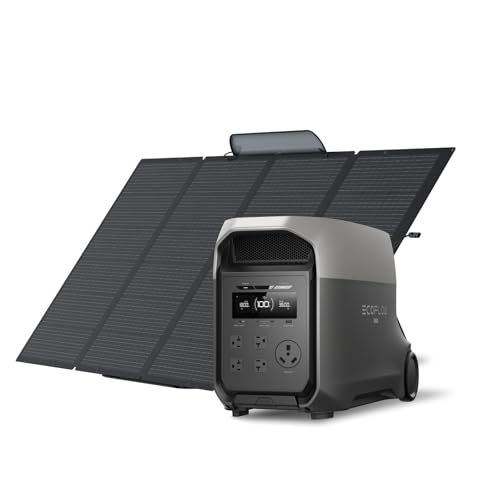
EF EcoFlow DELTA Pro 3 Portable Power Station
Best for full-time RV living and multi-day boondocking
EF EcoFlow DELTA Pro 3 Portable Power Station
Best for full-time RV living and multi-day boondocking
What we like
- Native TT-30 port plus L14-30 split-phase output covers both 30-amp and 240V RV setups in one unit.
- 4096Wh capacity runs a 12V fridge plus essentials for roughly 2 full days without solar input.
- IP65-rated battery pack is built to survive dust and water spray during transport between campsites.
- Expandable to 48kWh with extra batteries, so your power setup can grow with your rig.
What we don't
- Heaviest unit on this list — awkward to move solo without the carry handle extended.
- Price premium is real, especially if you don't need 240V split-phase output.
- Solar panels sold separately, which adds to the total cost quickly.
This is the unit for RVers who want to stop thinking about power entirely — 4096Wh capacity, a native TT-30 output, and 2600W of solar input means you can recover most of your overnight draw in a few hours of morning sun. Best fit for full-time travelers or anyone boondocking more than 3 nights at a stretch.
If you're doing occasional weekend trips with hookups available, the price doesn't justify itself.
EF EcoFlow DELTA 3 Ultra Portable Power Station
Best for RVers who want fast recharge and silent operation
EF EcoFlow DELTA 3 Ultra Portable Power Station
Best for RVers who want fast recharge and silent operation
What we like
- Runs at 25dB under load — quiet enough to use inside a sleeping RV without waking anyone.
- Under 10ms UPS transfer means sensitive electronics like CPAP machines never drop power.
- 3600W continuous output handles rooftop AC units and microwaves without a flinch.
- Compact enough to tuck into an RV storage bay without taking over the space.
What we don't
- No expandable capacity — what you buy is what you get, unlike the Pro 3.
- 1800W solar input is solid but slower to recover than higher-wattage competitors.
- No 240V output if you ever upgrade to a 50-amp rig later.
The DELTA 3 Ultra hits the sweet spot for most RV travelers — 3072Wh is enough for a night of real use, 3600W continuous covers air conditioning and cooking, and the whisper-quiet operation makes it livable inside a small rig. Pick this over the Pro 3 if you're a seasonal traveler who doesn't need 240V or expandable capacity.
Skip it if you're off-grid more than 3 nights and want the security of adding more battery later.
Jackery HomePower 3000 Portable Power Station
Best for RVers who also need home backup power
Jackery HomePower 3000 Portable Power Station
Best for RVers who also need home backup power
What we like
- Lightest 3kWh unit available — Jackery claims 47% smaller and 43% lighter than comparable models.
- Recharges in 1.7 hours via hybrid AC+DC input, so you're never waiting long at a campground hookup.
- 20ms UPS mode keeps essentials running through brief grid drops at home or partial outages.
- ZeroDrain technology retains 95% capacity after a year in storage — useful for seasonal RVers.
What we don't
- 1000W solar input is the lowest on this list — slower off-grid recovery than competitors.
- No expandable battery capacity — fixed at 3072Wh with no way to add more.
- Requires grounding adapter to connect directly to some RV shore power inlets.
Jackery built this to move easily between your RV and your garage, and it shows — the compact form factor and fast AC recharge make it practical for people who travel seasonally and want the same unit handling home backup the rest of the year. Best for RVers who need dual-purpose functionality.
Pass if you're parking off-grid for multiple days — 1000W solar input means slow recovery when you can't plug in.
BLUETTI AC200L Portable Power Station
Best for RVers who plan to expand capacity over time
BLUETTI AC200L Portable Power Station
Best for RVers who plan to expand capacity over time
What we like
- Expandable to 8192Wh with BLUETTI expansion batteries — the most scalable option at this price.
- Both NEMA TT-30 and D40 12V/30A DC ports included, covering AC and DC RV power needs in one unit.
- 2400W AC output handles most RV loads cleanly; Power Lifting mode stretches to 3600W for motor starts.
- 45-minute fast charge from 0–80% on AC means you can top it up at a campground hookup in under an hour.
What we don't
- 2048Wh base capacity is lowest here — you'll feel the limit on a full night of AC and fridge use.
- Power Lifting to 3600W is not continuous — it's a short-duration boost, not rated sustained output.
- Expansion batteries cost extra and add significant weight to an already substantial unit.
The AC200L is the starter unit for someone who knows their power needs will grow — 2048Wh is enough for moderate use today, and the expansion port means you can scale up to 8kWh without buying a whole new system. Smart buy for the RVer on a budget who still wants a native TT-30 port and a path to more capacity.
Not the call if you're already running AC constantly overnight — start with a 3072Wh unit instead.
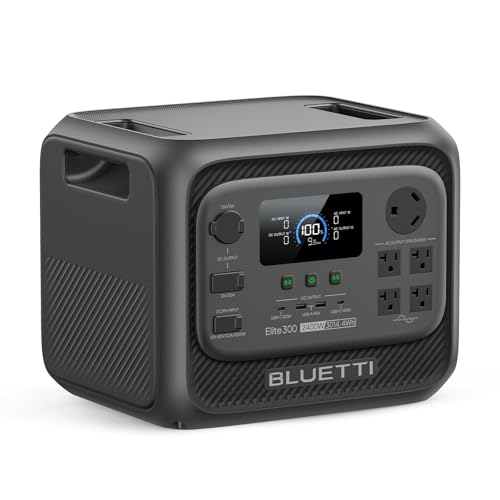
BLUETTI Elite 300 Portable Power Station
Best for weekend RVers who want simplicity and speed
BLUETTI Elite 300 Portable Power Station
Best for weekend RVers who want simplicity and speed
What we like
- 3014Wh capacity at the most competitive price on this list — solid watt-hours per dollar.
- Native TT-30 RV port plus 12V/30A DC output, so you can run AC and DC loads simultaneously.
- Charges from 0–100% in 78 minutes on AC — fastest full charge of any unit here.
- Compact form factor without wheels makes it easier to stow in tight RV storage compartments.
What we don't
- 2400W continuous output won't run a larger 15,000 BTU rooftop AC — only suits smaller units.
- No expandable capacity — 3014Wh is the ceiling, no expansion batteries available.
- 1200W max solar input is enough but not exceptional for all-day off-grid recovery.
BLUETTI priced this to be the easiest yes on the list — 3kWh of capacity, a built-in TT-30 port, and 78-minute full recharge make it a practical companion for 2–3 night weekend trips where you plug in at the start and solar-supplement the rest. Buy this if you're a weekend warrior who wants plug-and-play simplicity without the premium price.
Step up to the Elite 300's bigger siblings or the EcoFlow line if you run full-time or need sustained AC output above 2400W.
What to Look For
Native TT-30 output is the only port that plugs directly into your RV's shore power inlet without adapters or voltage converters. Every unit on this list has one built in — if a generator doesn't list NEMA TT-30 explicitly, keep looking.
Continuous AC output determines whether your air conditioner, microwave, or electric kettle will run without the unit cutting out. Most 30-amp RV systems draw up to 3600W under real load, so a generator rated below that will hit its limit fast.
Battery capacity in watt-hours (Wh) tells you how long you can run without sun. A 300W fridge running 24 hours needs roughly 720Wh minimum — capacity under 2000Wh means you'll need consistent solar input to survive a full off-grid day.
Who Should Skip This
If you have a 50-amp RV or a rig that runs a rooftop AC constantly for hours at a time, none of these units will carry that load indefinitely — you need a permanent solar installation with dedicated battery banks, not a portable generator. If you're doing weekend campground trips with hookups available, a solar generator is overkill; a smaller power station under $500 makes more sense.
What the Community Actually Uses
On r/overlanding and r/vandwellers, the consistent consensus is that native TT-30 output matters more than raw watt-hour specs — users repeatedly describe blown adapters and annoying voltage drops when using 30-amp workarounds. The brands that come up most often for serious RV use are EcoFlow and BLUETTI, with frequent callouts about solar input speed being the real differentiator for multi-day boondocking.
Quick Picks — In Case You've Already Decided
Frequently Asked Questions
What does a 30-amp solar generator actually mean for RV use?
It means the generator has a NEMA TT-30 outlet — the same three-prong plug your RV uses to connect to campground shore power. You run a standard RV power cord from the generator directly to your rig's shore power inlet, powering everything on your RV's electrical panel at once.
Can a solar generator run my RV's air conditioner?
It depends on your AC unit. A typical 13,500 BTU rooftop AC draws about 1500W running and can spike to 2800W on startup. Any generator on this list with 3000W or more continuous output can handle it — but you'll drain the battery fast without solar input keeping up.
How much solar input do I need to stay off-grid long-term?
Match your average daily consumption. Most RV essentials (fridge, lights, fans, phone charging) run about 500–800Wh per day. A generator with 1200W or more of solar input can recover that in 1–2 hours of good sun, leaving reserve capacity to spare.
Is LiFePO4 really worth it over standard lithium-ion for RV use?
Yes — LiFePO4 handles partial charging cycles better, tolerates heat, and lasts 3–5x longer in cycle count. For an RV that charges daily from solar and discharges every night, that longevity difference translates to years of extra usable life.
Do I need any special cable to connect a solar generator to my RV?
You need a standard 30-amp RV extension cord (NEMA TT-30P to TT-30R) — the same cord you'd use at a campground hookup. These run $20–40 and are available at most RV or hardware stores. The generator itself does not include one.
Buying Guide
You need a native TT-30 port — not an adapter. Check continuous output against your RV's biggest load: most 30-amp rigs pull up to 3600W peak.
Match battery capacity to how many nights you're off-grid. LiFePO4 chemistry lasts longer than lithium-ion.
Solar input above 1000W means faster recovery between sunny days.