Running a compressor fridge off a solar generator only works when your unit has enough true usable capacity — most undersized options quit by day two. The five generators here range from 1,056Wh to 2,042Wh, cover continuous draw from 45W to 150W compressor fridges, and carry LFP chemistry rated for 3,000-plus cycles.
| Photo |
Top Pick

|
Versatile

|
Budget

|
Best Value
|
Best for Reliability

|
|---|---|---|---|---|---|
| Product | Jackery Explorer 2000 Plus Portable Power Station | EcoFlow Delta 2 Max Portable Power Station | BLUETTI AC200L Portable Power Station | Goal Zero Yeti 1500 Portable Power Station (6th Gen) | Anker SOLIX C1000 Portable Power Station |
| Battery | LiFePO4 (LFP) | LiFePO4 (LFP) | LiFePO4 (LFP) | Lithium NMC | LiFePO4 (LFP) |
| Capacity | 2,042Wh | 2,048Wh | 2,048Wh | 1,516Wh | 1,056Wh |
| Ac output | 3,000W (6,000W surge) | 2,400W (3,400W X-Boost) | 2,400W (3,600W power lift) | 2,000W (3,500W surge) | 1,800W (2,400W surge) |
| Solar input | 1,000W max | 1,000W max | 900W max | 600W max | 600W max |
| Buy Now | Check Price → | Check Price → | Check Price → | Check Price → | Check Price → |
Quick Tips
Calculate your fridge's average daily watt-hours before buying — multiply running wattage by estimated daily runtime, then add 20% buffer for compressor startup surge.
Prioritize solar input wattage alongside battery capacity: a 2,000Wh unit with only 200W solar input won't recharge fast enough on a single day of sun.
LFP (LiFePO4) chemistry is non-negotiable for refrigerator use — NMC batteries degrade faster under the constant partial-cycle draw a fridge creates.
Use the 12V DC output port if your fridge supports it — running a compressor fridge on DC instead of AC cuts inverter conversion losses and extends runtime by 10–15%.
Jackery Explorer 2000 Plus Portable Power Station
Best for multi-day off-grid fridge power with expansion headroom
Jackery Explorer 2000 Plus Portable Power Station
Best for multi-day off-grid fridge power with expansion headroom
What we like
- 1,000W solar input ceiling means two 500W panels can recharge the unit in under 2.5 hours on a clear day.
- LFP chemistry is rated for 4,000 cycles, well above the 3,000-cycle standard across this category.
- Expandable to 24kWh with add-on battery packs — future-proofs the setup if your power needs grow.
- Whisper-quiet at 30dB, which matters when it's running overnight next to your sleeping area.
What we don't
- Heavier than comparably sized competitors at around 61 lbs, which limits portability.
- The base unit doesn't include solar panels — that's a separate purchase at meaningful additional cost.
- App-dependent features require Wi-Fi or Bluetooth connectivity to use fully.
If you're running a compressor fridge for more than two days off-grid, the Explorer 2000 Plus is the unit that won't make you ration power — 2,042Wh of LFP capacity with a 1,000W solar input ceiling means you can run a 60W fridge for 30+ hours and still recharge the same day with two decent panels. This is the right call for overlanders and van builds where the fridge is always on.
If you're doing single-night car camping trips and want something you can carry with one hand, the Anker SOLIX C1000 is a better fit.
EF EcoFlow DELTA 2 Max Portable Power Station
Best for fastest solar recharge in this class
EF EcoFlow DELTA 2 Max Portable Power Station
Best for fastest solar recharge in this class
What we like
- Dual AC+solar charging hits 0–80% in 43 minutes, the fastest recharge speed in this roundup.
- X-Boost mode powers appliances up to 3,400W, covering compressor startup surges on larger fridges.
- Expandable from 2kWh to 6kWh with add-on batteries for longer off-grid stretches.
- EcoFlow's app gives real-time watt draw monitoring, useful for tracking fridge consumption precisely.
What we don't
- X-Boost mode uses software to manage high-draw appliances, which adds complexity some users find unreliable.
- Solar panels are sold separately — the base unit price doesn't include any panels.
- Slightly noisier than the Jackery under heavy load.
The DELTA 2 Max matches the Jackery on capacity but wins on recharge speed — the combined AC+solar input can hit 2,400W, getting you back to 80% in under an hour when both sources are available. For cloudy-day recovery or situations where you need a fast top-up before the next leg of a trip, nothing in this price range comes close.
Pick this over the Jackery if your setup prioritizes fast recharge over expandability, or if you want the X-Boost feature to handle a wider range of appliances beyond the fridge.
BLUETTI AC200L Portable Power Station
Best for RV and van builds needing native 30A output
BLUETTI AC200L Portable Power Station
Best for RV and van builds needing native 30A output
What we like
- Native 30A TT-30 RV output port eliminates the need for a separate adapter in van or RV builds.
- Power Lifting mode runs appliances up to 3,600W, which covers larger 12V compressor fridges with high startup surges.
- Expandable to 8,192Wh with BLUETTI battery packs for extended off-grid operation.
- 15 output ports including dual 12V outputs for running fridge and other DC loads simultaneously.
What we don't
- 900W solar input ceiling is lower than the Jackery and EcoFlow, meaning slower solar recharge with large panel arrays.
- Heavier than competing 2kWh units, which makes it less practical as a portable carry-around unit.
- The proprietary 48V DC expansion port requires a separate converter to access 12V DC at 30A.
The AC200L's built-in TT-30 RV port is the detail that sets it apart — if your van or RV build already uses 30A connections, you plug directly in without adapters or workarounds. Combined with 2,048Wh of LFP capacity and expandability to 8kWh, it's the most purpose-built option here for permanent or semi-permanent installs.
If you need maximum solar recharge speed or a lighter unit you'll move between vehicles, the EcoFlow or Jackery are better picks. The AC200L earns its place in builds where the generator stays put.
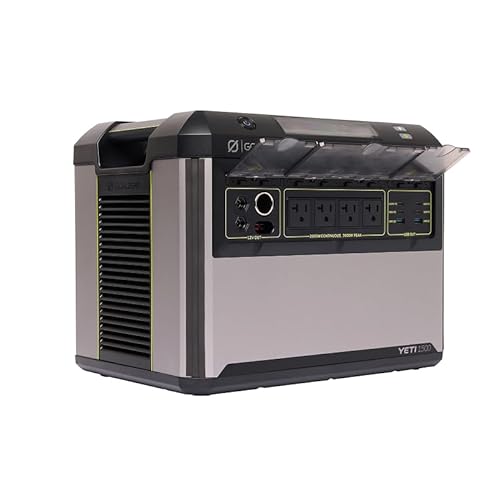
Goal Zero Yeti 1500X Portable Power Station
Best for durability and ecosystem compatibility
Goal Zero Yeti 1500X Portable Power Station
Best for durability and ecosystem compatibility
What we like
- Goal Zero's MPPT charge controller increases solar input efficiency by up to 30% compared to standard controllers.
- Built for the outdoors with durability-focused aluminum construction and vibration testing included.
- Integrates seamlessly with the full Goal Zero ecosystem including panels, lights, and coolers.
- Proven platform with a large user community and widely available support and accessories.
What we don't
- NMC battery chemistry degrades faster under the constant partial-cycle draw of a compressor fridge versus LFP.
- 600W solar input ceiling means slower recharge times compared to the 1,000W units in this roundup.
- Smaller 1,516Wh capacity is tighter for multi-day trips running a large compressor fridge continuously.
The Yeti 1500X costs more than its capacity warrants on paper — you're partly paying for the Goal Zero ecosystem and the brand's reputation for rugged, dependable hardware built to US standards. If you're already using Goal Zero panels or accessories, the seamless integration is a genuine advantage that justifies the premium.
The NMC chemistry and 600W solar ceiling are real limitations for dedicated fridge use compared to the LFP units above. Choose this if ecosystem consistency and proven durability matter more to you than raw capacity-per-dollar.
Anker SOLIX C1000 Portable Power Station
Best budget entry for running a fridge on weekend trips
Anker SOLIX C1000 Portable Power Station
Best budget entry for running a fridge on weekend trips
What we like
- Full charge from zero in 58 minutes via AC — fastest wall recharge time across all five units here.
- LFP chemistry at this price point is unusual and meaningfully extends the unit's service life.
- 15% smaller than competing 1kWh units, making it genuinely portable and easy to reposition.
- SurgePad technology handles 2,400W surges, covering compressor startup on most camping fridges.
What we don't
- 1,056Wh capacity runs a 60W fridge for roughly 15 hours — not enough for a full day without solar input.
- 600W solar input ceiling limits recharge speed when paired with a single large panel.
- Not expandable — what you buy is what you get, unlike the Jackery or BLUETTI options.
At under $500, the SOLIX C1000 is the only LFP unit in this roundup that won't break the budget — and the 58-minute AC recharge means you can top it up at a trailhead or campsite before heading off-grid for the night. For weekend car camping where you need the fridge cold for one or two nights, it handles the job cleanly.
It's not the right pick for multi-day overlanding where solar is your only recharge source — 1,056Wh isn't enough headroom for full off-grid fridge operation across 3+ days. Step up to the EcoFlow or Jackery if that's your use case.
What to Look For
Usable capacity is the most important spec — but 'usable' means after inverter losses, which typically reduce rated capacity by 10–15%. A 2,000Wh unit delivers roughly 1,700–1,800Wh of actual fridge runtime before it needs sun to top back up.
Solar input ceiling matters as much as panel wattage. If the generator accepts 800W+ of solar, you can pair two 400W panels and recharge a depleted 2kWh unit in under 3 hours on a clear day.
Battery chemistry determines how many seasons you get out of the unit. LFP cells handle the constant shallow-cycle draw of a compressor fridge far better than NMC — expect 3,000+ cycles versus 500–800 with older chemistry.
Who Should Skip This
If you only need to run a fridge for one night at a drive-in campsite with hookups available, a full solar generator is overkill — a quality 12V portable battery with a DC output will do the job for a fraction of the price. These units make the most sense for multi-day off-grid trips, overlanding setups, or van builds where shore power isn't an option.
What the Community Actually Uses
On r/overlanding and r/vandwellers, the recurring debate isn't which brand to buy — it's whether 1kWh or 2kWh is the right call. The consensus leans heavily toward 2kWh for anyone running a compressor fridge longer than two days, especially in hot climates where the compressor cycles more aggressively.
LFP chemistry and solar input ceiling come up constantly as the two specs users wish they'd paid more attention to before buying.
Quick Picks — In Case You've Already Decided
Frequently Asked Questions
What size solar generator do I need to run a refrigerator?
For a typical 12V compressor camping fridge drawing 40–80W running, you need at least 1,000Wh of usable capacity to get through a night without solar input. For multi-day off-grid use, 2,000Wh paired with 400–800W of solar panels is the practical minimum.
Can a 1,000Wh solar generator run a refrigerator all day?
It depends on your fridge's duty cycle and ambient temperature. In mild conditions a 40W-draw fridge might run 20+ hours, but in summer heat with a 75W draw you're looking at 12–14 hours. Solar recharging during daylight hours is essential to stay net-positive.
Is LiFePO4 better than lithium-ion for running a fridge?
Yes, significantly. LFP handles the constant partial-cycle draw of a compressor fridge without the degradation NMC cells experience. You'll get 3,000+ cycles with LFP versus 500–800 with standard lithium-ion, which matters when your fridge cycles the generator continuously.
Should I run my camping fridge on AC or DC from my solar generator?
DC if your fridge supports it. Running a 12V compressor fridge through the DC output port bypasses the inverter and its 10–15% conversion losses, giving you meaningfully more runtime per charge cycle.
How many solar panels do I need to keep a fridge running indefinitely off-grid?
A 200W fridge draw over 24 hours needs roughly 400–600Wh of solar input daily to stay net-neutral, accounting for partial sun hours and panel efficiency. Two 200W panels is a practical minimum; one 400W high-efficiency panel works well if you have clear skies most days.
Buying Guide
Your fridge's running wattage — not startup surge — is the number that matters most here. Most 12V compressor fridges draw 40–80W running, which means a 1,000Wh unit gives you roughly 10–15 hours before solar needs to catch up.
You want at least 1,000Wh of usable capacity and 800W+ solar input to stay net-positive on a sunny day.