If your RV has a 30 amp shore power inlet and your solar generator doesn't have a TT-30 or L14-30 port, you're using an adapter that caps your power and fries your peace of mind. These five units have the port built in — not bolted on — with output starting at 2400W and capacity from 2048Wh to 4096Wh.
| Photo |
Top Pick

|
Versatile
|
Budget

|
Best Value

|
Best for Reliability

|
|---|---|---|---|---|---|
| Product | EF EcoFlow DELTA Pro 3 Portable Power Station | BLUETTI Elite 300 Portable Power Station | Anker SOLIX F3800 Portable Power Station | BLUETTI AC200L Portable Power Station | Jackery HomePower 3000 Portable Power Station |
| Rv port | TT-30 (120V/30A) | TT-30 (120V/30A) | L14-30 + NEMA 14-50 | 30A RV output | TT-30 (built-in) |
| Capacity | 4096Wh | 3014Wh | 3840Wh | 2048Wh (expandable to 8192Wh) | 3072Wh |
| Ac output | 4000W (8000W surge) | 2400W (4800W surge) | 6000W (120V/240V) | 2400W (3600W surge) | 3600W (7200W surge) |
| Solar input | 2600W max | 1200W max | 2400W max | 1200W max | 1000W max |
| Buy Now | Check Price → | Check Price → | Check Price → | Check Price → | Check Price → |
Quick Tips
Check your RV's breaker panel label before buying — if it says TT-30R, you need a TT-30P output port on the generator, not an adapter.
Run your AC unit first thing in the morning when the battery is full — it's the biggest draw and drains fastest on partial charge.
Solar input wattage is the real bottleneck on overcast days; prioritize units with 1200W+ solar input if you're boondocking more than 2 nights.
LFP (LiFePO4) batteries handle full discharges far better than NMC — don't buy an NMC unit for full-time RV use.
EcoFlow DELTA Pro 3 Portable Power Station
Best for Class C RVs running AC on solar
EcoFlow DELTA Pro 3 Portable Power Station
Best for Class C RVs running AC on solar
What we like
- Native TT-30 RV port powers your rig directly with no adapter or adapter chain needed.
- 4000W continuous output handles rooftop AC startup surge on most Class C units without tripping.
- 2600W solar input refills the 4kWh battery in roughly 2 hours in direct sun with enough panels.
- Expandable to 48kWh with extra batteries — the only pick here that genuinely scales for extended off-grid trips.
What we don't
- Heavier and pricier than every other pick here — this is a serious investment, not a casual purchase.
- 4096Wh base capacity requires a large panel array to fully recharge in a single day.
- App setup can be fiddly on first use before firmware is updated.
When your Class C has an AC unit and you're not plugging into shore power, you need more headroom than most solar generators offer — the DELTA Pro 3's 4000W continuous output and 8000W surge handle a rooftop AC startup without the voltage dip that trips smaller inverters. The 2600W solar input ceiling and expandable capacity mean this unit actually keeps up with a full day of RV use, not just an overnight.
This is for RV owners who boondock for multiple days and refuse to run a gas generator — if you're at full hookups every night or using a smaller trailer, it's overkill and the price reflects that.
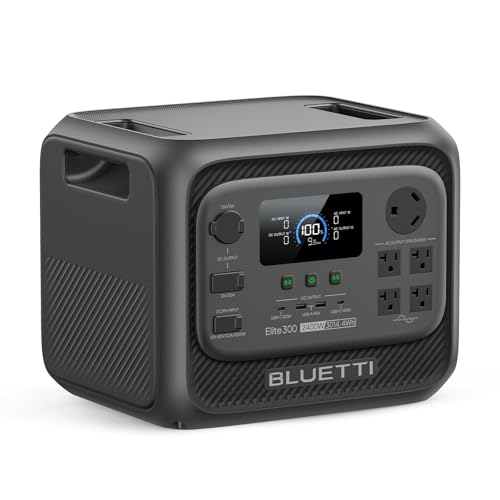
BLUETTI Elite 300 Portable Power Station
Best for Class B van builds needing native TT-30
BLUETTI Elite 300 Portable Power Station
Best for Class B van builds needing native TT-30
What we like
- Compact 3kWh design with a dedicated TT-30 port makes this the easiest plug-and-play pick for van builds.
- 2400W continuous output runs a residential fridge, CPAP, lights, and fan simultaneously without issue.
- BLUETTI app connects via Bluetooth or Wi-Fi for remote monitoring and charge scheduling.
- 10ms UPS switching keeps sensitive devices running through any brief power interruption.
What we don't
- 1200W solar input ceiling means a full recharge from flat takes a full sunny day even with multiple panels.
- No 240V output — this won't work for rigs that require L14-30 split-phase power.
- 2400W peak limits you to smaller AC units — won't reliably start a 15,000 BTU rooftop.
Van builds and Class B RVs rarely need 4000W — they need a reliable TT-30 port, enough capacity to get through the night, and a unit that's not the size of a car battery. The Elite 300 hits all three and keeps the footprint manageable enough for tight rear storage configurations.
At 3kWh with a native TT-30, it powers the essentials from fridge to CPAP without pulling an adapter out of your kit. Choose this over the DELTA Pro 3 if you're not running a rooftop AC unit and don't need expandable capacity — it's a simpler, lighter, cheaper solution for the van life use case.
Anker SOLIX F3800 Portable Power Station
Best for Class A rigs and 240V home backup overlap
Anker SOLIX F3800 Portable Power Station
Best for Class A rigs and 240V home backup overlap
What we like
- 6000W output with native L14-30 and NEMA 14-50 ports covers both 30 amp and 50 amp RV hookup standards.
- 120V/240V split-phase output makes this the only pick here that works for Class A rigs with 50 amp service.
- EV-class LFP battery rated for 10+ year lifespan with a 5-year full-device warranty.
- Expandable to 53.8kWh with BP3800 battery packs — serious long-haul range for extended trips.
What we don't
- Heaviest unit in this roundup — moving it in and out of storage solo is a two-handed job.
- No TT-30 port natively — Class B/C owners with standard 30 amp shore power need the L14-30 to TT-30 adapter.
- Price is the highest here; overkill for smaller rigs that only need 2400W.
The F3800 is built for people who need serious output — 6000W continuous, 120V/240V, and both 30 amp and 50 amp ports mean it covers the full spectrum of RV electrical standards in one unit. If your rig runs a residential fridge, rooftop AC, microwave, and charging infrastructure simultaneously, this is the unit that won't blink.
It also doubles as whole-home backup when you're parked. Pass on this if your RV is a standard Class B or C with a single TT-30 shore inlet — you're paying for 6000W and 50 amp capability you won't use.
BLUETTI AC200L Portable Power Station
Best expandable mid-range with a 30 amp RV port
BLUETTI AC200L Portable Power Station
Best expandable mid-range with a 30 amp RV port
What we like
- Starts at 2048Wh and expands to 8192Wh with BLUETTI expansion batteries — most upgrade path per dollar in this roundup.
- 30A RV output port plus 11 total output ports covers every device type you'd run in an RV simultaneously.
- 2400W continuous with 3600W Power Lifting covers a residential fridge and most smaller rooftop fans without issue.
- Lower base price than every other pick here while still delivering a real native 30 amp output.
What we don't
- Base 2048Wh capacity is the smallest here — expansion batteries are needed for multi-night boondocking.
- 1200W solar input is a ceiling, not a guarantee — partial shade cuts real-world charging significantly.
- 2400W continuous won't reliably start a 13,500 BTU rooftop AC without Power Lifting mode engaged.
The AC200L is the buy-in unit that doesn't trap you — 2048Wh base with a native 30 amp RV port, and a clear upgrade path to 8kWh if your trips get longer. You're not paying for 4000W output you don't need; you're paying for a real TT-30 capable output and the flexibility to grow.
At this price, nothing else in the category offers that combination. This is for the RV owner who does weekend trips now and wants the option to extend to a week off-grid later without buying a completely different unit.
Jackery HomePower 3000 Portable Power Station
Best plug-and-play TT-30 option for weekend RVers
Jackery HomePower 3000 Portable Power Station
Best plug-and-play TT-30 option for weekend RVers
What we like
- Built-in TT-30 RV port with 3600W output is plug-and-play for any standard 30 amp shore power inlet.
- 7200W surge capacity handles most rooftop AC compressor startups without tripping on first draw.
- Fully recharges in 1.7 hours via hybrid AC + DC — fastest wall charging speed in this roundup.
- 5-year warranty and Jackery's well-documented customer support record make this a low-risk purchase.
What we don't
- 1000W solar input ceiling is the lowest here — full solar recharge takes a full sunny day with optimal panel setup.
- No expandable capacity option — what you buy is what you get, with no battery add-on path.
- Heavier than the BLUETTI Elite 300 with slightly less capacity — the value is in the output headroom, not portability.
If you want a name-brand TT-30 solar generator with serious surge headroom and you don't need to expand capacity later, the HomePower 3000 is a clean, well-supported pick. The 7200W surge gives it more startup margin than most alternatives at this price, and Jackery's ecosystem means accessories and support are actually available.
It charges fast from the wall between trips — relevant if you're a weekend warrior, not a full-timer. Skip this if you want expandable capacity or more than 1000W of solar input — for multi-day boondocking, the AC200L's expandability or the DELTA Pro 3's solar input ceiling makes more sense.
What to Look For
The 30 amp port type matters more than people realize. A TT-30 port outputs 120V at up to 30 amps — standard for most campground hookups and Class B/C shore power inlets.
An L14-30 port delivers 120V/240V split-phase and is common on larger Class A rigs and home transfer switches. Confirm which your RV uses before you order.
Output wattage sets the ceiling on what you can run simultaneously. A 2400W unit handles a residential fridge, rooftop fan, phone charging, and lights without issue.
Add a rooftop AC and you need 3000W minimum — 3600W if it's a larger unit and starts under load. Solar input capacity determines off-grid runtime.
At 800W–1200W solar input, a 3kWh battery refills in 3–4 sunny hours. Drop below 600W and cloudy days become a problem fast.
Expandable capacity adds insurance — a unit that accepts an external battery pack keeps you mobile without buying a second generator.
Who Should Skip This
Skip these units if you're tent camping or car camping without an RV — a 30 amp port adds weight and cost you won't use. If your trailer is a simple pop-up with a single 15 amp circuit, a smaller 1000Wh station is all you need.
And if you're plugging into full hookups every night, you don't need a solar generator at all.
What the Community Actually Uses
On r/vandwellers and r/RVLiving, the TT-30 port question comes up constantly — and the consensus is consistent: adapter chains degrade over time, especially under heavy load. The community strongly prefers native 30 amp ports and tends to recommend units that support at least 1000W of solar input for real off-grid use.
BLUETTI and EcoFlow are the most frequently cited brands, with Anker SOLIX gaining traction in 2024–2025 for its 6000W output ceiling.
Quick Picks — In Case You've Already Decided
Frequently Asked Questions
What's the difference between a TT-30 and an L14-30 port on a solar generator?
TT-30 is a 120V, 30-amp outlet used on most RV shore power connections. L14-30 is a 120V/240V, 30-amp twist-lock port more common on home transfer switches and some larger rigs. Most portable solar generators include TT-30; only a few include L14-30.
Can a solar generator actually run an RV air conditioner through a 30 amp port?
Yes — if the output wattage is high enough. Most 13,500 BTU rooftop ACs draw 1500–1800W running, with a 2000–2500W startup surge. You need a generator with at least 3000W continuous output and 4000W+ surge to start it reliably.
How long will a 3kWh solar generator power my RV at night?
With a fridge (60W), lights (30W), and a fan (40W), you're drawing around 130W continuous — about 20–23 hours. Add a CPAP (40W) and the math stays similar. Running AC drops that to 2–3 hours depending on unit size.
Do I need a transfer switch to connect a solar generator to my RV?
No — that's the point of the 30 amp port. You plug the generator's TT-30 output directly into your RV's shore power inlet with a standard 30 amp RV extension cord. No transfer switch, no electrician, no rewiring.
Is LiFePO4 worth the extra cost over lithium-ion for RV use?
Yes, for RV use specifically. LFP handles deep discharges (down to 10–20%) without degradation, tolerates heat better, and typically delivers 3000–6000 cycles versus 500–1000 for standard lithium-ion. The long-term math strongly favors LFP.
Buying Guide
You need a unit with a native TT-30 or L14-30 port — not an adapter. Match output wattage to your RV's peak draw: 2400W handles most Class B setups; 3600W+ covers Class C with AC running.
Battery size determines how many nights you go without sun. LFP chemistry matters for cycle life.