The right rebounder turns 30 minutes of solo backyard work into something that actually moves the needle on your first touch. Five options under $300 cover every scenario — from a 9-year-old working the basics to a club player grinding volleys before tryouts.
| Photo |
Top Pick
|
Versatile

|
Budget
|
Best Value

|
Best for Reliability

|
|---|---|---|---|---|---|
| Product | QUICKPLAY TEKKERS TRAINER Soccer Rebounder | SKLZ Quickster Soccer Trainer | Tekk Trainer Pro Rebounder | Vallerta 12x6 Steel Frame Soccer Rebounder Wall | Open Goaaal Soccer Goal Rebounder Backstop |
| Weight | 13.2 lbs | 6.2 lbs | Not specified | Not specified | Not specified |
| Surface | Grass, turf, indoor | Grass, outdoor | Grass, outdoor | Grass, outdoor | Grass only |
| Net size | 6.5x4ft + 6.5x1.5ft | 6x4ft + 6x20in | 40 sq ft (approx 7x6ft) | 12x6 ft | 16x7 ft goal + backstop |
| Setup time | 2 minutes | Under 5 minutes | Under 5 minutes | Under 10 minutes | Under 10 minutes |
| Buy Now | Check Price → | Check Price → | Check Price → | Check Price → | Check Price → |
Quick Tips
Anchor the rebounder with sandbags or ground stakes before your first full-power session — most frames will creep backward on grass without them.
Start every session with 50 one-touch ground passes at 60% power to dial in your stance before going full pace.
Use a chalk or cone marker 8 feet back from the net — consistent distance builds muscle memory faster than random positioning.
Rotate your striking foot intentionally: 10 reps right, 10 reps left, every set. Your weak foot improves only if you make it the focus.
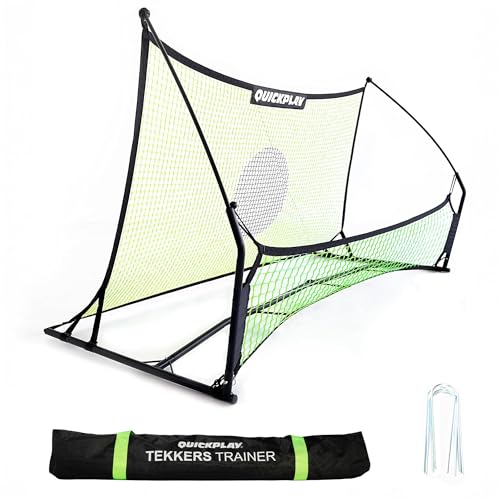
QUICKPLAY TEKKERS TRAINER Soccer Rebounder
Best for serious solo training with dual-net versatility
QUICKPLAY TEKKERS TRAINER Soccer Rebounder
Best for serious solo training with dual-net versatility
What we like
- Dual-net design handles volleys on the top net and ground passes on the low net in the same session.
- Patented flexi-post technology keeps the frame stable under hard strikes without requiring ground stakes.
- 13.2 lb packed weight fits in a car trunk and moves between home and field practice easily.
- 2-minute setup from carry bag to first kick — no tools, no instructions needed.
What we don't
- Premium price point puts it above entry-level options by $60-80.
- Larger footprint than single-net alternatives — needs a backyard with at least 12 feet of depth.
- Dual-net configuration can be overwhelming for kids under 8 who are still developing basic striking technique.
If you're doing real sessions — 45 minutes of structured passing and volley work — the TEKKERS TRAINER is the one piece of equipment that covers every drill without requiring a second setup. The top net catches volleys and half-volleys with a realistic bounce; the low net snaps ground passes back with a true roll that actually builds first-touch habit.
This is built for players 12 and up who are training with intention, not just kicking around. If your kid is still learning to make clean contact, start somewhere simpler — this rebounder rewards technique and punishes lazy passes with inconsistent returns that tell you exactly what went wrong.
SKLZ Quickster Soccer Trainer
Best for players who want air and ground training in one frame
SKLZ Quickster Soccer Trainer
Best for players who want air and ground training in one frame
What we like
- 6.2 lb total weight makes it the lightest full-size dual rebounder in this roundup — one hand carry.
- Large 6x4 ft top net is generously sized for chest traps, thigh control, and aerial settling drills.
- True-roll low net returns ground passes cleanly without the ball skipping or dying on arrival.
- Weather-resistant materials and tension-tite poles have held up for multiple outdoor seasons.
What we don't
- Fiberglass tension rods have a documented history of cracking along the length after several months of hard use.
- Frame creeps backward on grass under full-pace strikes — ground stakes or a wall brace are strongly recommended.
- Low net section is narrow at 6x20 inches, limiting ground-pass drill variety compared to wider alternatives.
The Quickster punches above its weight class on surface area and rebound feel for the price — the large upper net is genuinely useful for headers and chest control work, not just a gimmick. At 6.2 lbs it's the rebounder you'll actually grab from the garage and take to the park instead of leaving it assembled outside.
The fiberglass rod cracking is a real issue after 6-12 months of daily hard use, so it's the better pick for a motivated youth player rather than an adult training daily at full pace. If you're the parent buying for a 10-14 year old who wants proper backyard sessions, this is the value-to-quality sweet spot in the category.
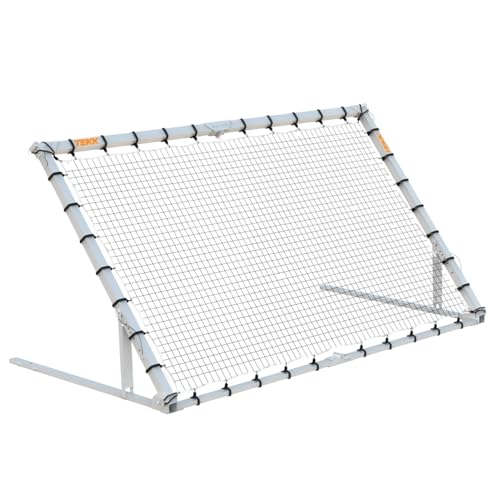
Tekk Trainer Pro Rebounder
Best for multi-sport households that want one training tool
Tekk Trainer Pro Rebounder
Best for multi-sport households that want one training tool
What we like
- Aircraft-grade aluminum frame with powder-coated steel brackets is the most durable construction in this roundup.
- 7-position angle adjustment covers everything from flat ground passes to near-vertical shooting angles.
- 45-ply PE knotted net with 1.75-inch square mesh delivers the strongest, most consistent rebound of any option here.
- Used by MLS academies and college programs — this is professional-grade training equipment.
What we don't
- Heaviest and bulkiest option in this roundup — not designed for frequent transport to different locations.
- Higher price ceiling than any other pick here puts it out of range for casual-use households.
- Single-net design means no dedicated low ground-pass net — all ground work uses angle adjustment.
The Tekk Trainer is a different category of equipment — it's what academies and college programs actually use, built to survive years of daily hard use from multiple players. The 40 square feet of surface area and 7-angle adjustment system let one piece of equipment run every drill from basic passing to goalkeeper reaction work.
Buy this if you have multiple kids playing at competitive club or high school level and want one rebounder that lasts a decade rather than replacing a lighter frame every couple of years. If it's one casual player doing backyard sessions twice a week, the TEKKERS TRAINER covers 90% of the same drills at half the price.
Vallerta 12x6 Steel Frame Soccer Rebounder Wall
Best for dedicated passing wall practice with maximum rebound surface
Vallerta 12x6 Steel Frame Soccer Rebounder Wall
Best for dedicated passing wall practice with maximum rebound surface
What we like
- 12x6 ft net surface is the largest in this roundup — nearly impossible to miss-kick out of the target area.
- Military-grade powder-coated steel frame and HDPE mesh net are rated for all-weather outdoor use year-round.
- Fixed-angle wall design gives consistent, predictable ball returns that build passing rhythm faster than adjustable nets.
- Includes a carry case, making it portable despite the large frame size.
What we don't
- Fixed angle means no volley or aerial drill capability — strictly a ground passing and first-touch trainer.
- Assembly takes closer to 10 minutes than quick-deploy alternatives — not a grab-and-go option.
- Large footprint requires meaningful backyard space — needs at least 15 feet of depth for comfortable training distance.
If your primary training goal is building a reliable first touch on ground passes, the 12x6 ft Vallerta wall covers more surface area than any other option here — which means faster sessions with fewer interruptions from wayward passes leaving the net area. The fixed-angle design isn't a limitation; it's a feature for players doing repetitive passing sets where consistency of return is the whole point.
This is the pick for a player working on the basics of accurate passing and clean receiving at pace, or a parent who wants to set it up once in the backyard and leave it there season to season. Competitive players who want volley and angle variety will hit its ceiling fast — they need the TEKKERS TRAINER instead.
Open Goaaal Soccer Goal Rebounder Backstop
Best for backyards where missed shots become a problem
Open Goaaal Soccer Goal Rebounder Backstop
Best for backyards where missed shots become a problem
What we like
- Backstop net catches every missed shot automatically — no chasing balls down the yard or into the street.
- Bungee rope suspension system returns missed shots back toward the striker, keeping training flow continuous.
- 16x7 ft goal size is appropriate for both youth and adult shooting practice without needing separate equipment.
- Dura-coated steel frame handles rain and outdoor storage through multiple seasons.
What we don't
- Grass-only installation — poles spike into natural grass and won't work on turf, concrete, or sand.
- Requires a rectangular grass area of roughly 28-34 feet wide and 7.5 feet deep for proper setup.
- Designed primarily for shooting practice, not passing and first-touch repetition drills.
The Open Goaaal solves a different problem than the other options here — it's not a passing trainer, it's a shooting setup that stops you from spending half your session retrieving balls from across the yard. If your kid is doing penalty practice or shooting drills where they're going at a full-size goal, the backstop net keeps sessions moving instead of stopping every three kicks.
This is the right pick if you want a goal-and-backstop shooting setup for a youth player and don't have the space or patience to chase missed shots. Skip it if your focus is first touch and passing — for that use case, the Vallerta wall or the TEKKERS TRAINER are the tools built for the job.
What to Look For
Frame material determines how long your rebounder survives daily use. Steel frames with powder coating hold up to weather and hard strikes; fiberglass tension rods can crack under high-velocity impacts within months.
Net tension controls return quality. A high-tension net snaps the ball back with pace and accuracy; a slack net deadens the return and kills the training rhythm you're trying to build.
Setup time is a real factor. If it takes 20 minutes to assemble, you won't use it consistently — look for sub-5-minute setup with no tools required.
Who Should Skip This
If your backyard is smaller than 10 feet deep, even compact rebounders leave almost no reaction distance — you'll be better served by a flat passing wall attached to a fence. Apartment dwellers without outdoor space should look at indoor kick-return boards that fit against a wall instead.
What the Community Actually Uses
On r/bootroom, the recurring advice is to skip novelty 'multi-sport' rebounders and buy something purpose-built for soccer. The thread consensus favors dual-net designs for players 12 and up, and simpler single-net frames for younger kids who are still developing basic contact and don't need the extra complexity.
Quick Picks — In Case You've Already Decided
Frequently Asked Questions
What size rebounder is best for a small backyard?
A 5x3 ft or 6.5x4 ft frame works in most residential yards. You need at least 8 feet of clear distance behind you to comfortably receive the return, so measure before you buy.
Can I leave a soccer rebounder outside year-round?
Powder-coated steel frames handle rain and cold well. UV-degraded nets are the weak point — most need replacing after 2-3 seasons of outdoor exposure if left out permanently.
Are soccer rebounders good for young kids?
Yes, from about age 6 up with a small frame. The feedback loop of the ball returning immediately is one of the fastest ways to build first touch in early development.
What's the difference between a rebounder and a passing wall?
A passing wall is a rigid flat surface — great for fast-twitch reflex training but no adjustability. A rebounder uses a tensioned net at an angle, giving more realistic, varied ball returns that better simulate game scenarios.
Do I need to anchor my rebounder?
For any session involving full-pace striking: yes. Ground stakes or sandbags on the base frame stop creep on grass and keep the rebound angle consistent throughout your session.
Buying Guide
You need to match the rebounder to your training goals. A dual-net design covers both ground passes and volleys in one unit.
Size matters if your backyard is tight — compact 5x3 ft frames work where 8x5 ft rigs won't fit. Metal frame trumps fiberglass for durability if you're kicking hard every day.