Finding a recreational kayak shouldn't require a paddling degree — the right one is stable enough to get in without thinking, fast enough to keep up with your group, and comfortable enough that you actually want to stay out longer. Five of the best options right now range from $350 to $1,200, covering every skill level and budget with verified Amazon listings.
| Photo |
Top Pick

|
Versatile

|
Budget

|
Best Value
|
Best for Reliability

|
|---|---|---|---|---|---|
| Product | Wilderness Systems Pungo 120 Recreational Kayak | Perception Joyride 10 Sit Inside Kayak | Pelican Argo 100X Recreational Sit-In Kayak 10 ft | Lifetime Tamarack Pro 103 Sit-On-Top Kayak | Sun Dolphin Bali 8 SS Recreational Sit-On-Top Kayak |
| Length | 12.2 ft | 10 ft | 10 ft | 10.3 ft | 8 ft |
| Weight | 47 lbs | 50 lbs | 36 lbs | 52 lbs | 30 lbs |
| Capacity | 325 lbs | 275 lbs | 275 lbs | 300 lbs | 197 lbs |
| Cockpit type | Sit-inside | Sit-inside | Sit-inside | Sit-on-top | Sit-on-top |
| Buy Now | Check Price → | Check Price → | Check Price → | Check Price → | Check Price → |
Quick Tips
Test stability before you buy: wider hulls (28–30 in) are more forgiving for beginners, while narrower hulls reward experienced paddlers with better speed.
A 10 ft kayak fits on most roof racks without overhang — go 12 ft only if you have the vehicle and storage to match.
Foam floatation blocks inside the hull matter — they keep a swamped kayak from sinking and are often left out of budget models.
Check the weight capacity before ordering, not after: your body weight plus gear, water, and snacks adds up faster than you'd expect.
Wilderness Systems Pungo 120 Recreational Kayak
Best for paddlers who want speed and comfort without trading one for the other
Wilderness Systems Pungo 120 Recreational Kayak
Best for paddlers who want speed and comfort without trading one for the other
What we like
- Phase 3 Air Pro seat is one of the most comfortable kayak seats available — mesh-covered 3D foam keeps your back cool on long paddles.
- Renowned Pungo hull tracks straight and paddles fast for a recreational kayak, reducing effort needed to hold a line on open water.
- Orbix stern hatch with dual-lock closure keeps gear genuinely dry — not just splash-resistant.
- SlideTrax mounting system lets you add accessories like rod holders or GPS mounts without drilling.
What we don't
- The price is a real commitment — this is a buy-once kayak, not a starter boat.
- At 47 lbs and 12.2 ft, you'll want a roof rack system or kayak cart for regular solo transport.
- Overkill for paddlers who only get out a few times a year.
If you've ever paddled a cheap recreational kayak and wondered why your arms gave out before the scenery did, the Pungo 120 answers that question — its hull glides efficiently, holds a line without constant correction, and lets you cover real distance without grinding through every stroke. This is the right pick if you're committing to kayaking as a regular hobby and want something that rewards skill as you develop it.
If you're paddling once a summer, look at the Pelican Argo instead — the Pungo is designed for people who go back every weekend.
Perception Joyride 10 Sit Inside Kayak
Best for all-day casual paddling with the most comfortable seat in its price range
Perception Joyride 10 Sit Inside Kayak
Best for all-day casual paddling with the most comfortable seat in its price range
What we like
- Zone Deluxe seat system with thigh pads and adjustable backrest offers all-day comfort at a price point below premium brands.
- Built-in rear bulkhead adds buoyancy for safety if the kayak takes on water — a feature often left off kayaks at this price.
- Patent-pending Selfie Slot mounts your phone at a usable angle without accessories or mounts.
- Two Solo Mount recesses let you add RAM accessories without drilling into the hull.
What we don't
- At 10 ft it won't track as straight as a 12 ft kayak on open water — expect more paddle correction in wind.
- 50 lbs is on the heavier end for a 10 ft kayak, making solo cartop loading awkward without help.
- The Selfie Slot feature is fun but adds cost you may not need if you're not a content creator.
The Joyride 10 hits a sweet spot between beginner-friendly stability and enough features to keep you interested past your first summer — the seat is genuinely good, the storage is thoughtful, and the hull behavior won't punish you for imperfect technique. This is the right boat if you want something a step above the entry-level Pelican options but aren't ready to spend Pungo money — and especially if you paddle mixed waters, since the Joyride handles slow rivers and open lakes equally well.
Pelican Argo 100X Recreational Sit-In Kayak
Best for first-time buyers who want a proven, stable beginner kayak
Pelican Argo 100X Recreational Sit-In Kayak
Best for first-time buyers who want a proven, stable beginner kayak
What we like
- Twin-arched multi-chine hull is specifically engineered for beginner stability — wide, flat, and very forgiving on flat water.
- 36 lbs is genuinely light for a hardshell kayak, making solo loading and transport manageable for most paddlers.
- Foam floatation blocks inside the hull prevent sinking if the kayak swamps — a real safety feature at this price point.
- Bungee-secured front hatch and rear tank well cover provide more storage access than most entry-level competitors.
What we don't
- Ergoform padded seat is comfortable enough for 1–2 hours but not well-suited for full-day paddling sessions.
- 10 ft length and flatter hull means more wind drift and less glide efficiency than 12 ft options.
- Designed for calm water — tracking becomes a chore in any meaningful wind or current.
The Argo 100X is the kayak you buy when you want to see if you actually like paddling before committing to something expensive — it's stable enough that you'll never feel tippy, light enough to load alone, and available at a price that doesn't sting if it lives in the garage all winter. Step up to the Joyride or Pungo if you already know you'll paddle regularly — the Argo is built for occasional use and calm conditions, and it's exactly right for that purpose.
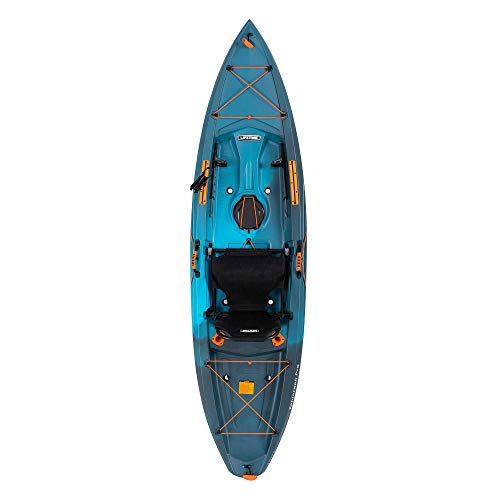
Lifetime Tamarack Pro 103 Sit-On-Top Kayak
Best value sit-on-top for recreational paddlers who also want to fish
Lifetime Tamarack Pro 103 Sit-On-Top Kayak
Best value sit-on-top for recreational paddlers who also want to fish
What we like
- Flat-bottom hull with deep tracking channels provides a stable, predictable ride — forgiving for beginners and comfortable for casual paddlers.
- Two flush-mounted rod holders and a built-in fish ruler make this a dual-purpose recreational and light fishing kayak.
- Framed adjustable seat is more supportive than the basic padded strap seats found on most budget competitors.
- 12-inch mounting tracks let you add accessories like fish finders or phone mounts without permanent modifications.
What we don't
- At 52 lbs, this is one of the heavier options at this price — a kayak cart is a near-requirement for solo use.
- Sit-on-top design means you'll get wet in any kind of chop or wind — not ideal for cooler conditions.
- Tracking performance drops noticeably when loaded close to the 300 lb capacity limit.
The Tamarack Pro punches above its price by being both a legitimate recreational kayak and a usable light fishing platform — you're getting two use cases for the price of one, with stability and storage that entry-level sit-on-tops rarely offer. Choose this over the Argo 100X if you want a sit-on-top instead of a sit-inside, or if you ever plan to bring a rod along — the built-in rod holders and ruler mean you don't have to add anything to be fishing-ready on day one.
Sun Dolphin Bali 8 SS Recreational Sit-On-Top Kayak
Best budget option for casual paddlers and families sharing a kayak
Sun Dolphin Bali 8 SS Recreational Sit-On-Top Kayak
Best budget option for casual paddlers and families sharing a kayak
What we like
- 30 lbs is the lightest option on this list — easy for one person to carry to the water without help or a cart.
- Open cockpit with graduated molded foot wells accommodates different sized paddlers without adjustment.
- Includes a paddle, which none of the higher-priced options do — lower actual total cost for a first-time buyer.
- UV-stabilized Fortiflex HDPE construction holds up to sun, shallow water, and the inevitable dock scrapes.
What we don't
- 197 lb weight capacity is the tightest on this list — heavier paddlers or any gear load will hit this limit quickly.
- 8 ft length tracks noticeably worse than longer kayaks — significantly more effort required to hold a straight line.
- Dry storage compartment is small — not suited for anything beyond a phone, keys, and a snack.
The Bali 8 SS earns its place as a budget pick not by cutting corners in dangerous places, but by being exactly what it is — a simple, light, stable kayak that gets you on the water for less than any other quality option on this list, paddle included. This is the right choice for kids, teenagers, or anyone paddling calm ponds and protected coves where distance and tracking don't matter — or for a second kayak when you have company and don't want to spend serious money on an infrequently-used boat.
What to Look For
Hull width determines how nervous the kayak feels when you first get in — anything 28 inches or wider is considered stable enough for beginners, while 24–26 inch hulls reward technique with more speed. Length controls how the kayak tracks: 10 ft kayaks turn easily but need more paddle strokes to hold a straight line, while 12 ft kayaks glide farther per stroke and hold course better on open lakes.
Seat quality matters more than most first-time buyers expect — a padded, adjustable backrest is the difference between a two-hour paddle and a one-hour paddle that ends early because your back is done.
Who Should Skip This
Skip this category entirely if you're planning to paddle Class III or higher whitewater — recreational kayaks aren't designed for it and can be genuinely dangerous in fast-moving turbulent water. Also skip if you're over 250 lbs and looking at budget options — weight capacity limits are real, and underpowered hulls become sluggish and unstable when loaded near the max.
What the Community Actually Uses
On r/kayaking, the Wilderness Systems Pungo comes up constantly as the benchmark recreational kayak — paddlers describe it as the first boat that finally felt fast without sacrificing stability. The Pelican Argo line gets recommended to complete beginners looking to spend under $500 without buying something they'll regret in year two.
Quick Picks — In Case You've Already Decided
Frequently Asked Questions
What's the difference between a sit-inside and sit-on-top recreational kayak?
Sit-inside kayaks enclose your lower body in the cockpit, which keeps you warmer and drier — better for cooler weather or spring paddling. Sit-on-top kayaks have an open deck, making them easier to remount if you flip and better for hot summer days when getting wet doesn't matter.
How long of a kayak do I need for a lake?
A 10 ft kayak works fine for casual lake paddling, especially if storage or car-topping is a concern. If you plan to cover distance on larger lakes, a 12 ft kayak will hold a straighter line and require less effort per mile.
Is a recreational kayak good for rivers?
Yes — recreational kayaks are designed for flatwater, slow-moving rivers, and calm coastal water. Avoid using them in anything faster than Class I-II current, where the wider hull becomes hard to control and the open cockpit can fill with water.
How heavy is too heavy to carry a kayak solo?
Most recreational kayaks weigh 36–52 lbs, which a single person can manage with a carry cart or by dragging on grass. Anything over 55 lbs usually requires two people or a dedicated kayak cart for safe transport.
Do I need a license or registration to paddle a recreational kayak?
Rules vary by state — most states require registration for motorized boats but not human-powered kayaks. Some states do require registration or a launch permit for any vessel, so check your local DNR or wildlife agency website before your first trip.
Buying Guide
You need a kayak that's stable enough to get in confidently, tracks straight without constant correction, and fits in your car. Sit-inside kayaks keep you drier and warmer; sit-on-top models are easier to remount if you flip.
Match length to your goals: 10 ft for easy storage and turning, 12 ft for better speed and tracking on open water.