Cold weather doesn't have to drain your power station before it drains your patience — the right battery chemistry makes all the difference. Every unit below uses LiFePO4 cells rated to discharge at or below -4°F, and five of them start under $1,200.
| Photo |
Top Pick

|
Versatile
|
Budget

|
Best Value

|
Best for Reliability
|
|---|---|---|---|---|---|
| Product | EF EcoFlow Portable Power Station DELTA 2 | Anker SOLIX C2000 Gen 2 Portable Power Station | Jackery Explorer 1000 Pro Portable Power Station | BLUETTI AC200P Portable Power Station | Goal Zero Yeti 1000 Core Portable Power Station |
| Capacity | 1024Wh | 2048Wh | 1002Wh | 2000Wh | 983Wh |
| Ac output | 1800W (2700W surge) | 2400W (4000W peak) | 1000W (2000W surge) | 2000W (4800W surge) | 1200W (2400W surge) |
| Battery type | LiFePO4 | LiFePO4 | NMC (Li-ion) | LiFePO4 | NMC (Li-ion) |
| Discharge temp | -4°F / -20°C | -4°F / -20°C | 14°F / -10°C | -4°F / -20°C | 14°F / -10°C |
| Buy Now | Check Price → | Check Price → | Check Price → | Check Price → | Check Price → |
Quick Tips
Pre-warm your power station indoors before heading out — LFP chemistry slows charge acceptance below 32°F, so start cold and you'll lose 30-40% of your recharge rate.
Insulate the unit inside a sleeping bag or foam-lined case when ambient temps drop below 20°F — cold slows discharge efficiency even in LFP units.
Avoid charging from solar when panels are snow-covered or heavily shaded; the low input will trigger MPPT throttling and barely make a dent in a 1000Wh+ battery.
Use the 12V car outlet for low-draw overnight devices like a CPAP or phone instead of the AC inverter — it skips the inverter conversion loss and saves 10-15% more capacity per night.
EF EcoFlow Portable Power Station DELTA 2
Best for overlanders who need fast recharge and cold-weather reliability
EF EcoFlow Portable Power Station DELTA 2
Best for overlanders who need fast recharge and cold-weather reliability
What we like
- Charges 0-80% in 50 minutes via AC wall outlet — fastest in this price range.
- LFP battery rated to 3000 cycles, keeping 80% capacity after 10 years of daily use.
- App control via Wi-Fi and Bluetooth lets you monitor load and set charge limits remotely.
- 100W USB-C output handles laptops, drones, and cameras at full speed from a single port.
What we don't
- 1024Wh is tight for three-night trips running a fridge plus heating devices simultaneously.
- Fan noise is audible when pulling over 1000W — not silent in a tent or sleeping space.
- Solar input capped at 500W, so pairing with multiple panels requires a combiner.
When the temperature drops, the DELTA 2's LFP chemistry keeps it discharging reliably where NMC units start throttling — and the 50-minute AC recharge means you can top it off at a trailhead or friend's cabin before heading back into the cold. This is the right call for overlanders who want a proven 1kWh unit they can actually recharge quickly in winter conditions.
If you're running a heated mattress pad plus a fridge simultaneously for more than two nights, step up to the Delta 2 Max instead.
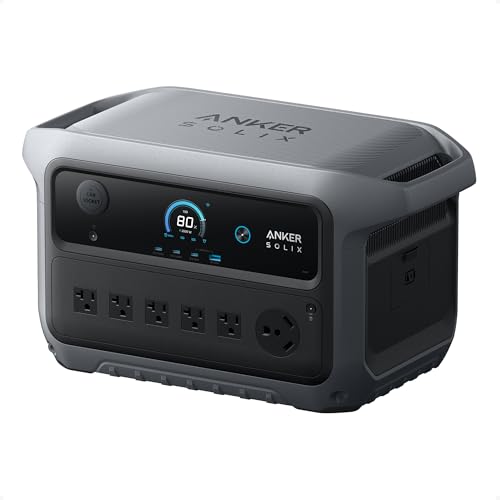
Anker SOLIX C2000 Gen 2 Portable Power Station
Best for basecamp power with room to expand capacity
Anker SOLIX C2000 Gen 2 Portable Power Station
Best for basecamp power with room to expand capacity
What we like
- Full charge in 58 minutes combining AC and solar — genuinely useful when you have a short window at a power source.
- Expandable to 4kWh with a single BP2000 expansion battery, giving you multi-night basecamp runtime.
- Only 9W idle draw keeps the station from bleeding capacity overnight when nothing is actively running.
- 4000W peak handles motor-start surges from compressor fridges and power tools without tripping.
What we don't
- At roughly 48 lbs, it takes two hands and a clear path to move — not a grab-and-go unit.
- Expansion battery sold separately adds significant cost if you need the full 4kWh.
- App required to unlock some advanced charging settings, which is annoying in the field.
The C2000 Gen 2 is built for people who set up camp and stay — 2048Wh of LFP capacity with a 9W idle draw means a two-night basecamp trip barely makes a dent if you're managing your loads carefully. Choose this over the Delta 2 if you're running multiple devices, a larger compressor fridge, or a heated shelter that stays on through the night.
Solo minimalists who move camp daily will find the weight punishing — that person should look at the EcoFlow Delta 2 instead.
Jackery Explorer 1000 Pro Portable Power Station
Best for truck campers who want a trusted brand with solar support
Jackery Explorer 1000 Pro Portable Power Station
Best for truck campers who want a trusted brand with solar support
What we like
- 800W solar input is the highest in this price tier — charges fully in under two hours with enough panels.
- Charges from 0-80% in roughly 1.8 hours from wall power, competitive for an NMC unit.
- Reliable brand support and wide accessory ecosystem including dedicated carrying bags and panel bundles.
- Quiet operation with minimal fan noise at moderate loads under 500W.
What we don't
- NMC chemistry loses more capacity in cold than LFP — real-world usable capacity at 14°F is noticeably lower.
- Discharge temp rated only to 14°F, which rules it out for genuinely cold alpine or Arctic conditions.
- 1000W AC output is limiting if you want to run a larger electric heater or multiple appliances at once.
The Explorer 1000 Pro's 800W solar input makes it the pick for winter trips where you get decent sun — a pair of 200W panels can fully recharge it mid-day even with reduced winter harvest. Be honest about your conditions though: the 14°F discharge floor and NMC chemistry mean it underperforms in genuinely brutal cold compared to the LFP options above.
Best for Pacific Northwest winters or high desert cold — not northern Canada or high-altitude winter basecamp.
BLUETTI AC200P Portable Power Station
Best for high-draw winter setups on a relative budget
BLUETTI AC200P Portable Power Station
Best for high-draw winter setups on a relative budget
What we like
- 2000Wh LFP at this price point offers more capacity per dollar than nearly anything else in the category.
- 700W solar input combined with 500W AC allows simultaneous dual-input charging in about 2.5 hours.
- 4800W surge handles large appliance motor starts — more headroom than most competitors at this price.
- 17 output ports let you power an entire group camp setup without a separate power strip.
What we don't
- Weighs approximately 60 lbs — the heaviest unit in this roundup and a real challenge to move solo.
- Older design means no app connectivity — you manage everything from the front panel display only.
- Recharge speed via AC alone (dual adapter needed for fast charge) lags behind newer units like the SOLIX C2000.
You get 2000Wh of cold-rated LFP for less than some competitors charge for 1024Wh — that value gap is real and the AC200P has earned a loyal following for exactly that reason. The trade-off is pure bulk: 60 lbs means this lives in your truck bed and stays there.
If you move camp often or need to carry the unit any distance, the weight will wear on you fast — pick the Delta 2 Max instead.
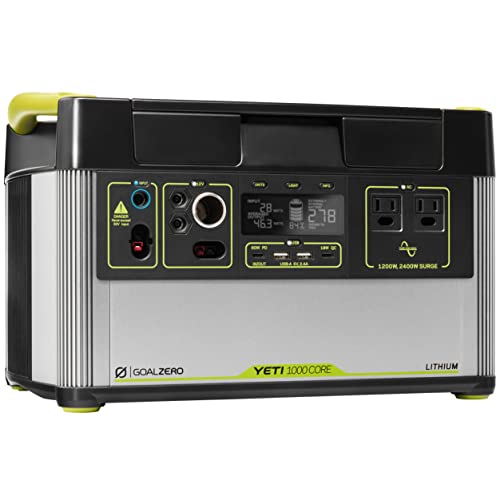
Goal Zero Yeti 1000 Core Portable Power Station
Best for overlanders who want ecosystem compatibility and rugged build quality
Goal Zero Yeti 1000 Core Portable Power Station
Best for overlanders who want ecosystem compatibility and rugged build quality
What we like
- Goal Zero's Yeti ecosystem means it pairs cleanly with Boulder and Ranger solar panels via the 8mm port — no adapters needed.
- 1200W inverter handles most two-person camp loads including a fridge, lights, and device charging simultaneously.
- Build quality and brand warranty support are consistently rated among the best in the category for long-term durability.
- More compact and lighter than the BLUETTI AC200P, making it easier to move in and out of a truck topper or overland rig.
What we don't
- NMC chemistry and 14°F discharge floor mean real-world cold-weather performance trails the LFP options above.
- Wall recharge takes 9 hours on the included 120W supply — the 230W upgrade is sold separately.
- Lacks app connectivity, which limits remote monitoring in setups where the station is tucked under a sleeping platform.
The Yeti 1000 Core earns its spot as the entry point for overlanders already in or planning to build into the Goal Zero ecosystem — the panel and accessory compatibility is genuinely useful, and the build quality holds up in rough conditions. Just go in clear-eyed about the NMC chemistry: at 14°F the effective capacity drops noticeably, and sub-zero use is off the table.
If you're camping in the northern Rockies or anywhere that sees single digits regularly, spend the extra money on an LFP unit.
What to Look For
Battery chemistry is your first filter in winter. LiFePO4 (LFP) outperforms NMC in cold because it holds voltage more consistently below freezing — look for a rated discharge temperature of at least -4°F and avoid any unit that only lists a 32°F lower limit.
Capacity and output wattage need to match your actual load. A heated blanket runs 50-150W, a 12V compressor fridge pulls 40-80W, and a CPAP with a humidifier can spike to 200W — so 1000Wh is the practical floor for a two-night overlanding setup.
Charging flexibility matters in winter when solar is unreliable. Prioritize units that support fast AC wall charging (under 2 hours), car/alternator input, and ideally a dual-input mode so you can combine AC and solar when the sun finally shows up.
Who Should Skip This
If your entire winter use case is a single overnight in a heated camper van with shore power available, a power station is overkill — a quality lithium battery bank and a 12V fridge will cover you for less money. Backpackers in winter conditions should also look elsewhere; even the lightest units here are 12-27 lbs, which is a non-starter for a technical snow route.
What the Community Actually Uses
On r/overlanding, winter power setups come up every November like clockwork — the recurring advice is always to skip cheap NMC units and go LFP, and to size up one tier from what you think you need because cold reduces effective capacity by 15-20% in real use.
Quick Picks — In Case You've Already Decided
Frequently Asked Questions
Will a portable power station work in freezing temperatures?
LFP units can discharge down to -4°F with reduced efficiency. Charging in sub-freezing temps is a different story — most units require temps above 32°F to accept a charge safely, so pre-charge indoors before heading out.
How much capacity do I need for a winter overlanding trip?
Plan for at least 1000Wh per two nights if you're running a 12V fridge and charging devices. Cold reduces effective capacity by 15-20%, so size up — a 1024Wh unit in winter performs closer to 800Wh in practice.
Can I leave a power station in my truck overnight in the cold?
LFP units handle cold storage better than NMC, but extended sub-zero storage will still accelerate battery degradation. Bring the unit inside overnight if temps will drop below -10°F.
Is solar charging useful in winter?
Panels still produce in cold weather — actually more efficiently than in summer heat — but short days and low sun angles cut your daily harvest significantly. Treat solar as a supplement in winter, not a primary charge source.
What's the difference between LFP and NMC batteries for cold weather?
LFP (LiFePO4) retains voltage more consistently at low temperatures and is less prone to capacity loss when cold. NMC batteries are lighter and cheaper but can lose 30-50% of effective capacity at 14°F compared to LFP's 15-25% loss.
Buying Guide
In winter, battery chemistry matters more than capacity. LiFePO4 holds voltage in the cold far better than NMC.
Look for a discharge rating below -4°F, at least 1000Wh for a two-night trip, and an AC output above 1500W so you can run a heated blanket or fridge without tripping the inverter.