Running your fridge, CPAP, and phone off a truck cab without an APU is completely doable with the right power station. The five options below cover everything from 1,056Wh compact units that recharge off your alternator in under four hours to 2,048Wh rigs that can run a 12V fridge for two full days.
| Photo |
Top Pick

|
Versatile

|
Budget

|
Best Value

|
Best for Reliability
|
|---|---|---|---|---|---|
| Product | EcoFlow Delta 2 Max Portable Power Station | Jackery Explorer 1000 Pro Portable Power Station | BLUETTI AC200L Portable Power Station | Anker SOLIX C1000 Portable Power Station | Goal Zero Yeti 1500 Portable Power Station (6th Gen) |
| Capacity | 2048Wh | 1002Wh | 2048Wh | 1056Wh | 1505Wh |
| Ac output | 2400W (3400W X-Boost) | 1000W (2000W surge) | 2400W (3600W surge) | 1800W (2400W surge) | 2000W (3600W surge) |
| Battery type | LFP (LiFePO4) | NMC Lithium | LFP (LiFePO4) | LFP (LiFePO4) | LFP (LiFePO4) |
| Car charge input | Up to 500W DC | Up to 65W | Up to 560W with Charger 1 | Up to 100W | Up to 600W solar/AC combined |
| Buy Now | Check Price → | Check Price → | Check Price → | Check Price → | Check Price → |
Quick Tips
Charge via your truck's 12V port or alternator input while you drive — most of these units will hit 80% before you reach your next stop on a long haul.
LFP (LiFePO4) batteries handle the heat and vibration of a cab far better than NMC chemistry — always choose LFP for a truck environment.
Pair your power station with a 12V compressor fridge rather than a thermoelectric cooler — you'll use a fraction of the watt-hours per day.
If you use a CPAP without a humidifier, most 1,000Wh stations will run it for two or more full nights on a single charge.
EcoFlow DELTA 2 Max Portable Power Station
Best for OTR drivers running a fridge plus CPAP overnight
EcoFlow DELTA 2 Max Portable Power Station
Best for OTR drivers running a fridge plus CPAP overnight
What we like
- 2,048Wh capacity runs a 12V fridge plus CPAP through a full 10-hour overnight stop without shore power.
- Charges 0-80% in 43 minutes from a wall outlet at a truck stop — fastest recharge in this class.
- X-Boost mode powers appliances up to 3,400W, covering coffee makers and small inverter microwaves.
- Expandable up to 6kWh with additional batteries for drivers who go days between shore power access.
What we don't
- At roughly 50 lbs, it is heavier than 1,000Wh alternatives and takes up meaningful cab real estate.
- Full price is steep compared to budget options — look for EcoFlow direct sales to bring cost down.
- Car charging input maxes out at 500W via DC-DC; requires a separate alternator charger accessory for fastest in-cab recharging.
Two thousand watt-hours means you stop rationing. You can run a compressor fridge, a CPAP, your phone, and a tablet through a full sleeper stop and still have capacity left when you pull back out in the morning.
This is the pick for OTR drivers who make long runs between truck stops with reliable shore power. If you park somewhere with hookups every night, you do not need this much capacity — step down to the Jackery or Anker and save several hundred dollars.
Jackery Explorer 1000 Pro Portable Power Station
Best for drivers who want a proven, easy-to-use overnight setup
Jackery Explorer 1000 Pro Portable Power Station
Best for drivers who want a proven, easy-to-use overnight setup
What we like
- 1,002Wh is enough for CPAP, phone, laptop, and lighting through a full overnight without touching shore power.
- Charges wall-to-full in 1.8 hours — fast enough to top off at a truck stop during a 30-minute break.
- Compact handle and ergonomic design make it easy to carry in and out of the cab without help.
- Quiet 46dB operation means it will not disrupt sleep in a sleeper berth.
What we don't
- 1,000Wh is tight if you also run a 12V compressor fridge overnight — monitor your draw carefully.
- Car charging input is limited to 65W, meaning a full charge from a 12V truck outlet takes 12+ hours.
- NMC battery chemistry is less ideal for high-heat cab environments compared to LFP alternatives.
The 1000 Pro is the most popular power station in the overlanding and truck-camping community for a reason — it hits the sweet spot of enough capacity, manageable weight, and fast wall recharging that fits around a driving schedule. Choose this if your overnight draw is phone, CPAP, and a light or two without a fridge.
If you plan to run a compressor fridge, step up to the EcoFlow DELTA 2 Max instead.
BLUETTI AC200L Portable Power Station
Best for drivers who want maximum expandability from one unit
BLUETTI AC200L Portable Power Station
Best for drivers who want maximum expandability from one unit
What we like
- Dedicated 30A RV outlet is a genuine differentiator — plugs directly into truck stop shore power pedestals without an adapter.
- Expandable from 2,048Wh to 8,192Wh with add-on battery packs for teams or multi-day no-hookup runs.
- 560W alternator charger accessory (BLUETTI Charger 1) can charge this fully from your truck alternator in under four hours.
- LFP battery is rated for 3,500+ cycles, making it one of the longest-lasting options in this price range.
What we don't
- At roughly 61 lbs, this is the heaviest option on this list and requires effort to move in and out of a sleeper.
- The best alternator charging speed requires the Charger 1 accessory, which is sold separately and adds to total cost.
- App interface is less polished than EcoFlow's app, though core functionality works fine without it.
The 30A RV outlet alone sets this apart for truck drivers who use shore power at truck stops — you plug in with the same cord truckers use for APUs and never need an adapter. The alternator charging speed with the BLUETTI Charger 1 accessory is also the best on this list for in-cab recharging while driving.
Buy this if you run multi-day trips, need to share power with a co-driver, or want the option to scale up capacity with a second battery later. The weight is a real tradeoff — if you move it in and out of the cab daily, you will feel it.
Anker SOLIX C1000 Portable Power Station
Best compact option for day cab and regional drivers
Anker SOLIX C1000 Portable Power Station
Best compact option for day cab and regional drivers
What we like
- LFP battery chemistry with 3,000-cycle lifespan handles cab temperature swings better than NMC units in its price class.
- Charges 0-80% from a wall outlet in 43 minutes — the fastest at this capacity and price point.
- 15% smaller than comparable 1,000Wh units, making it easier to fit under a bunk or on a passenger floor.
- Anker app gives real-time power monitoring and lets you set custom charge limits to extend battery longevity.
What we don't
- Car charging input caps at 100W, meaning alternator recharging is slow — this unit favors truck stop wall charging over in-cab charging.
- 1,056Wh is borderline tight for overnight stops with a fridge running.
- No RV outlet — requires a standard 15A adapter to connect to truck stop shore power pedestals.
The SOLIX C1000 is the right choice for regional and day-cab drivers who spend most nights at terminals or truck stops with reliable shore power access. It charges from empty to full in under an hour at a truck stop and is compact enough to slide into tight cab spaces.
Pick something else if you go dark on shore power regularly — 1,056Wh gets thin fast once you add a fridge to your overnight load. For CPAP-only overnight use at a cost well under $600, this is the sharpest value on the list.
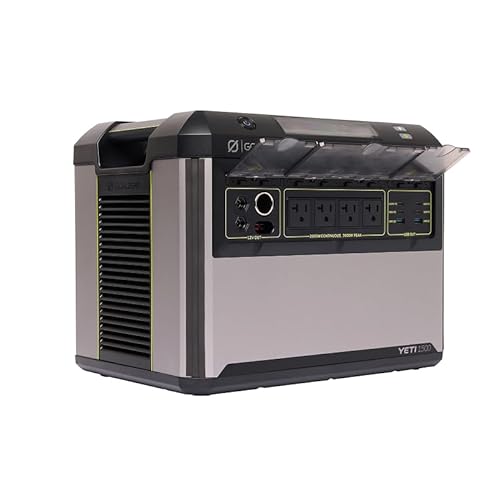
Goal Zero Yeti 1500 Portable Power Station (6th Gen)
Best for drivers who prioritize rugged build and long lifespan
Goal Zero Yeti 1500 Portable Power Station (6th Gen)
Best for drivers who prioritize rugged build and long lifespan
What we like
- Aluminum casing with rubber bumpers and IPX4 weatherproofing survives the vibration and rough handling of daily truck use better than plastic-cased competitors.
- 4,000 LFP cycles translates to 10+ years of daily use — the best longevity rating on this list.
- 140W USB-C port is the fastest USB-C output here and handles modern laptops without a separate adapter.
- Vibration-tested and port-shielded specifically for off-grid and mobile use — designed with road conditions in mind.
What we don't
- Premium build quality carries a premium price — comparable capacity options from EcoFlow cost less at launch.
- Car charging input requires Goal Zero's specific cable setup and is not as fast as competitors for alternator-based recharging.
- Heavier than the Anker SOLIX C1000 despite similar capacity — the aluminum build adds weight.
If you have driven hard miles on rough roads and destroyed cheaper plastic electronics, you will immediately understand why Goal Zero's aluminum chassis exists. This is the power station that survives five years of daily truck cab use without cracking, coroding, or losing port function from dust and moisture.
Choose this if longevity and build quality matter more than price-per-watt-hour. If you are cost-focused and plan to charge at truck stops most nights, the Anker SOLIX C1000 gets you similar capacity for less money.
What to Look For
Capacity and recharge source matter most for truck use. You want at least 1,000Wh to cover overnight CPAP, lighting, and phone charging — and ideally a unit that accepts alternator or 12V DC input above 100W so you arrive charged instead of depleted.
Output quality is just as important as capacity. A pure sine wave inverter protects sensitive electronics like CPAPs and laptops — avoid modified sine wave units entirely, as they can damage motor-driven and medical devices over time.
Size and placement in a cab are real constraints. Measure your bunk or passenger-side floor before ordering — a unit that slides under a bunk and stays put on rough roads is worth far more than extra capacity you cannot safely secure.
Who Should Skip This
If your truck already has a factory APU or shore power hookup at every stop, a standalone power station is redundant weight. Drivers on short regional routes with predictable access to electrical hookups at terminals will get more value from a simple 300Wh jump-starter battery than a full 2,000Wh unit.
What the Community Actually Uses
On r/Truckers and r/TruckingIndustry, alternator charging setups come up constantly — most experienced OTR drivers recommend sizing up rather than down on capacity, since real-world draw from a fridge plus CPAP plus phone charging routinely exceeds 800Wh per overnight stop. The consensus there is to skip anything under 1,000Wh if you run a fridge.
Quick Picks — In Case You've Already Decided
Frequently Asked Questions
Can a portable power station charge from a truck's alternator while driving?
Yes, most units accept 12V car charging input, and several on this list accept alternator input via DC-to-DC charger at rates of 200W or higher. Check the car-charging input wattage spec before buying — lower-end units cap at 65W, which means 15+ hours to fully charge.
Will a 1,000Wh unit run a CPAP all night?
A standard CPAP without humidifier draws roughly 30-60W, so a 1,000Wh unit gives you 15-30 hours of run time. With humidifier enabled, expect that to drop by 30-40% — size up to a 2,000Wh unit if you run heated humidity every night.
Is it safe to use a power station inside a truck cab?
All five picks here are battery-based and produce zero emissions, making them completely safe for cab use. They emit no fumes and run far quieter than a diesel APU — most produce less noise than a normal conversation.
What size portable power station do I actually need for OTR trucking?
For a basic overnight setup — phone, tablet, CPAP, small fan — 1,000Wh is sufficient. Add a 12V compressor fridge and you should plan on 1,500-2,000Wh minimum to make it through 10+ hours without shore power.
Can these handle the vibration and temperature swings of a truck cab?
LFP-chemistry units handle temperature swings and vibration significantly better than older NMC units. All five picks here use LFP batteries. Still, secure the unit on a non-slip mat and avoid leaving it loose on a bunk during highway driving.
Buying Guide
You need a unit that charges from your truck's alternator or 12V outlet, holds enough capacity to run overnight without shore power, and outputs clean sine wave AC for sensitive gear like CPAPs. Prioritize capacity above 1,000Wh, LFP battery chemistry for longevity, and a dedicated car-charging input rated above 120W.