Finding the right power station for a projector comes down to one thing: pure sine wave output and enough watt-hours to last through a whole movie without a fan screaming at you. Every station on this list delivers at least 1000Wh of clean power, handles projector loads from 50W to 300W, and stays quiet enough that nobody's asking you to turn it off.
| Photo |
Top Pick

|
Versatile

|
Budget

|
Best Value
|
Best for Reliability

|
|---|---|---|---|---|---|
| Product | Jackery Explorer 1000 Pro Portable Power Station | Anker SOLIX C1000 Portable Power Station | EF EcoFlow Portable Power Station DELTA 2 | Goal Zero Yeti 1000 Core Portable Power Station | BLUETTI AC180 Portable Power Station |
| Capacity | 1002Wh | 1056Wh | 1024Wh | 983Wh | 1152Wh |
| Ac output | 1000W (2000W peak) | 1800W (2400W peak) | 1800W (2700W peak) | 1200W (2400W surge) | 1800W (2700W peak) |
| Noise level | 46dB | Not rated | Not rated | Not rated | Not rated |
| Recharge time | 1.8 hrs (AC) | 58 min (AC) | 80 min (AC) | 4.5 hrs (230W supply) | 1 hr (AC + solar combined) |
| Buy Now | Check Price → | Check Price → | Check Price → | Check Price → | Check Price → |
Quick Tips
Check your projector's actual watt draw on the label — marketing specs often list peak, not running watts, and your runtime estimate depends on the real number.
Enable the eco mode or quiet mode on your power station before movie night — most units drop fan noise significantly when output demand is low.
Position the power station behind or beside seating, not in front — even the quietest units produce some fan hum that the projector's own fans will mask from the screen side.
Run a test charge-and-discharge cycle at home first so you know exactly how many hours your specific projector gets before you rely on it at camp.
Jackery Explorer 1000 Pro Portable Power Station
Best for quiet all-night projector sessions at camp
Jackery Explorer 1000 Pro Portable Power Station
Best for quiet all-night projector sessions at camp
What we like
- 46dB fan noise is among the quietest in its class — legitimately inaudible from 10 feet at low projector loads.
- Pure sine wave output across all three AC ports protects sensitive projector electronics and lamp drivers.
- 1002Wh capacity runs a 100W projector for roughly 8 hours on a single charge.
- Foldable handle and 25.4 lb weight make it genuinely portable between truck and campsite.
What we don't
- 1000W continuous output means high-draw 4K laser projectors over 900W will trigger protection shutoff.
- Older ternary lithium cells have fewer charge cycles than LFP competitors — roughly 1000 vs 3000.
- Charging ports limited compared to newer units — only one USB-A port alongside the two USB-C PD ports.
The Explorer 1000 Pro earns its reputation for one reason that matters on movie night: it runs nearly silent at projector-level loads, so your audio track doesn't compete with a cooling fan. You get a full 1002Wh of clean pure sine wave power that handles every mainstream projector on the market without a hiccup.
This is the right call for overlanders and van lifers who run a 1080p outdoor projector on a recurring basis and want something that just works without fiddling. If you're running a power-hungry short-throw laser setup that pulls over 900W, step up to the 2000 Pro instead.
Anker SOLIX C1000 Portable Power Station
Best for fast recharge between movie nights
Anker SOLIX C1000 Portable Power Station
Best for fast recharge between movie nights
What we like
- 1800W continuous output handles virtually every projector on the market including high-lumen 4K laser units.
- Full recharge in 58 minutes via AC means you can top off between uses and always start with a full battery.
- LiFePO4 battery rated to 3000 cycles — over 10 years of daily use before hitting 80% capacity.
- SurgePad technology handles 2400W surge draws — no tripping at projector startup.
What we don't
- Heavier than competitors at similar capacity — less convenient for single-person pack-in setups.
- UltraFast recharging requires the Anker app and a smartphone to activate — inconvenient off-grid.
- Fan can ramp noticeably under higher loads — not as quiet as the Jackery at low projector draws.
The SOLIX C1000 is for the person who runs their projector hard, charges from the grid when they can, and wants the station fully topped in under an hour before the next outing. The 1800W output means zero projector compatibility concerns — if it has an AC plug, this runs it.
Pick this over the Jackery if you run back-to-back events or need to power a fridge, speakers, and a projector simultaneously without load-balancing anxiety. Skip it if silent fan noise is your top priority — the Jackery wins that fight.
EcoFlow DELTA 2 Portable Power Station
Best for overlanders who also solar-charge daily
EcoFlow DELTA 2 Portable Power Station
Best for overlanders who also solar-charge daily
What we like
- Up to 500W solar input means a full recharge from two 220W panels in under 3 hours of good sun.
- X-Stream AC charging technology takes it from 0 to 80% in just 50 minutes — fastest in this price tier.
- LFP battery chemistry rated to 3000+ cycles for a 10-year daily-use lifespan.
- EcoFlow app gives real-time watt draw monitoring — useful for confirming your projector's actual load.
What we don't
- App dependency for some advanced features adds a layer of friction when you just want simple campsite power.
- Slightly louder fan ramp-up under moderate load compared to the Jackery Explorer 1000 Pro.
- Non-returnable when shipped by EcoFlow direct — check the seller before ordering.
The DELTA 2 hits the sweet spot for overlanders running solar: 500W solar input is the highest in this price range, and the app gives you live wattage data so you know exactly how long your movie night has left. You get 1800W output and 1024Wh capacity — plenty for a full evening of projector, lights, and a fan.
This is the one to pick if your rig already has solar panels or you're planning to add them — the charge speed advantage over the Jackery is real and meaningful on multi-day trips. If you never solar-charge, the Jackery's quieter fan makes it the better call.
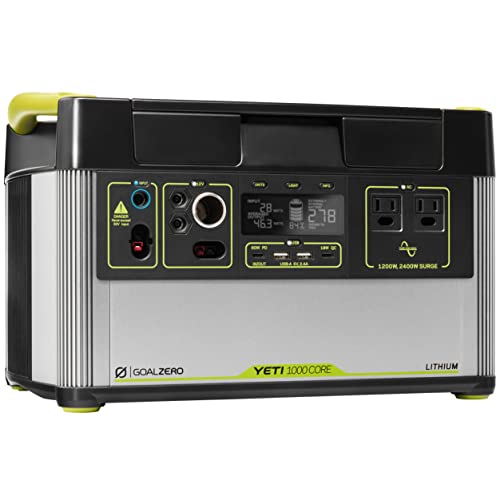
Goal Zero Yeti 1000 Core Portable Power Station
Best for reliability-first buyers who want proven hardware
Goal Zero Yeti 1000 Core Portable Power Station
Best for reliability-first buyers who want proven hardware
What we like
- Goal Zero's reputation for bulletproof build quality is well-earned — this unit is designed for frequent outdoor use.
- 1200W inverter handles every mainstream home or outdoor projector without tripping protection.
- Seven output port types including 60W USB-C PD, multiple USB-A, 12V regulated, and two 120V AC outlets.
- Pairs natively with Goal Zero's Ranger and Boulder solar panel ecosystem for drop-in solar compatibility.
What we don't
- Slowest AC recharge time on this list — 9 hours with the included 120W charger, 4.5 hours with the optional 230W unit sold separately.
- 983Wh capacity is the lowest on this list — roughly 30 minutes less projector runtime than 1056Wh competitors.
- No battery expansion capability — unlike the Yeti 1000X, the Core cannot add tank batteries for extended capacity.
The Yeti 1000 Core is what you pick when you want a power station that will still be running without drama five years from now. Goal Zero has been in this space longer than most, and the Core distills that into a no-nonsense unit at the best price-per-watt-hour in the Yeti lineup.
Choose this if you're already in the Goal Zero solar ecosystem or you value long-term reliability over fast charging. The slow recharge time is the real tradeoff — if you're topping off daily at a campsite with access to AC power, that's a non-issue; if you're deep off-grid, the EcoFlow or Anker charge faster.
BLUETTI AC180 Portable Power Station
Best budget-tier option with full 1800W output
BLUETTI AC180 Portable Power Station
Best budget-tier option with full 1800W output
What we like
- 1152Wh is the largest capacity on this list — more projector runtime per dollar than any other option here.
- 1800W AC output with 2700W surge handles every mainstream projector including short-throw and high-lumen models.
- 0-80% in 45 minutes is among the fastest recharge times at this price point.
- BLUETTI app lets you unlock power lifting mode to push output beyond rated wattage for demanding projector startup draws.
What we don't
- Build quality and brand support trail Jackery, Anker, and EcoFlow — less polished software experience.
- Power lifting mode that unlocks 2700W peak has to be toggled manually in the app each session.
- Fan noise management is less refined than premium units — can ramp audibly even at moderate projector loads.
The AC180 punches above its price tag: 1152Wh is more capacity than the Jackery and Goal Zero options, the 1800W output covers every projector, and the sub-$600 street price makes it the obvious call when budget is the real constraint. You give up some build polish and a quieter fan, but the raw specs are genuinely competitive.
Buy this if you want maximum watt-hours per dollar and you're okay managing the app for advanced features. If fan noise on a quiet movie night is your concern, the Jackery Explorer 1000 Pro is worth the extra $150.
What to Look For
Look for a pure sine wave inverter rated at 1800W or higher — this protects projector electronics from power irregularities and handles startup surges from larger lamps. Capacity matters more than peak wattage for projector use.
A 1000Wh station running a 100W projector gives roughly 8 hours of runtime; go bigger if you run other gear simultaneously. Fan noise is underrated as a buying factor.
Some units ramp fans aggressively at low loads; others stay nearly silent under 200W draw — check reviews specifically for projector or laptop use.
Who Should Skip This
Skip a 1000Wh station if you're powering a high-lumen 4K laser projector that draws 300W or more — those need 1500Wh minimum for a full movie. Skip this category entirely if you only need power for a battery-powered pico projector; a 300Wh unit at half the price will handle that fine.
What the Community Actually Uses
On r/overlanding and r/vandwellers, outdoor projector setups come up every summer. The consensus is consistently that cheap modified sine wave inverters will kill projector bulbs over time — the posts that get the most upvotes are always the ones recommending a proper LFP-based station with pure sine wave output over a gas generator or inverter hack.
Quick Picks — In Case You've Already Decided
Frequently Asked Questions
Will any portable power station run a projector?
No — you need a pure sine wave inverter, not a modified sine wave inverter. Modified sine wave can damage projector electronics and lamp drivers over time. Every station on this list outputs pure sine wave AC power.
How many watt-hours do I need for a full movie night?
A standard 100W projector running a 2-hour movie uses about 200Wh. A 1000Wh station gives you 4-5 full movies with overhead for lights and speakers. Go to 1500Wh if you run anything else from the same station.
Can I run a projector and a fridge off the same power station?
Yes, if your station has enough capacity. A 12V compressor fridge pulls 40-60W average; combined with a 100W projector, that's roughly 140-160W draw. A 1000Wh unit covers about 6 hours of both running simultaneously.
Will the power station fan noise ruin movie audio?
At low loads — under 200W — most modern LFP stations run fans quietly or not at all. Position the station 6-8 feet away from seating and the projector audio will mask it completely in most setups.
Is solar charging realistic for a daily movie-night setup?
One 200W solar panel fully recharges a 1000Wh station in 5-6 hours of solid sun. That covers one movie per day comfortably. For two movies, add a second panel or recharge partially via car DC input during driving.
Buying Guide
Your projector pulls between 50W and 300W depending on the model. Divide your station's watt-hours by that number — that's your runtime.
A 1000Wh unit running a 100W projector gets you roughly 8 hours. Pure sine wave output is non-negotiable.
Fan noise matters more than you think when movies are involved.