A portable power station can absolutely run your power tools on-site or off-grid — you just need one with enough continuous wattage to handle startup surge. Five verified options start at under $700 and top out at 3600W continuous, enough to run a circular saw and a corded drill simultaneously.
| Photo |
Top Pick
|
Versatile
|
Budget

|
Best Value

|
Best for Reliability

|
|---|---|---|---|---|---|
| Product | EF ECOFLOW Portable Power Station DELTA Pro 3600Wh | Jackery Explorer 2000 Pro Portable Power Station | BLUETTI AC200L Portable Power Station | Goal Zero Yeti 1500X Portable Power Station | Anker SOLIX C1000 Portable Power Station |
| Capacity | 3600Wh | 2160Wh | 2048Wh | 1516Wh | 1056Wh |
| Ac output | 3600W continuous | 2200W continuous | 2400W continuous | 2000W continuous | 1800W continuous |
| Battery type | LFP | NMC | LFP | NMC | LFP |
| Surge output | 7200W peak | 4400W peak | 3600W peak | 3500W peak | 2400W peak |
| Buy Now | Check Price → | Check Price → | Check Price → | Check Price → | Check Price → |
Quick Tips
Check your tool's startup surge wattage, not just its running wattage — motors spike to 2x or more on startup and will trip undersized inverters.
Run one high-draw tool at a time when near the station's continuous limit; stagger startups to avoid tripping the overload protection.
Recharge via your truck's alternator while driving between sites using a DC-DC charger cable — most stations support 12V car charging.
Keep the station in shade during heavy use — battery management systems throttle output at high temps, which cuts your available wattage mid-session.
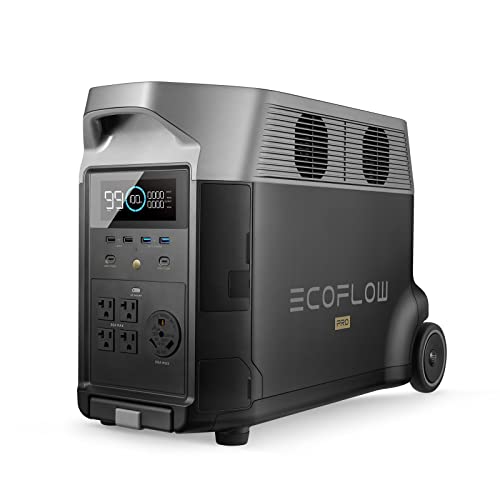
EF EcoFlow DELTA Pro Portable Power Station
Best for running multiple power tools simultaneously
EF EcoFlow DELTA Pro Portable Power Station
Best for running multiple power tools simultaneously
What we like
- 3600W continuous output handles a circular saw, compressor, and drill running at the same time without tripping.
- X-Boost technology can power tools rated up to 4500W by regulating draw, extending what the inverter can handle.
- Recharges in 2.7 hours via a standard 120V wall outlet — fast enough for overnight recovery between jobsite days.
- EcoFlow app lets you monitor real-time wattage draw and set charge limits to protect battery longevity.
What we don't
- Weighs 99 lbs, so you are not carrying this to a second-floor framing job without help.
- At this price tier, it costs nearly twice as much as mid-range options with half the continuous output.
- Older NMC battery version; verify you are getting the LFP variant before purchasing.
When you are running a miter saw and a compressor at the same time on a remote build, the DELTA Pro is the only portable station that does not ask you to choose. The 3600W continuous rating with 7200W surge means it absorbs the startup spike from nearly any corded tool you throw at it.
This is built for contractors and serious overlanders doing real work off-grid — not the occasional drill charge. If your tool use is light or intermittent, you are paying for headroom you will never use and should look at the Jackery or Anker instead.
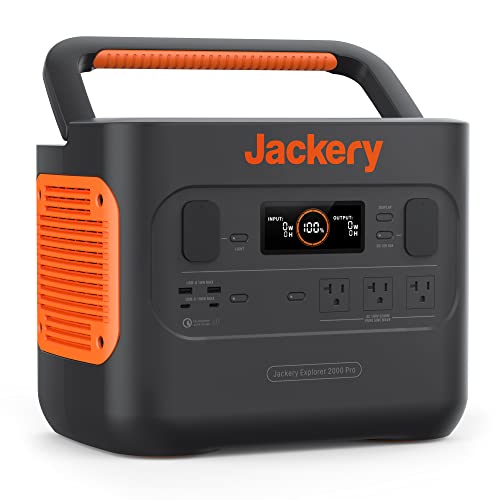
Jackery Explorer 2000 Pro Portable Power Station
Best for weekend builds and overlanding worksites
Jackery Explorer 2000 Pro Portable Power Station
Best for weekend builds and overlanding worksites
What we like
- 2200W continuous output comfortably runs a circular saw, jigsaw, or drill without approaching the inverter limit.
- Charges from 0 to 100% in just 2 hours via AC wall outlet, making overnight recovery fast and predictable.
- Three AC outlets let you keep tools plugged in simultaneously and alternate use without swapping cords.
- Industry-leading cylindrical cells with UL certification provide reliable output under sustained load.
What we don't
- NMC battery chemistry has fewer cycle life ratings than LFP options at this price point.
- Weighs 43 lbs — lighter than the DELTA Pro but still a two-handed lift to load into a truck bed.
- No pass-through charging at full AC input speed, which can slow recharge during solar-only situations.
The Explorer 2000 Pro sits in the sweet spot for weekend warriors and overlanders doing real work — enough output to run a circular saw or a compressor without getting into DELTA Pro pricing. The 2-hour AC recharge means you arrive home, plug in, and are ready again by morning.
This is the right call if your tool use is concentrated — one tool at a time, a few hours of work, then recharge. If you need to run a saw and compressor together continuously, the 2200W ceiling will feel tight under simultaneous load.
BLUETTI AC200L Portable Power Station
Best for all-day tool use with solar recharging
BLUETTI AC200L Portable Power Station
Best for all-day tool use with solar recharging
What we like
- 2400W continuous output is 200W more than the Jackery 2000 Pro and handles circular saws cleanly in real-world use.
- LFP cells rated for 3500+ cycles — this station will outlast multiple years of jobsite daily cycling.
- Up to 1200W solar input means a 400W panel setup can meaningfully offset discharge during an active work session.
- 30A RV output and expandable capacity via B300 batteries make it versatile for camp power beyond just tools.
What we don't
- At 61 lbs it is notably heavier than the Jackery 2000 Pro for similar usable capacity.
- BLUETTI's app and firmware update process has drawn mixed reviews compared to EcoFlow's ecosystem.
- Surge rating of 3600W is lower than competitors at this price, which can cause tripped inverters on high-torque tools.
If you are doing multi-hour tool sessions and want the battery to last years of daily use, the AC200L's LFP chemistry is the argument to make here. The 2400W output handles most corded saws and compressors, and 1200W of solar input means a decent panel setup keeps you topped up through a full work day.
This is the pick for the overlander or remote builder who wants a station that will still hold 80% capacity after 3 years of heavy cycling — not just one that works great out of the box.
Goal Zero Yeti 1500X Portable Power Station
Best for light tool use and camp power combined
Goal Zero Yeti 1500X Portable Power Station
Best for light tool use and camp power combined
What we like
- 2000W continuous output handles drills, jigsaws, and light circular saw work without tripping the inverter.
- Regulated power output with pure sine wave inverter protects sensitive electronics and tools with variable speed controls.
- Expandable with Goal Zero's YETI Tank batteries, letting you add capacity as your needs grow.
- One of the most refined hardware builds in its class with durable casing designed for frequent transport.
What we don't
- 2000W continuous is on the lower end for sustained circular saw use — it will handle it but leaves little headroom.
- Charges slowly via solar compared to BLUETTI and EcoFlow — maximum solar input is 600W.
- Premium pricing for this capacity tier when compared directly to EcoFlow and BLUETTI competitors.
The Yeti 1500X is the pick when your power tool use is part of a bigger camp setup — you need reliable drill and jigsaw power, but you also want to run a fridge, lights, and charge devices without juggling capacity. The regulated output is gentle on tool electronics and the build quality is noticeably more refined than Chinese-branded alternatives.
If your primary job is running a circular saw or air compressor hard, the 2000W ceiling is workable but not comfortable. Overlanders who split power between tools and camp amenities get the most value here.
Anker SOLIX C1000 Portable Power Station
Best budget pick for drills, jigsaws, and light saws
Anker SOLIX C1000 Portable Power Station
Best budget pick for drills, jigsaws, and light saws
What we like
- SurgePad technology delivers up to 2400W output, letting it handle a circular saw startup surge that would trip a basic 1800W inverter.
- LFP cells rated for 3000 cycles make this the most durable option under $1000 for regular use.
- Charges from empty to full in 58 minutes via UltraFast charge mode — the fastest recharge time in this roundup.
- 15% smaller than comparable 1kWh units, making it genuinely portable for truck bed and job bag storage.
What we don't
- 1056Wh capacity means only about 45 minutes of sustained circular saw use before needing a recharge.
- Continuous 1800W output will trip under a corded worm drive saw or large compressor at full load.
- No expansion battery option means the capacity ceiling is fixed — this is not a grow-with-you system.
At under $1000 with LFP cells and a 58-minute recharge, the SOLIX C1000 is the right answer for overlanders and campers who need occasional drill and jigsaw power — not contractors running tools all day. The SurgePad surge handling is genuinely better than competitors at this price, which matters for circular saw startup.
The 1056Wh capacity is the honest limiting factor here. You are getting 40-50 minutes of saw time per charge, which is workable if you are doing repairs and occasional cuts — not a framing job.
Pair with a 200W solar panel and it becomes a solid off-grid tool companion.
What to Look For
Continuous AC output is the number that matters for power tools, not peak or surge. A 1800W continuous rating handles most circular saws, jigsaws, and drills — but add a compressor and you need 2400W or more.
Capacity in watt-hours determines how long you can work. A 2000Wh station running a 1400W saw gives you roughly 1.2 hours of cutting time before recharge — factor your session length before buying.
LiFePO4 (LFP) battery chemistry is the right call for jobsite use. It tolerates more charge cycles, handles heat better, and is safer under repeated deep discharge than older NMC lithium cells.
Who Should Skip This
If you need to run a 15-amp table saw or a 240V welder, a portable power station is not your answer — those tools demand more than any battery station currently delivers. Contractors doing 8-hour days of continuous heavy tool use will also find even the largest units need mid-day recharging.
Gas generators still win on raw continuous output for all-day industrial work.
What the Community Actually Uses
On r/overlanding and r/vandwellers, the recurring power tool question is always the same: can it actually run a circular saw without browning out? The consensus has shifted toward the EcoFlow DELTA Pro and BLUETTI AC200L as the go-to jobsite-capable options, with users specifically calling out the surge handling and LFP longevity as the deciding factors over budget competitors.
Quick Picks — In Case You've Already Decided
EF ECOFLOW Portable Power Station DELTA Pro 3600Wh
Check Price on AmazonFrequently Asked Questions
Can a portable power station actually run a circular saw?
Yes, as long as the station's continuous AC output exceeds the saw's running wattage and its surge rating covers the startup spike. Most 7-1/4 inch circular saws draw around 1400W running and spike to around 2800W on startup — a station with 1800W continuous and 3600W surge handles that cleanly.
How long will a 2000Wh station run my tools?
Divide the station's watt-hour capacity by your tool's running wattage, then apply a rough 85% efficiency factor. A 2000Wh station running a 1400W saw gives you about 1.2 hours of cutting time. Light drills and jigsaws draw far less, so runtime stretches considerably.
What's the difference between continuous and peak wattage?
Continuous wattage is what the inverter can sustain indefinitely — this is the number that matters for power tools. Peak or surge wattage is what it can deliver for a fraction of a second at motor startup. Your tool's startup surge must fall within the peak rating or the station will shut off.
Is LiFePO4 better than lithium-ion for jobsite use?
Yes for this use case. LFP chemistry tolerates more charge cycles (3000+ vs 500-800 for NMC), handles heat better, and degrades more gracefully under repeated deep discharge. The tradeoff is lower energy density, so LFP units tend to be heavier for the same capacity.
Can I recharge the station while using it on tools?
Most stations support pass-through charging, meaning you can plug into solar or shore power while running tools simultaneously. This extends your effective work session significantly, especially with a 200-400W solar panel keeping the battery topped up between cuts.
Buying Guide
You need continuous wattage that exceeds your tool's rated draw, plus surge headroom for motor startup — usually 2x the rated watts. A circular saw pulls 1400W running, 2800W at startup.
Match capacity in watt-hours to your work session length. LiFePO4 chemistry handles repeated deep cycles better than NMC for daily jobsite use.