Running out of battery on day two is a gear problem, not a location problem — and every unit on this list solves it. The five picks below span 288Wh to 2160Wh and cover everything from weekend car campers to full-time overlanders living off solar.
| Photo |
Top Pick

|
Versatile

|
Budget

|
Best Value
|
Best for Reliability

|
|---|---|---|---|---|---|
| Product | EF EcoFlow DELTA 2 Portable Power Station | Jackery Explorer 1000 Pro Portable Power Station | Anker SOLIX C800 Portable Power Station | Jackery Explorer 2000 Pro Portable Power Station | Jackery Explorer 300 Plus Portable Power Station |
| Capacity | 1024Wh | 1002Wh | 768Wh | 2160Wh | 288Wh |
| Ac output | 1800W | 1000W | 1200W | 2200W | 300W |
| Solar input | 500W max | 800W max | 300W max | 1200W max | 100W max |
| Battery type | LiFePO4 | NMC Lithium | LiFePO4 | NMC Lithium | LiFePO4 |
| Buy Now | Check Price → | Check Price → | Check Price → | Check Price → | Check Price → |
Quick Tips
Calculate your actual daily watt-hour draw before buying — add up every device times its usage hours, then size up by 30% for inefficiency losses.
LiFePO4 batteries typically last 3000-plus charge cycles versus 500-800 for standard lithium-ion — prioritize chemistry over brand name.
Solar input wattage determines how fast you recover capacity during the day — a 1000Wh unit with only 200W solar input takes 5-plus hours of direct sun to fully recharge.
Dual charging (wall plus solar simultaneously) cuts charge time dramatically on units that support it — confirm this before purchasing if speed matters.
EF EcoFlow DELTA 2 Portable Power Station
Best for all-around off-grid use with solar
EF EcoFlow DELTA 2 Portable Power Station
Best for all-around off-grid use with solar
What we like
- 1800W AC output handles appliances most 1000Wh units cannot touch, including small electric skillets and power tools.
- 3000-plus cycle LiFePO4 battery chemistry means roughly a decade of regular use before noticeable capacity loss.
- 500W max solar input is one of the highest in its class — fully rechargeable from panels in around 2 hours in direct sun.
- Expandable to 2048Wh with the DELTA 2 Extra Battery, making it future-proof if your power needs grow.
What we don't
- At roughly 27 lbs it is heavier than budget competition at the same capacity.
- Expansion battery sold separately adds significant cost if you need the full 2048Wh.
- The app is useful but required to access some charging modes — adds friction for no-phone users.
The DELTA 2 hits the overlap between capacity and output wattage better than anything else at this price — 1024Wh stored and 1800W out means you can actually run camp appliances, not just charge devices. If your current setup has you rationing power after day two, this is the fix.
This is the right pick for overlanders, van campers, and rooftop tent setups running a small fridge, CPAP, or power tools alongside the usual phone and laptop rotation. If you only charge phones and a laptop, step down to the 300 Plus and save $500.
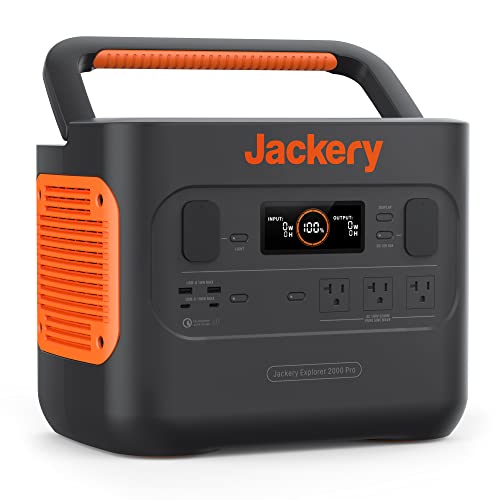
Jackery Explorer 1000 Pro Portable Power Station
Best for fast solar recharge on extended trips
Jackery Explorer 1000 Pro Portable Power Station
Best for fast solar recharge on extended trips
What we like
- 800W max solar input is the highest in its class — fully rechargeable from panels in under 1.8 hours with the right panel array.
- Dual 100W USB-C PD ports charge laptops and drones at full speed simultaneously without an adapter.
- Three AC outlets plus DC and USB outputs cover every device combination you bring to camp.
- Compact for its capacity — cleaner to pack than competitors at the same watt-hour rating.
What we don't
- NMC lithium chemistry rates for around 1000 cycles versus 3000-plus for LiFePO4 competitors at similar prices.
- AC output capped at 1000W rules out higher-draw appliances like electric griddles or power saws.
- Heavier than the 300 Plus makes sense, but at 11.5 lbs it is not the lightest 1000Wh option on the market.
The 1000 Pro's 800W solar input is the real differentiator — if you are running solar panels and need to recover capacity fast between cloudy days or move camp frequently, no other unit in this price range closes that gap as quickly. You lose the LiFePO4 longevity but gain solar speed that changes how you plan multi-day trips.
This is specifically for overlanders and van campers who have invested in a solid solar panel setup and need the station to keep up. If you do not have panels and rely mostly on wall charging between trips, the EcoFlow DELTA 2 is the smarter buy for its higher AC output.
Anker SOLIX C800 Portable Power Station
Best for fast charge turnaround between trips
Anker SOLIX C800 Portable Power Station
Best for fast charge turnaround between trips
What we like
- Fully rechargeable in 58 minutes via UltraFast wall charging — fastest turnaround in its capacity class.
- LiFePO4 chemistry with 3000-plus cycle rating at a price point where most competitors still use NMC lithium.
- Built-in camping light adds genuine utility for basecamp use without carrying a separate lantern.
- 10 output ports cover every device combination without needing a hub or splitter.
What we don't
- 768Wh capacity is tight for multi-day trips running a fridge alongside phones and a laptop.
- 300W max solar input means slower solar recovery than the Jackery 1000 Pro at a similar price.
- The built-in light, while useful, adds bulk and cost you pay for whether you want it or not.
The C800 is built for people who leave Friday night and are back Sunday — 768Wh handles a two-day trip cleanly, and the 58-minute wall recharge means it is back to full before your next outing without planning around it. The LiFePO4 at this price is genuinely unusual and worth the premium over generic 768Wh competitors.
This makes sense for weekend overlanders and car campers who rely on wall charging before trips and want fast top-ups at camp from the car. If you are off grid for four-plus days and depend on solar, the EcoFlow DELTA 2 or Jackery 1000 Pro handles that duty better.
Jackery Explorer 2000 Pro Portable Power Station
Best for base camp power and group trips
Jackery Explorer 2000 Pro Portable Power Station
Best for base camp power and group trips
What we like
- 2160Wh capacity runs a portable fridge, CPAP, multiple devices, and lighting for four-plus days without a full recharge.
- 2200W AC output handles power-hungry appliances including electric skillets, small air compressors, and power tools.
- 1200W max solar input means you can fully recharge from panels in as little as 2.5 hours with the right array.
- Three 2200W AC outlets run multiple high-draw devices simultaneously without splitting capacity.
What we don't
- At 43 lbs it is heavy enough that two-person lifting is practical rather than optional on rough terrain.
- NMC lithium chemistry caps cycle life at around 1000 full cycles before capacity degradation begins.
- Price puts it firmly in the premium tier — overkill for anyone running fewer than three devices at camp.
The 2000 Pro is a base camp power hub, not a backpack unit — 2160Wh and 2200W AC output means you stop compromising on what you run at camp and start running all of it. If your current setup has you debating whether to run the fridge or charge devices, this ends that conversation.
This is the right buy for group overlanding trips, rooftop-tent base camps with multiple users, and anyone running power tools, a full-size cooler, or medical equipment off grid. Solo campers or anyone under three nights should size down significantly.
Jackery Explorer 300 Plus Portable Power Station
Best lightweight budget pick for solo trips
Jackery Explorer 300 Plus Portable Power Station
Best lightweight budget pick for solo trips
What we like
- At 8.3 lbs it is light enough to carry one-handed and fits in most mid-size backpacks alongside other gear.
- LiFePO4 chemistry with 4000-cycle rating — the longest cycle life of any unit on this list by a significant margin.
- App control via Wi-Fi or Bluetooth lets you monitor remaining capacity and adjust charging modes without touching the unit.
- Sub-$300 entry point makes it the lowest-risk first power station for anyone new to off-grid camping.
What we don't
- 288Wh capacity runs out fast if you add anything beyond phones, a laptop, and basic lighting.
- 300W AC output cannot run a mini fridge, coffee maker, or CPAP with humidifier simultaneously.
- 100W max solar input means full solar recharge takes 3-plus hours of direct sun even in ideal conditions.
The 300 Plus is the entry point that makes sense — not underpowered junk at a low price, but a genuinely capable unit sized for solo trips where you are running phones, a laptop, and lights for two nights. The LiFePO4 chemistry at this price is rare and means it will outlast most units twice its cost.
This is specifically for solo campers, bikepacking setups, and people testing off-grid power before investing in a 1000Wh-plus system. Anyone running a portable fridge or sharing a camp with two or more people should jump directly to the EcoFlow DELTA 2 instead.
What to Look For
Battery chemistry separates long-term value from short-term savings. LiFePO4 (also called LFP) handles 3000-plus cycles before dropping to 80% capacity — standard NMC lithium gives you 500-800 cycles under the same conditions.
Solar input wattage is what keeps you running when you are off grid more than two days. A unit with 500W max solar input recharges twice as fast as one capped at 200W in the same sun conditions.
AC output wattage determines what you can actually run — not just charge. A 1000W output handles a CPAP, laptop, and phone simultaneously; a 300W unit cannot run a coffee maker or electric blanket.
Who Should Skip This
If you only need to charge phones and a laptop for a single overnight trip, a portable power station is overkill — a quality 30,000mAh power bank costs a fraction of the price and does the job. Skip this category entirely if your rig has a second battery system already dialed in, since adding a standalone unit creates redundancy without solving a real problem.
What the Community Actually Uses
On r/overlanding, the recurring debate is capacity versus portability — members running roof tents and dual-battery setups consistently recommend 1000Wh as the minimum for four-day trips, while r/vandwellers leans toward 2000Wh-plus units paired with dedicated solar arrays for longer off-grid stretches.
Quick Picks — In Case You've Already Decided
Frequently Asked Questions
How much capacity do I actually need for a 3-day off-grid trip?
Figure 100-150Wh per day for phones, lights, and a laptop — add a mini fridge and you jump to 400-600Wh per day. A 1000Wh unit with solar input covers most car campers for three to four days without rationing.
Can I charge a portable power station while using it?
Yes — most units support pass-through charging, meaning you can run devices while plugged into wall or solar. Check the spec sheet for your specific model, as some units limit output wattage during simultaneous charging.
Is LiFePO4 worth paying more for?
For anyone using a power station more than a few times a year, yes. LiFePO4 chemistry lasts 3000-plus cycles compared to 500-800 for standard lithium-ion, which translates to roughly 8-10 years of regular use before noticeable capacity loss.
How do I size solar panels to match my power station?
Match panel wattage to your unit's max solar input rating — going over that number wastes money since the unit cannot accept more than its rated input. Panels rated at 80-100% of max input is the practical sweet spot.
Can portable power stations run a CPAP machine off grid?
Yes — a CPAP draws roughly 30-60W per night without a humidifier, meaning a 288Wh budget unit can run it for four to eight nights. Add a humidifier and draw jumps to 100-150W, requiring a 500Wh-plus unit for multi-night use.
Buying Guide
Capacity is the number that matters most — match it to your daily draw, not your wishlist. Count up your devices, multiply watts by hours, then add 30% buffer.
LiFePO4 chemistry outlasts standard lithium by years. Fast solar input beats raw capacity when you are off grid more than two nights.