A gaming PC mid-session doesn't care that you're off-grid — but the right power station does, and three of these picks deliver 2000Wh or more with pure sine wave output designed to handle GPU surge draws without tripping. The EcoFlow DELTA Pro tops out at 3600W continuous output, enough to run a mid-to-high-end gaming rig for 3 to 5 hours on a single charge.
| Photo |
Top Pick
|
Versatile

|
Budget

|
Best Value

|
Best for Reliability
|
|---|---|---|---|---|---|
| Product | EF ECOFLOW Portable Power Station DELTA Pro 3600Wh | Jackery Explorer 2000 Plus Portable Power Station | BLUETTI AC200L Portable Power Station | Anker SOLIX C1000 Portable Power Station | Jackery Explorer 2000 Pro Portable Power Station |
| Capacity | 3600Wh | 2042Wh | 2048Wh | 1056Wh | 2160Wh |
| Ac output | 3600W (4500W X-Boost) | 3000W | 2400W (3600W Power Lifting) | 1800W (2400W SurgePad) | 2200W |
| Battery type | LiFePO4 | LiFePO4 | LiFePO4 | LiFePO4 | NMC Cylindrical |
| Recharge time | 2.7 hrs (AC) | 2 hrs (AC) | 1.7 hrs (Solar+AC combined) | 58 min (AC UltraFast) | 2 hrs (AC) |
| Buy Now | Check Price → | Check Price → | Check Price → | Check Price → | Check Price → |
Quick Tips
Measure your rig's actual watt draw with a Kill-A-Watt meter under full gaming load before buying — GPU spikes at startup can be 1.5x the steady-state number
Pure sine wave output is non-negotiable for gaming PCs — modified sine wave stations can corrupt saves and damage PSUs over time
Run your monitor and peripherals off the same station to avoid ground loop hum through USB audio
If you're mobile (van, overlanding rig), prioritize units with LiFePO4 chemistry — they handle heat and vibration far better than NMC cells
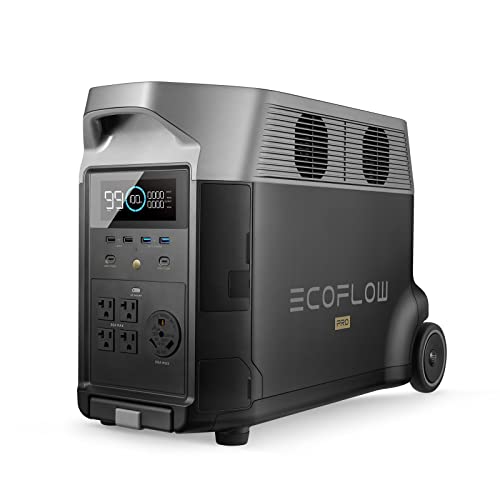
EF EcoFlow DELTA Pro 3600Wh Portable Power Station
Best for high-end gaming rigs and long off-grid sessions
EF EcoFlow DELTA Pro 3600Wh Portable Power Station
Best for high-end gaming rigs and long off-grid sessions
What we like
- 3600W continuous AC output handles even the most power-hungry gaming desktops without throttling
- Expandable to 25kWh with extra batteries — effectively unlimited runtime for long off-grid builds
- X-Boost technology pushes output headroom to 4500W for GPU-heavy surge moments
- Pure sine wave inverter protects PSUs and prevents data corruption during saves
What we don't
- At 99 lbs it requires wheels to move — not practical for carry-in setups
- Price sits well above every other unit on this list
- AC fast charge requires 240V to hit 1.8-hour recharge time — standard 120V takes 2.7 hours
This is the only unit here that genuinely matches a high-end gaming PC without compromise — 3600W continuous means even a 4090 rig at full draw has room to breathe, and 3600Wh of LiFePO4 capacity puts 5+ hours of actual gaming within reach. Buy this if you're running a serious rig (RTX 4080/4090, 850W+ PSU) or want one station that also handles your fridge, lights, and camp kitchen.
Skip it if your PC draws under 400W — you're paying for headroom you won't use.
Jackery Explorer 2000 Plus Portable Power Station
Best for mid-range gaming rigs needing expandable runtime
Jackery Explorer 2000 Plus Portable Power Station
Best for mid-range gaming rigs needing expandable runtime
What we like
- 3000W AC output covers mid-range to upper-mid gaming rigs (RTX 3080 and below) with solid headroom
- Expandable to 24kWh with additional battery packs for extended off-grid stays
- 2-hour full AC recharge is among the fastest in this capacity class
- Whisper-quiet 30dB operation won't disrupt your session or campsite neighbors
What we don't
- 3000W continuous draws closer to its ceiling than EcoFlow DELTA Pro under heavy GPU load
- Expansion batteries add significant cost to the already premium base price
- App connectivity occasionally drops on Bluetooth-only mode away from Wi-Fi
The 3000W output and 2042Wh capacity hit the sweet spot for most mid-range gaming rigs — you get 4+ hours from an RTX 3070 build and the expandable ecosystem means you can grow runtime without buying a whole new unit. This is the pick for van lifers and overlanders who want one station that runs the gaming rig and doubles as home backup.
If your PC pulls over 700W sustained, step up to the DELTA Pro.
BLUETTI AC200L Portable Power Station 2048Wh
Best for basecamp builds needing max outlet versatility
BLUETTI AC200L Portable Power Station 2048Wh
Best for basecamp builds needing max outlet versatility
What we like
- Power Lifting technology pushes effective output to 3600W — handles most gaming PC surge draws without shutting down
- 11 output ports including a 30A RV outlet and 48V DC port make it the most versatile unit on this list
- 0-80% in just 45 minutes with 2400W AC input — fastest recharge among 2kWh units here
- Expandable to 8192Wh with compatible B300K battery packs for extended basecamp use
What we don't
- Power Lifting is a boosting technology — actual continuous output is 2400W, not 3600W under all conditions
- Heavier than similarly-specced competitors at around 61 lbs
- Expansion battery ecosystem is pricier than Jackery's comparable options
The AC200L's 45-minute fast charge to 80% is the real draw here — if you're recharging from a generator or shore power between sessions, this unit gets back in the game faster than anything else at this capacity. Grab this if your basecamp already has a lot of devices to power alongside your gaming rig and you need the RV port and DC output flexibility.
Pass if you need straightforward maximum wattage without reading into Power Lifting specs.
Anker SOLIX C1000 Portable Power Station
Best for lightweight gaming laptops and compact gaming rigs
Anker SOLIX C1000 Portable Power Station
Best for lightweight gaming laptops and compact gaming rigs
What we like
- Sub-60-minute full recharge via UltraFast AC mode — fastest in the sub-1kWh class by a wide margin
- SurgePad technology delivers 2400W peak for startup surges without tripping the inverter
- LiFePO4 battery rated for 3000 cycles over a 10-year lifespan
- 15% more compact than comparable 1kWh units — actually fits under a van build workstation
What we don't
- 1056Wh limits runtime to 1.5-2 hours for a 400W gaming rig — needs recharging for long sessions
- 1800W continuous won't support high-end desktops (RTX 4080+) under full load
- UltraFast charging requires the Anker app on a smartphone to activate
This unit isn't built for a full desktop gaming rig — it's built for someone running a Mini-ITX build or a gaming laptop who needs a fast, compact station that recharges in under an hour between sessions. It's the right call for day trips, hunting camp setups, or anyone who needs a light carry-in option that won't strain their back.
Step up to the 2kWh options if you're running a full ATX build with a discrete GPU.
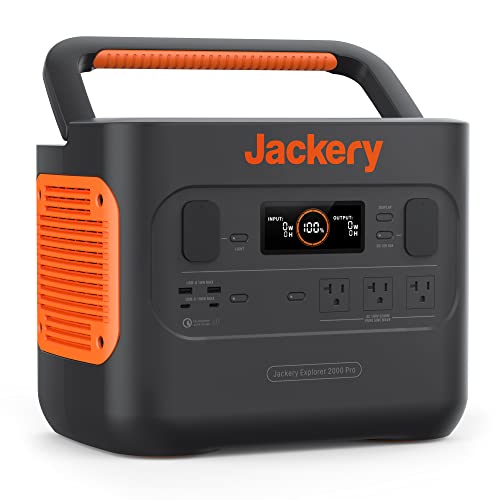
Jackery Explorer 2000 PRO Portable Power Station
Best for proven reliability across outdoor gaming setups
Jackery Explorer 2000 PRO Portable Power Station
Best for proven reliability across outdoor gaming setups
What we like
- 2160Wh capacity gives mid-range gaming rigs (300-400W draw) close to 5 hours of actual play
- Industry-leading cylindrical NMC cells with UL certification and proven field reliability
- Pure sine wave inverter with 2200W output safely handles most gaming PC configurations
- Under 53dB operation makes it genuinely quiet during late-night gaming sessions
What we don't
- NMC chemistry means fewer lifetime cycles (500-1000) than LiFePO4 alternatives on this list
- 2200W ceiling is tighter than newer 2kWh LiFePO4 competitors — no headroom for power-hungry GPUs
- Slightly heavier than the Jackery 2000 Plus despite lower rated output
The Explorer 2000 PRO is the proven workhorse option — it's been in the field longer than most competitors and has a track record of consistent output without surprises, which matters when your rig is mid-session and you're two hours from the nearest outlet. This is the pick if you want a battle-tested unit at a slightly lower price than the 2000 Plus and your rig draws comfortably under 500W.
If you're future-proofing for a GPU upgrade, the LiFePO4 options above are worth the extra spend.
What to Look For
Continuous wattage matters more than peak wattage on the spec sheet. Most brands advertise surge numbers — look for the continuous AC output and confirm it exceeds your PC's full-load draw by at least 30%.
Capacity in Wh determines how long you actually play. A 500W gaming rig running from a 2000Wh station gives you roughly 3.5 hours before you hit reserve — factor that against your session length.
LiFePO4 battery chemistry is worth the premium for off-grid use. It handles 3000+ charge cycles, runs cooler, and won't degrade as fast as NMC chemistry when stored partially charged in a hot truck or trailer.
Who Should Skip This
If you're running a high-end desktop with a 1000W+ PSU under full load, even the largest unit here will give you limited runtime — you'll want a full solar setup or a dual-station stack instead. Laptop gamers and console players don't need any of this — a 500Wh station at a third of the price handles those loads easily.
What the Community Actually Uses
On r/overlanding and r/vandwellers, the portable power station conversation for gaming PCs comes up constantly during winter builds — members debate EcoFlow vs BLUETTI vs Jackery with real watt-draw screenshots from Kill-A-Watt meters. The consensus leans toward 2kWh+ LiFePO4 units for anything more than a light session.
Quick Picks — In Case You've Already Decided
EF ECOFLOW Portable Power Station DELTA Pro 3600Wh
Check Price on AmazonJackery Explorer 2000 Plus Portable Power Station
Check Price on AmazonFrequently Asked Questions
Can a portable power station really run a gaming PC?
Yes, if the station delivers at least 1800W continuous pure sine wave output and your rig draws under 600W under load. A 2000Wh unit gives most gaming PCs 3-4 hours of play. High-end rigs with 800W+ PSUs need 3000W+ stations.
What wattage do I need for my gaming PC?
Measure with a Kill-A-Watt meter at full gaming load, then add 30% headroom for GPU surge. Most mid-range rigs (RTX 3070 or similar) pull 350-500W. A 2000W continuous station covers nearly all of them comfortably.
Does pure sine wave output actually matter for a PC?
Yes — gaming PCs with quality PSUs can tolerate modified sine wave for short periods, but over time it causes premature capacitor wear and can corrupt data during saves. Always use pure sine wave with any desktop PC.
How long will a 2000Wh station power my gaming PC?
At 400W load (typical mid-range rig under gaming), a 2000Wh station gives roughly 4-4.5 hours accounting for inverter efficiency losses around 85%. At 600W load, expect 2.5-3 hours.
Can I solar-charge these stations while gaming?
Yes, but solar input rarely offsets a gaming PC's draw — 200W of solar puts back maybe 1 hour of runtime for every 3 hours of play. It extends sessions, not eliminates the need to recharge. Great for basecamp setups with panels deployed.
Buying Guide
You need wattage headroom, not just capacity. Check your PC's peak draw under load — most gaming rigs pull 300-600W — then double it for surge.
Pick a pure sine wave unit with at least 2000W continuous output. Capacity above 1500Wh gets you real session time.
Skip any station rated under 1800W continuous.