The right portable power station keeps your fridge cold, your phone charged, and your medical devices running through a multi-day outage without a single drop of gas. The five units below span 499Wh to 1,152Wh, start at under $300, and every one charges from zero to full in under two hours.
| Photo |
Top Pick

|
Versatile

|
Budget

|
Best Value
|
Best for Reliability

|
|---|---|---|---|---|---|
| Product | EF EcoFlow DELTA 2 Portable Power Station | Jackery Explorer 1000 v2 Portable Power Station | Anker SOLIX C1000 Portable Power Station | BLUETTI AC180 Portable Power Station | Goal Zero Yeti 500 Portable Power Station |
| Capacity | 1,024Wh | 1,070Wh | 1,056Wh | 1,152Wh | 499Wh |
| Ac output | 1,800W (2,700W surge) | 1,500W (3,000W surge) | 1,800W (2,400W surge) | 1,800W (2,700W surge) | 500W (1,000W surge) |
| Battery type | LiFePO4 (3,000+ cycles) | LiFePO4 (3,000+ cycles) | LiFePO4 (3,000+ cycles) | LiFePO4 (3,500+ cycles) | LiFePO4 (4,000+ cycles) |
| Recharge time | ~80 min via AC | ~1 hr via AC | ~58 min via AC | ~45 min to 80% via AC | ~90 min via AC |
| Buy Now | Check Price → | Check Price → | Check Price → | Check Price → | Check Price → |
Quick Tips
Store your power station at 80% charge — fully depleted or fully topped lithium batteries degrade faster during long storage periods.
Run a load test before hurricane season: plug in your actual fridge and time how long the station lasts at that draw.
Solar input turns a 3-day outage into indefinite power — verify your panel's wattage matches the station's max solar input before buying.
Keep a short list of your household's watt-hour needs on your phone so you can quickly calculate runtime when the next storm is inbound.
EF EcoFlow DELTA 2 Portable Power Station
Best for home backup with fast recharge
EF EcoFlow DELTA 2 Portable Power Station
Best for home backup with fast recharge
What we like
- LiFePO4 battery rated for 3,000-plus cycles means it will outlast most of the emergencies you ever face.
- 1,800W AC output handles full-size fridges, sump pumps, and most household appliances without hesitation.
- Charges from 0 to 80% in about 50 minutes via AC — faster than almost anything else at this price.
- Expandable to 3kWh with an optional add-on battery, so your emergency setup can grow without buying a new unit.
What we don't
- At around 27 lbs, it's not something you'll carry far — this is a set-it-in-the-closet unit.
- App dependency for some advanced features means a dead phone can limit your configuration options.
- Fan noise under heavy load is noticeable in a quiet room.
When the grid drops and your fridge is full of a week's groceries, the DELTA 2's 1,800W output and 80-minute recharge window give you something no other unit in this price range matches: the ability to top it back up from your car or a solar panel fast enough to actually matter. This is the pick for households that want one unit to cover the refrigerator, CPAP, phone charging, and a few lights simultaneously.
If you only need to run a lamp and charge a phone, it's more than you need.
Jackery Explorer 1000 v2 Portable Power Station
Best for fast charge and solar pairing
Jackery Explorer 1000 v2 Portable Power Station
Best for fast charge and solar pairing
What we like
- One-hour emergency fast-charge mode via the Jackery app turns a window of grid power into a full tank before the next outage.
- 100W USB-C output charges laptops at wall-outlet speed — critical when you're working from home during a multi-day outage.
- 30 dB quiet overnight mode lets you run it in a bedroom for CPAP use without sleep disruption.
- Pairs natively with Jackery's SolarSaga panels for indefinite off-grid operation when paired with a 200W panel.
What we don't
- Emergency fast-charge must be manually enabled each session via the app — it doesn't stay on by default.
- 1,500W AC output is lower than EcoFlow's DELTA 2, so high-draw appliances may not be compatible.
- Solar panel sold separately, which adds significant cost if solar recharging is part of your plan.
The Explorer 1000 v2 earns its spot for one specific emergency feature: the app-enabled one-hour charge mode that lets you slam a full tank in before a storm hits. That's not a spec you'll find on many competitors, and in a real outage scenario it's the difference between being prepared and being caught off guard.
Buy this if solar pairing is in your plan or if you need the quietest overnight operation for a CPAP. Skip it if you need to run a full-size refrigerator — the 1,500W ceiling will trip its limits.
Anker SOLIX C1000 Portable Power Station
Best for apartment and home office backup
Anker SOLIX C1000 Portable Power Station
Best for apartment and home office backup
What we like
- SurgePad technology pushes peak output to 2,400W, letting it start motors and compressors that standard 1,800W inverters reject.
- 15% more compact than comparable 1kWh units — genuinely fits under a desk or in an apartment closet.
- Charges to 80% in 43 minutes with UltraFast mode, one of the fastest charge rates in its class.
- 11 output ports handle a full home office setup — monitors, laptops, a router, and phone charging all at once.
What we don't
- UltraFast charging requires both an AC connection and enabling the mode through the Anker app via smartphone.
- Expansion battery costs extra and requires a separate purchase to increase capacity beyond 1,056Wh.
- Higher price point than EcoFlow DELTA 2 for a similar capacity spec.
The SOLIX C1000 is the one to reach for if your emergency priority is keeping a home office running — router, two monitors, a laptop, and your phone all drawing power simultaneously without flipping any breakers. Its compact footprint means you're not moving furniture to store it.
It's a close match to the EcoFlow DELTA 2 in raw specs, so the decision usually comes down to brand ecosystem. If you already own Anker charging gear, the app integration is seamless.
If not, the EcoFlow is a better starting point.
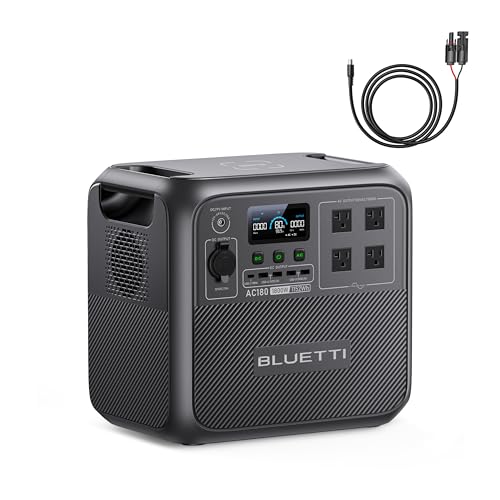
BLUETTI AC180 Portable Power Station
Best for maximum capacity at this price tier
BLUETTI AC180 Portable Power Station
Best for maximum capacity at this price tier
What we like
- 1,152Wh is the largest capacity in this roundup, giving you more runtime per dollar than any other option listed.
- 3,500-plus cycle rating edges out most competitors, meaning more years of reliable standby before capacity degrades.
- Power Lifting mode via the app boosts output to 2,700W for high-draw appliances that would normally exceed the inverter rating.
- 20ms UPS switchover time is fast enough to protect sensitive electronics like desktop computers without a hiccup.
What we don't
- 2-AC-outlet version sells alongside the 4-outlet version — double-check which SKU you're ordering before purchasing.
- BLUETTI's app has received mixed reviews for interface clarity compared to EcoFlow and Anker.
- Physical size is larger than the Anker SOLIX C1000, making it harder to store in tight spaces.
If your emergency checklist includes a refrigerator, a few lights, phone charging, and a router — and you want the most runtime for your money — the AC180 wins on capacity at 1,152Wh while matching the competition on output wattage. The Power Lifting mode is a real differentiator: it lets the unit punch above its inverter rating for appliances that normally need more power to start.
This is the pick for families who want one unit that outlasts a 48-hour outage on a single charge. Skip it if physical size or number of outlets is a priority — the SOLIX C1000 is more compact.
Goal Zero Yeti 500 Portable Power Station
Best lightweight option for basic emergency power
Goal Zero Yeti 500 Portable Power Station
Best lightweight option for basic emergency power
What we like
- 4,000-plus cycle LiFePO4 rating is the highest in this roundup — this unit is built to outlast every other option by years.
- IPX4 water resistance and dustproof rating mean it can sit in a garage, truck bed, or utility room without special protection.
- Charges from 0 to 100% in about 90 minutes — among the fastest per-watt recharge rates available.
- Goal Zero's build quality and US-based support reputation set it apart from newer budget brands in the emergency prep space.
What we don't
- 500W AC output can't run a full-size refrigerator or most window AC units — it's for phones, lights, and small appliances only.
- Half the capacity of the other units means you'll be recharging daily during a multi-day outage.
- Fewer output ports than the competition — not the right pick for powering multiple devices simultaneously.
The Yeti 500 is the unit that makes sense when your emergency priority is a CPAP for one person, phone charging for the family, and keeping the lights on — not running a refrigerator. At half the price and half the weight of the 1kWh options, it's the entry point that covers the basics without a $600 commitment.
Get this if you rent, live alone, or are adding a second station to a vehicle or go-bag. The 500W ceiling rules it out for anyone whose primary concern is food preservation during an outage.
What to Look For
Capacity in watt-hours (Wh) is the most important spec for emergencies — it tells you exactly how long a device will run. A 1,000Wh station can power a 50W mini-fridge for roughly 17 hours, or keep a CPAP running through two full nights.
AC output wattage determines what you can actually plug in. A 500W inverter won't run a full-size refrigerator; a 1,800W inverter will handle nearly any household appliance.
Battery chemistry separates the survivors from the disposables. LiFePO4 (LFP) cells deliver 3,000 or more charge cycles — double or triple older lithium-ion chemistry — meaning your emergency unit stays reliable for a decade of annual use.
Who Should Skip This
If your primary concern is whole-home backup during extended outages lasting a week or more, a portable power station isn't the right tool — you need a permanently installed generator or a home battery system like the Tesla Powerwall. These units are also a poor fit if you need to run high-draw appliances like central AC units, electric water heaters, or electric stoves, which typically require 5,000W or more.
What the Community Actually Uses
On r/preppers, the debate between gas generators and portable power stations comes up constantly. The consensus leans toward power stations for anything under 72 hours — no fuel storage, no fumes, no noise — with gas as the backup for longer events.
r/SolarDIY is the better community if you want to pair your station with panels for indefinite off-grid capability.
Quick Picks — In Case You've Already Decided
Frequently Asked Questions
How long will a 1,000Wh power station run a refrigerator?
A standard mini-fridge draws around 50-80W on average. At 60W average draw, a 1,000Wh station gives you roughly 14-16 hours of runtime. A full-size refrigerator draws more and will cut that time in half.
Can I run a CPAP machine from a portable power station?
Yes — most CPAP machines draw 30-60W, making them one of the best use cases for these units. A 500Wh station will run a CPAP for 8-15 hours depending on pressure settings and whether a humidifier is attached.
Is LiFePO4 really better than regular lithium for emergency use?
For emergency gear that sits on a shelf most of the year, yes. LiFePO4 holds its charge longer between uses, tolerates more charge cycles before degrading, and is chemically more stable — meaning lower fire risk.
Can I use these indoors during a power outage?
Yes, and this is one of their biggest advantages over gas generators. Portable power stations produce zero emissions and can be used safely inside your home, garage, or apartment — no ventilation required.
How do I keep the battery healthy during long-term storage?
Store it between 50-80% charge in a cool, dry location. Recharge it every 3-6 months to prevent deep discharge. Avoid leaving it fully charged at high temperatures for extended periods.
Buying Guide
For emergencies, start with capacity: 500Wh keeps phones and lights going for days; 1,000Wh adds a mini-fridge or CPAP. Check AC output wattage — you need at least 1,000W for most appliances.
LiFePO4 chemistry lasts 3,000-plus cycles. Recharge speed matters when the storm passes fast.