A portable fridge runs off your 12V outlet and holds 0°C for the entire trip without a single cube of ice. The Dometic CFX3 35 weighs 26 lbs, pulls under 45W, and keeps contents frozen solid at -22°C — even parked in 40°C desert heat.
| Photo |
Top Pick

|
Versatile
|
Budget
|
Best Value

|
Best for Reliability

|
|---|---|---|---|---|---|
| Product | Dometic CFX3 35 Portable Refrigerator and Freezer | BougeRV 12 Volt Refrigerator 23 Quart Portable Freezer | ARB 10802442 Smart Portable Refrigerator Freezer Zero 47QT | ICECO VL35 ProS 12V Refrigerator | Alpicool T36 Dual Zone 12V Portable Refrigerator |
| Weight | 26.5 lbs | 22.3 lbs | 38.6 lbs | 28.2 lbs | 30.6 lbs |
| Capacity | 36L (47 cans) | 22L (30 cans) | 47QT (65 cans) | 35L (47 cans) | 38QT (dual zone) |
| Compressor | VMSO3 (Embraco) | BD35F (SECOP) | Secop BD35F | SECOP BD35F | Single compressor, dual zone |
| Temp range | -22°C to +20°C | -20°C to +10°C | -22°C to +10°C | -18°C to +10°C | -20°C to +10°C |
| Buy Now | Check Price → | Check Price → | Check Price → | Check Price → | Check Price → |
Quick Tips
Pre-cool your fridge for 2–3 hours at home before loading food — starting warm forces the compressor to work hard and drains your battery faster.
Load in order of access: things you'll grab least (frozen meat, backup drinks) go in first at the bottom; daily items on top or in a wire basket.
Use ECO mode whenever you're not actively opening the fridge — it reduces compressor cycling and can double your battery runtime on a stationary camp day.
An insulated transit cover or shade cloth over the fridge can reduce power draw by up to 30% in direct sun — cheap fix that matters on multi-day trips.
Dometic CFX3 35 Portable Refrigerator and Freezer
Best for car camping and overlanding trips up to 7 days
Dometic CFX3 35 Portable Refrigerator and Freezer
Best for car camping and overlanding trips up to 7 days
What we like
- App-controlled via WiFi and Bluetooth so you can monitor temperature without opening the lid.
- Full-color display with touch buttons reads actual internal temp at a glance — not just a dial setting.
- Handles ambient temps up to 43°C without performance loss, which covers a locked vehicle on a hot day.
- Dual-lid design lets you access from the front or side depending on how it's mounted in your vehicle.
What we don't
- Price sits at the top of the mid-range bracket — you're paying for the brand and the app.
- At 26.5 lbs empty it's manageable but not something you'll want to haul to a campsite by hand.
- App occasionally loses Bluetooth connection and requires a phone restart to relink.
When your cooler fails on day two, the CFX3 35 is the fridge most r/overlanding regulars already have in their rig — and the reason it keeps winning is the VMSO3 compressor's ability to hold temp in brutal heat without spiking your power draw past 45W. This is the right call if you want a verified brand with a track record, a resale value that holds, and zero drama on multi-week trips.
If you're on a tight budget or need dual independent zones, look at the Alpicool T36 or BougeRV instead.
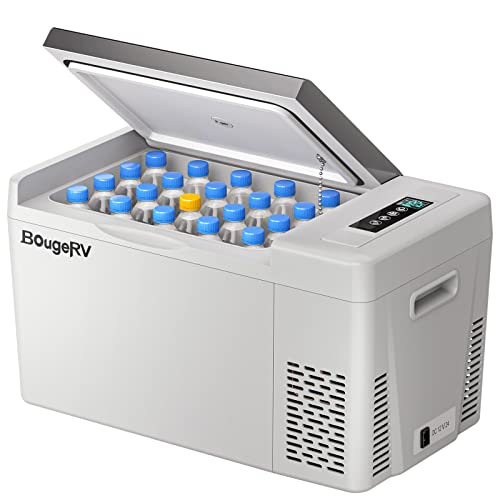
BougeRV CR22 23 Quart 12V Portable Refrigerator
Best for solo trips and tight cargo space under $200
BougeRV CR22 23 Quart 12V Portable Refrigerator
Best for solo trips and tight cargo space under $200
What we like
- SECOP compressor inside — same compressor brand used in units costing twice as much.
- Reaches 32°F from 77°F in 15 minutes flat, which is faster than most fridges at any price.
- 22.3 lbs makes it genuinely one-hand portable when the basket is empty.
- Three-level battery protection prevents you from draining your starter battery overnight.
What we don't
- No app or Bluetooth — temperature is set and monitored on the unit only.
- 22L fills up fast for two people; a 3-night trip with real food takes planning.
- Lid seal is adequate but not as tight as Dometic or ARB — keep it out of heavy rain.
You're not getting Dometic build quality at this price, but you are getting a SECOP compressor — and that's the only spec that truly matters for long-term reliability on a vehicle fridge. Pick this if you're solo, your cargo space is tight, or you want to test a compressor fridge before committing to a premium unit.
Step up to the Dometic or ICECO if you need more capacity or plan trips longer than 4 days.
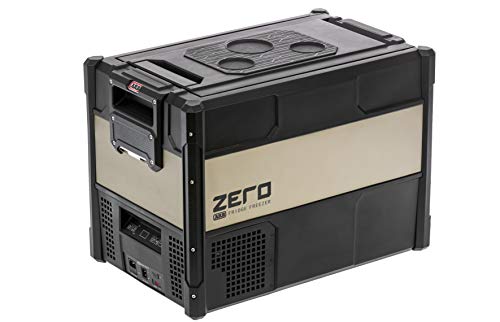
ARB 10802442 Zero Single Zone 47QT Portable Fridge Freezer
Best for serious overlanding and extended backcountry runs
ARB 10802442 Zero Single Zone 47QT Portable Fridge Freezer
Best for serious overlanding and extended backcountry runs
What we like
- Front and rear DC inlets let you mount it any direction in your truck bed or drawer system without cable issues.
- Bluetooth app monitors temp history, not just current reading — useful for diagnosing power drops overnight.
- Built for 4WD vibration from the ground up — ARB engineered this for corrugated dirt roads, not parking lots.
- 65-can capacity handles two people comfortably for 10+ days without restocking.
What we don't
- At $580–$680 it's the most expensive unit here by a wide margin.
- 38.6 lbs empty means you need two people or a fridge slide to move it loaded.
- Some units ship with a cracked corner plastic — documented in reviews, worth inspecting on arrival.
If you're running a purpose-built overlanding setup with a second battery, a drawer system, or a trailer, the ARB Zero is engineered for exactly that environment — not adapted from a home appliance the way some cheaper units are. This is overkill for a weekend car camper and essential for a 4WD tourer doing remote multi-week runs.
If you don't have a dual-battery system already, the Dometic CFX3 is a better starting point at $250 less.
ICECO VL35 ProS 12V Portable Refrigerator
Best for van life and daily-driver vehicle setups
ICECO VL35 ProS 12V Portable Refrigerator
Best for van life and daily-driver vehicle setups
What we like
- Multi-directional lid opens four ways without tools — major advantage when the fridge is wedged into a vehicle build.
- DC ports on both sides of the unit means you never have to reposition it to reach the power inlet.
- SECOP compressor with a 5-year manufacturer warranty — longer than anything else at this price.
- Metal shell accepts the optional ICECO magnetic battery as a bolt-on power extension with no extra cables.
What we don't
- No app control — monitoring is display-only on the unit itself.
- The insulated cover costs extra and really should be included at this price point.
- Slightly deeper than the BougeRV, which can be an issue in narrow cargo areas.
The rotating lid alone makes this the best choice for any built-in van or truck setup where the fridge sits tight against a wall — you're not fighting to open it at an awkward angle every time you need a drink. This hits the sweet spot between the BougeRV's entry price and the Dometic's premium tier.
Skip it if you want app control or the longest brand pedigree; pick it if you want German compressor quality and a lid that actually works in confined spaces.
Alpicool T36 Dual Zone 12V Portable Refrigerator
Best for families who need fridge and freezer at the same time
Alpicool T36 Dual Zone 12V Portable Refrigerator
Best for families who need fridge and freezer at the same time
What we like
- Detachable zone divider means you can run it as single-zone or split fridge/freezer depending on the trip.
- Foldable handles and built-in wheels make it the most physically manageable large-capacity option here.
- Runs on 12/24V DC and 100–240V AC, so it works at home, in the car, and at a powered site without any adapter.
- Three-level battery protection with temperature memory — settings survive a power interruption.
What we don't
- Single compressor powering two zones means the zones influence each other — independent control is limited compared to true dual-compressor units.
- No Bluetooth or app — display panel only.
- Build quality on the lid and handle feels noticeably lighter than Dometic or ICECO at the same capacity.
Getting dual-zone capability under $250 is genuinely rare in this category — and the Alpicool T36 delivers it by using a single compressor with a divider, which works well enough for most family camping use cases where you're not doing precision temperature management. This is the pick if you want frozen meat and cold drinks in one box without spending $400+.
Move up to the Dometic or ARB if you need more reliability on extended trips or harsh-condition overlanding where build quality is a real variable.
What to Look For
Compressor brand matters more than price tier. Only SECOP (formerly Danfoss) and Embraco compressors are worth putting in a vehicle — they handle tilt, vibration, and extreme ambient temps without failing.
Capacity is measured in liters, not quarts, across serious brands. A 35L fridge holds roughly 47 standard 12oz cans; a 47L holds 65 — plan around what you actually need per day, not the biggest number.
Dual-zone is a real feature, not a gimmick. If you want cold drinks at 4°C and frozen meat at -18°C at the same time, you need independent zones — single-zone fridges force you to pick one or the other.
Who Should Skip This
If you're car camping once a year at a drive-in site with power hookups, a good cooler with quality ice is still cheaper and simpler. Portable fridges earn their price on multi-day trips away from power, overlanding runs, or van life setups where food loss from melted ice is a recurring cost.
If your trips are under 48 hours and you're always near a store, skip it.
What the Community Actually Uses
On r/overlanding, the portable fridge conversation comes up constantly — and the consensus is clear: Dometic and ARB are the community trust standards, with ICECO gaining serious ground for budget-conscious builds. Threads on r/vandwellers and r/CampingandHiking echo the same pattern: once someone switches from a cooler to a compressor fridge, they never go back.
The recurring complaint about cheap brands is compressor failure in the second summer — the community consistently warns against anything not running SECOP or Embraco internals.
Quick Picks — In Case You've Already Decided
BougeRV 12 Volt Refrigerator 23 Quart Portable Freezer
Check Price on AmazonFrequently Asked Questions
Can I run a portable fridge off my car battery without draining it?
Yes, but you need to manage it carefully. Most fridges draw 35–45W and most compressors cycle on about 50% of the time, so real average draw is closer to 20W. A standard 100Ah car battery gives you roughly 30–40 hours, but you should never discharge below 50% or you risk not being able to start your engine. All quality fridges include a low-battery cutoff — make sure yours is set correctly.
What size portable fridge do I actually need?
A 20–25L fridge is enough for one person on a 3–4 day trip. Two people for a week need 35–45L. If you're buying meat in bulk or want a dedicated freezer zone, go 47L or larger. When in doubt, size up — a fridge that's too small is a constant frustration.
Is a dual-zone portable fridge worth the extra cost?
Only if you genuinely need frozen and refrigerated at the same time. If you just want cold drinks and cold food, a single-zone fridge set to 2–4°C is fine. Dual-zone adds weight, cost, and complexity — it pays off on week-long trips where you need fresh meat frozen until day 5.
Can a portable fridge handle the heat inside a locked vehicle?
Yes, quality compressor fridges are rated to work in ambient temperatures up to 40–43°C — which is typical of a hot car interior. Performance does drop above that threshold. Parking in shade and using an insulated cover helps significantly, and it reduces your power draw at the same time.
What's the difference between a portable fridge and a 12V cooler?
Thermoelectric coolers (12V coolers) can only drop temperature 20–40°F below ambient — they cannot freeze anything and struggle in hot weather. Compressor fridges work exactly like a home refrigerator and can reach -22°C regardless of outside temperature. For actual food preservation, only a compressor fridge is reliable.
Buying Guide
You need to match capacity to your trip length and vehicle space before anything else. A 20–25L fridge fits one person for a weekend; 35–45L handles two people for a week.
Always check your power setup — most 12V fridges draw 35–45W, which means a 100Ah battery gives you roughly 20–24 hours without solar or alternator charging.