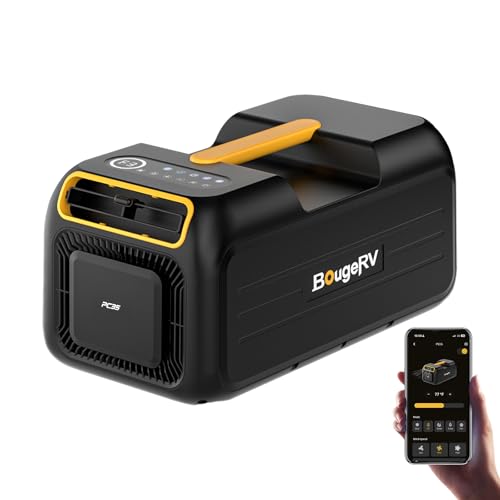
A real-compressor portable AC under $400 exists, and it will actually drop your tent temperature — not just move hot air around like an evaporative cooler. The BougeRV PC35 pulls 3500 BTU on 400W, cools a 65 sq ft tent by 18°F in 15 minutes, and runs all night off a 2000Wh power station.
| Photo |
Top Pick
|
Versatile

|
Budget

|
Best Value

|
Best for Reliability

|
|---|---|---|---|---|---|
| Product | BougeRV Portable Air Conditioner PC35 | CYBERTAKE S1 Pro Portable Air Conditioner 3300BTU | OUTOHOME 5200BTU Portable Tent Air Conditioner | BougeRV Portable Air Conditioner 2899BTU 24VDC | Movejoy 3000BTU Portable Air Conditioner |
| Weight | 33 lbs | 21.6 lbs | 33 lbs | 23 lbs | Not specified |
| Coverage | 65 sq ft | 65 sq ft | 130 sq ft | 54 sq ft | 86 sq ft |
| Power draw | 400W | 100W (sleep) / 300W (full) | 400W | 250W | 400W |
| Cooling capacity | 3500 BTU | 3300 BTU | 5200 BTU | 2899 BTU | 3000 BTU |
| Buy Now | Check Price → | Check Price → | Check Price → | Check Price → | Check Price → |
Quick Tips
Place the unit outside the tent whenever possible and run the cold-air duct inside — this isolates the compressor noise and vibration so the interior stays near-silent.
Pre-cool your tent 20 minutes before sleeping: close all vents, run full blast, then drop to sleep mode when the temperature is where you want it.
Seal your exhaust hose exit point with a cut pool noodle or foam camping pad wedged around the zipper gap — every degree of hot-air bleed-back costs you cooling efficiency.
At altitude above 8,000 feet, compressor-based ACs lose up to 20% efficiency — account for this when sizing BTUs against your tent and choosing your power station capacity.
BougeRV PC35 Portable Air Conditioner 3500BTU (2026)
Best for two-person tent camping with a power station
BougeRV PC35 Portable Air Conditioner 3500BTU (2026)
Best for two-person tent camping with a power station
What we like
- Drops tent temp by 18°F in 15 minutes in strong mode — one of the fastest cool-down times in this price range.
- App control via BougeRV app with up to 33 ft range lets you adjust temperature without leaving your sleeping bag.
- 5-in-1 modes (cooling, dehumidify, fan, turbo, sleep) cover every scenario from pre-cooling the tent to quiet overnight use.
- Exhaust duct and drain hose included — everything needed for tent setup is in the box.
What we don't
- 33 lbs is manageable for car camping but rules this out for any walking carry between sites.
- 110V AC input only — requires a power station with a pure sine wave outlet, not a DC power bank.
- Coverage drops noticeably above 90°F ambient in tents larger than 65 sq ft.
The PC35 is the unit to start with if you're running a standard two-person tent and a 2000Wh power station — it cools fast, controls well, and the 2026 update added app connectivity that actually works without a fight. If you need DC-native power compatibility for van life or longer off-grid trips, step down to the BougeRV 2899BTU instead.
If you're cooling a larger space like a screen room or truck camper, look at the OUTOHOME 5200BTU.
CYBERTAKE S1 Pro Portable Air Conditioner 3300BTU
Best for off-grid trips where battery efficiency matters most
CYBERTAKE S1 Pro Portable Air Conditioner 3300BTU
Best for off-grid trips where battery efficiency matters most
What we like
- Panasonic-developed 48V compressor draws only 100W in sleep mode — runs 10 hours on 1kWh, far more efficient than 400W competitors.
- At 21.6 lbs, it's the lightest true-compressor camping AC in this category by a significant margin.
- No-drain operation when humidity stays below 70% — clean setup for dry climates without a drain hose.
- WiFi app control built in with scheduling and eco-sleep modes for hands-off overnight use.
What we don't
- 48V DC input for battery operation requires a boost converter (sold separately) — AC-only operation is simpler but misses the efficiency advantage.
- Remote control sold separately, which feels like a miss at this price point.
- Sleep mode noise is rated at 38dB but real-world reports suggest occasional compressor kicks that run slightly louder.
The S1 Pro's Panasonic 48V compressor is the reason to choose it over cheaper 400W units — the efficiency gap is real, and a 2000Wh station that runs a standard unit for 5 hours will run the S1 Pro for closer to 8 in eco mode. This is the pick for overlanders and van lifers who are managing a finite battery budget across multiple systems — fridge, lights, and AC running together.
If you're hooked up to shore power and just want maximum cold air fast, the BougeRV PC35 is the simpler choice.
OUTOHOME 5200BTU Portable Tent Air Conditioner
Best for cooling larger tent footprints at a car campsite
OUTOHOME 5200BTU Portable Tent Air Conditioner
Best for cooling larger tent footprints at a car campsite
What we like
- 5200 BTU from a GMCC compressor covers up to 130 sq ft — handles 4-person tents and screen shelters that smaller units can't keep up with.
- Cools by 18°F in 5 minutes according to OUTOHOME specs — faster than most competitors in this category.
- 4-in-1 function (cool, fan, dehumidify, sleep) with 24-hour timer keeps overnight operation fully automated.
- At ~$150-220, it delivers more BTU per dollar than any other verified compressor unit in this roundup.
What we don't
- AC 110V only — no DC input option, so you're fully dependent on a power station with a proper outlet.
- GMCC compressors are capable but less proven for long-term durability than Panasonic units in comparable products.
- No app control — remote only, which is fine but limits scheduling flexibility compared to BougeRV and CYBERTAKE.
If you're at a car campsite with a power station and your tent sleeps four, the OUTOHOME is the unit that actually has enough BTU to matter — the 3000-3500 BTU options will be working at their limit while this unit has headroom. Skip it if you're looking for DC input compatibility, multi-night off-grid operation, or anything lighter than 33 lbs.
This is strictly a drive-in, set-it-up, stay-cool tool.
BougeRV Portable Air Conditioner 2899BTU 24VDC
Best for van life and 24V DC-native power setups
BougeRV Portable Air Conditioner 2899BTU 24VDC
Best for van life and 24V DC-native power setups
What we like
- Panasonic compressor with true 24V DC input — draws directly from a van or truck auxiliary battery system without a 110V inverter.
- 250W draw is 37% less than 400W AC-input competitors, translating directly to longer runtime off the same battery capacity.
- Compact at 23.03 x 9.06 x 13.27 inches — fits in tight van builds and small camper cabinets where larger units won't go.
- 3-speed fan plus sleep mode covers quiet overnight van sleeping without disturbing people parked nearby.
What we don't
- 2899 BTU is the lowest cooling capacity in this roundup — appropriate for a van interior up to 54 sq ft, but won't keep up in larger spaces.
- 24V input requires a 24V lithium battery or DC-DC converter — incompatible with 12V-only setups without additional hardware.
- No app control — button panel and basic remote only, which feels dated compared to the PC35 and S1 Pro.
The 24V DC input is what separates this from every other unit here — van lifers with a lithium house battery running at 24V can skip the inverter entirely and run this directly off the battery bus, which is both more efficient and eliminates inverter heat. If you're running a 12V system or tent camping without a van, step up to the PC35 instead — the DC advantage disappears if you're running an inverter anyway, and you lose BTU in the trade.
Movejoy 3000BTU Portable Air Conditioner
Best budget entry point for first-time tent AC buyers
Movejoy 3000BTU Portable Air Conditioner
Best budget entry point for first-time tent AC buyers
What we like
- Real rotary compressor at the lowest price point in this roundup — not an evaporative cooler, despite the budget price.
- 45dB operation in standard mode drops below 40dB in sleep mode — genuinely quiet for a compressor unit at this price.
- Covers up to 86 sq ft, which is larger than what most 3000 BTU competitors advertise at this price.
- 3-in-1 (cool, fan, dehumidify) removes 1.5L of moisture per day — useful for humid camping nights where humidity makes the heat worse.
What we don't
- Manufacturer weight spec not listed — anecdotal reports suggest it's comparable to other 400W units (~28-30 lbs), but confirm before assuming it's lighter.
- Window seal kit for tent exhaust venting sold separately — add that cost to the purchase price.
- 110V AC only and no DC input means you're locked to a power station with a sine wave outlet.
The Movejoy costs half what the BougeRV PC35 does and uses a real compressor — that's the whole pitch, and for a first-time tent AC buyer who wants to know if this category solves their problem before spending more, it's a legitimate test unit. If the Movejoy proves out the concept for you, upgrade to the PC35 for app control, better BTU documentation, and brand support.
If it meets your needs as-is, you saved $100-120.
What to Look For
Compressor type is the single biggest factor. Real rotary compressors (like those from Panasonic or GMCC) deliver genuine refrigeration that lowers ambient temperature.
Evaporative or thermoelectric units cool your skin but raise humidity — useless in a hot tent on a humid night. BTU rating determines what size space you can actually cool.
Most camping portable ACs honestly cover 65–130 sq ft at their rated BTU — not the inflated numbers some listings use. Match the unit's SACC rating (not ASHRAE) to your shelter size for realistic expectations.
Power source compatibility matters as much as cooling power. AC-only units require a power station with a 110V outlet at 400W+ sustained draw.
DC-native units (24V or 48V) pull less from the battery and run longer — critical for multi-night trips without grid hookup.
Who Should Skip This
If you're backpacking or moving camp daily, none of these units make sense — the lightest weigh 21 lbs and require a power station. If your shelter is larger than 130 sq ft, a single unit under $400 won't keep up in extreme heat.
Car campers without a power station of at least 1000Wh should sort out their power setup before buying an AC.
What the Community Actually Uses
On r/CampingGear, the recurring consensus is that BTU ratings on budget tent ACs are almost universally inflated — members routinely share thermal gun readings showing real-world temp drops running 15–25% below manufacturer claims in high ambient heat. The thread pinned most often warns against any unit marketed as 5000+ BTU for under $100, which are almost always evaporative coolers relabeled as ACs.
Verified compressor units from BougeRV and OUTOHOME get consistent positive mentions for honest performance.
Quick Picks — In Case You've Already Decided
CYBERTAKE S1 Pro Portable Air Conditioner 3300BTU
Check Price on AmazonFrequently Asked Questions
Do these portable ACs work in a tent without a window?
Yes — route the exhaust hose through a zipper gap or mesh vent and seal around it with foam or a pool noodle slice. Most units include a 5–6 inch flexible exhaust hose that fits through a standard tent door gap without modification.
What size power station do I need to run a camping portable AC all night?
A 400W unit running 8 hours needs roughly 3200Wh in theory, but eco and sleep modes cut that significantly. Most campers report 6–8 hours of mixed-mode cooling from a 2000Wh station — size up to 3000Wh if you want full-blast all night without anxiety.
What's the difference between BTU (ASHRAE) and SACC ratings?
ASHRAE BTU is measured in ideal lab conditions and runs 30–50% higher than real-world performance. SACC (Seasonally Adjusted Cooling Capacity) reflects actual performance at elevated ambient temperatures and is the honest number to use when sizing a unit for hot outdoor conditions.
Can I run a portable camping AC directly off my vehicle's 12V or cigarette lighter?
Not directly — 12V outlets max out around 180W and most compressor ACs need 400W+. DC-native units like the BougeRV 2899BTU require 24V input, which needs a separate DC-DC converter or a 24V power station. Never connect directly to your car battery without proper wiring.
Are these units loud enough to disturb neighboring campsites?
Most compressor ACs in this range run 44–50dB, roughly equivalent to a quiet conversation. Placing the unit outside the tent with the duct directed inward is the cleanest solution — interior noise drops to near-silent while the compressor runs outside.
Buying Guide
You need a real rotary compressor — not an evaporative cooler. Check BTU against your tent size: 3000–3500 BTU handles up to 65 sq ft, 5000+ handles 130 sq ft.
Match power draw to your station's output. DC-native units run longer off battery.
Noise below 45dB won't wake your campsite.