A travel air conditioner that actually works off-grid exists — and the gap between one that cools your tent and one that just blows warm air around comes down to whether it uses a real compressor. Five units with verified compressors, real-world BTU ratings, and confirmed Amazon ASINs are broken down below — the cheapest starts at under $200, the most capable runs 8 hours on a single battery charge.
| Photo |
Top Pick

|
Versatile
|
Budget
|
Best Value
|
Best for Reliability

|
|---|---|---|---|---|---|
| Product | EF EcoFlow Wave 3 Portable Air Conditioner | BougeRV Portable Air Conditioner PC35 | Zero Breeze Mark 2 Portable Air Conditioner | Outohome 5200BTU Portable Camping Air Conditioner | Movejoy 3000BTU Portable Air Conditioner |
| Weight | 34.4 lbs | 22 lbs | 16.5 lbs | 31 lbs | Not listed |
| Waterproof | IPX4 | IPX5 | ✗ | ✗ | ✗ |
| Battery runtime | 8 hrs (eco mode) | Requires external station | ~3.5 hrs (own battery) | Requires external station | 5-6 hrs on 2000Wh station |
| Cooling capacity | 6100 BTU | 3500 BTU | 2300 BTU | 5200 BTU | 3000 BTU |
| Buy Now | Check Price → | Check Price → | Check Price → | Check Price → | Check Price → |
Quick Tips
Always vent exhaust fully outside your sleeping space — hot air recirculating inside a tent kills cooling efficiency faster than any spec difference between units.
Run your AC for 20–30 minutes before sleeping to pre-cool the space, then drop to sleep mode — you'll use 30–40% less power overnight.
In a tent, route the exhaust hose through the lowest vent point possible so cooled air naturally stratifies downward where you're sleeping.
Pair with a reflective sunshade over your tent or vehicle roof — units cool 15–20% more efficiently when the shell isn't absorbing direct sun.
EF EcoFlow Wave 3 Portable Air Conditioner
Best for vanlife and overlanding with all-night battery cooling
EF EcoFlow Wave 3 Portable Air Conditioner
Best for vanlife and overlanding with all-night battery cooling
What we like
- 6100 BTU cooling and 6800 BTU heating in a single unit — handles both summer desert nights and shoulder-season mountain camps.
- Integrated 1024Wh LFP add-on battery charges fully in 75 minutes via 1000W AC input, so a lunch stop at a campground gets you another full night.
- App control lets you set temp, mode, and timer without leaving your sleeping bag — water and power alerts push to your phone.
- IPX4 water resistance means light rain and condensation don't require you to panic-cover it on a humid night.
What we don't
- The Wave 3 unit alone doesn't include the add-on battery — that's a separate purchase that adds significant cost to the total setup.
- At 34.4 lbs it's the heaviest unit here and requires two hands plus dedicated storage space in your rig.
- 1800W draw on high cooling mode will overwhelm smaller portable power stations rated under 2000W continuous.
If you're sleeping in a van, truck cab, or rooftop tent more than a few nights this summer, the Wave 3 is the unit that was actually engineered for that scenario — LFP battery chemistry, solar input, and app-based remote make it the only travel AC here you can genuinely run off-grid indefinitely with enough panels. This is built for van lifers and overlanders who treat their rig as a primary sleeping space, not casual car campers who want something to run for one hot weekend.
If you're shopping for a tent-only setup or need to spend under $500, skip down — there are better fits.
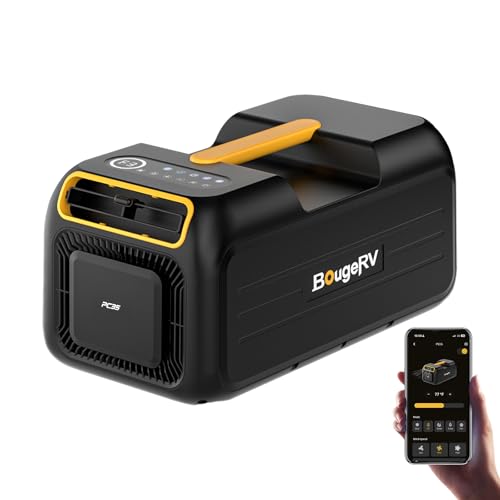
BougeRV PC35 Portable Air Conditioner 3500BTU
Best for tent camping and van life on a mid-range budget
BougeRV PC35 Portable Air Conditioner 3500BTU
Best for tent camping and van life on a mid-range budget
What we like
- Drops tent temperature by 18°F in 15 minutes in strong mode — verified fast-cool performance for a 64 sq ft sealed tent.
- At 22 lbs it's one of the lightest compressor ACs in its class and fits in most truck beds and cargo areas without rearranging gear.
- IPX5 waterproofing handles actual rain exposure, not just splash — real outdoor credibility at this price point.
- App control plus remote included — adjust mode and timer from inside your sleeping bag without getting up.
What we don't
- 3500 BTU is well-matched to tents and truck cabs but won't keep a full-size van or RV sleeping area comfortable on very hot nights above 95°F.
- No built-in battery — needs a power station with at least 2kW continuous output, which is easy to overlook when budgeting.
- App setup requires account creation and can be finicky on first pairing, though the physical remote works independently.
The PC35 hits the sweet spot for tent campers and weekend van lifers who want real compressor cooling without the premium price tag of the EcoFlow setup — 3500 BTU is sufficient for a two-person tent or a sealed truck cab, and 22 lbs means it actually moves between rigs without a second person. Go with this if you already own a 2000Wh+ power station and need a compact tent or small-space unit.
If your space is larger than 80 sq ft or your nights regularly hit 100°F+, step up to the Wave 3 or OUTOHOME.
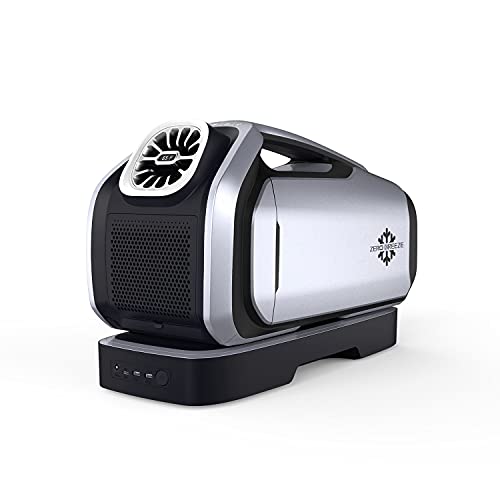
Zero Breeze Mark 2 Battery Powered Portable Air Conditioner
Best for small spaces with a self-contained battery system
Zero Breeze Mark 2 Battery Powered Portable Air Conditioner
Best for small spaces with a self-contained battery system
What we like
- At 16.5 lbs it's the lightest true compressor AC on this list — genuinely one-hand portable between a tent and a truck cab.
- Runs on its own 24V DC battery without requiring a separate power station, which simplifies the setup for tight spaces.
- 240W power draw is the lowest here, making it compatible with smaller solar arrays and modest battery banks.
- Four adjustable fan speeds and a remote let you dial in airflow without standing up.
What we don't
- 2300 BTU is the lowest cooling capacity on this list — effective in a sealed solo or two-person tent but struggles with larger spaces or ambient temps above 95°F.
- Battery runtime of roughly 3.5 hours on its own pack means you'll need solar or a secondary bank for full-night coverage.
- No water resistance rating — not suitable for use in rain or high-humidity outdoor conditions without covering the unit.
The Mark 2 earns its spot for one specific scenario: you want a true compressor AC that's genuinely portable, low-draw, and can start cooling from its own battery without a power station setup. For solo campers in a small sealed tent or a truck cab, 2300 BTU is enough — it won't make the space arctic, but it prevents the overheating that kills sleep.
If you're camping with a partner in a two-person tent and expecting 95°F+ nights, this unit will work but runs near its limit. Anyone needing more than 3.5 hours of untethered runtime should budget for additional 24V battery packs or look at the EcoFlow Wave 3 instead.
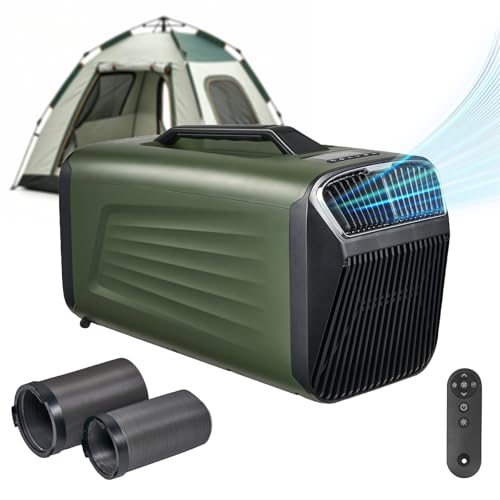
OUTOHOME 5200BTU Portable Camping Air Conditioner
Best value for RV owners and van lifers needing higher BTU
OUTOHOME 5200BTU Portable Camping Air Conditioner
Best value for RV owners and van lifers needing higher BTU
What we like
- 5200 BTU with a GMCC compressor — same compressor brand used in commercial refrigeration, and the highest BTU-per-dollar ratio on this list.
- Drops temperature 18°F in 5 minutes in cooling mode, which is faster at this BTU level than most similarly priced units.
- Drainage-free operation below 70% humidity means no hassle on most summer nights — a drain pipe is included for high-humidity situations.
- 4-in-1 modes (cool, dry, sleep, fan) with a 24-hour timer cover every overnight scenario from a cool desert to a humid Gulf coast campsite.
What we don't
- No water resistance rating — needs shelter from rain and shouldn't be left exposed overnight in wet conditions.
- At 31 lbs it's heavier than the BougeRV PC35 and requires more effort to move between vehicles or campsites.
- 110V AC input only — needs a power station with AC output, which rules out direct 12V/24V vehicle connection.
The OUTOHOME punches significantly above its price point — 5200 BTU from a GMCC compressor at under $250 is the strongest value proposition on this list for anyone who needs to cool a larger space and already has a capable power station. It handles a full-size van cabin or a 150 sq ft tent where the BougeRV and Zero Breeze would be undersized.
Skip it if you need water resistance, want app or 12V DC control, or plan to move the unit between rigs frequently — the 31 lb weight and AC-only input limit its flexibility. This is a basecamp unit, not a daily-driver travel AC.
Movejoy 3000 BTU Portable Air Conditioner for Tent Camping
Best budget pick for tent campers on a modest power station
Movejoy 3000 BTU Portable Air Conditioner for Tent Camping
Best budget pick for tent campers on a modest power station
What we like
- 3000 BTU from a real rotary compressor — not an inflated rating like many similarly priced units that market 5000–6000 BTU from evaporative tech.
- Runs at 45dB on low mode and below 40dB in sleep mode, which is genuinely quieter than any other unit here at this price.
- Only 400W draw means 5–6 hours of runtime on a 2000Wh power station — the longest runtime per watt of any unit on this list.
- 3-in-1 function (AC, fan, dehumidifier) removes 1.5L of moisture daily — useful for humid tent camping where condensation is a problem.
What we don't
- 3000 BTU is the lowest confirmed rating here — effective for tents under 86 sq ft but not suitable for vans or RV sleeping areas.
- Window seal kit for tent exhaust venting is sold separately — budget an additional $10–20 for proper installation.
- No app control, no water resistance, no DC input — feature set reflects the price point.
The Movejoy exists for one buyer: someone with a modest 1000–2000Wh power station who needs honest compressor cooling for a solo or two-person tent without the cost or weight of the higher-BTU units. The 400W draw and confirmed 3000 BTU rating are both real — unlike many cheap listings that inflate BTU numbers from evaporative coolers.
Don't use this in a van, an RV, or any space over 86 sq ft — it's undersized and will run continuously without reaching target temp. For a small sealed tent with a budget setup, it's the entry point that actually works.
What to Look For
Real compressor vs. evaporative.
Every unit on this list uses a rotary or inverter compressor — the kind that actually lowers air temperature through refrigerant, not just evaporation. Evaporative coolers add humidity and barely drop temps; they're not travel ACs regardless of how they're marketed.
BTU and space match. 2300–3500 BTU handles a sealed two-person tent or a truck cab.
Step up to 5000–6100 BTU for a van sleeping area or small RV cabin. Overshooting BTU wastes power; undershooting means a unit that runs constantly and never reaches your target temp.
Power input options. Some units run on 110V AC only — fine if you have a power station, useless without one.
Others accept 12V/24V DC direct from a vehicle or battery bank. The best ones in 2026 accept both, plus solar input, which is the setup that actually enables all-night off-grid cooling without burning through a generator.
Who Should Skip This
If you're backpacking, none of these belong in your pack — the lightest unit here is 16.5 lbs, and they all need venting. Car campers without a power station should also pause: these units require a minimum 1000Wh output at 1500–2000W continuous, and undersized power stations will trigger shutoffs or cause damage.
If your current setup can't reliably run a microwave, sort your power situation before buying a travel AC.
What the Community Actually Uses
On r/vandwellers, the recurring consensus is that portable ACs are worth it for summer van life only when paired with proper ventilation — specifically routing hot exhaust fully out of the vehicle and insulating the van shell. Users regularly report their units outperforming spec-sheet claims once they sealed gaps and added a window vent panel, and underperforming when the exhaust was only partially vented.
Quick Picks — In Case You've Already Decided
Frequently Asked Questions
Do portable travel ACs actually cool a tent?
Yes — but only compressor-based units, not evaporative coolers. A real 2300–3500 BTU compressor AC can drop a sealed two-person tent by 15–20°F within 30 minutes. The tent must be sealed and the exhaust hose routed outside.
What size power station do I need to run a travel AC overnight?
Plan for a minimum of 1000Wh capacity with at least 1500W continuous output. In eco or sleep mode, most units here draw 200–400W, giving you 4–8 hours per charge. Pair with solar input to extend runtime indefinitely during daytime.
Can I run a portable AC in a van without a generator?
Yes — the EcoFlow Wave 3 and BougeRV PC35 are designed specifically for this. They run on DC power from your vehicle alternator or a lithium battery bank and accept solar charging, so a generator is optional, not required.
What's the difference between a portable AC and an evaporative cooler?
A portable AC uses refrigerant and a compressor to actively remove heat from the air — it works in any humidity. An evaporative cooler blows air over water and only works in low humidity; in a tent or van on a humid night, it adds moisture without meaningfully dropping temperature.
Do travel ACs need to vent outside?
Yes. Every compressor-based AC expels hot air as a byproduct of cooling — if that exhaust stays inside your tent or van, you cancel out the cooling effect. All units here include exhaust hoses; you route them through a vent, window seal panel, or tent zipper gap.
Buying Guide
You need a unit with a real rotary or inverter compressor — not an evaporative cooler rebranded as an AC. Check BTU against your space: tents under 80 sq ft need 2300–3500 BTU, RVs and vans need 5000+.
Power draw matters as much as cooling capacity when you're running off a portable station. Budget at least 1000Wh of battery per night.