Sleeping in a hot camper past midnight isn't a preference problem—it's a gear problem, and the right portable AC unit solves it completely. The five units below are all compressor-based, verified on Amazon, and the top pick cools a 50 sq ft van space from 86°F to 68°F in under 15 minutes.
| Photo |
Top Pick
|
Versatile
|
Budget
|
Best Value
|
Best for Reliability

|
|---|---|---|---|---|---|
| Product | EcoFlow Wave 2 Portable Air Conditioner (Battery Not Included) | Cybertake S2 Pro Portable Camping Air Conditioner | Zero Breeze Mark 2 Portable Air Conditioner | BougeRV Portable Air Conditioner PC35 | OUTOHOME 5200BTU Portable Tent Air Conditioner |
| Weight | 38.6 lbs | 25.6 lbs | 16.5 lbs | 33.07 lbs | 31 lbs |
| Power draw | 1,050W max / ~150W eco | 100W eco / 600W max | 240W / ~100W sleep mode | ~250W | 400W |
| Cooling btu | 5,100 BTU | 5,100 BTU | 2,300 BTU | 3,500 BTU | 5,200 BTU |
| Battery compatible | ✓ | ✓ | ✓ | ✓ | ✗ |
| Buy Now | Check Price → | Check Price → | Check Price → | Check Price → | Check Price → |
Quick Tips
Insulate your van or roof tent first—even the best AC unit loses half its efficiency to a single uninsulated wall panel.
Run your AC on a dedicated power station, not through a cheap inverter off your vehicle battery—voltage sag kills compressors.
Pre-cool before you sleep: run the unit on high for 20 minutes, drop the space 15°F, then switch to sleep mode to preserve battery.
Vent both exhaust hoses away from the sleeping area—recirculated hot air cuts cooling output by up to 30%.
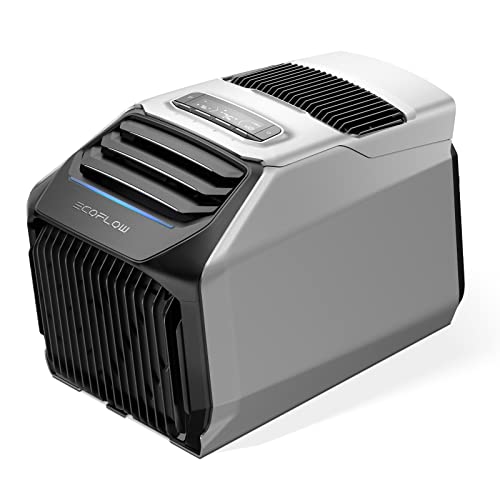
EF EcoFlow Wave 2 Portable Air Conditioner
Best for van lifers who want off-grid AC with heat and no installation
EF EcoFlow Wave 2 Portable Air Conditioner
Best for van lifers who want off-grid AC with heat and no installation
What we like
- Cools and heats in the same unit—drops or raises temp by 18°F in 5 minutes using EcoFlow's custom compressor.
- App-controlled with sleep mode at 44 dB—quiet enough to run all night without waking a partner.
- No installation required and no drainage needed in cooling mode below 70% humidity.
- Pairs natively with EcoFlow Delta 2 and Delta Pro stations for 7–14 hours of runtime in eco mode.
What we don't
- Battery add-on sold separately—the base unit alone won't run wirelessly without purchasing the 1,159Wh pack.
- At 38.6 lbs it's the heaviest unit in this list—not a one-handed carry.
- 110V adapter is required for wall power, which adds a charging step if you're running between shore power and off-grid.
The Wave 2 is the only unit here that does both cooling and heating in a package that requires zero drilling, zero plumbing, and runs entirely off a portable power station. If your summer setup already includes an EcoFlow power station, this is a plug-and-play upgrade that turns your van into a livable space year-round.
This is the pick for full-time van lifers, campervan builds, and anyone doing multi-week trips where weight is acceptable but comfort is non-negotiable. If you're a weekend warrior with a small power station under 700Wh, the BougeRV or Cybertake will stretch your battery further.
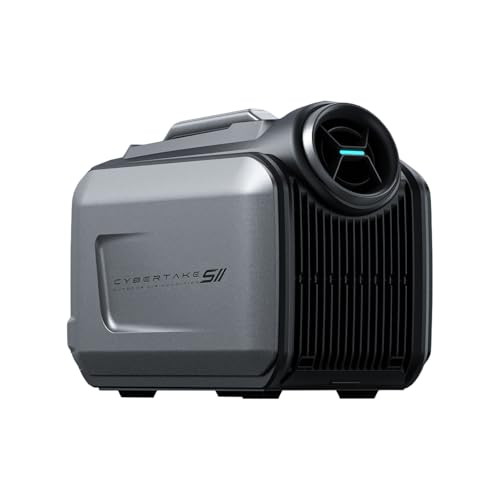
Cybertake S2 Pro Portable Camping Air Conditioner
Best for off-grid campers who need max efficiency on limited battery
Cybertake S2 Pro Portable Camping Air Conditioner
Best for off-grid campers who need max efficiency on limited battery
What we like
- 8 hours of cooling on just 1kWh in ECO+ mode—the most power-efficient compressor unit in this roundup.
- Three-way power: 48V DC, 12–24V vehicle input, and 100–240V wall—works with almost any setup.
- 5,100 BTU with heating at 6,100 BTU makes it a true four-season unit for cold-desert nights.
- Drain-free operation in normal humidity conditions, with port available for high-humidity environments.
What we don't
- At $300–$450, it costs more than the Outohome but requires its own power station—budget accordingly.
- The 48V DC input requires a compatible power station or boost converter if you're running a 12V vehicle system.
- Newer brand with less long-term reliability data than EcoFlow or Zero Breeze.
The Cybertake S2 Pro's 100W eco mode is the headline number—it means a 1,000Wh power station gets you through a full 8-hour sleep without sweating the gauge. That efficiency combined with 5,100 BTU of real compressor cooling puts it ahead of nearly everything at this price.
Buy this if you're running a mid-size power station (500–1,500Wh) and want the most runtime per dollar without giving up real cooling output. It's not the call if you're already deep in the EcoFlow ecosystem—the Wave 2 integrates better—but for brand-agnostic off-grid setups it's the efficiency winner.
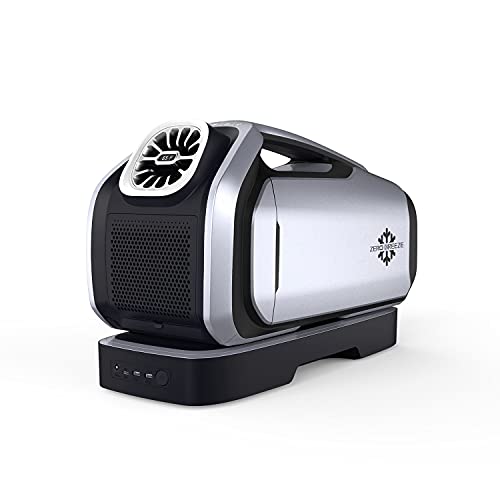
Zero Breeze Mark 2 Portable Air Conditioner
Best for roof tent campers and solo van travelers who prioritize portability
Zero Breeze Mark 2 Portable Air Conditioner
Best for roof tent campers and solo van travelers who prioritize portability
What we like
- At 16.5 lbs with a single-hand carry handle, it's the lightest real-compressor AC unit available for campers.
- Micro dual-cylinder compressor drops outlet air temp by 30°F within 10 minutes in a properly sealed space.
- 24V DC native—runs on solar panels, vehicle battery via converter, or the proprietary 840Wh Mark 2 Battery.
- Compact enough to fit in a packed Jeep or roof tent storage compartment without sacrificing other gear.
What we don't
- 2,300 BTU is only enough to cool 25–40 sq ft under ideal conditions—not sufficient for a full-size van interior.
- Proprietary battery system means you're locked into Zero Breeze accessories for wireless operation.
- At $499–$599 it costs as much as the Wave 2 but cools a smaller space—the premium is for portability alone.
The Mark 2 exists for one specific person: the solo camper who sleeps in a roof top tent, compact SUV, or van cab and needs true AC they can carry with one arm. Nothing at this weight class uses a real compressor—everything else is evaporative, and that's not the same thing.
If you're cooling more than 40 sq ft or sleeping two people in a build-out van, the BTU ceiling will disappoint you—step up to the Cybertake or Wave 2. But for solo truck campers and RTT setups, the Mark 2 is still the only unit light enough to justify the weight penalty.
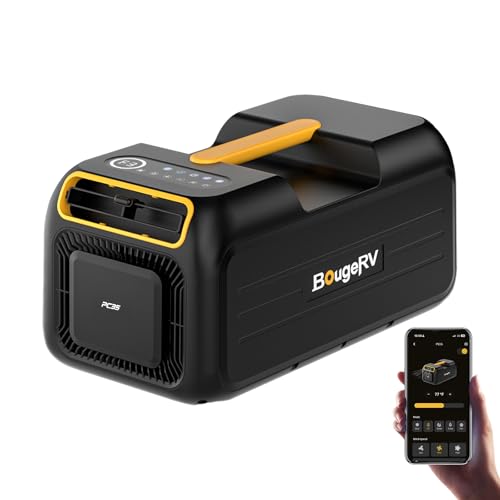
BougeRV PC35 Portable Air Conditioner 3500BTU
Best for budget-conscious campers who want app control and reliable cooling
BougeRV PC35 Portable Air Conditioner 3500BTU
Best for budget-conscious campers who want app control and reliable cooling
What we like
- Drops temperature by 18°F in 15 minutes in strong mode—BougeRV's Panasonic compressor is notably quiet and durable.
- Full app control via BougeRV app within 33 ft—adjusts temp, mode, and timer without leaving your sleeping bag.
- 5-in-1 modes (cooling, dehumidify, fan, strong, sleep) cover all conditions from muggy nights to dry desert heat.
- The best price-to-BTU ratio in this roundup—roughly half the cost of the Wave 2 with two-thirds of the cooling.
What we don't
- At 250W, you'll get about 4 hours from a 1,000Wh station in standard mode—plan for a larger battery for all-night cooling.
- 3,500 BTU is solid for a solo tent or compact van cab but undersized for a fully built-out campervan interior.
- 2026 model is new—long-term durability data on this specific version is still thin.
The BougeRV PC35 is the answer when you want a real compressor AC and a real budget at the same time. At $200–$280 with app control and a Panasonic compressor, it punches well above its price point for weekend campers.
Pair it with a 1,500Wh power station for full-night coverage, or use it for targeted evening cool-downs before switching to a fan for sleeping. If you're doing longer off-grid stretches where the battery math matters, the Cybertake S2 Pro's efficiency advantage is worth the price jump.
OUTOHOME 5200BTU Portable Tent Air Conditioner
Best budget pick for car campers and RV owners with shore power
OUTOHOME 5200BTU Portable Tent Air Conditioner
Best budget pick for car campers and RV owners with shore power
What we like
- 5,200 BTU GMCC compressor drops temp by 18°F in 5 minutes—more cooling power than units costing twice as much.
- Four modes (cool, dry, sleep, fan) with a 24-hour timer and remote control handle any camping comfort scenario.
- At 31 lbs with a single carry handle, it's manageable for one person to move between the cab and the tent.
- The lowest price for a true compressor-based camper AC in this roundup—significant savings over DC-native units.
What we don't
- 110V AC power only—requires a shore power hookup, a generator, or a power station with a 1,500W+ inverter.
- At 400W draw, a 1,000Wh power station runs it for roughly 2–2.5 hours maximum—not suitable for overnight battery use.
- No app control, no heating mode, and no DC compatibility—bare-bones feature set compared to the competition.
The OUTOHOME costs under $180 and delivers 5,200 BTU of genuine compressor cooling—that's a number that embarrasses units at three times the price. The catch is simple: it needs 110V, so it's built for campground hookups, RVs with shore power, and car campers running a generator or big inverter station.
Don't buy this if your setup is a standalone power station under 1,500W—the draw is too high for overnight use and you'll drain the pack by midnight. Do buy it if you camp with hookups regularly, hate spending money on gear, and want the most BTU per dollar available.
What to Look For
BTU rating tells you how fast a unit cools, but it means nothing without matching your space size. A 2,300 BTU unit cools a solo roof tent or compact van cab; you need 5,000+ BTU for a full camper van sleeping area.
Power input type is the spec most buyers overlook and most regret. DC-native units (24V or 48V) are far more efficient on battery power than 110V AC units run through an inverter.
Weight and handle design determine whether this unit actually travels with you. Units over 35 lbs without a solid grip tend to get left home after the first trip—check both specs before buying.
Who Should Skip This
If you're tent camping without a power station of at least 1,000Wh, no portable AC unit will give you a full night of cooling. Evaporative coolers are not listed here—they add humidity and don't produce real temperature drops in warm climates.
Skip the whole category if you're ultralight backpacking.
What the Community Actually Uses
On r/vandwellers, the recurring consensus is that fans and cracked windows stop cutting it once you're parked in the Southwest in July. The thread on 12V and 24V DC AC units gets resurfaces every summer with updated power draw tests—EcoFlow Wave 2 and Cybertake consistently come up as the two picks that don't wreck a mid-size power station overnight.
Quick Picks — In Case You've Already Decided
EcoFlow Wave 2 Portable Air Conditioner (Battery Not Included)
Check Price on AmazonCybertake S2 Pro Portable Camping Air Conditioner
Check Price on AmazonFrequently Asked Questions
Can a portable AC unit run off a 1,000Wh power station all night?
In ECO or sleep mode, DC-native units like the Cybertake S2 Pro and EcoFlow Wave 2 draw roughly 100W, giving you 8–10 hours from a 1,000Wh station. Higher BTU units on 110V AC draw 400W+, giving you only 2–2.5 hours on the same bank.
What's the difference between a portable AC and an evaporative cooler?
A portable AC uses a compressor and refrigerant to actually lower air temperature—it works in any climate. An evaporative cooler blows air over wet pads, adds humidity, and only works in dry climates below about 30% relative humidity.
Do I need to drain a portable camper AC unit?
Most units listed here use drain-free mode in cooling when humidity is below 70%, which covers most camping scenarios. In high humidity (Pacific Northwest, Southeast summer), you'll need to route a drain hose—check the spec before setup.
Will a 2,300 BTU unit cool a full camper van?
Not reliably. A 2,300 BTU unit like the Zero Breeze Mark 2 is rated for 25–40 sq ft in ideal conditions—that's a roof tent or compact cab, not a full conversion van interior. For a standard van build, look at 5,000 BTU and up.
Can I run a portable AC off solar panels directly?
Yes, if the unit accepts DC input at the panel's output voltage and you have enough panels for continuous draw. The EcoFlow Wave 2 and Cybertake S2 Pro both support solar input, but you'll typically need 400–600W of panels minimum to sustain cooling while the sun is up.
Buying Guide
The single most important spec is power draw—you need an AC that matches your power station. DC-native units like 24V or 48V models run 3–5× longer per kWh than 110V plug-in units.
Match BTU to your space: under 50 sq ft needs 2,300–3,500 BTU; up to 130 sq ft needs 5,000+ BTU. Check noise level if you sleep with it running.