You don't need a roof-mounted unit to sleep cool in a caravan — the right portable AC handles it without drilling a single hole. Five verified options from 2300 BTU battery-powered units to a 6500 BTU window-sill saddle mount start under $200 and top out around $1,200 with a battery included.
| Photo |
Top Pick
|
Versatile
|
Budget
|
Best Value
|
Best for Reliability
|
|---|---|---|---|---|---|
| Product | EcoFlow Wave 2 Portable Air Conditioner (Battery Not Included) | BougeRV Portable Air Conditioner PC35 | Ivation 6500 BTU Camper Air Conditioner | Zero Breeze Mark 2 Portable Air Conditioner | Outohome 5200BTU Portable Camping Air Conditioner |
| Noise level | 44 dB (Sleep Mode) | < 50 dB | Shockproof dampeners (dB unspecified) | Low (dB not specified by manufacturer) | 46–50 dB (Sleep Mode) |
| Power input | AC / Solar / 12V Car / Add-on Battery | 110V AC / Portable Power Station | 110V AC (Shore Power / Generator) | 24V DC / AC with adapter | 110V AC / Portable Power Station / Solar Inverter |
| Cooling capacity | 5100 BTU | 3500 BTU | 6500 BTU | 2300 BTU | 5200 BTU |
| Power consumption | 1100W (Max) / ~150W (Eco) | ~350W | ~650W | 240W | 400W |
| Buy Now | Check Price → | Check Price → | Check Price → | Check Price → | Check Price → |
Quick Tips
Insulate before you cool: reflective window covers and roof vent fans reduce your AC's workload by 30–40%, letting a smaller unit keep up on hot days
Run your AC for 20 minutes before sleeping rather than all night — pre-cooling the space and switching to fan mode stretches battery runtime significantly
For DC-powered units like the BougeRV or Zero Breeze, connect directly to your battery with proper gauge wire rather than through a cigarette lighter socket, which is rated for only 10A
Pair any portable AC with a temperature monitor inside the caravan — it tells you when the unit has done its job so you can dial back to sleep mode instead of running full power unnecessarily
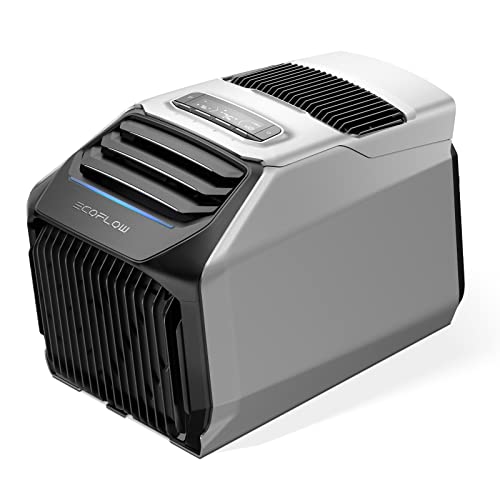
EF EcoFlow Wave 2 Portable Air Conditioner
Best for off-grid caravans running on solar or a power station
EF EcoFlow Wave 2 Portable Air Conditioner
Best for off-grid caravans running on solar or a power station
What we like
- Drops interior temp by 18°F in under 5 minutes — fastest cool-down in the category
- 44 dB in Sleep Mode is genuinely quiet enough to sleep next to
- Four charging inputs including 12V car port and solar make it the most flexible off-grid option
- No drainage needed in cooling mode below 70% humidity — one less thing to manage
What we don't
- Battery sold separately — the unit alone can't run untethered without the $500+ add-on pack
- At 1100W max draw, you need a substantial power station to sustain it beyond Eco mode
- Heavier and pricier than any other option here — overkill for a solo sleeper with a small van
The Wave 2 is the only unit here built from the ground up for off-grid use — EcoFlow's custom compressor runs on AC, solar, 12V car input, or its dedicated battery pack, so you're not locked into shore power to get real cooling in your caravan. This is the right call if you've already invested in a LiFePO4 battery system and want AC that integrates cleanly with it.
If you're still running on a small power station or a single 100Ah battery, the draw in max mode will eat it fast — step down to the BougeRV or Outohome instead.
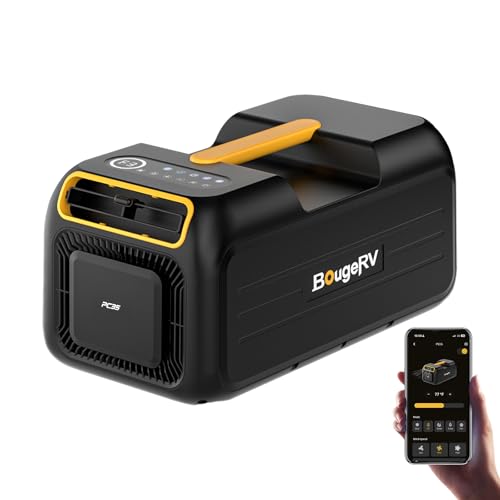
BougeRV PC35 Portable Air Conditioner 3500BTU
Best for van lifers and compact caravans with a power station
BougeRV PC35 Portable Air Conditioner 3500BTU
Best for van lifers and compact caravans with a power station
What we like
- App control within 33 ft means you can adjust temperature without leaving your sleeping bag
- 350W draw is manageable on a mid-size power station (1000Wh+) for a full night
- Compact ergonomic handle makes it easy to move between the van, campsite, and storage
- 5-in-1 functions (Cool, Dehumidify, Fan, High Power, Sleep) with 24H timer in one unit
What we don't
- 3500 BTU is the ceiling — on a 95°F day in a full-size caravan it will run continuously and not fully keep up
- Requires 110V AC input, so you need a power station or inverter rather than connecting direct to 12V battery
- Newer brand with less long-term reliability data than EcoFlow or Zero Breeze
The BougeRV PC35 hits the sweet spot for van lifers running a mid-range power station — 350W draw is low enough to get 5–6 hours from a 2000Wh station while still pumping real compressor-cooled air, not just fan air. Best matched to caravans under 80 sq ft or anyone who wants a capable compact unit without the $1,000+ commitment of the EcoFlow.
Skip it if your caravan is larger than a campervan interior or you're in extreme heat above 100°F — the 3500 BTU ceiling will leave you warm.
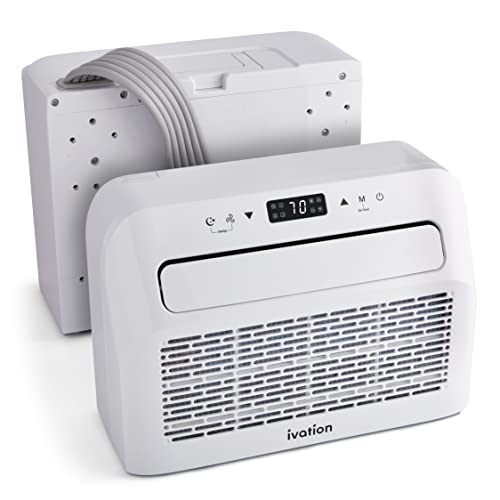
Ivation 6500 BTU Camper Air Conditioner
Best for caravans with shore power and a real window to work with
Ivation 6500 BTU Camper Air Conditioner
Best for caravans with shore power and a real window to work with
What we like
- 6500 BTU is the highest raw cooling capacity in this roundup — handles full caravan interiors up to 150 sq ft
- Over-the-sill split design keeps the compressor outside, reducing interior heat bleed and vibration noise
- Saddle-mount installation requires no permanent modifications to your caravan
- Includes all mounting hardware, washable filter, and integrated hose — ready to run out of the box
What we don't
- Needs a real window to mount on — doesn't work in windowless vans or caravans with roof vents only
- 110V AC only — not usable off-grid without a generator or large inverter setup
- Split design means two physical units to store and manage when moving between sites
The Ivation's split saddle-mount design solves the problem that tanks most portable ACs: heat bleed-back into the space. The compressor sits outside the window while only the cooling head stays inside, which is exactly how a wall unit works — and at 6500 BTU, it has the grunt to actually cool a full-size caravan on a hot day.
This is the right pick for caravan owners on campsite shore power who have a usable window and want maximum cooling without a permanent rooftop install. If you're parking off-grid or don't have a suitable window, the EcoFlow or BougeRV are your options.
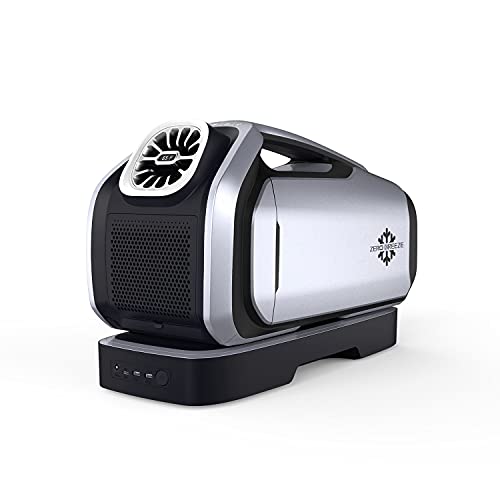
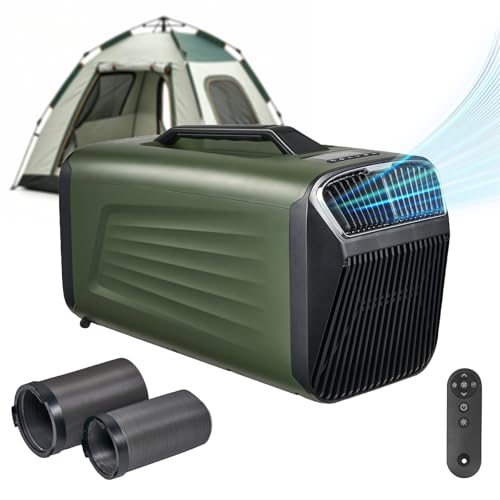
Zero Breeze Mark 2 Battery Powered Portable Air Conditioner
Best for solo sleepers who want the smallest off-grid footprint
Zero Breeze Mark 2 Battery Powered Portable Air Conditioner
Best for solo sleepers who want the smallest off-grid footprint
What we like
- 240W draw is the lowest true compressor-based AC in this roundup — pairs with even a 500Wh power station
- 16.5 lb body is genuinely portable and fits on a van armrest or narrow shelf without taking over the space
- 24V DC input means you can wire it directly to a lithium battery bank with minimal current draw
- Rotary compressor cools fast relative to its BTU rating — reviewers report comfortable sleeping temps in small vans within 30 minutes
What we don't
- 2300 BTU is only sufficient for a tight sleeping space — won't cool a full caravan interior even on a mild day
- Battery (if purchased separately) only runs it at max power for around 3.5 hours before needing a recharge
- Cannot recharge the battery and run the unit simultaneously without an additional splitter accessory
The Mark 2 earns its place by being the only true compressor AC here that a solo van lifer with modest battery capacity can realistically run all night — 240W at 24V DC is about as efficient as compressor cooling gets at this BTU level. It's best suited to one-person sleeping zones in a pop-top, small campervan, or truck camper where the volume of air to cool is tight.
If you're traveling with a partner or in anything larger than 70 sq ft, you'll outrun its 2300 BTU and end up just uncomfortable — step up to the BougeRV or EcoFlow.
Outohome 5200BTU Portable Camping Air Conditioner
Best budget option for caravans with 110V access
Outohome 5200BTU Portable Camping Air Conditioner
Best budget option for caravans with 110V access
What we like
- 5200 BTU at only 400W makes it the most power-efficient 110V unit in this roundup — runs longer on the same power station
- GMCC high-end compressor drops temp 18°F in 5 minutes, matching performance claims of units costing twice as much
- Drain-free operation below 70% humidity — no manual draining needed in most camping conditions
- At 31 lbs with a carry handle, it's among the lightest 5000+ BTU units available
What we don't
- 110V AC only — needs a power station, inverter, or shore hookup, no direct DC battery connection
- Relatively new brand — limited long-term durability data compared to EcoFlow or Zero Breeze
- Exhaust duct must be routed outside, which requires some planning in a sealed caravan
The Outohome delivers 5200 BTU at 400W — that's nearly the same raw cooling as the Ivation at a fraction of the price, and with lower power consumption that lets it run longer on a portable power station before draining the battery. This is the pick if your budget is under $250 and you have shore power or a 1500W+ power station to feed it.
It won't win on build quality or brand confidence, but on actual BTU-per-dollar for caravan cooling it's the strongest value in this category.
What to Look For
BTU determines whether you're actually cooling the space or just making noise. A 2300 BTU unit is enough for a sleeping zone in a small van; a 5000–6500 BTU unit is what you need for a full caravan interior on a 95°F day.
Power source compatibility is the make-or-break spec most buyers miss. Units requiring 110V AC need a power station or shore hookup, while 24V DC units can run directly from lithium batteries with far lower draw.
Noise level at night matters more than most spec sheets admit. Look for units that list a specific sleep-mode dB rating — anything under 50 dB is liveable; anything unlisted is a gamble.
Who Should Skip This
If you're in a large motorhome over 200 sq ft and connected to shore power at a campsite, a traditional rooftop RV unit will outperform every option here on raw cooling power and efficiency. These portable units are built for caravans, campervans, and small trailers where a rooftop install isn't practical or you need flexibility to move between rigs.
What the Community Actually Uses
On r/vandwellers, the dominant advice is to pair any portable AC with a proper battery setup rather than relying on shore power — most users recommend at least 200Ah of LiFePO4 and a dedicated DC unit for overnight use. The EcoFlow Wave series comes up constantly in threads about off-grid summer builds, while the Zero Breeze Mark 2 is a recurring recommendation for solo sleepers wanting the smallest possible footprint.
Quick Picks — In Case You've Already Decided
EcoFlow Wave 2 Portable Air Conditioner (Battery Not Included)
Check Price on AmazonFrequently Asked Questions
Can a portable air conditioner cool an entire caravan?
A 5000–6500 BTU portable unit can comfortably cool 80–150 sq ft — enough for most small to mid-size caravans. Larger motorhomes over 200 sq ft will struggle with any unit in this category; a rooftop unit is the better call.
Do portable caravan AC units need to be vented outside?
True compressor-based units always need to exhaust hot air outside via a duct hose — no exceptions. Evaporative coolers don't vent heat but also don't actually air condition; they only add moisture and move air.
How long can a battery-powered AC run on one charge?
At real-world Eco mode draw, expect 6–8 hours from a dedicated add-on battery like the EcoFlow Wave 2's pack. Max-power mode cuts that to 3–4 hours. Most users pre-cool the space and switch to a lower setting overnight.
What's the difference between a 12V and a 24V DC portable AC?
24V DC units like the BougeRV and Zero Breeze are purpose-built for van and caravan battery systems — more efficient and less likely to blow fuses than 12V equivalents. 12V units exist but pull extremely high amperage that most vehicle wiring can't sustain.
Is 3500 BTU enough for a caravan?
For a sleeping zone or small pop-top camper under 60–70 sq ft, yes. For a full caravan interior on a 95°F day with any sun exposure on the roof, you'll want 5000 BTU minimum — the smaller unit will run continuously and still struggle.
Buying Guide
Match BTU to your interior size first: under 80 sq ft needs 3500 BTU or less, 80–150 sq ft needs 5000–6500 BTU. Then confirm your power source — shore power, portable power station, or 12V/24V DC.
Battery-powered units cost more upfront but eliminate the generator. You get real compressor cooling either way.