A personal locator beacon is the only emergency device that contacts search and rescue directly via satellite with no subscription, no cell towers, and no commercial relay. Five proven PLBs under $400 cover every scenario from ultralight solo hiking to offshore boating, and all of them work at the poles.
| Photo |
Top Pick
|
Versatile

|
Budget

|
Best Value

|
Best for Reliability

|
|---|---|---|---|---|---|
| Product | ACR ResQLink View PLB-425 | ACR ResQLink View RLS Personal Locator Beacon | Ocean Signal rescueME PLB1 | ACR ResQLink 400 Personal Locator Beacon | McMurdo FastFind 220 PLB |
| Weight | 5.6 oz | 5.3 oz | 4 oz | 5 oz | 4.6 oz |
| Waterproof | ✓ | ✓ | ✓ | ✓ | ✓ |
| Battery life | 7 years | 5 years | 7 years | 5 years | 6 years |
| Operational life | 28 hrs | 28 hrs | 24 hrs | 24 hrs | 24 hrs |
| Buy Now | Check Price → | Check Price → | Check Price → | Check Price → | Check Price → |
Quick Tips
Register your PLB with NOAA at beaconregistration.noaa.gov immediately after purchase — registration is free and required by US law.
Run the self-test function every trip. Most PLBs allow 60 self-tests over the 5-year battery life without triggering false rescue alerts.
Mount it where you can reach it with one gloved hand — chest strap on your pack or the shoulder loop, not buried in a pocket.
Write the battery expiration date in permanent marker on the outside of your pack. PLBs sit unused for years and expired batteries are a leading cause of failure.
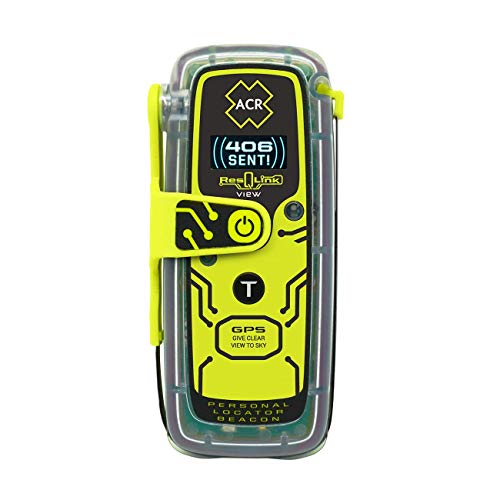
ACR ResQLink View PLB-425
Best for hikers who want live GPS confirmation on the beacon itself
ACR ResQLink View PLB-425
Best for hikers who want live GPS confirmation on the beacon itself
What we like
- Digital display shows live GPS coordinates and beacon status so you can confirm it is transmitting before conditions worsen.
- Buoyant design keeps it at the surface if you go overboard — critical for kayakers and offshore boaters.
- Dual GNSS uses both GPS and Galileo satellite constellations for faster position acquisition in dense canopy or canyon terrain.
- Made in the USA with military-grade durability and a 5-year warranty against manufacturing defects.
What we don't
- No Return Link Service — you will not receive satellite confirmation that rescue has received your signal.
- Costs more than the ResQLink 400 for the display upgrade, which is useful but not essential in a true emergency.
- Larger than the Ocean Signal PLB1, so it adds slightly more bulk to ultralight carry setups.
When your hands are shaking and visibility is dropping, the ResQLink View gives you something no basic PLB can — a screen that shows your GPS coordinates and confirms the beacon is actively transmitting, so you are not left guessing whether help is on the way. This is the right pick for anyone who goes out solo and wants that extra layer of certainty in the worst moment.
If you want true satellite confirmation sent back to the device, step up to the View RLS; if you want the same unit for less money and do not need the display, the ResQLink 400 saves you roughly $80.
ACR ResQLink View RLS PLB-435
Best for anyone who needs confirmation rescue received the signal
ACR ResQLink View RLS PLB-435
Best for anyone who needs confirmation rescue received the signal
What we like
- Return Link Service sends a satellite confirmation back to the beacon so you see a flashing blue light and display message when rescue has received your signal.
- Digital display shows live GPS coordinates and beacon status, identical to the PLB-425.
- Buoyant and rated for all environments from arctic to marine, certified to the same military spec as the rest of the ResQLink line.
- MEOSAR-compatible for near-instant detection — most signals reach the satellite network within minutes of activation.
What we don't
- Battery life is 5 years versus 7 on the PLB-425, so you will pay for a factory battery replacement sooner.
- Most expensive PLB on this list by a notable margin.
- RLS confirmation requires the beacon to still be in a location with satellite line of sight — deep canyon or heavy overhead cover can delay it.
Every other PLB on this list is a one-way broadcast — you activate it and you have no idea whether the signal reached anyone. The View RLS closes that loop with a visible confirmation on the beacon itself, which matters a lot when you are injured, alone, and deciding whether to stay put or keep moving.
Choose this if you do remote solo trips where the psychological certainty of knowing rescue is coming could affect your decisions in the hours after activation. If that feedback loop is not a priority, save money with the standard View.
Ocean Signal rescueME PLB1
Best for ultralight and everyday carry on any trip
Ocean Signal rescueME PLB1
Best for ultralight and everyday carry on any trip
What we like
- Smallest and lightest GPS-enabled PLB on the market — 30% smaller than its next closest competitor, fits in a pants pocket.
- One-hand operation with a spring-loaded cover over the activation button prevents accidental triggering without slowing you down in a real emergency.
- 7-year battery life and 7-year warranty match the best in class, making the total cost of ownership one of the lowest available.
- 66-channel GPS receiver and 1-candela strobe provide accurate positioning and visibility for rescuers arriving on scene.
What we don't
- No display — you cannot see GPS status or confirm signal strength on the unit itself.
- Not natively buoyant without the optional flotation pouch, which is sold separately.
- No Return Link Service, so you will not receive satellite confirmation that rescue has acknowledged your signal.
The PLB1 is the beacon you actually carry every day because it disappears into a hip belt pocket or clips to a lifejacket loop without adding meaningful bulk or weight. That frictionless carry is the entire value proposition — a PLB left in the car because it was too heavy to bother with is useless.
This is the right pick for ultralight backpackers, trail runners, and kayakers who want emergency capability on every trip without planning around the weight. If you want a screen or buoyancy built in, look at the ACR line instead.
ACR ResQLink 400 PLB-400
Best entry-level PLB with full GPS and buoyancy
ACR ResQLink 400 PLB-400
Best entry-level PLB with full GPS and buoyancy
What we like
- Full GPS plus 406 MHz and 121.5 MHz triple-signal technology locates you to within 100 meters and guides rescuers directly to your position.
- Buoyant by design and floats face-up, making it the practical choice for boaters, kayakers, and anyone crossing water.
- Made in the USA with the same military-grade build quality as the rest of the ResQLink lineup, at the lowest price in the family.
- MEOSAR-compatible for fast satellite detection — no waiting for a slow satellite pass to pick up the signal.
What we don't
- No digital display — you activate it and trust it is working without on-device confirmation.
- 5-year battery life means an earlier factory service visit compared to the 7-year models.
- Slightly heavier and larger than the Ocean Signal PLB1 for a similar price.
The ResQLink 400 is the baseline PLB that checks every essential box — GPS, buoyancy, 406 MHz, 24-hour runtime, MEOSAR-compatible — without the display premium of the View models. It is the PLB most survival instructors recommend to beginners because it does exactly what a beacon needs to do and nothing it does not.
Buy this if you want a trusted US-made beacon at the lowest price in the ResQLink family and you are comfortable activating a device without a status screen. If you want the screen, spend the extra $50-80 for the View.
McMurdo FastFind 220 PLB
Best for hikers who want dual GPS and Galileo at a budget price
McMurdo FastFind 220 PLB
Best for hikers who want dual GPS and Galileo at a budget price
What we like
- World's first Galileo-enabled PLB — dual GPS and Galileo GNSS provides faster, more accurate location acquisition than single-constellation units.
- Subscription-free and transmits directly to search and rescue authorities without commercial call centers in the chain.
- 6-year battery life sits between the 5-year ACR 400 and 7-year Ocean Signal, and competitive at this price point.
- Compact palm-sized form factor includes a flotation pouch for marine and river use.
What we don't
- Non-buoyant on its own — requires the included flotation pouch for water use, which is an extra step under stress.
- No digital display or Return Link Service — no on-device feedback of any kind after activation.
- Less widely reviewed by US-based outdoors testers compared to ACR, so community support resources are thinner.
The FastFind 220 earns its spot with dual GPS and Galileo receivers that most PLBs at this price point do not offer — Galileo coverage is denser over Europe and polar regions, which matters if you travel internationally or run expeditions at high latitudes. This is the right pick for budget-conscious buyers who do not need a display or buoyancy built in, and who appreciate the Galileo advantage for international trips.
If you primarily hike in North America and want a name with more US community support, the ACR ResQLink 400 is the safer default at a similar price.
What to Look For
The only signal that matters in an emergency is 406 MHz — it is the internationally recognized distress frequency monitored by Cospas-Sarsat satellites 24/7 worldwide. Every PLB on this list transmits on 406 MHz, but cheaper emergency devices do not, so verify before you buy.
GPS integration cuts rescue response time from hours to minutes. A PLB without GPS still transmits your distress signal, but rescuers must narrow your position from a 5-kilometer radius; a GPS-enabled PLB puts them within 100 meters.
Battery life runs 5-7 years on sealed lithium cells. You cannot replace them yourself — when the battery expires, you send the unit in for a factory replacement.
Factor that cost and timeline into your purchase decision.
Who Should Skip This
A PLB is a one-way SOS device with no two-way messaging, no weather updates, and no tracking. If you want to send check-in messages to family or need two-way communication on remote trips, a satellite communicator like the Garmin inReach is the better tool.
PLBs are strictly for life-threatening emergencies where the only goal is getting rescue on the way.
What the Community Actually Uses
On r/WildernessBackpacking and r/overlanding the recurring advice is consistent: get a PLB before you think you need one, not after a close call. The thread consensus typically lands on ACR as the benchmark brand for land use, with Ocean Signal getting strong recommendations for compact carry.
Several threads specifically call out that Garmin inReach and SPOT require monthly subscriptions while PLBs do not — that distinction matters for hikers who go out a few times a year and do not want an annual fee for a device they hope never to activate.
Quick Picks — In Case You've Already Decided
Frequently Asked Questions
Do PLBs require a subscription fee?
No. PLBs transmit directly to the government-operated Cospas-Sarsat satellite network, which is funded by search and rescue agencies worldwide. Registration is free and required by law, but there is no monthly or annual service fee to use the emergency function.
How long does it take for search and rescue to respond after I activate a PLB?
With a GPS-enabled PLB on the MEOSAR satellite system, your signal is typically detected within minutes and your position is accurate to within 100 meters. Actual rescue response time depends on your location and the resources available to SAR in that region.
Can I use a PLB outside the United States?
Yes. All 406 MHz PLBs work globally, including at the poles. You register the device with your home country, but the Cospas-Sarsat system routes your distress signal to the appropriate rescue coordination center wherever you are in the world.
What is the difference between a PLB and an EPIRB?
EPIRBs (Emergency Position Indicating Radio Beacons) are designed for marine vessels and can auto-deploy if a boat sinks. PLBs are personal devices carried by individuals on land or water. Functionally both transmit on 406 MHz to the same satellite network.
What happens to my PLB when the battery expires?
You must send the unit back to an authorized service center for a factory battery replacement. Battery life is 5-7 years depending on the model. The battery expiration date is printed on the beacon and marks when you need to service it, not when it stops working entirely.
Buying Guide
You need a PLB that activates fast under stress, transmits GPS coordinates via 406 MHz to Cospas-Sarsat satellites, and runs for at least 24 hours. Look for buoyancy if you're on water.
Skip devices requiring a subscription if you want zero recurring cost. Battery life is 5-7 years — register yours with NOAA after purchase.