The moment you stop paddling to cast is the moment you drift off your spot — pedal drive fishing kayaks fix that completely. The five picks here range from $500 to $1,500 and cover everything from shallow creek fishing to open-water tournament setups, all with verified Amazon listings.
| Photo |
Top Pick
|
Versatile

|
Budget

|
Best Value

|
Best for Reliability

|
|---|---|---|---|---|---|
| Product | BKC Brooklyn 10.0 Single Pedal Fishing Kayak | Pelican Catch 110HDII | Perception Pescador Pilot 12 | Old Town Topwater 120 PDL Angler Fishing Kayak | Wilderness Systems Radar 115 |
| Length | 10 ft | 10.5 ft | 12 ft | 12 ft | 11.6 ft |
| Weight | 58 lbs | 67 lbs | ~80 lbs | 87 lbs | 85 lbs |
| Capacity | 350 lbs | 350 lbs | 375 lbs | 500 lbs | 450 lbs |
| Drive type | Flipper (fin) | HyDryve II (fin) | Pilot Drive (prop) | PDL Drive (prop, sealed) | Helix PD (prop, tri-power) |
| Buy Now | Check Price → | Check Price → | Check Price → | Check Price → | Check Price → |
Quick Tips
Test the pedal drive in shallow water before your first real trip — most drives tip up for shallow docking, but technique matters to avoid grounding the prop.
Add a fish finder mount early: kayaks with SlideTrax or gear track rails let you install electronics without drilling, which protects your hull and resale value.
Bring a spare paddle even on pedal-only trips — weeds, mechanical issues, or dead battery on a motor-assist model can leave you stranded without one.
Load the stern tank well evenly: an overloaded rear on a pedal kayak raises the bow and kills tracking, especially on models with narrower hulls like the Pescador Pilot.
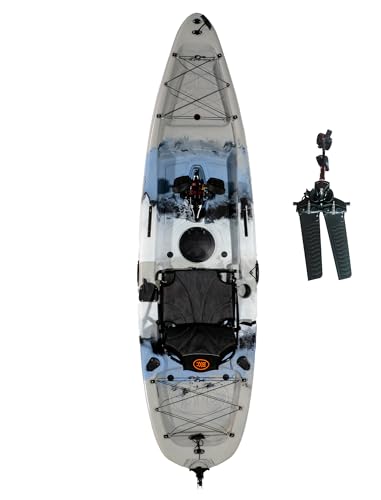
BKC Brooklyn 10.0 Single Pedal Fishing Kayak
Best for budget entry into hands-free fishing
BKC Brooklyn 10.0 Single Pedal Fishing Kayak
Best for budget entry into hands-free fishing
What we like
- At 58 lbs it's the lightest kayak on this list — easy to car-top solo without a roof rack system.
- Flipper-style pedal drive handles weeds and shallows without snagging, good for lake edges and lily pad zones.
- Comes loaded with 2 rod holders, watertight front hatch, and rear bungee cargo area out of the box.
- Hand-operated rudder is simple and responsive — no cable-over-pulley complexity to tune or replace.
What we don't
- At 10 feet, you're working with limited storage and a shorter waterline — expect slower tracking than 12-foot competitors.
- The flipper drive is efficient in calm water but struggles against any meaningful current or wind.
- Seat quality is basic; extended trips over 3–4 hours will likely require an aftermarket upgrade.
The BKC Brooklyn 10.0 does one thing better than anything else on this list: it gets you into pedal kayak fishing without a painful first investment, and it's light enough to handle solo every time you go out. This is the right pick if you're fishing calm lakes and reservoirs and want to test whether hands-free fishing is worth the upgrade before spending $1,500.
Skip it if you're fishing in current, need to cover long distances, or plan to stand and cast — the 10-foot hull isn't built for that.
Pelican Catch 110 HDII Fishing Kayak
Best for shallow-water anglers on a mid-range budget
Pelican Catch 110 HDII Fishing Kayak
Best for shallow-water anglers on a mid-range budget
What we like
- HyDryve II pedal system is specifically engineered for shallow water and around aquatic vegetation — works where prop drives stall.
- Ergocast G2 seat is one of the most comfortable mid-range kayak seats available, removable for beach use.
- Multiple flush-mounted rod holders, 8-inch day hatch, bottle holders, and tackle box holder are all included at this price.
- Rudder is hand-controlled from the seat — intuitive to use without needing to reach or lean.
What we don't
- At 10.5 feet you lose tracking speed versus 12-foot competitors on open water.
- 350 lb capacity leaves little margin if you're a larger paddler who also loads heavy gear.
- The HyDryve II is reliable in weeds but slower than prop systems in open-water speed comparisons.
The Pelican Catch 110 HDII hits a real sweet spot: it's priced for someone who takes fishing seriously without needing a $1,500 platform, and the HyDryve II pedal system is genuinely well-suited to the kind of shallow, weedy freshwater most lake anglers actually fish. This is the pick for the angler who fishes lily pad edges, creek mouths, and reservoir flats — places where a prop drive would be constantly fouling.
If you fish offshore or need max speed to reach spots, step up to the Pescador Pilot or Old Town.
Perception Pescador Pilot 12 Fishing Kayak
Best for stand-up fishing and all-water versatility
Perception Pescador Pilot 12 Fishing Kayak
Best for stand-up fishing and all-water versatility
What we like
- Pilot Drive propeller system delivers forward and reverse with enough power to hold position against light current.
- Made in the USA with high-density polyethylene and one-piece roto-molded construction — significantly more durable than import competitors at this price.
- Stand-up stable hull combined with a 12-foot waterline gives you both speed and casting platform in one boat.
- Gear tracks are pre-installed so you can mount fish finders and rod holders without drilling the hull.
What we don't
- Prop drive will foul on heavy weed beds — the drive tips up, but you'll be clearing debris more often than on fin-drive competitors.
- At roughly 80 lbs the hull is manageable solo but significantly heavier than the BKC or Pelican options.
- The rod holders in the standard configuration are oversized for most rod diameters and require PVC inserts to fit correctly.
The Pescador Pilot 12 is where pedal kayak fishing starts feeling like a serious platform instead of a novelty — the prop drive has real speed, the hull is wide enough to stand on confidently, and American-made construction means it will outlast every import on this list. This is the move for an angler who fishes multiple water types across a season and wants one kayak that handles lakes, light rivers, and coastal bays without compromising.
Step up to the Old Town or Wilderness Systems if you need premium seat comfort for full-day trips or tournament-level rigging options.
Old Town Topwater 120 PDL Angler Fishing Kayak
Best for all-day fishing and full stand-up stability
Old Town Topwater 120 PDL Angler Fishing Kayak
Best for all-day fishing and full stand-up stability
What we like
- PDL Drive is sealed, maintenance-free, and rated saltwater-safe with a 5-year warranty — the most reliable drive system on this list.
- DoubleU pontoon hull gives you a 500 lb capacity and a flat standing platform that is genuinely stable for casting.
- Instant forward and reverse pedaling — no shifting or lever pull required, which matters when you're fighting a fish.
- Universal transducer mounting system integrates fish finder cables cleanly into the hull without hacking the deck.
What we don't
- At 87 lbs hull weight, car-topping solo requires a loader or a significant investment in a roof rack system.
- Price sits above the Pescador Pilot without the same accessory track versatility as the Wilderness Systems Radar.
- Prop drive will encounter weeds like all prop systems — the tip-up mechanism handles it, but fin-drive boats are cleaner in heavy vegetation.
The Old Town Topwater 120 PDL earns the top spot because the PDL drive system is simply the most proven, lowest-maintenance pedal system on the market — sealed, saltwater-ready, five-year warranty, and smooth enough that you genuinely forget you're propelling the boat. If you're doing full-day trips, targeting multiple species across the season, or putting the kayak in saltwater at any point, this is the one.
Skip it only if budget is the constraint — the Pescador Pilot gives you 80% of this performance at a lower price point.
Wilderness Systems Radar 115 Fishing Kayak
Best for tournament anglers and serious electronics rigging
Wilderness Systems Radar 115 Fishing Kayak
Best for tournament anglers and serious electronics rigging
What we like
- Flex Pod system accepts the Helix PD pedal drive, Helix MD motor drive, or a fish finder — without drilling or permanent modification.
- SlideTrax rails run the full gunnel length, giving you more accessory mounting positions than any other kayak on this list.
- S.M.A.R.T. hull technology is engineered for stability, maneuverability, and tracking simultaneously — it handles chop better than the Pescador Pilot.
- AirPro MAX seat adjusts for both pedaling position and paddling position — the most capable seat system here.
What we don't
- The Helix PD drive is sold separately on some listings — confirm it's included before purchasing or budget for the add-on cost.
- At the top of the price range on this list, the value calculation only works for anglers who will use the electronics rigging and accessory system seriously.
- Heavier accessory rails and components add up — at 85 lbs it's not meaningfully lighter than the Old Town despite being slightly shorter.
The Radar 115 is the kayak that tournament anglers and serious freshwater/saltwater fishermen end up in — the Flex Pod system means you can run a side-scanning fish finder, a motor drive for trolling, and a pedal drive all from the same hull without buying a second boat. This is overkill if you're fishing local lakes three times a summer.
It earns its price if you're running electronics, fishing competitively, or want a kayak that scales as your rigging gets more serious over time.
What to Look For
Hull stability determines whether you can stand and cast or if you're white-knuckling every ripple. Wider W-hull or pontoon designs like the Old Town DoubleU give you a confident stand-up platform; narrower recreational hulls are faster but not for standing.
Drive type splits the field between fin/flipper drives and prop drives. Fin drives are quieter, snag less on weeds, and work better in shallow water; prop drives move faster on open lakes and handle reverse more powerfully.
Seat quality decides whether you last 4 hours or 8 hours on the water. Mesh-back, height-adjustable seats with lumbar support aren't a luxury at this price range — they're the difference between a good trip and a ruined back.
Who Should Skip This
Skip a pedal kayak entirely if your primary water is narrow rivers with current — you'll spend more time fighting the boat than fishing. Anglers who mostly do short bank-launch trips under 30 minutes probably won't recoup the extra cost and weight over a standard paddle kayak.
If you're under budget and need something under $400, a traditional sit-on-top will serve you better until you can step up.
What the Community Actually Uses
On r/kayakfishing, the pedal vs. paddle debate has run for years — and the consensus is clear: once you go hands-free, paddle-only feels like dragging an anchor.
The most-upvoted threads consistently put Old Town PDL drives and Wilderness Systems setups at the top for reliability, while budget-conscious anglers defend the BKC and Pelican HyDryve as legitimate entry points. Shallow-water anglers in that sub swear by fin drives over prop systems for weedy lakes.
Quick Picks — In Case You've Already Decided
Frequently Asked Questions
What's the difference between a fin drive and a prop drive on a pedal kayak?
Fin drives use a side-to-side flipper motion — quieter, snag-resistant, and better in weeds and shallows. Prop drives use a spinning propeller for more speed and stronger reverse thrust. For fishing in vegetation or shallow water, fin drives win; for open lakes where speed matters, prop drives are worth the extra weed-clearing hassle.
Can you use a pedal kayak in saltwater?
Most pedal drives on this list are rated saltwater-safe, including the Old Town PDL and Wilderness Systems Helix PD. Rinse the drive system with fresh water after every salt use — this is non-negotiable. Avoid submerging drive components unnecessarily and inspect the prop or fins for corrosion after each season.
How much does a good pedal fishing kayak weigh?
Expect 58–90 lbs for the kayak hull alone, plus 15–25 lbs for the pedal drive. The BKC at 58 lbs is the lightest on this list; the Old Town Sportsman PDL 120 sits at 116 lbs fully rigged. If you're car-topping solo, 70–80 lbs is the practical ceiling for most people.
Do pedal kayaks work in shallow water?
Yes, but with a caveat: most drives tip up or disengage for very shallow water (under 18 inches), and you paddle or push through. Fin-drive kayaks like the Pelican HyDryve II handle shallows better than prop systems. The Old Town PDL drive tips up instantly for shallow-water docking.
Is a pedal kayak worth it over a regular fishing kayak?
If you fish more than a few times per season and regularly need to hold position while casting, yes — the hands-free advantage is real and immediate. For occasional casual fishing from shore-adjacent spots, the extra cost and weight isn't justified. The Pelican Catch 110 HDII is the lowest-cost entry to find out without major commitment.
Buying Guide
You want a pedal kayak that keeps your hands free when it matters most — while casting, netting, or fighting a fish. Look at hull stability first, then drive type.
Fin drives handle weeds and shallows better; prop drives are faster on open water. Weight matters if you're car-topping solo.
Don't skip seat comfort.