The wrong rucksack doesn't just slow you down — it ends trips early, and the sizing and suspension system matter far more than the brand name. These five packs range from $70 to $280 and cover every trip length from quick overnights to week-long backcountry slogs.
| Photo |
Top Pick
|
Versatile

|
Budget
|
Best Value

|
Best for Reliability
|
|---|---|---|---|---|---|
| Product | Osprey Atmos AG 65 Men's Backpacking Backpack | Gregory Baltoro 65L Pro Backpacking Pack | Osprey Kestrel 48 Men's Backpacking Backpack | Kelty Coyote 65 Backpack | TETON Sports Scout 3400 Internal Frame Backpack |
| Weight | 4 lbs 10 oz | 5 lbs 2 oz | 3 lbs 8 oz | 4 lbs 13 oz | 4 lbs 8 oz |
| Capacity | 65L | 65L | 48L | 65L | 55L |
| Torso fit | Adjustable S/M and L/XL | 3 adjustable torso sizes | Adjustable S/M and L/XL | Adjustable 15.5-21 inch torso | Multi-position torso adjustment 15-19.5 inch |
| Rain cover | ✓ | ✓ | ✓ | ✗ | ✓ |
| Buy Now | Check Price → | Check Price → | Check Price → | Check Price → | Check Price → |
Quick Tips
Load the pack with 30 lbs of gear in-store before buying — back pain from poor fit shows up immediately under real weight.
Heaviest gear goes closest to your spine and centered between your shoulder blades for optimal load transfer to your hips.
Adjust the hipbelt first, then the shoulder straps — 80% of the load should sit on your hips, not your shoulders.
Use compression straps to cinch down a partially filled pack or the load shifts side-to-side on uneven terrain.
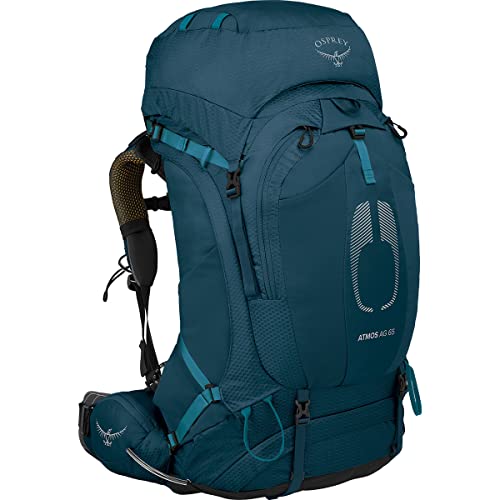
Osprey Atmos AG 65 Men's Backpacking Backpack
Best for multi-day comfort on loaded carries
Osprey Atmos AG 65 Men's Backpacking Backpack
Best for multi-day comfort on loaded carries
What we like
- AntiGravity suspended mesh backpanel keeps your back ventilated even under heavy loads.
- Integrated raincover stows in the hipbelt pocket so you never forget it at home.
- Stow-on-the-Go trekking pole attachment lets you rack poles without stopping or removing the pack.
- Hipbelt pockets are large enough for a full-size phone plus snacks — actually usable on trail.
What we don't
- At 4 lbs 10 oz it's not a lightweight pack, which adds up on long mileage days.
- The suspended mesh backpanel means the pack rides slightly away from your back, making it less stable on scrambles.
- Premium price puts it out of reach for casual hikers who go out twice a year.
If your back is soaked through before lunch and your shoulders ache by mile five, this pack fixes both problems at once — the 3D-suspended mesh backpanel creates an air gap that no foam backpanel can match, and the AG suspension wraps your hips so load transfer actually happens. This is the pack for 4-7 night trips where base weight climbs past 20 lbs and comfort over distance is non-negotiable.
If you're a minimalist covering 20+ miles daily, the weight penalty makes something lighter worth considering.
Gregory Baltoro 65L Pro Backpacking Pack
Best for serious multi-day trips with a heavy kit
Gregory Baltoro 65L Pro Backpacking Pack
Best for serious multi-day trips with a heavy kit
What we like
- FreeFloat A3 suspension features rotating shoulder straps and a dynamic hipbelt that moves with your stride instead of fighting it.
- Available in three torso sizes — small, medium, large — giving you a more precise fit than the two-size systems most competitors use.
- SideWinder bottle holster lets you grab your water bottle one-handed without breaking stride.
- Front U-zip panel provides top-to-bottom access to the main compartment without unpacking everything above what you need.
What we don't
- At over 5 lbs it is one of the heavier packs in this category, which matters on long-distance routes.
- The feature set adds complexity — first-time backpackers may need time to learn the adjustment system.
- Premium price sits at the top of this roundup.
The Baltoro earns its price with a suspension system that actually adapts to how your body moves — the rotating shoulder straps and dynamic hipbelt reduce the constant micro-adjustments you'd otherwise make every mile when a load shifts on uneven ground. This is the pick for experienced backpackers with a heavier kit who want a pack that earns its weight through superior carrying mechanics.
If you're counting grams or just starting out, the Osprey Atmos or Kestrel 48 are more appropriate starting points.
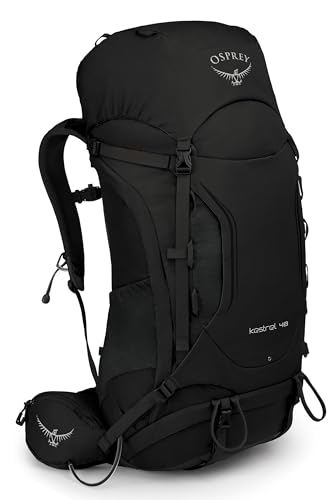
Osprey Kestrel 48 Men's Backpacking Backpack
Best for fast-and-light overnight trips
Osprey Kestrel 48 Men's Backpacking Backpack
Best for fast-and-light overnight trips
What we like
- AirScape ridged foam backpanel provides ventilation while keeping the pack close to your back for better stability on technical terrain.
- At 3 lbs 8 oz it's significantly lighter than 65L options, which compounds over a long mileage day.
- Lower sleeping bag compartment with removable divider converts to extra main compartment space when you need one big cavity.
- Integrated raincover and trekking pole attachment included at a price well below the premium tier.
What we don't
- 48L is tight for trips longer than 3 nights unless you pack deliberately light.
- Hipbelt pockets are smaller than the Atmos AG, limiting what you can carry on-body.
- The AirScape backpanel doesn't ventilate as effectively as the Atmos AG's suspended mesh under sustained heat.
The Kestrel 48 hits the sweet spot if your trips are 1-3 nights and you want a pack that disappears into the background rather than reminding you it exists every mile — the AirScape backpanel keeps load transfer close to your spine and the lighter frame doesn't fatigue you on technical terrain. This is specifically for hikers who go light and fast on shorter routes.
If your typical trip runs 4 nights or longer, the 48L capacity forces compromises that the Atmos AG 65 handles without complaint.
Kelty Coyote 65 Backpack
Best for weekend to week-long trips on a budget
Kelty Coyote 65 Backpack
Best for weekend to week-long trips on a budget
What we like
- Fit Pro torso adjustment system gives you a genuinely customized fit even without a fitting appointment at a gear shop.
- Amp Flow ventilated back panel keeps airflow moving on hot-weather trips without the cost premium of suspended mesh systems.
- 65L capacity handles multi-day trips with a full shelter, sleep system, and cooking kit without forcing gear compromises.
- Dual front zippered pockets provide organized access to layers and small gear without digging through the main compartment.
What we don't
- No rain cover included — a $25-35 aftermarket cover is a near-mandatory addition before your first wet trip.
- Shoulder strap padding is thinner than Osprey and Gregory equivalents, noticeable under loads above 35 lbs.
- Hip belt pocket size is limited compared to premium alternatives.
The Coyote 65 does something rare at this price: it gives you a torso adjustment system that actually works, not just a single-size hipbelt that fits most people poorly. For hikers who can't spend $280 on a pack but need real load-carrying mechanics for 3-5 night trips, this is the answer.
Buy this if you're getting serious about backpacking but aren't ready to invest at the Osprey or Gregory level yet. If you're doing trips over 5 nights in wet conditions, budget for the rain cover and consider upgrading the hipbelt padding with an aftermarket add-on.
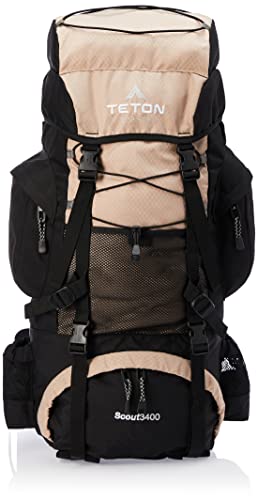
TETON Sports Scout 3400 Internal Frame Backpack
Best for first-time backpackers on a tight budget
TETON Sports Scout 3400 Internal Frame Backpack
Best for first-time backpackers on a tight budget
What we like
- Raincover included in the box — no extra spend required before your first outing in variable weather.
- Torso adjustment spans a wide range, making it genuinely wearable for adults of different heights without modification.
- Separate sleeping bag compartment at the base keeps your sleep system accessible without disturbing the main compartment.
- At under $80, it's the lowest-risk entry point into overnight backpacking if you're not sure the hobby will stick.
What we don't
- At 4.5 lbs it's heavy for a 55L pack — lightweight backpackers will feel the difference on long days.
- Hip belt and shoulder padding compress quickly under heavy loads compared to premium alternatives.
- The suspension system is functional but basic — fine for 2-3 night trips, noticeable on anything longer.
This pack exists to answer one question: can you try overnight backpacking without spending $200+ to find out if you like it. The answer is yes — the Scout 3400 has actual torso adjustment, an included rain cover, and a sleeping bag compartment, which is more than most sub-$100 packs offer.
Buy this if you're doing your first 1-3 night trips and want to test the hobby before committing to a premium pack. If you already know backpacking is your thing and plan trips of 4+ nights regularly, skip to the Kelty Coyote 65 at minimum.
What to Look For
Suspension fit is the single most important spec — a pack adjusted to your torso length carries the same weight with noticeably less strain. Look for a hipbelt that wraps fully around your iliac crest; packs with thin foam hipbelts transfer load to your shoulders instead.
Capacity should match your trip length, not your ambition. Overpacking a 65L pack because you bought a 75L is how knees get destroyed on descents.
For 3-season backpacking, 55-65L handles most kit without forcing you to carry unnecessary weight. Raincover inclusion matters on multi-day routes where weather is unpredictable.
Some packs include one; for those that don't, budget an extra $25-35 for a fitted cover before your first wet trip.
Who Should Skip This
If you're doing day hikes or trips under one night, a 30-40L daypack does this job better and won't fatigue you with unnecessary structure. Ultralight thru-hikers logging 20+ miles daily should look at sub-2lb frameless options that don't appear in this roundup — the packs here prioritize carry comfort over absolute minimum weight.
What the Community Actually Uses
On r/ultralight and r/backpacking, suspension fit debates are a recurring thread — most experienced hikers agree that a poorly fitted $400 pack feels worse than a correctly fitted $150 one. The consensus leans toward trying packs loaded in-person before committing, with Osprey and Gregory consistently recommended for their fit range and torso adjustability.
Quick Picks — In Case You've Already Decided
Frequently Asked Questions
What size backpack do I need for a 3-day trip?
A 45-55L pack covers most 3-day trips comfortably for 3-season conditions. If you carry a larger tent or bulkier sleeping bag, size up to 60L. Going bigger than that for 3 days just encourages overpacking.
How much should a good backpacking rucksack weigh?
Most quality internal-frame packs in the 55-65L range weigh between 3.5 and 5.5 lbs. Under 4 lbs is considered lightweight for a full-featured pack. Ultralight frameless options can go under 2 lbs but sacrifice hipbelt support.
Do I need a pack with a built-in rain cover?
For multi-day trips in variable weather, yes. A fitted rain cover keeps your gear dry when an unexpected storm rolls in. If your pack doesn't include one, buy a model-specific cover — universal covers shift around and can blow off in wind.
What's the difference between top-loading and panel-loading packs?
Top-loading packs are more durable and better for uneven terrain since there's no exposed zipper along the main compartment. Panel-loading packs give easier access to gear buried at the bottom. Most backpacking-specific packs are top-loading.
Can I take a 65L backpack as a carry-on?
No. Most airlines limit carry-ons to 40-45L maximum, and a 65L pack won't fit in the overhead bin. Plan to check it or bring a dedicated travel pack if you're flying to your trailhead.
Buying Guide
Look at capacity first: 45-55L covers 2-4 nights, 60-70L handles week-long trips with a full kit. Then check suspension fit — a pack adjusted to your torso length carries 20% more weight comfortably than one that isn't.
Weight matters most when you're going over 8 miles a day.