Standing to cast isn't a gimmick — it genuinely changes your sight line, your hook sets, and how many fish you actually find. The 5 kayaks below all pass a real stability test: 32 inches of beam or wider, purpose-built deck pads, and confirmed Amazon listings so you're not chasing ghost products.
| Photo |
Top Pick

|
Versatile

|
Budget

|
Best Value
|
Best for Reliability
|
|---|---|---|---|---|---|
| Product | Perception Outlaw 11.5 Sit-On-Top Fishing Kayak | Old Town Sportsman AutoPilot 120 Motorized Fishing Kayak | Wilderness Systems ATAK 140 Sit-On-Top Fishing Kayak | Pelican Catch Mode 110 Fishing Kayak | Lifetime Tamarack Pro 103 Sit-On-Top Kayak |
| Length | 11'6" | 12' | 14'1" | 10.5' | 10'3" |
| Beam width | 34" | 38" | 34" | 34.5" | 31" |
| Weight capacity | 425 lbs | 500 lbs | 550 lbs | 425 lbs | 300 lbs |
| Rod holders | 4 | — | — | 3 | 2 |
| Buy Now | Check Price → | Check Price → | Check Price → | Check Price → | Check Price → |
Quick Tips
Always test your stand-up balance in shallow, calm water before fishing from a standing position — muscles you don't use sitting down fatigue fast.
EVA foam deck pads reduce fatigue dramatically on long sessions; if your kayak doesn't have them, aftermarket pads cut and stick on in under 20 minutes.
Keep your center of gravity low when transitioning from seated to standing — use the paddle laid across the cockpit as a brace point.
A wider kayak tracks slower; add a skeg or rudder system if you find yourself constantly correcting course on open water.
Perception Outlaw 11.5 Sit-On-Top Fishing Kayak
Best for anglers who want serious stability without a serious price tag
Perception Outlaw 11.5 Sit-On-Top Fishing Kayak
Best for anglers who want serious stability without a serious price tag
What we like
- 34-inch beam delivers a genuinely stable stand-up platform for anglers of all sizes.
- Fold-away lawn chair seat drops completely out of the way when you want to stand and move.
- Four integrated rod holders keep every active rod accessible without a crate setup.
- Made in the USA with a hull built for both flatwater lakes and slow coastal bays.
What we don't
- At around 80 lbs, solo loading onto a truck bed requires a roller system or a second person.
- No pedal drive option — paddle fishing only, which means hands are occupied while repositioning.
- Integrated tackle trays are convenient but shallow — serious anglers will still need a bag.
The Outlaw 11.5 earns its reputation because Perception actually engineered the hull width for standing, not just sitting — the 34-inch beam keeps you planted when you lean into a cast, and the fold-away seat means there's nothing underfoot when you're up. This is the right boat if you want a legitimate stand-up platform without crossing into the $1,500+ motorized bracket.
If you need hands-free propulsion to cover big water, look at the AutoPilot — but for lake and pond fishing where you paddle to a spot and then stand and work it, the Outlaw is hard to beat.
Old Town Sportsman AutoPilot 120 Motorized Fishing Kayak
Best for covering big water with both hands free to fish
Old Town Sportsman AutoPilot 120 Motorized Fishing Kayak
Best for covering big water with both hands free to fish
What we like
- Integrated Minn Kota trolling motor with GPS Spot-Lock holds position hands-free while you fish.
- 38-inch beam with EVA foam deck pads is one of the most stable stand-up platforms in its class.
- Bluetooth i-Pilot remote lets you reposition without ever touching the motor with your hands.
- Saltwater-rated components throughout, so it transitions from freshwater to coastal fishing without issue.
What we don't
- Motor battery not included — a quality lithium setup adds another $200-$400 to the total cost.
- Weight pushes past 100 lbs with motor installed, making solo car-topping genuinely difficult.
- Premium price point is a significant investment that takes real fishing volume to justify.
The AutoPilot 120 solves the biggest problem with stand-up fishing: staying on a fish while repositioning, without sitting back down to paddle. The Spot-Lock holds you in place at the push of a button, which means you can stand, cast, and work structure for hours without ever breaking your rhythm.
This is the right kayak if you fish big reservoirs, coastal flats, or any water where covering distance and holding position both matter. If you only fish a single small pond or lake and rarely need to reposition, the Outlaw 11.5 does the same standing job for a fraction of the cost.
Wilderness Systems ATAK 140 Sit-On-Top Fishing Kayak
Best for anglers who want a walk-the-deck platform for all-day standing
Wilderness Systems ATAK 140 Sit-On-Top Fishing Kayak
Best for anglers who want a walk-the-deck platform for all-day standing
What we like
- 14-foot hull is stable enough to walk bow to stern while fishing, not just stand in one spot.
- FlexPod OS removable console mounts a fish finder, battery, and transducer in a clean integrated pod.
- 550-lb capacity handles big anglers with full gear without sitting low in the water.
- Catamaran-style hull responds to edging inputs, making it less tippy in chop than flat-bottom competitors.
What we don't
- At 95 lbs, it is one of the heaviest kayaks in this roundup and genuinely requires two people to load.
- Length makes it harder to maneuver in tight cover or small creek systems.
- Premium price without the motorized propulsion of the AutoPilot means you're paying for platform, not power.
The ATAK 140 is the only kayak in this roundup where you can actually walk from bow to stern mid-session — the catamaran hull and 14-foot length create a platform stable enough to move around on while working a school of fish instead of committing to one casting spot. This is the right boat if you fish offshore structure, large flats, or anywhere that demands you cover the full deck to reach different angles.
If you fish smaller ponds or prefer to anchor in one spot, the extra length is weight and drag you're paying for without payoff.
Pelican Catch Mode 110 Fishing Kayak
Best for casual anglers who want to stand up occasionally without spending big
Pelican Catch Mode 110 Fishing Kayak
Best for casual anglers who want to stand up occasionally without spending big
What we like
- Tunnel hull design provides a flat, stable deck that holds steady when you shift weight to stand.
- Anti-slip deck carpet keeps your feet planted without the extra cost of aftermarket EVA pads.
- ERGOBOOST seat adjusts to a higher position for better visibility when you drop back into seated.
- Rigging tracks and three flush-mount rod holders give you a real fishing setup out of the box.
What we don't
- 10.5-foot length tracks less efficiently than longer kayaks on open water crossings.
- No motor drive compatibility limits your range to what you can cover by paddle.
- The lawnchair-style seat, while comfortable, folds differently than a standard frame seat and takes getting used to.
The Catch Mode 110 earns the value pick because Pelican built the standing platform first and cut costs elsewhere — the 34.5-inch beam with tunnel hull and anti-slip carpet is a real stand-up setup, not a compromise version of one. This is the right kayak if you fish ponds, small lakes, or slow rivers and want to stand for sight fishing without paying for features you won't use.
If you're covering water or fishing big reservoirs where you need range and speed, step up to the Outlaw 11.5 for a longer, faster hull.
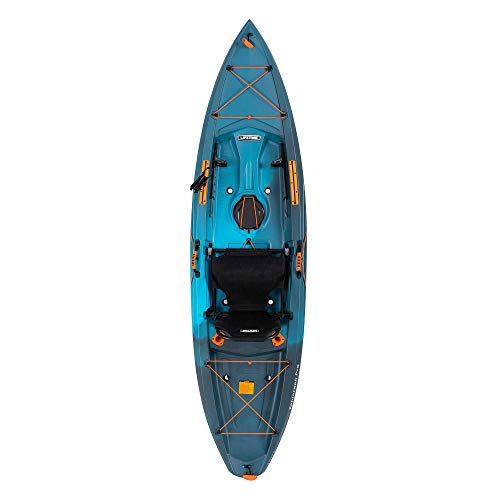
Lifetime Tamarack Pro 103 Sit-On-Top Kayak
Best for budget-conscious beginners testing stand-up fishing for the first time
Lifetime Tamarack Pro 103 Sit-On-Top Kayak
Best for budget-conscious beginners testing stand-up fishing for the first time
What we like
- Flat bottom with deep tracking channels delivers more stability than the price point would suggest.
- Framed seat removes completely, opening the cockpit for standing without anything underfoot.
- Two flush-mount rod holders and 12-inch mounting tracks give you a functional fishing rig at entry price.
- At around 60 lbs, it's the lightest kayak in this roundup and manageable solo at the water's edge.
What we don't
- 31-inch beam is the narrowest in this roundup — standing is possible but requires more active balance.
- 300-lb weight capacity leaves little room for heavier anglers once gear is added.
- No accessory ecosystem or motor compatibility limits where you can take this kayak long-term.
The Tamarack Pro 103 is the honest answer for someone who wants to try stand-up fishing before committing to a $700+ hull — at 31 inches wide with a flat bottom, it's the entry-level threshold for standing, and Lifetime's track record means it holds up season after season without drama. This is the right kayak if you're under 200 lbs, fish calm ponds and protected coves, and want to confirm you actually like fishing from a standing position before doubling or tripling the budget.
Once you're hooked, move up to the Outlaw or Catch Mode — but don't skip this step if you're not sure yet.
What to Look For
Width is the single most important spec for standing stability — look for 32 inches minimum, and 34 inches or wider if you plan to stand for extended periods or fish in any chop. A flat or tunnel hull design spreads your weight evenly, which keeps the wobble out when you shift your weight for a cast.
Deck padding is often underestimated until your feet are screaming after hour four — EVA foam pads aren't optional on a serious stand-up platform. Some kayaks include them from the factory; others treat them as aftermarket, which adds cost and a DIY step.
Storage layout matters as much as total volume — gear that's in the way when you stand is gear you'll trip over. Look for rear tank wells sized for a milk crate and front bow hatches that stay sealed when you shift weight forward.
Who Should Skip This
If you're primarily paddling moving rivers or technical water, a wide stand-up platform will fight you — these kayaks are designed for flatwater, slow current, and calm coastal bays where their stability shines. Paddlers who never plan to stand and just want a fast, efficient fishing kayak will pay a weight and tracking penalty for a feature they won't use.
Anyone under 5'6" should sit in the kayak before buying — some cockpit configurations position the standing zone awkwardly for shorter anglers.
What the Community Actually Uses
On r/kayakfishing, the standing stability debate comes up constantly — the consensus is that width beats length every time for platform fishing, and anglers who've tried both a 30-inch and a 34-inch hull almost universally don't go back. The thread on deck pad aftermarket options gets revived every spring, and the Old Town and Wilderness Systems models show up in top-comment recommendations more than any other brands.
Quick Picks — In Case You've Already Decided
Old Town Sportsman AutoPilot 120 Motorized Fishing Kayak
Check Price on AmazonFrequently Asked Questions
Can any kayak be used for stand-up fishing?
Technically yes, but practically no — kayaks under 30 inches wide require significant balance skill and become dangerous in any wind or wake. A purpose-built stand-up fishing kayak with 32+ inches of beam and a flat hull makes the difference between fishing and swimming.
What width kayak do I need to stand up and fish?
Most anglers find 32 inches of beam the minimum for casual standing, but 34 inches is the sweet spot for all-day stand-up fishing in varied conditions. Anything narrower and you're burning leg energy on balance instead of on fishing.
Is a pedal drive kayak better for stand-up fishing?
Yes, if budget allows — pedal drive keeps your hands free while moving and repositioning, which is a major advantage when you're trying to maintain position and cast simultaneously. It also eliminates the paddle-storage problem when you stand.
How much weight capacity do I need for a stand-up fishing kayak?
Take your body weight, add 50 lbs for gear, and look for a kayak rated at least 100 lbs above that total. Overloaded kayaks sit low in the water and lose the freeboard that makes standing stable.
Are sit-on-top kayaks better for stand-up fishing than sit-inside?
Almost always yes — sit-on-top kayaks provide a wider, unobstructed deck with no cockpit rim to trip over when transitioning from seated to standing. Virtually every purpose-built stand-up fishing kayak uses a sit-on-top design.
Buying Guide
You need at least 32 inches of width to stand safely — anything narrower and you're compensating with your legs all day. Deck pads matter more than people admit.
A trolling motor mount extends your range. Pedal drive keeps your hands free.
Weight capacity should exceed yours by at least 150 lbs once you add gear.