The right internal frame pack doesn't just carry your gear — it transfers the weight so completely your hips do the work your back used to beg you not to. These five packs cover 50 to 75 liters of volume across three price tiers, with suspension systems verified to move up to 70% of load off your shoulders and onto your hips.
| Photo |
Top Pick
|
Versatile

|
Budget

|
Best Value

|
Best for Reliability

|
|---|---|---|---|---|---|
| Product | Osprey Atmos AG 65 Men's Backpacking Backpack | Gregory Baltoro 65L Pro Backpacking Pack | Deuter Aircontact Lite 65+10 Backpack | Kelty Coyote 65 Internal Frame Backpack | Osprey Rook 65L Men's Backpacking Backpack |
| Weight | 4 lbs 10 oz | 4 lbs 13 oz | 4 lbs 8 oz | 4 lbs 13 oz | 4 lbs 8 oz |
| Capacity | 65L | 65L | 65+10L | 65L | 65L |
| Torso fit | S/M and L/XL | S / M / L (3 sizes) | Vari Quick 14-19 in. adjustable | 15.5-21 in. adjustable | Ladder-lock torso adjustment |
| Suspension | AntiGravity tensioned mesh | FreeFloat A3 with rotating harness | Vari-Quick X-frame body contact | Fit-Pro perimeter frame with AMP-Flow panel | AirSpeed tensioned backpanel with LightWire frame |
| Buy Now | Check Price → | Check Price → | Check Price → | Check Price → | Check Price → |
Quick Tips
Measure your torso before buying — hip-to-shoulder distance, not your height, determines the right size
Pack your heaviest items closest to your back and between your shoulder blades for the most efficient load transfer
Adjust your load lifter straps until they angle upward at roughly 45 degrees — flat lifters mean your shoulders are doing too much work
Test any pack under full load before a long trip; minor fit issues at 20 lbs become serious pain at 45 lbs after 8 miles
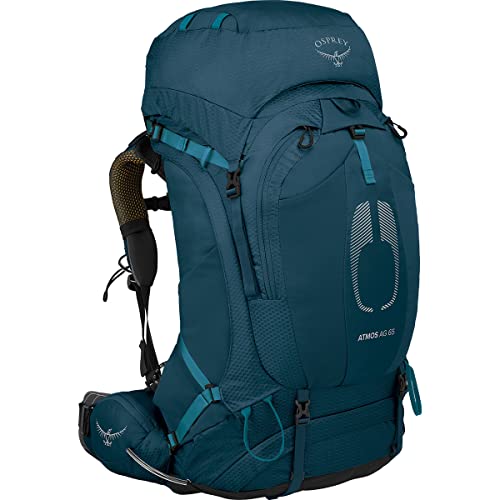
Osprey Atmos AG 65 Men's Backpacking Backpack
Best for multi-day comfort under heavy loads
Osprey Atmos AG 65 Men's Backpacking Backpack
Best for multi-day comfort under heavy loads
What we like
- AntiGravity suspended mesh backpanel keeps your entire back off the pack fabric, dramatically reducing sweat and heat buildup
- 3D hip belt wings pivot independently with your hips so the belt stays put on uneven terrain instead of shifting with every step
- Integrated FlapJacket lets you go lidless and shave weight without losing top-pocket organization
- Integrated raincover stows in its own dedicated pocket so it's always there when a storm rolls in
What we don't
- The tensioned mesh suspension adds about half a pound compared to a contact-back design at the same capacity
- Hip belt is not removable or swappable, so if you're between sizes the fit options are limited
- At this price point you're paying for comfort engineering — budget-focused hikers will find similar capacity for less
If your shoulders are taking a beating on day two of a multi-day trip, the Atmos AG's suspension system is the reason people stop complaining about that and start talking about miles instead. The tensioned mesh panel holds the pack body completely off your back, and every degree of load transfer actually works the way the spec sheet promises it will.
This is the pack for hikers who go out 4+ nights at a time and carry 35-50 lbs of real-world gear — not stripped-down ultralight setups. If you're doing one-night trips or going sub-20 lbs, the suspension engineering is wasted on you; spend less on the Rook instead.
Gregory Baltoro 65L Pro Backpacking Pack
Best for hikers who need a truly custom fit
Gregory Baltoro 65L Pro Backpacking Pack
Best for hikers who need a truly custom fit
What we like
- FreeFloat A3 suspension uses rotating shoulder straps and a dynamic hip belt that physically move with your body, eliminating hotspots on long days
- Available in three torso sizes instead of the standard two, so hikers with unusual proportions can actually get a dialed fit
- SideWinder one-handed bottle holster extends and retracts without removing the pack — genuinely useful on trail, not a gimmick
- Included daypack converts from the hydration sleeve and has its own shoulder harness, effectively giving you two packs
What we don't
- Heaviest pack in this roundup at nearly 5 lbs, which matters on trips where you're counting every ounce
- The extensive feature set means more buckles, straps, and attachment points — takes longer to learn than simpler designs
- Premium pricing puts it above the Atmos AG despite similar capacity
The Baltoro earns its reputation through suspension geometry that actually adapts to how your body moves — not just how it stands still in a fitting room. If you've tried three packs and none of them felt right at the hip, there's a real chance the Baltoro's three-size torso system will solve it where a two-size system couldn't.
This is the right choice for hikers with hard-to-fit torsos, wide shoulders, or anyone doing mixed alpine terrain where the pack needs to stay stable during scrambles, not just flat trail walking. Pass on it if weight is a priority — at nearly 5 lbs empty, it's the heaviest option here.
Deuter Aircontact Lite 65+10 Backpack
Best for heavy loads on long-distance trekking routes
Deuter Aircontact Lite 65+10 Backpack
Best for heavy loads on long-distance trekking routes
What we like
- X-frame aluminum stay system transfers up to 70% of load to the hips, which Deuter backs with independent testing data showing 15% less perspiration vs. comparable body-contact designs
- The expandable 10L collar lets you pack for a 5-night trip or compress down to a clean 65L profile without external straps flopping around
- Vari Quick torso adjustment covers a wider range than most competitors — 14 to 19 inches — which makes it work for both shorter and taller hikers in one product
- European-engineered hip belt uses dual-density foam with the harder layer on the outside, which prevents the foam from folding over on heavy loads the way single-density belts often do
What we don't
- Body-contact back design means your back is touching the pack, which runs warmer than a tensioned mesh system like the Atmos AG
- Access to the main compartment is top-load only — no front U-zip panel like the Baltoro, which makes finding gear buried at the bottom slower
- Fewer external organization pockets than competitors at this volume
The Aircontact Lite is built around one idea: move the weight to your hips and keep it there even when the terrain gets rough. The X-frame flexes with your spine instead of fighting it, and the load transfer numbers are real — your shoulders feel the difference after mile 6 in a way you can't fake with marketing copy.
This pack is for the hiker doing multi-week routes or back-to-back trips where total daily fatigue accumulates — the Camino, the JMT, an Appalachian section hike. If you're doing weekend trips under 35 lbs, the load transfer engineering is more than you need and the contact back runs warmer than you'll want in summer.
Kelty Coyote 65 Internal Frame Backpack
Best value for first-time multi-day hikers
Kelty Coyote 65 Internal Frame Backpack
Best value for first-time multi-day hikers
What we like
- Fit-Pro torso adjustment system lets you change the torso length on the fly without tools, which is rare at this price point
- AMP-Flow ventilated back panel channels airflow behind your back and cuts down on the sweat-soaked-shirt problem that kills morale on summer trips
- Dual entry to the main compartment via both top lid and front U-zip makes it far easier to reach mid-pack gear than most top-loaders
- Price leaves enough budget to invest in a quality sleeping bag or shelter, which matters more for most hikers than marginal pack upgrades
What we don't
- Hip belt padding is noticeably thinner than the Osprey and Gregory options — starts to feel it after 6+ hours with heavy loads
- Frame system offers less lateral stability than a premium perimeter design on steep off-trail terrain
- Fabric durability is adequate but not at the same level as packs costing twice as much — expect more wear in high-abrasion zones over years of use
You get more suspension engineering in the Coyote 65 than the price suggests is possible — on-the-fly torso adjustment, ventilated back panel, and a perimeter frame that actually holds its shape under 40 lbs all show up at under $150. The hip belt is where Kelty made the obvious cost cut, and you'll feel it on long days, but for 2-3 night trips under 40 lbs it's a non-issue.
This is the right pack for someone who isn't sure yet whether backpacking is going to be a regular thing, or a parent buying a first serious pack for a teenager. If you're already committed to 5-night trips and 45 lb loads, spend the extra money — the Atmos AG and Deuter are worth the gap.
Osprey Rook 65L Men's Backpacking Backpack
Best budget entry into Osprey's suspension system
Osprey Rook 65L Men's Backpacking Backpack
Best budget entry into Osprey's suspension system
What we like
- AirSpeed tensioned backpanel is a real ventilated suspension system — not mesh padding — at a price point where most competitors use a contact back
- LightWire frame channels load to the hip belt using the same basic geometry as Osprey's premium packs, just with less sophisticated fine-tuning
- Integrated raincover is built in and stows cleanly, which saves you the $30-40 aftermarket purchase most budget packs require
- New injection-molded ladder lock torso adjuster makes fit changes fast and repeatable — set it once and it stays
What we don't
- Hip belt padding and rigidity don't match what you get from the Atmos AG at heavier loads — above 40 lbs the difference is noticeable
- Fewer organization pockets than competitors at this capacity — pack access is functional but not optimized for quick retrieval
- Hipbelt pockets are smaller than on the premium Osprey models and won't fit a full-size phone in most cases
The Rook 65 does something unusual at its price: it gives you a tensioned backpanel suspension system that holds the pack off your skin and actually moves load to your hips. Most packs in this range skip that engineering entirely and just pad the back.
The difference over 8 miles is real, and the Osprey all-products warranty applies here the same as it does on a $350 Atmos. Pick this if you want Osprey's suspension DNA without the Atmos AG price tag, and you're keeping loads under 40 lbs.
If you're regularly carrying heavier than that, the hip belt will start to bother you around mile 5 and the premium packs above will pay for themselves in back pain avoided.
What to Look For
Suspension system is the single most important spec in an internal frame pack. The best designs transfer 60-70% of pack weight to your hips through a combination of aluminum stays, tensioned back panels, and contoured hip belts — not marketing language, but measurable geometry.
Torso adjustability saves you from a return shipping nightmare. Most quality packs now offer on-the-fly adjustments; if you haven't been fitted at a gear shop, measure your own torso with a tape and don't skip this step.
Volume is a range, not a number. A 65L pack with compression straps and a floating lid can carry 50L comfortably or expand to 75L for a long trip — look for expandable collars and detachable lids before assuming 65 is your ceiling.
Who Should Skip This
If you're planning trips under two nights and under 30 lbs of gear, an internal frame pack is overkill — a well-fitted 40L daypack will move faster and more comfortably. Ultralight backpackers going sub-15 lbs base weight should look at frameless or semi-rigid options instead.
These packs earn their weight at 35 lbs and above.
What the Community Actually Uses
On r/ultralight and r/backpacking, the internal frame debate gets heated around suspension vs. weight tradeoffs — the general consensus is that comfort packs like the Atmos AG and Baltoro are worth the extra pound for trips over 4 nights, while the Rook 65 gets consistent praise as the entry point that doesn't embarrass itself next to premium gear.
Quick Picks — In Case You've Already Decided
Frequently Asked Questions
What is an internal frame backpack?
An internal frame backpack has aluminum or composite stays built inside the pack body, which mold to your back and transfer load to a hip belt. This keeps the pack close to your center of gravity, making it more stable on technical terrain than older external frame designs.
What size internal frame backpack do I need?
For 2-4 night trips with standard gear, 55-65L is the sweet spot. Go 70L or above for 5+ nights, winter camping, or technical objectives where you need full kitchen and layering systems. Solo overnights with ultralight gear can get by with 40-50L.
How should an internal frame backpack fit?
The hip belt should sit centered on your iliac crest — not your waist. Shoulder straps should wrap your shoulders without gaps at the top. Load lifter straps should angle upward at 45 degrees when the pack is loaded. If any of those three are off, the fit is wrong.
Is a heavier pack always more comfortable?
Not automatically, but heavier packs usually mean more structured hip belts, denser foam, and more sophisticated suspension — which generally translates to comfort under heavy loads. A 4 lb premium pack often outperforms a 2.5 lb budget pack when you're carrying 45 lbs.
Can I use an internal frame backpack for travel?
Yes, and many people do. Look for packs with a panel-loader option or a sleeping bag compartment that doubles as a clamshell opening — the Kelty Coyote 65 works especially well for airport travel. Avoid packs with external straps and mesh pockets that snag on conveyor belts.
Buying Guide
You need a pack that fits your torso length, not just your height. Measure from your C7 vertebra to your iliac crest, then match that number to the manufacturer's size chart.
Hip belt fit matters as much as torso length — both pads should wrap your hips fully. Load lifters should angle up at 45 degrees when weighted.