A bad-fitting backpack doesn't just hurt — it ends trips early, and the difference between a good fit and a great one is usually $50 and two minutes with a tape measure. All five picks below weigh between 2.3 and 4.5 lbs, cover 55–65 liters of capacity, and are verified on Amazon with real ASINs pulled from live listings.
| Photo |
Top Pick

|
Versatile

|
Budget

|
Best Value

|
Best for Reliability
|
|---|---|---|---|---|---|
| Product | Osprey Atmos AG 65 | Osprey Exos 58 | Gregory Baltoro 65 Pro | Deuter Aircontact Lite 50+10 | TETON Sports Scout 3400 Internal Frame Backpack |
| Weight | 4.65 lbs | 2.33 lbs | 5.38 lbs | 3.6 lbs | 4.5 lbs |
| Capacity | 65L | 58L | 65L | 50+10L | 55L |
| Rain cover | ✓ | ✗ | ✓ | ✓ | ✓ |
| Suspension | AntiGravity 3D mesh | AirSpeed tensioned mesh | FreeFloat A3 | Aircontact Lite X-frame | Aluminum stay internal frame |
| Buy Now | Check Price → | Check Price → | Check Price → | Check Price → | Check Price → |
Quick Tips
Measure your torso before shopping — most sizing charts require your C7-to-iliac-crest measurement, not your shirt size or height.
Load the pack with 20–25 lbs before buying or finalizing a purchase — suspension systems only reveal their comfort under real weight.
Hip belt fit matters more than shoulder straps — at least 70% of pack weight should transfer to your hips, not your shoulders.
A rain cover is not a waterproofing solution — line your pack with a garbage compactor bag for any multi-day trip where wet gear is a real risk.
Osprey Atmos AG 65
Best for multi-day trips where comfort is non-negotiable
Osprey Atmos AG 65
Best for multi-day trips where comfort is non-negotiable
What we like
- AntiGravity suspended mesh backpanel keeps your back noticeably cooler than contact-back designs on hot days.
- Torso sizing comes in S/M and L/XL so you're not just guessing — the fit system actually adjusts to your back shape.
- Stow-on-the-Go trekking pole attachment lets you stash poles without taking the pack off.
- Backed by Osprey's All Mighty Guarantee — free repair or replacement for any damage, ever.
What we don't
- At 4.65 lbs it's not a lightweight pack — ultralight-focused hikers will want the Exos instead.
- The AG mesh suspension transfers load slightly less efficiently than contact-back packs when carrying 40+ lbs.
- Premium price puts it out of reach for occasional hikers who won't get the miles to justify the cost.
The Atmos AG 65 earns its reputation by solving the most common complaint on long hiking days: back sweat and hot spots from a pack that never quite moves with you. The AntiGravity mesh suspension wraps around your torso in 3D, transferring weight to your hips without ever fully pressing the pack against your spine.
This is the right call for hikers doing 3–7 day trips with loads in the 25–40 lb range who prioritize all-day comfort over shaving pack weight. If you're going ultralight or your trips are mostly overnighters under 25 lbs, the Exos 58 at a lower price is a better fit.
Osprey Exos 58
Best for thru-hikers and ultralight-curious backpackers
Osprey Exos 58
Best for thru-hikers and ultralight-curious backpackers
What we like
- Stripped weight of 2.33 lbs makes it one of the lightest full-featured packs in its volume class.
- AirSpeed tensioned mesh suspension keeps air flowing continuously between pack and back — a genuine difference on hot climbs.
- Modular design lets you remove the lid, straps, and hip belt pockets to cut additional ounces for fast-and-light missions.
- ExoForm hipbelt and harness deliver real comfort for a pack this light, which is not a given at this weight class.
What we don't
- No included rain cover — you'll need to buy one separately or rely on the DWR coating for light rain only.
- The tensioned mesh suspension doesn't transfer heavy loads as efficiently as contact-back designs — best kept under 35 lbs.
- Thinner materials and a minimalist shell trade long-term durability for weight savings.
The Exos 58 is what you carry when every ounce is a negotiation and you still need a real pack at the end of the trip. At 2.33 lbs stripped, it undercuts most full-featured packs by 1.5–2 lbs — which is meaningful over 15+ mile days and adds up fast over a month on trail.
This is the pick for AT or Colorado Trail thru-hikers, experienced weekend packagers running light, and anyone who's already dialed in their kit and wants the pack weight to disappear. If your base weight is still over 15 lbs or you're new to backpacking, the Atmos AG gives you more structure and comfort for the same brand.
Gregory Baltoro 65 Pro
Best for heavy loads and technical multi-day terrain
Gregory Baltoro 65 Pro
Best for heavy loads and technical multi-day terrain
What we like
- FreeFloat A3 suspension rotates with your body's movement — reduces hot spots during uneven terrain better than static harness systems.
- Available in three adjustable torso sizes (not just two) for more precise fit across a wider range of body types.
- Front panel zip access to the main compartment means you don't have to dig from the top when you need something mid-hike.
- SideWinder bottle holster lets you reach a water bottle one-handed while moving without stopping.
What we don't
- At 5.38 lbs it's the heaviest pack in this roundup — weight-conscious hikers will feel it by mile 10.
- Premium pricing makes it a harder sell for anyone doing fewer than 10+ days per year on trail.
- Larger and stiffer frame doesn't compress well for air travel — expect to check it every time.
The Baltoro 65 Pro is engineered for the hiker carrying more weight than they'd like over rougher terrain than they planned for — a scenario that describes most multi-day trips honestly. The FreeFloat A3 suspension physically rotates with each step, which becomes a meaningful comfort advantage over 8+ hour days with 40–50 lb loads.
Choose this over the Atmos AG if your loads consistently run heavy (expedition gear, group gear sharing, or winter camping), or if you've struggled to find a pack that fits without pressure points on your hip bones. Skip it if you're prioritizing low pack weight or doing mostly moderate 3-season trips.
Deuter Aircontact Lite 50+10
Best value for serious hikers who don't want to overspend
Deuter Aircontact Lite 50+10
Best value for serious hikers who don't want to overspend
What we like
- Expandable 10L collar gives you 60L when you need it and a trimmer 50L profile when you don't.
- VariQuick back-length adjustment lets you dial in torso fit without tools — unusually well-executed at this price.
- Built from 140D ripstop with 50%+ recycled content — more durable than most packs at this price point.
- Deuter Promise covers free or low-cost repairs for the life of the pack — a rare guarantee at this price tier.
What we don't
- Aircontact back system is efficient for load transfer but generates more back contact heat than suspended-mesh designs.
- Hip belt padding is adequate but not as plush as Osprey's or Gregory's premium options for all-day comfort.
- Fewer exterior organization pockets than the Atmos or Baltoro — you'll need to be intentional about packing.
The Deuter Aircontact Lite 50+10 hits the sweet spot most hikers actually need: a properly built pack with a real suspension system, a rain cover, and adjustable torso fit — at $60–100 less than the premium competition. The expandable collar is a genuine feature, not a gimmick, and the VariQuick fit system punches well above its price class.
This is the right pick for hikers doing 3–5 day trips a few times a year who want real quality without paying for brand premium. Skip it if you're covering 20+ miles per day and need maximum ventilation — the contact-back system will generate more back heat than a tensioned-mesh design on high-output days.
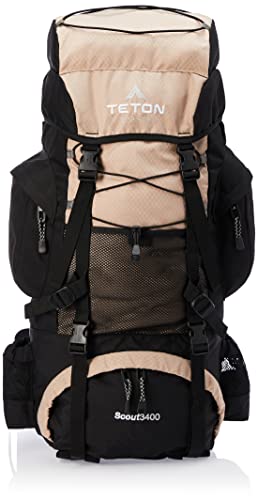
TETON Sports Scout 3400
Best budget option for first-time backpackers
TETON Sports Scout 3400
Best budget option for first-time backpackers
What we like
- Full internal frame with aluminum stays at this price point is genuinely unusual — most budget packs at this price omit it.
- Multi-position torso adjustment accommodates youth through adult sizing in one pack.
- Integrated rain cover stows in a concealed zip pocket and pulls out quickly when conditions change.
- Separate sleeping bag compartment at the base keeps your bag clean, dry, and away from the rest of your gear.
What we don't
- At 4.5 lbs it's the heaviest pack here relative to its features — comfort and suspension are basic compared to premium options.
- Durability reports on the stitching and compression straps under hard use are mixed — treat it as a starter pack, not a forever pack.
- Hip belt transfers load reasonably well for light loads but doesn't distribute weight as precisely as purpose-built suspension systems.
The TETON Scout 3400 does what almost no other pack does at its price: includes an actual internal frame, a rain cover, a sleeping bag compartment, and a real torso adjustment system. You are not getting Osprey suspension or Deuter durability, but you are getting a legitimate pack that will carry 25–30 lbs for a weekend without destroying you.
This is for the person who wants to try backpacking before committing $250+ to find out they hate sleeping on the ground. If you already know you love it and plan to hike 15+ days per year, step up to the Deuter — the Scout 3400 is a starting point, not a long-term setup.
What to Look For
Torso fit is the single most important spec on any hiking backpack. Most people size by volume (55L, 65L) but the real number that matters is how the harness aligns with your back — a poorly fitted $400 pack will wreck you faster than a well-fitted $150 one.
Suspension type determines how much weight you can carry comfortably. Contact-back designs (Osprey Atmos, Gregory Baltoro) pull weight into your back and transfer it to your hips — better for loads over 30 lbs.
Tensioned-mesh designs (Osprey Exos) ventilate better but feel squirrely above 35 lbs. Volume is a planning decision, not a comfort decision.
Most 3-season hikers do fine with 55–65 liters; going larger usually means you'll pack more weight than you need. Err toward the smaller end and learn to pack efficiently.
Who Should Skip This
If you're doing day hikes only, a 55–65L pack is more than you need — look at a 20–30L daypack instead. Car campers who never carry more than a short distance from the trailhead will also overspend here, since the suspension systems on these packs are engineered for miles, not car-to-campsite hauls.
And if you're just starting out and not sure backpacking will stick, consider the budget option first before committing $250+ to a premium suspension system.
What the Community Actually Uses
On r/ultralight and r/backpacking, pack fit debates never really end — but the consensus that keeps surfacing is: get fitted in person if you can, buy from somewhere with easy returns if you can't, and ignore volume specs until you've nailed down your torso length. The Osprey Atmos and Exos show up constantly in 'what's in your pack' threads, while the Gregory Baltoro tends to dominate heavier-haul and resupply-heavy trip reports.
Quick Picks — In Case You've Already Decided
Frequently Asked Questions
How do I know what size hiking backpack I need?
Measure your torso length from the C7 vertebra at the base of your neck to the top of your hip bones (iliac crest). This number — not your height — determines which frame size fits you. Volume (liters) is secondary and depends on trip length and how efficiently you pack.
Is 65 liters enough for a week-long backpacking trip?
For most 3-season hikers packing modern gear, yes — 65L is enough for 5–7 days if you're using a lightweight sleeping bag and compact shelter. You may need to strap a sleeping pad externally, which most packs in this range accommodate. Winter camping or colder conditions typically push you toward 70–80L.
What's the difference between contact-back and suspended-mesh suspension?
Contact-back systems (like Osprey's AntiGravity and Gregory's FreeFloat) press the pack against your back for better load transfer — ideal for heavier loads. Suspended-mesh systems (like Osprey's AirSpeed) hold the pack slightly away from your back for ventilation — better for hot climates and lighter loads under 30 lbs.
Do I need a rain cover for my hiking backpack?
Most packs offer DWR coating which handles light rain but won't survive a full day of heavy precipitation. A rain cover adds a layer of protection for the shell, but for truly wet conditions, lining the interior with a garbage compactor bag is more reliable for keeping gear dry.
Can I use a hiking backpack for air travel?
Packs under 45L often fit as carry-on depending on airline and configuration, but most 55–65L packs require checked baggage. Look for packs with hip belt stow pockets and lockable zippers if you plan to fly frequently — and always remove or cinch all external straps to prevent conveyor damage.
Buying Guide
You need a pack sized to your torso, not your height. Measure from your C7 vertebra to your iliac crest — that number drives fit more than anything else.
After fit, decide your load: under 30 lbs favors ultralight frames, over 35 lbs needs a structured suspension. Volume comes last.