Picking the wrong road bike GPS costs you hours of bad data and mid-ride frustration when the map lags or the battery dies 40 miles from home. The five picks here cover every rider from the $90 budget buyer to the data-obsessed racer running a $600 unit with adaptive coaching and 26-hour battery.
| Photo |
Top Pick

|
Versatile

|
Budget

|
Best Value

|
Best for Reliability
|
|---|---|---|---|---|---|
| Product | Garmin Edge 540 GPS Cycling Computer | Wahoo ELEMNT Bolt V2 GPS Cycling Computer | Hammerhead Karoo 3 | Bryton Rider S810 | iGPSPORT BSC300T GPS Bike Computer |
| Gnss | Multi-band GPS + GLONASS + Galileo | GPS + GLONASS + Galileo | Multi-band GPS + GLONASS + Galileo + BeiDou | GPS + GLONASS + BeiDou + Galileo | GPS + BeiDou + GLONASS + Galileo + QZSS |
| Display | 2.6" color, button controls | 2.2" color, button + LED strip | 3.2" full-color touchscreen | 3.5" color touchscreen | 2.4" color touchscreen + buttons |
| Waterproof | IPX7 | IPX7 | IPX7 | IPX7 | IPX7 |
| Battery life | 26 hrs (42 hrs saver mode) | 15 hrs | Up to 17 hrs (GPS mode) | 50 hrs | 20 hrs |
| Buy Now | Check Price → | Check Price → | Check Price → | Check Price → | Check Price → |
Quick Tips
Mount matters as much as the unit — an out-front mount keeps your GPS in eyeline without forcing you to dip your chin on climbs.Pair your GPS with a cadence sensor from day one; speed alone tells you very little about your actual effort or efficiency.Download offline maps before long rides even if your unit has solid LTE — GPS signal through canyons and tree cover is inconsistent regardless of brand.Set your auto-pause threshold deliberately: 0 mph auto-pause inflates average speed and distorts training load data on hilly routes with stops.
Garmin Edge 540
Best for serious road cyclists who train with power
Garmin Edge 540
Best for serious road cyclists who train with power
What we like
- Adaptive coaching adjusts your daily workouts based on actual training load when paired with a power meter and heart rate monitor.
- Multi-band GNSS delivers accurate positioning even under heavy tree cover and in city canyons where single-band units drift.
- ClimbPro shows remaining ascent and gradient on every climb without needing a preloaded route.
- Button controls work reliably with wet gloves, unlike touchscreens that misfire in the rain.
What we don't
- No touchscreen means more button presses for navigation and settings changes mid-ride.
- Full training feature depth requires a power meter and HRM — adds significant cost on top of the unit.
- The 2.6" screen feels small next to competitors like the Karoo 3 or Bryton S810.
The Edge 540 is the sweet spot for road cyclists who actually train — not just log rides. Where budget units record what happened, the 540 tells you what to do next: it adjusts your workouts in real time based on recovery, training load, and your upcoming events when paired with a power meter.
This is the pick if you're running structured training blocks, targeting a century or gran fondo, or racing. Skip it if you mostly ride for fun on familiar routes and don't own a power meter — the coaching depth becomes irrelevant without one.
Wahoo ELEMNT Bolt V2
Best for riders who want fast setup and clean data
Wahoo ELEMNT Bolt V2
Best for riders who want fast setup and clean data
What we like
- Companion app setup takes under 10 minutes and automatically downloads routes from Strava, Komoot, and Ride with GPS without manual sync.
- Aerodynamic integrated mount sits lower on your stem and reduces frontal drag compared to standard out-front mounts.
- Quicklook LED strip lets you monitor heart rate zones and turn alerts without looking directly at the screen.
- Pairs seamlessly with TrainerRoad and TrainingPeaks for riders already inside those training ecosystems.
What we don't
- 15-hour battery is the shortest on this list — a real concern for century rides or all-day adventures.
- Initial setup is locked behind the companion app, which frustrates riders who prefer out-of-box use.
- Smaller 2.2" screen shows fewer data fields at once compared to larger competitors.
The Bolt V2 is the GPS for riders who hate fiddling with devices. Wahoo's philosophy is phone-first setup and then get out of the way — you configure everything in the app once, and the unit just works ride after ride.
Navigation, route sync, sensor pairing: all handled from your phone before you clip in. Pick this if you're Strava-native, ride routes under 100 miles, and value how the device looks on your bike as much as what it does.
If you're regularly pushing past 8 hours of ride time or need deep adaptive training tools, the battery and feature ceiling will frustrate you.
Hammerhead Karoo 3
Best for navigation-heavy riders who explore new routes
Hammerhead Karoo 3
Best for navigation-heavy riders who explore new routes
What we like
- The 3.2" display renders the most detailed, fastest-loading maps of any cycling computer at this price — no waiting for tiles to fill in.
- Android-based OS receives frequent software updates that add real features, not just bug fixes, long after purchase.
- 64GB of storage means you can pre-load maps for multiple regions and store months of ride history on-device.
- Routing adapts in real time with automatic rerouting that recalculates instantly on the device without needing a cell signal.
What we don't
- The most expensive unit on this list — hard to justify if you ride familiar routes and don't prioritize navigation.
- Training tools are less mature than Garmin's adaptive coaching system; better for exploration than structured training.
- Larger form factor is noticeably heavier on the stem compared to the compact Bolt or Edge 540.
If you ride new roads more than familiar ones, the Karoo 3 is the best GPS you can buy. The screen is simply in a different class — it's what a smartphone display looks like on a cycling computer, and the maps render fast enough that you can actually follow them at speed without slowing to squint.
This is the pick for touring riders, long-distance explorers, and anyone who regularly rides in unfamiliar cities or remote terrain. If you train on power data and adaptive coaching, the Edge 540 gives you more for less money.
Bryton Rider S810
Best for long-distance riders who hate charging anxiety
Bryton Rider S810
Best for long-distance riders who hate charging anxiety
What we like
- 50-hour battery is nearly double the next-best on this list — a genuine game-changer for multi-day tours and ultra-distance events.
- 3.5" screen is the largest display here, giving you more visible data fields without shrinking font size uncomfortably.
- Climb Challenge 2.0 provides real-time gradient and summit distance without a preloaded route — works on any road.
- Strava Live Segments, offline maps, and ANT+ power meter support at a price point significantly below Garmin and Wahoo.
What we don't
- Bryton Active app is functional but noticeably less polished than Garmin Connect or the Wahoo companion app.
- Training ecosystem depth doesn't match Garmin — no adaptive coaching or stamina insights even when paired with a power meter.
- Brand recognition is lower, which matters if you're reselling or want a strong ecosystem of third-party accessories.
Fifty hours of battery on a GPS computer sounds like marketing — it isn't. Bryton built the S810 for cyclists who do multi-day events, bikepacking trips, or back-to-back centuries where charging is inconvenient.
You get a bigger screen than Garmin, better battery than Wahoo, and offline maps that work without a signal, all under $250. The S810 is the pick if battery anxiety is your primary concern or you're doing any kind of long-distance or multi-day riding.
Trade-off is training depth — Garmin's adaptive coaching and Wahoo's ecosystem integration are both ahead of what Bryton offers.
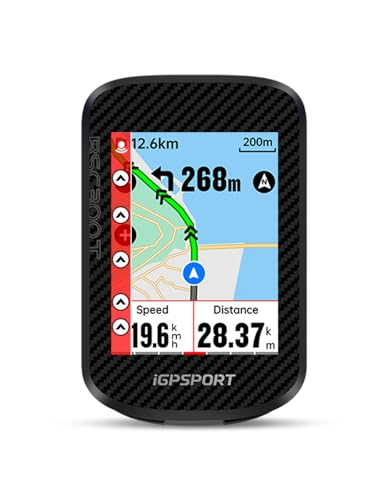
iGPSPORT BSC300T
Best budget GPS with offline maps and touch controls
iGPSPORT BSC300T
Best budget GPS with offline maps and touch controls
What we like
- Offline global map download and turn-by-turn navigation at under $100 — a feature set most sub-$150 competitors don't offer.
- Dual control via touchscreen and physical buttons means you can operate it reliably with wet gloves or in cold weather.
- Supports 130+ data fields including ANT+ power meters and rear-view radar integration at a price point no competitor matches.
- 20-hour battery handles century rides with significant buffer for a unit this affordable.
What we don't
- 2.4" screen is smaller and less vivid than every other GPS on this list — harder to read quickly at speed.
- iGPSPORT app is rudimentary compared to Garmin Connect; route planning and data analysis are noticeably limited.
- No adaptive coaching or training load features — data logging only, not training guidance.
The BSC300T does something no sub-$100 GPS should be able to do: it offers real offline maps, turn-by-turn navigation, and ANT+ sensor support without cutting corners on weatherproofing. Five satellite systems means positioning locks faster and drifts less than competitors at twice the price.
This is the GPS for new cyclists, commuters, or anyone who wants a capable head unit without a $300 commitment. If you're training seriously with a power meter and coach-driven workouts, you will outgrow this within a season — but for riders who just want to know where they are and how far they've gone, it's the best dollar-for-dollar buy on this list.
What to Look For
Battery life is the spec that ends rides early. A 15-hour unit covers a century with buffer; anything under 12 hours gets stressful on big days.
Solar charging sounds nice but rarely moves the needle on pure road use — prioritize raw battery hours over solar topping. Navigation quality splits devices more than any other feature.
Turn-by-turn is table stakes. What separates good from great is how fast the map renders, whether rerouting happens on-device without a data connection, and how well the unit handles urban canyons or dense tree cover where GPS signal degrades.
Training data depth is where the price gap is real. Budget units log speed, distance, and elevation.
Mid-tier adds cadence and heart rate. True performance units layer in power guide, adaptive coaching, ClimbPro, stamina insights, and live segment comparison — tools that actually change how you train rather than just recording what you did.
Who Should Skip This
If you ride a set 20-mile loop three times a week and never race, a $400 cycling computer is overkill — the Wahoo Bolt or iGPSPORT will handle everything you actually need. If you primarily ride indoors on a trainer, a dedicated head unit is redundant; your training app handles data better.
And if you refuse to use a companion app at all, avoid Wahoo — it requires the app for initial setup.
What the Community Actually Uses
On r/cycling and r/Velo, the Garmin-vs-Wahoo debate runs constantly. The consistent pattern: Wahoo users stay for the simple setup and ecosystem lock-in; Garmin users stay because nothing else matches the training depth when you're running a power meter and heart rate monitor together.
Budget picks like the iGPSPORT and Bryton get genuine love in both communities as long as users go in knowing the companion apps aren't as polished.
Quick Picks — In Case You've Already Decided
Frequently Asked Questions
Do I need a GPS computer if I already have a cycling app on my phone?
Your phone works but it drains battery fast, isn't weatherproof, and is hard to glance at while riding. A dedicated GPS computer is brighter in sunlight, visible at speed, and frees your phone for emergencies.
What's the difference between a $100 and a $400 road bike GPS?
Budget units give you speed, distance, elevation, and basic navigation. The jump to $400 buys adaptive coaching, multi-band GNSS accuracy, power meter support, ClimbPro, and Strava live segments — tools built for training progression, not just ride logging.
Do I need ANT+ or is Bluetooth enough?
Bluetooth handles most sensors just fine for casual and recreational riders. ANT+ matters if you're running a power meter, rear radar, or want to broadcast simultaneously to multiple devices — it's the standard serious cyclists use.
Is the Hammerhead Karoo 3 worth the extra cost over Garmin?
If you live in the app and love customization, yes — the Karoo 3 has the best screen and fastest map rendering at any price. If you rely on Garmin Connect's training ecosystem and adaptive coaching, the Edge 540 wins.
Can I use a road bike GPS on a gravel or mountain bike?
Every unit on this list supports multiple profiles. The main difference is map type — road-optimized units may not show singletrack detail. Bryton and Hammerhead both offer routing mode switching between road, gravel, and MTB.
Buying Guide
You need a GPS that matches how you actually ride. Training metrics matter more than maps if you're on familiar routes — get a unit with power and heart rate support.
Navigation is everything if you explore. Battery life kills the decision faster than any spec: 15 hours is fine for day rides, 26-plus if you're doing centuries or multi-day tours.