Your phone GPS isn't a navigation plan — it's a liability the moment you drop into a canyon with zero bars. The five GPS units below work offline, route around your rig's height and weight, and between them cover every budget from $200 to $600.
| Photo |
Top Pick

|
Versatile
|
Budget

|
Best Value
|
Best for Reliability

|
|---|---|---|---|---|---|
| Product | Garmin Tread 2 Overland Edition | Garmin Overlander | Garmin Tread XL Overland Edition | Magellan TRX7 CS PRO | Garmin Tread Overland Edition |
| Display | 8" ultrabright touchscreen | 7" color touchscreen | 10" ultrabright touchscreen | 7" sunlight-readable touchscreen | 8" ultrabright touchscreen |
| Waterproof | Yes (IP67) | Yes (IP67) | Yes (IP67) | Yes (IP54) | Yes (IP67) |
| Trail database | OSM + USFS Motor Vehicle Use Maps | TopoActive + iOverlander POIs | OSM + USFS Motor Vehicle Use Maps | 160,000+ OHV/ATV/4WD routes | OSM + USFS Motor Vehicle Use Maps |
| Vehicle routing | ✓ | ✓ | ✓ | ✗ | ✓ |
| Buy Now | Check Price → | Check Price → | Check Price → | Check Price → | Check Price → |
Quick Tips
Download satellite imagery over Wi-Fi before you leave — once you're on trail, that option is gone.
Set your vehicle profile with accurate height, weight, and length so routing actually keeps you off roads you can't clear.
Mount the unit where it stays readable in direct sun — a dim screen at 2pm on a dusty trail is as useless as no screen.
Pair your GPS with an inReach communicator for two-way messaging and SOS in areas with no cell or radio coverage.
Garmin Tread 2 Overland Edition
Best for serious vehicle-based overland expeditions
Garmin Tread 2 Overland Edition
Best for serious vehicle-based overland expeditions
What we like
- Preloaded topo maps for North and South America with public and private land boundaries included out of the box.
- Vehicle-profile routing factors your rig's height, weight, and length into every route suggestion.
- Subscription-free BirdsEye satellite imagery downloads directly to the device over Wi-Fi.
- Built-in inReach capability supports two-way satellite messaging and interactive SOS when paired with a subscription.
What we don't
- The inReach satellite communication features require a separate active subscription to actually use.
- At this price point it's a significant investment if you only do occasional light off-road running.
- Group Ride tracking requires all members to have Tread navigators connected to vehicle power.
The Tread 2 picks up where every trail app leaves off — the moment you lose signal, it's already loaded the topo, the land boundaries, the campgrounds, and knows your rig is too heavy for that forest road you almost turned down. This is the right unit if you run multi-day BLM routes or deep forest service tracks and need nav you can trust without a cell tower in range.
If you're mostly running day trips on established trails close to pavement, the original Tread Overland at a lower price point gets you 90% of the way there.
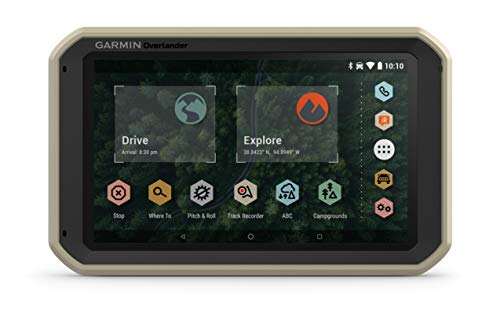
Garmin Overlander
Best for full-time overlanders who want proven offline nav
Garmin Overlander
Best for full-time overlanders who want proven offline nav
What we like
- 64GB onboard storage lets you download additional USGS quad sheets and regional maps beyond what's preloaded.
- Vehicle-profile routing based on height, weight, and length filters route suggestions for large rigs.
- Preloaded with iOverlander POIs and Ultimate Public Campgrounds for campsite discovery without a signal.
- Multi-GNSS support using GPS, GLONASS, and Galileo for more reliable position fixes in challenging terrain.
What we don't
- Older platform than the Tread 2 — slower processor and dimmer display in direct sun comparison.
- No built-in pitch/roll gauges or altimeter — sensors the Tread Overland editions include.
- Pairs with inReach communicators but doesn't have the Tread's built-in inReach capability.
The Overlander is the GPS that proved Garmin's overlanding concept — vehicle-profile routing, offline topo maps, and iOverlander POIs on a dedicated 7" unit. Street pricing has dropped since the Tread launched, making this a legitimate value pick for a capable navigator.
Buy this if you want proven offline navigation with 64GB of map storage and you don't need the Tread's brighter display, sensor suite, or built-in inReach. Skip it if you run technical terrain where pitch/roll data and a brighter display would change decisions.
Garmin Tread XL Overland Edition
Best for cab-mounted rigs and side-by-sides where screen size matters
Garmin Tread XL Overland Edition
Best for cab-mounted rigs and side-by-sides where screen size matters
What we like
- The 10" ultrabright display is readable from across a wide cab without squinting or leaning in to confirm a turn.
- Same trail database, topo maps, and vehicle-profile routing as the standard Tread Overland in a larger housing.
- Built-in altimeter, barometer, compass, and pitch/roll gauges for complete terrain situational awareness.
- Built-in inReach capability supports satellite communication and SOS when paired with an active subscription.
What we don't
- The larger footprint means mounting placement is more limited in tight cabs or on short windshields.
- Premium pricing over the standard Tread Overland for what is primarily a screen size upgrade.
- Overkill for solo builds where the standard 8" Tread is already easy to read from the driver's seat.
The XL is the same Tread Overland platform with a 10" screen — the entire value proposition is visibility from a wider seating position, which matters in a full-size side-by-side or a lifted truck where you're sitting further from the dash. Buy this if you run a wide-cab SxS or a truck where reading the standard 8" Tread requires leaning in.
If you're in a standard-width cab and the 8" Tread is already comfortable, the XL is a premium you don't need.
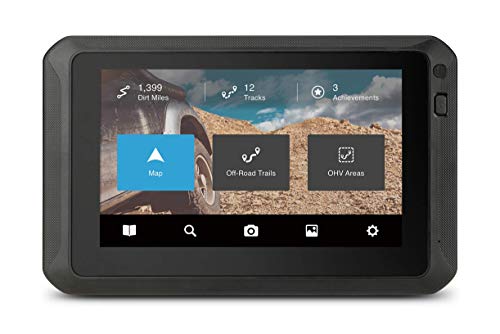
Magellan TRX7 CS PRO
Best for OHV and ATV riders who want a trail camera built in
Magellan TRX7 CS PRO
Best for OHV and ATV riders who want a trail camera built in
What we like
- 160,000+ preloaded OHV, ATV, motorcycle, and snowmobile trails is one of the largest dedicated off-road databases available.
- Built-in rear-facing 8MP camera with LED flash auto-starts recording when approaching trails.
- RAM dual mount included — fits both suction cup windshield mounting and 1"-1.25" bar mounting out of the box.
- Lower entry price than the Garmin Tread line with a solid 7" touch screen and Android-based interface.
What we don't
- IP54 rating is lower than the IP67 of Garmin's Tread and Overlander — less protection in sustained water exposure.
- No vehicle-profile routing based on rig height or weight — it routes trails, not around your clearance.
- App stability on long multi-day routes has drawn complaints; better suited to day trips than extended expeditions.
The TRX7 CS PRO wins on trail database size — 160,000+ designated OHV routes is a real differentiator for ATV and UTV riders who want to discover new terrain, not just navigate a pre-planned route. The integrated rear-facing camera is a genuine bonus for that riding style.
Buy this if you're primarily running ATV or side-by-side trails and the camera plus trail database matters more than vehicle-profile routing. If you're running a truck or overland rig where clearance routing and a higher waterproof rating are priorities, step up to the Garmin Overlander.
Garmin Tread Overland Edition
Best for overlanders who want the Tread platform without the Gen 2 premium
Garmin Tread Overland Edition
Best for overlanders who want the Tread platform without the Gen 2 premium
What we like
- Same core preloaded trail maps, iOverlander POIs, and vehicle-profile routing as the Tread 2 at a lower street price.
- Built-in inReach capability for satellite communication and SOS with an active subscription.
- Built-in altimeter, barometer, compass, and pitch/roll gauges — the full Tread sensor suite.
- IP67-rated housing handles dust and water immersion up to 1 meter for 30 minutes.
What we don't
- The Tread 2 has a faster processor and subscription-free satellite imagery — this gen requires checking download status before trips.
- Older firmware platform means some newer Tread app features may not be fully supported long-term.
- Street pricing overlap with the Tread 2 makes the value gap narrower than it used to be — worth comparing current prices.
The original Tread Overland is the same hardware platform as the Tread 2 in most ways that matter on trail — same IP67 rating, same vehicle-profile routing, same sensor suite, same preloaded maps. Where it falls behind is processing speed and the Tread 2's smoother satellite imagery workflow.
Buy this if current street pricing puts it meaningfully below the Tread 2 and you don't need the slightly faster interface. If the price gap has closed to under $50, spend up for the Tread 2.
What to Look For
Offline map storage is non-negotiable — any unit that needs a data connection to route is not an overlanding GPS. Look for full topo coverage of North America preloaded, not just road maps with a hiking trail layer bolted on.
Vehicle-profile routing is the feature that separates overlanding-specific units from general outdoor GPS. A unit that knows your rig is 7'2" tall and 6,800 lbs will route you differently than one that treats you like a Subaru.
Screen brightness and IP rating determine whether the unit survives your trip. A 1000-nit display and an IP67 housing aren't luxury specs on trail — they're the minimum for a device you're relying on.
Who Should Skip This
If you mostly run established campgrounds with paved access and only occasionally hit a gravel forest road, a dedicated overlanding GPS is overkill — a phone mount and an offline app like Gaia GPS will serve you fine. These units are built for people running BLM two-tracks, forest service roads with no cell coverage, and multi-day routes where losing nav means losing the group.
What the Community Actually Uses
On r/overlanding, the recurring advice is to treat phone GPS as a backup and a dedicated unit as primary — not the other way around. The thread consensus is that Garmin's Tread line has largely replaced the older Overlander for new buyers, but the Overlander still shows up as a recommended pick for budget-minded builds because street pricing has dropped significantly since the Tread launched.
Quick Picks — In Case You've Already Decided
Frequently Asked Questions
Do I still need a dedicated GPS if I have Gaia GPS on my phone?
Gaia is excellent software, but a phone is a single point of failure — one dead battery, one cracked screen, or one failed download ends your navigation. A dedicated unit with preloaded maps on internal storage is a separate device that keeps working when your phone doesn't.
What's the difference between the Garmin Overlander and the Tread Overland?
The Tread Overland is the newer generation with a faster processor, a brighter ultrabright display, and built-in inReach satellite communication capability. The Overlander is the previous platform — still solid, lower cost now, but lacks the Tread's pitch/roll gauges and group tracking features.
Can these units route based on my truck's size and weight?
Yes — the Garmin Overlander and Tread lines both accept a vehicle profile with height, weight, length, and width, and use that data to filter route suggestions. It won't catch every low bridge, but it's a meaningful filter for stock forest service roads and trail gates.
Do I need a subscription for the maps on these units?
The preloaded topo maps, trail data, and iOverlander POIs on Garmin units require no subscription. BirdsEye satellite imagery can be downloaded subscription-free over Wi-Fi. The optional Outdoor Maps+ subscription adds premium layers like burn zones and night lights, but the core offline nav is free.
Is the Magellan TRX7 still worth buying in 2025?
The TRX7 CS PRO's main advantage is its 160,000+ OHV trail database and built-in rear-facing camera — useful for UTV and ATV riders specifically. It's a legitimate pick for that use case, but Garmin's overall ecosystem integration and map update cadence are stronger for vehicle-based overlanding.
Buying Guide
You need a unit that stores maps locally, not one that streams them. Look for preloaded topo coverage of the areas you're running, vehicle-profile routing so it accounts for your rig's clearance and weight, and an IP67 rating minimum.
Screen brightness matters more than size when you're reading it in direct sun at noon.