Picking a GPS cycling computer shouldn't take three Reddit threads and a spreadsheet — the right one for your riding style is a 30-second decision once you know what to filter for. The five options here cover every scenario from sub-$100 navigation to full adaptive coaching, with battery lives ranging from 20 to 40+ hours and verified specs across the board.
| Photo |
Top Pick

|
Versatile

|
Budget

|
Best Value

|
Best for Reliability
|
|---|---|---|---|---|---|
| Product | Garmin Edge 840 GPS Cycling Computer | Wahoo ELEMNT ROAM V2 GPS Bike Computer | Garmin Edge 540 GPS Cycling Computer | Bryton Rider 750SE GPS Cycling Computer | iGPSPORT BSC300T GPS Bike Computer |
| Display | 2.7" touchscreen + buttons | 2.7" 64-color screen | 2.6" color display | 2.8" color touchscreen | 2.4" color touchscreen |
| Navigation | ✓ | ✓ | ✓ | ✓ | ✓ |
| Waterproof | IPX7 | IPX7 | IPX7 | IPX7 | IPX7 |
| Battery life | 26 hrs (42 in saver mode) | 17 hrs GPS active | 26 hrs (42 in saver mode) | 40 hrs | 20 hrs |
| Buy Now | Check Price → | Check Price → | Check Price → | Check Price → | Check Price → |
Quick Tips
Check whether your existing sensors use ANT+ or Bluetooth before buying — most premium computers support both, but budget units sometimes support only one.Download offline maps before your ride; even units with navigation can drop connectivity in canyons, dense forests, or remote gravel routes.Mount position matters: an out-front mount keeps the screen in your line of sight without dropping your head, which matters on fast descents.Battery life specs are always best-case — expect 15–20% less in real-world use with GPS tracking, backlight, and active sensor connections running.
Garmin Edge 840 GPS Cycling Computer
Best for serious training rides with power meter integration
Garmin Edge 840 GPS Cycling Computer
Best for serious training rides with power meter integration
What we like
- Dual-input control — touchscreen and physical buttons — means it works whether you're wearing gloves or not.
- Multi-band GNSS delivers accurate positioning under dense tree cover and in urban canyons where single-band units drift.
- ClimbPro is now available on every ride without a pre-loaded course, which is a meaningful upgrade from the Edge 830.
- Adaptive coaching adjusts your training plan based on actual recovery and power data, not just calendar days.
What we don't
- Requires a power meter and heart rate monitor to unlock the coaching features that justify the price.
- The touchscreen can lag when wet or if you're wearing certain glove types.
- No built-in speaker, so navigation prompts are visual-only unless paired with compatible earbuds.
If you train with a power meter, the 840 turns your raw watts into a structured, adaptive plan that adjusts every week based on how your body actually responded — not how it was supposed to. You get 26 hours of real-world battery, offline maps, and a screen that works with fingers or buttons depending on what the weather demands.
This is the right buy if you're racing or training toward events and want your computer doing analysis work between rides. If you just want GPS tracking and don't own a power meter, you're overpaying for features you'll never touch.
Wahoo ELEMNT ROAM V2 GPS Bike Computer
Best for navigation-first riders who hate complicated menus
Wahoo ELEMNT ROAM V2 GPS Bike Computer
Best for navigation-first riders who hate complicated menus
What we like
- Dual-band GPS with support for six satellite systems delivers the most consistent tracking accuracy in the mid-range segment.
- Seamless route import from Strava, Komoot, Ride with GPS, and GPX files without fumbling through a PC app.
- Companion app setup is genuinely faster than Garmin Connect — most riders are ride-ready in under 10 minutes.
- On-demand route generation lets you point to a destination on the map and generate a route directly from the device.
What we don't
- No touchscreen — all navigation is via physical buttons, which some riders find slower when scrolling maps.
- Training analytics are notably less deep than Garmin's; no native adaptive coaching without a third-party app.
- Battery life at 17 hours active GPS is shorter than the Garmin 840 at similar price.
The ROAM V2 is built for riders who think of their computer as a navigation device first and a training tool second. Route setup takes minutes via the app, offline maps work without a signal, and the interface doesn't punish you for not reading the manual before your first ride.
Pick this over the Garmin 840 if your priority is exploring new roads and gravel routes rather than structured training — it's the cleaner navigation experience. Choose the Garmin if you're tracking training load and recovery.
Garmin Edge 540 GPS Cycling Computer
Best for button-control riders who want full Garmin features
Garmin Edge 540 GPS Cycling Computer
Best for button-control riders who want full Garmin features
What we like
- Identical GPS hardware and adaptive coaching engine to the more expensive 840 — you're paying less just for the touchscreen.
- Physical button controls are faster to operate in gloves, rain, or any conditions where touchscreen reliability drops.
- ClimbPro now works on every ride without a pre-loaded course, giving real-time grade and remaining ascent data.
- 42-hour battery saver mode is useful on multi-day bikepacking trips where you're managing power carefully.
What we don't
- No touchscreen means zooming or panning the map requires button presses, which is slower during navigation.
- Same price caveat as the 840 — full feature value only unlocked with a power meter.
- Screen resolution is slightly lower than the 840's, noticeable when reading map detail.
The 540 and 840 share the same GPS chip, the same coaching algorithms, and the same battery life — the only real difference is how you interact with the screen. If you ride in gloves, in cold weather, or in consistent rain, buttons beat touchscreen every time, and the 540 is $50–80 cheaper for exactly that tradeoff.
This is the pick for riders who want the full Garmin training ecosystem without paying for a touchscreen they'd rather not have anyway. Skip it if you're buying without a power meter — the budget picks below deliver more per dollar at that use case.
Bryton Rider 750SE GPS Cycling Computer
Best value for mapping-heavy rides and long multi-day tours
Bryton Rider 750SE GPS Cycling Computer
Best value for mapping-heavy rides and long multi-day tours
What we like
- 40-hour battery is longer than any Garmin or Wahoo in this roundup, making it purpose-built for multi-day touring.
- Pre-loaded OSM offline maps work without a phone connection, with voice search and on-device rerouting.
- Climb Challenge mode shows color-coded gradient previews of upcoming climbs before you hit them.
- Strava, TrainingPeaks, and Komoot sync all work through the Bryton Active app.
What we don't
- Training analytics and coaching are significantly less sophisticated than Garmin's adaptive system.
- Online navigation requires a phone connection — offline mode is solid, but live search needs your smartphone nearby.
- The Bryton Active app is less polished than Garmin Connect or the Wahoo Companion app.
At $130–180, the Rider 750SE delivers offline navigation, a 40-hour battery, and a 2.8" touchscreen that would cost $350+ from Garmin. The training features aren't in the same league as the Edge 840, but the navigation and battery performance genuinely compete at twice the price.
Buy this if you're a touring cyclist or bikepacker who needs maximum battery life and offline maps without spending $400. If you're training with power data and want coaching feedback, step up to a Garmin.
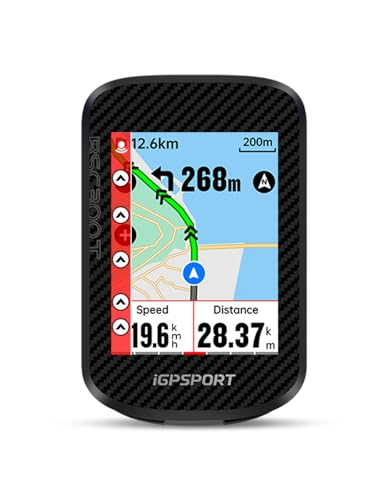
iGPSPORT BSC300T GPS Bike Computer
Best budget pick for navigation and Strava tracking under $80
iGPSPORT BSC300T GPS Bike Computer
Best budget pick for navigation and Strava tracking under $80
What we like
- Offline map navigation with off-course warning at this price point is genuinely unusual — most sub-$100 units skip maps entirely.
- 5-satellite GNSS (GPS, BeiDou, GLONASS, Galileo, QZSS) locks faster than older 3-constellation budget units.
- 130+ data fields cover speed, cadence, grade, power, and temperature — more than most riders will ever configure.
- ANT+ and Bluetooth 5.0 dual protocol means it connects to virtually any sensor on the market.
What we don't
- 2.4" screen is workable for data fields but cramped for map navigation — expect squinting at complex intersections.
- No adaptive coaching or training load analysis; it tracks your ride but doesn't tell you what to do with the data.
- Charging cable is not included in the box — you need a standard USB-C cable.
Most sub-$100 bike computers give you speed and distance and call it GPS. The BSC300T gives you offline map navigation, off-course warnings, Strava sync, and dual-protocol sensor connectivity at a price that makes the premium units feel like they're selling air.
The 2.4" screen is the honest limitation — it works, but you're not getting a rich map experience. This is the right buy for newer cyclists, commuters, or recreational riders who want real GPS navigation and Strava logging without committing to a Garmin ecosystem.
Anyone serious about training metrics or long-distance navigation should budget up to the Bryton or Wahoo.
What to Look For
Screen size and readability at speed should be your first filter. A 2.4" screen is workable for data fields, but if you want to navigate by map rather than turn prompts, you need at least 2.7" — anything smaller and you're squinting at intersections.
Battery life determines what riding you can do. A 20-hour battery is plenty for century rides and most multi-day tours with overnight charging.
If you're doing unsupported bikepacking across multiple days without reliable power, push up to 33–40+ hours. Ecosystem fit is underrated.
Garmin's Connect app has the richest third-party integration and training analytics. Wahoo's app is simpler and faster to set up.
Budget brands like iGPSPORT and Bryton sync with Strava and Komoot, which covers most riders' needs at a fraction of the price.
Who Should Skip This
Skip a GPS cycling computer entirely if you ride purely on familiar routes and use your phone for music anyway — a phone mount with a free cycling app costs nothing. Also skip if you're a purely indoor trainer rider; a computer that excels on the road adds zero value on a stationary setup.
If budget is the only concern, the $50–70 no-nav options from CYCPLUS or COOSPO do speed, distance, and cadence without GPS overhead.
What the Community Actually Uses
On r/cycling and r/gravelcycling, the recurring debate isn't Garmin vs. Wahoo — it's whether either is worth the price for someone who just wants to track a route and sync to Strava.
The consensus that keeps surfacing: Garmin's ecosystem wins for training-focused riders, Wahoo wins on UI simplicity for navigators, and the iGPSPORT / Bryton tier surprises almost everyone who tries it at that price point.
Quick Picks — In Case You've Already Decided
Frequently Asked Questions
Do I need ANT+ or is Bluetooth enough?
ANT+ is required for connecting to power meters and most high-end speed/cadence sensors, and it allows multiple devices to connect to the same sensor simultaneously. If you own a power meter or plan to, make sure your computer supports ANT+. Bluetooth-only units are fine for heart rate monitors and basic sensors.
Can I use a GPS cycling computer without a phone?
Yes — all GPS units on this list work standalone for tracking speed, distance, and time. Navigation with preloaded offline maps also works without a phone. Some features like live traffic rerouting, real-time weather, and segment leaderboards require a paired smartphone.
What's the difference between the Garmin Edge 540 and 840?
The 840 adds a touchscreen to the 540's physical button controls — both have the same GPS hardware, adaptive coaching, and ClimbPro. The 840 is easier to operate with bare hands; the 540's buttons are more reliable in gloves or heavy rain.
How important is waterproofing on a cycling computer?
IPX7 (the standard on most units here) means it can handle submersion up to 1 meter for 30 minutes — more than enough for rain riding. The real concern is condensation inside the unit over time; sealed, quality-built housings matter more than the IPX rating alone.
Will a cheaper cycling computer sync to Strava?
Yes — both iGPSPORT and Bryton units on this list sync to Strava via their companion apps. The process is slightly less seamless than Garmin's automatic post-ride upload, but the data gets there. TrainingPeaks and Komoot integration is also available on both.
Buying Guide
You need to match the computer to how you actually ride. Serious training with a power meter? Get something with adaptive coaching.
Navigation-heavy gravel rides? Prioritize offline maps and battery. Budget commuter wanting GPS tracking? A $60 unit does more than you expect.
Screen size, waterproofing, and ecosystem lock-in matter more than feature lists.