A half-rigged kayak costs you fish and patience every single trip — but five targeted accessories fix 90% of what goes wrong out there. The five picks below cover every major gap, and the most expensive one runs under $250.
| Photo |
Top Pick

|
Versatile

|
Budget
|
Best Value

|
Best for Reliability

|
|---|---|---|---|---|---|
| Product | Garmin Striker 4 | YakAttack Omega Pro Rod Holder with LockNLoad Track Mount | YakAttack LeverLoc Anchor Trolley Kit | Booms Fishing G05 Fish Lip Gripper Saltwater | Earth Pak Waterproof Dry Bag with IPX8 Phone Case |
| Sonar | CHIRP 77/200 kHz | N/A | N/A | N/A | N/A |
| Weight | 7.3 oz | Under 1 lb | Under 0.5 lb | 4.8 oz | Under 1 lb (empty) |
| Display | 3.5-inch color | N/A | N/A | N/A | N/A |
| Waterproof | IPX7 | Marine-grade polymer | ✓ | ✓ | IPX8 |
| Buy Now | Check Price → | Check Price → | Check Price → | Check Price → | Check Price → |
Quick Tips
Run your fish finder transducer through the hull using kayak-safe epoxy putty — it reads perfectly and you never drill a hole in your hull.
Mount your rod holder slightly behind your dominant shoulder so rods load and deploy without twisting your torso mid-paddle.
Set your anchor trolley ring to the stern position by default — it keeps your bow into the current automatically without constant adjustment.
Always clip a carabiner through your dry bag's buckle and into a deck bungee before launching — capsizing with loose gear is expensive.
Garmin Striker 4 GPS Fish Finder with CHIRP Sonar Transducer
Best for anglers who want to stop guessing where the fish are
Garmin Striker 4 GPS Fish Finder with CHIRP Sonar Transducer
Best for anglers who want to stop guessing where the fish are
What we like
- CHIRP sonar delivers noticeably sharper fish arches than traditional dual-beam units at this price point.
- Built-in GPS lets you mark and return to productive spots without a separate device.
- Sonar history rewind scrolls backward through the display so you can mark waypoints you paddled past.
- Compact enough to fit on any kayak without dominating limited deck space.
What we don't
- 3.5-inch screen is small — anglers with vision issues may want the 5-inch Striker Plus instead.
- Doesn't include ClearVü scanning sonar, which the step-up Striker 4cv adds for a side-imaging view.
- Requires a separate battery and wiring run to power it from the hull.
Most kayak anglers are fishing blind over structure they've already paddled past — the Striker 4 ends that by showing you a real-time sonar picture of what's below before your next cast. The GPS waypoint system means when you find fish, you can return to within feet of that same spot on your next trip.
This is the right unit if you're new to on-water sonar and want proven reliability without a complicated install. If you already run a chartplotter or want side-imaging, the Striker 4cv is the natural next step — but most kayak anglers never need it.
YakAttack Omega Pro Rod Holder with LockNLoad Track Mount
Best for anglers rigging multiple rods on a track-equipped kayak
YakAttack Omega Pro Rod Holder with LockNLoad Track Mount
Best for anglers rigging multiple rods on a track-equipped kayak
What we like
- Three-mode LockNLoad system — stage, adjust, or fully lock — handles spinning, casting, and fly reels without a separate insert.
- 360-degree rotating collar lets spinning reels hang in the natural downward position instead of torquing sideways.
- Extension arm raises the reel high enough off the deck to clear longer rod butts comfortably.
- Made in the USA from marine-grade polymer that doesn't corrode in saltwater after a full season.
What we don't
- Only works with YakAttack GearTrac or MightyMount systems — kayaks without factory tracks need a separate base plate.
- Premium price compared to basic flush-mount rod holders, though the functionality is genuinely different.
- Single rod capacity means you'll need two units for a two-rod setup, which adds up fast.
A cheap flush-mount rod holder drops your rod into a fixed tube at one angle — the Omega Pro holds your rod at the exact position you want, rotates to follow the fish, and releases in under a second when you need to grab and go. That difference matters most when you're trolling and strike, or when you need to switch from casting to trolling without fighting the holder.
Buy this if your kayak has factory GearTrac or a MightyMount system and you want a rod holder you won't replace next season. If your kayak has no tracks at all, start with a deck-mount base instead — the Omega Pro attaches to it just the same.
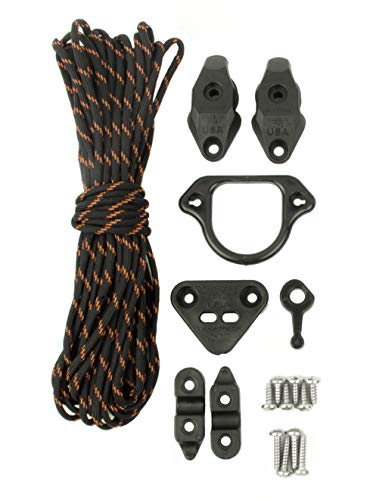
YakAttack LeverLoc Anchor Trolley Kit
Best for anglers who drift out of position before they can land a fish
YakAttack LeverLoc Anchor Trolley Kit
Best for anglers who drift out of position before they can land a fish
What we like
- LeverLoc line clamp locks the trolley position with a single flip — no fumbling with cleats while a fish is running.
- Stealth Pulleys run silently so your anchor adjustment doesn't spook fish in shallow water.
- Includes 35 feet of USA-made 550 paracord with a reflective tracer for low-light recovery.
- PadHook design keeps the trolley line flush against the hull instead of riding up over the gunwale.
What we don't
- Installation requires drilling small holes in the hull — not a reversible modification.
- Paracord stretches and slackens after the first wet session, requiring retensioning before it runs smoothly.
- Doesn't include the anchor itself — you'll need a kayak-specific folding grapnel anchor separately.
An anchor trolley is the single biggest position-control upgrade you can make to a fishing kayak — it lets you anchor from any point between bow and stern, keeping your boat oriented into current without constant paddle corrections. Without one, you're constantly fighting your position instead of fishing it.
This is the right buy for any sit-on-top kayak angler fishing rivers, tidal flats, or wind-exposed lakes where drift control is the difference between a productive day and a frustrating one. If you fish only flat, calm ponds with no current, the upgrade is less critical.
Booms Fishing G05 Fish Lip Gripper Saltwater
Best for catch-and-release anglers landing fish solo from a seated position
Booms Fishing G05 Fish Lip Gripper Saltwater
Best for catch-and-release anglers landing fish solo from a seated position
What we like
- Jaw design opens the fish's mouth with one hand so the other stays on the rod — essential when you're seated and can't use your knees.
- Tooth-shaped locking jaws hold up to 110 lbs of fish weight without slipping during hook removal.
- Anti-corrosion nylon and glass fiber construction handles both freshwater and saltwater without rusting.
- Wrist lanyard keeps it attached to your body so it doesn't sink when you drop it reaching for pliers.
What we don't
- Plastic construction feels less premium than aluminum grippers at three times the price.
- 9.4-inch length is awkward for very small fish — a shorter 6-inch gripper handles panfish more cleanly.
- No built-in scale, so you'll need a separate digital scale if you're weighing catches for tournaments.
Landing a fish from a seated kayak without a lip gripper means wet-handing a thrashing fish while trying not to tip — one dropped rod later you're looking for your lure in the lake. The G05 solves this with a single-hand jaw lock that secures the fish while you work the hook out.
This is the pick for bass, walleye, and catfish anglers who practice catch-and-release and need a reliable grip without spending $60 on aluminum. If you fish tournament bass and need the built-in scale, step up to a KastKing grip-and-weigh combo instead.
Earth Pak Waterproof Dry Bag with IPX8 Phone Case
Best for protecting electronics, wallets, and dry clothes on the water
Earth Pak Waterproof Dry Bag with IPX8 Phone Case
Best for protecting electronics, wallets, and dry clothes on the water
What we like
- Roll-top closure with double buckle is faster to open and close one-handed than zipper-seal bags.
- Bags float when sealed, so a capsize won't take your phone, keys, and wallet to the bottom with it.
- Includes an IPX8-rated phone case sized for phones up to 6.5 inches, which fits most current flagship models.
- Five-year warranty from a brand that Wirecutter picked as a top dry bag — rare in a sub-$40 category.
What we don't
- Roll-top design takes 3–4 folds minimum to seal properly — not as quick as a single-zip design if you're reaching in frequently.
- Shoulder strap on the 10L and 20L is single-strap only, which feels awkward on longer carries to the put-in.
- Bright colors make it easy to spot if it falls overboard, but some anglers prefer a lower-profile look on the water.
A kayak capsize happens once and you learn why dry storage isn't optional — keys that float cost $30 to replace, phones don't, and neither does your car ignition fob. The Earth Pak seals everything into a floating, submersible sack that takes a full dunking without passing water.
Buy this if you want the most proven sub-$40 dry bag on the market and you're fine accessing contents at the put-in rather than mid-paddle. If you need frequent cockpit access to your bag during a trip, a deck bag with a quick-open lid is a better fit for how you fish.
What to Look For
The most important spec on any kayak accessory isn't performance — it's mounting compatibility. Check whether your kayak has factory gear tracks, threaded inserts, or deck bungees before buying anything, because the wrong mounting system means drilling or returning gear.
For electronics like fish finders, battery life and screen readability in direct sun matter more than extra features. A 3.5-inch display you can actually read beats a 7-inch screen washed out by glare.
Waterproof ratings are not interchangeable — IPX6 means splash-resistant, IPX8 means submersible. For anything on a kayak, target IPX7 or IPX8 minimum unless it's already sealed inside a dry bag.
Who Should Skip This
If you paddle a tandem kayak or a longer touring boat primarily for recreation with occasional fishing, most of these accessories will feel like overkill. Serious rod holders and anchor trolleys are built around sit-on-top fishing kayaks with gear tracks — they don't fit every hull.
If you fish from the bank more than from a boat, or only take one or two kayak trips a season, a simple rod leash and a waterproof phone pouch will serve you better than a full rig-out.
What the Community Actually Uses
On r/kayakfishing, the perennial debate isn't which fish finder to buy — it's whether to run a transducer through-hull or over the side. The consensus in most high-voted threads is in-hull mounting using epoxy putty, which preserves read quality and avoids any drilling.
Rod holders and anchor trolleys from YakAttack get mentioned almost universally in rigging threads, and dry bag recommendations almost always land on Earth Pak or Sea to Summit for proven waterproofing.
Quick Picks — In Case You've Already Decided
YakAttack Omega Pro Rod Holder with LockNLoad Track Mount
Check Price on AmazonFrequently Asked Questions
Do I need a fishing license to use a fish finder on a kayak?
A fish finder doesn't affect your licensing requirements — you need whatever license your state requires for fishing in that body of water, regardless of gear. The fish finder is just electronic equipment.
Can I install these accessories on an inflatable kayak?
Some accessories work on inflatables and some don't. Dry bags and fish grips are universal. Rod holders that use gear tracks require a hard-shell kayak with factory-installed rails — inflatable kayaks use clip-on or strap-mount alternatives instead.
What's the difference between an anchor trolley and just tying off at the stern?
A stern tie-off locks your kayak into one orientation — usually broadside to wind or current. An anchor trolley lets you slide the anchor attachment point from bow to stern, keeping your bow pointed into current so you can cast forward without fighting the boat.
How do I power a fish finder on a kayak without a big battery?
Most compact fish finders like the Garmin Striker 4 run off a small sealed lead-acid or LiFePO4 battery that fits in a hatch or dry bag. A 7Ah sealed battery lasts 8–12 hours for a unit this size and weighs under 5 pounds.
Is a lip grip actually necessary or is it just convenience gear?
For catch-and-release fishing on a kayak it's closer to necessary — landing a fish with wet hands while seated and managing a rod with limited deck space is genuinely difficult. A lip grip holds the fish securely with one hand while you remove the hook with the other.
Buying Guide
You need gear that mounts fast, holds up in salt or fresh water, and doesn't turn your cockpit into a tackle shop explosion. Focus on four systems: rod management, fish location, anchor control, and dry storage.
Get those four right and every other kayak upgrade starts making sense. Skip anything that needs special tools to install.