The right kayak fish finder turns a blank morning into a productive one — the problem is most units are built for boats, not 10-foot sit-on-tops with no power outlet. All five picks here run on a small 12V battery, mount without drilling, and weigh under 2 lbs including transducer.
| Photo |
Top Pick

|
Versatile

|
Budget

|
Best Value
|
Best for Reliability

|
|---|---|---|---|---|---|
| Product | Garmin Striker Vivid 4cv | Humminbird Helix 5 CHIRP GPS G3 | Lowrance Hook Reveal 5 SplitShot | Deeper PRO+ 2 Smart Sonar | Garmin Striker 4 |
| Gps | ✓ | ✓ | ✓ | ✓ | ✓ |
| Sonar | CHIRP + ClearVu | Dual Spectrum CHIRP | CHIRP + DownScan Imaging | Dual beam CHIRP | CHIRP traditional |
| Weight | 11.2 oz | 1.5 lbs | 1.3 lbs | 3.5 oz | 0.56 lbs |
| Display | 4-inch color LCD | 5-inch widescreen color | 5-inch SolarMAX color | Smartphone app (iOS/Android) | 3.5-inch color LCD |
| Buy Now | Check Price → | Check Price → | Check Price → | Check Price → | Check Price → |
Quick Tips
Run your transducer through a scupper hole or use a RAM-style mount on a rail — don't drill into your hull unless you have to.
A 7Ah sealed lead-acid battery will run most units all day; a 10Ah lithium battery weighs half as much and lasts longer.
Sensitivity set too high in shallow water creates a noisy, unusable picture — dial it back until the bottom line is clean.
Mark waypoints the moment you catch a fish, not after — the GPS drift on a kayak means you'll miss the exact spot otherwise.
Garmin Striker Vivid 4cv
Best for kayak anglers who want GPS and sonar in one compact unit
Garmin Striker Vivid 4cv
Best for kayak anglers who want GPS and sonar in one compact unit
What we like
- CHIRP ClearVu scanning sonar produces nearly photographic bottom images in shallow kayak depths.
- Built-in GPS with Quickdraw Contours lets you map your local lake on the fly and save waypoints instantly.
- Vivid color palettes make it dramatically easier to distinguish fish from structure at a glance.
- Compact enough to mount on a kayak rail without a bulky arm — tilt/swivel mount is included in the box.
What we don't
- 4-inch screen feels small when running split-screen sonar and GPS simultaneously.
- No built-in lake maps — Quickdraw only builds contours as you paddle, so your first trip is flying blind.
- GT20 transducer cable is 6 feet, which can be tight depending on your kayak layout.
The Striker Vivid 4cv is the unit that shows up most in r/kayakfishing recommendation threads because it solves the two things that actually matter on a kayak: it sees fish clearly in shallow water and it saves the spot where you caught them. This is the right pick if you're rigging a dedicated fishing kayak and want one unit that handles everything.
If you need a no-installation solution you can use on multiple boats or from shore, scroll to the Deeper PRO+ 2 instead.
Humminbird Helix 5 CHIRP GPS G3
Best for serious kayak anglers who want the clearest sonar picture available
Humminbird Helix 5 CHIRP GPS G3
Best for serious kayak anglers who want the clearest sonar picture available
What we like
- Dual Spectrum CHIRP sonar offers Wide Mode for coverage and Narrow Mode for precise target separation — switchable on the water.
- 5-inch widescreen display is the largest in its class and dramatically reduces squinting in direct sunlight.
- AutoChart Live builds custom depth maps of any water in real time, even lakes not in any database.
- Humminbird Basemap includes 10,000+ US lakes pre-loaded — useful before you've mapped anything yourself.
What we don't
- Heavier and bulkier than the Garmin Striker series — mounting hardware choices matter more on a small kayak.
- At this price point you're paying for sonar performance the average kayak angler may not fully use.
- AutoChart Live requires a blank microSD card not included in the box.
The Helix 5 produces a noticeably cleaner sonar image than anything else in this price range — anglers who've fished both sides of the Garmin vs Humminbird debate consistently put Humminbird ahead on screen quality once you hit 5 inches and Dual Spectrum CHIRP. This is for the kayak angler who goes out 40+ times a year, fishes structure seriously, and wants to stop second-guessing what they're looking at on the screen.
If you fish casually or just want to mark depth changes, the Garmin Striker Vivid 4cv saves you $100.
Lowrance Hook Reveal 5 SplitShot
Best for anglers who want down-imaging and maps without the Humminbird price
Lowrance Hook Reveal 5 SplitShot
Best for anglers who want down-imaging and maps without the Humminbird price
What we like
- FishReveal overlays CHIRP sonar targets on the DownScan image so fish pop out from structure without any settings adjustment.
- SolarMAX display is one of the brighter panels in this class — noticeably better in midday kayak sun than the Garmin 4cv.
- Autotuning sonar adjusts sensitivity automatically as depth changes, which is genuinely useful on a kayak moving through variable water.
- Preloaded C-MAP US inland maps cover nearly 4,000 lakes right out of the box with 1-foot contours.
What we don't
- Keypad navigation takes longer to learn than touchscreen units — the menu layout is not intuitive on first use.
- Genesis Live real-time mapping requires a microSD card sold separately.
- The SplitShot transducer cable is thicker than competitors, which can create routing issues in tighter kayak layouts.
The Hook Reveal 5 is where you go when you want DownScan Imaging to see the difference between a brush pile and a school of crappie holding over it — but can't justify Humminbird pricing. Pick this if you fish shallow lakes with heavy structure and you've been burned by sonar that blurs fish into the bottom.
If you don't care about DownScan and mainly want GPS plus standard sonar, the Garmin 4cv does that for less.
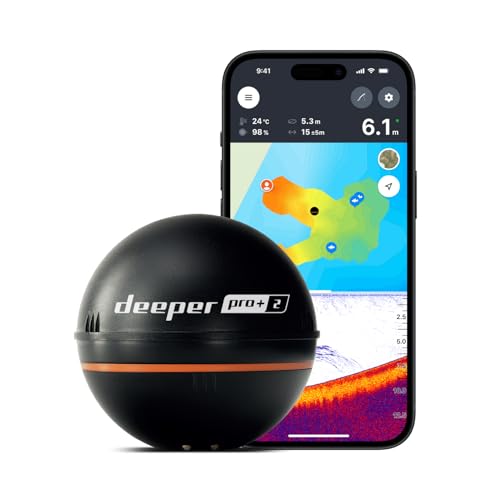
Deeper PRO+ 2
Best for kayakers who also fish from shore, docks, or multiple boats
Deeper PRO+ 2
Best for kayakers who also fish from shore, docks, or multiple boats
What we like
- Cast it from shore, hang it from a kayak mount, or drop it in an ice hole — one unit works across every fishing scenario you have.
- At 3.5 oz it weighs less than a can of soda — meaningfully reduces the electronics load on a weight-conscious kayak build.
- Built-in GPS creates bathymetric maps of any water automatically via the Fish Deeper app, stored and accessible on any device.
- No installation required — clip it to your rod or mount the flexible arm, and you're fishing in under two minutes.
What we don't
- Relies on your smartphone display, which can wash out in direct sun worse than a dedicated unit with a marine-grade screen.
- Battery lasts around 5 hours of continuous use — a full day trip may require a portable charger.
- Wi-Fi range to your phone maxes out around 330 feet, which limits how far you can cast it from the kayak.
The Deeper PRO+ 2 is the only fish finder on this list that disappears into a jacket pocket — which matters if you also wade, fish from a canoe, or share the unit between two kayaks. This is for the angler who fishes more than one way and doesn't want to buy two units.
If you fish exclusively from a dedicated rigged kayak and want the clearest possible display, a mounted unit with a dedicated screen will outperform it in harsh light.
Garmin Striker 4
Best budget fish finder for first-time kayak anglers
Garmin Striker 4
Best budget fish finder for first-time kayak anglers
What we like
- Under $130 with transducer included — the lowest barrier to entry on a quality CHIRP sonar unit for kayak use.
- Built-in GPS with Quickdraw Contours is not a feature you expect at this price and it works reliably.
- Compact and light enough to mount on virtually any kayak rail, track, or RAM arm without counterbalance concerns.
- Simple two-button operation means zero learning curve — you can hand it to anyone and they'll figure it out on the water.
What we don't
- 3.5-inch screen is noticeably small when running GPS and sonar side-by-side in bright conditions.
- No ClearVu or DownScan — sonar return is traditional CHIRP only, which misses structure detail the Vivid 4cv catches.
- Transducer is the older GT8 dual-beam, not the GT20 included with the Striker Vivid 4cv.
The Striker 4 is the most popular entry point for kayak anglers because it's $50 less than the next step up and still comes with GPS and real CHIRP sonar — not the toy sonars on budget no-name units. Buy this if you're rigging your first kayak and want to confirm fish finding actually changes your day before committing to a more expensive unit.
When you're ready to upgrade, the Striker Vivid 4cv adds ClearVu and a bigger screen for about $50 more.
What to Look For
Screen brightness is the most underrated spec on a kayak fish finder. A 4" unit that washes out in afternoon sun is useless; look for SolarMAX or IPS displays rated for outdoor viewing.
CHIRP sonar is worth the upgrade over standard single-frequency. In the 5-20 foot depths most kayak anglers fish, CHIRP separates fish from weeds and bottom clutter far more cleanly.
Power draw matters when you're running off a small battery. Most quality units pull under 0.5A at normal settings — check the spec before you buy, because a 3A draw will kill a 7Ah battery before lunch.
Who Should Skip This
If you fish moving rivers where current and rocks dominate, a dedicated fish finder adds less value than a paddle-mounted depth sounder. Side-imaging units are overkill on a kayak — you can't cover the water speed needed to get a clean image.
Budget under $100 for electronics on your kayak build and a castable sonar is your best move.
What the Community Actually Uses
On r/kayakfishing the most common question isn't which fish finder is best — it's how to mount one without buying a $60 aftermarket arm. The consensus leans toward RAM mounts on existing rail slots and running the transducer through the scupper.
Garmin Striker units dominate the recommendation threads for beginners; Humminbird shows up most often from anglers who've been at it for years.
Quick Picks — In Case You've Already Decided
Frequently Asked Questions
Do I need a special transducer for a kayak?
Not necessarily. Most standard transducers work fine on a kayak. The key is mounting — a scupper mount or hull-glued transducer avoids any bracket that hangs below the hull line and risks a hit on shallow bottom.
What battery should I use for a kayak fish finder?
A 7Ah sealed lead-acid battery runs most units all day. For weight savings, a 10Ah lithium LiFePO4 battery costs more upfront but weighs about 60% less and lasts multiple trips on a single charge.
Is a 4-inch screen big enough on a kayak?
Yes for most fishing scenarios. You're seated close to the unit, so 4" is readable. The bigger issue is screen brightness in direct sunlight — look for units with IPS or SolarMAX displays rather than chasing screen size.
Can I use a castable fish finder instead of a mounted unit?
Absolutely. Castable units like the Deeper PRO+ 2 are ideal for kayakers who switch between fishing from shore, a dock, and the water. The trade-off is battery life and the need to keep a phone or tablet accessible.
Do fish finders work in saltwater on a kayak?
Yes — most modern units are rated for both fresh and salt. Just rinse the transducer and connectors after each saltwater session. Corrosion on the power cable connection is the most common failure point on inshore kayak setups.
Buying Guide
You need a unit small enough for a kayak rail, bright enough to read in direct sun, and powered by a battery you can fit in a dry bag. CHIRP sonar beats standard 200kHz in shallow water.
GPS matters more than you think — marking a productive depth change at 6am is the move.