The right fish finder turns a slow kayak session into a systematic hunt — you stop covering water randomly and start working structure with purpose. Five proven picks cover every setup from $100 castable sonar to a full 5-inch chartplotter with GPS mapping preloaded on 4,000 lakes.
| Photo |
Top Pick

|
Versatile

|
Budget
|
Best Value

|
Best for Reliability

|
|---|---|---|---|---|---|
| Product | Garmin Striker 4 | Garmin Striker Vivid 4cv | Deeper PRO+ 2 Smart Sonar | Humminbird Helix 5 CHIRP GPS G3 | Lowrance Hook Reveal 5 SplitShot |
| Gps | ✓ | ✓ | Yes (built-in) | Yes + Basemap | Yes + C-MAP inland |
| Sonar | CHIRP 77/200 kHz | CHIRP + ClearVü | Dual beam CHIRP | Dual Spectrum CHIRP | CHIRP + DownScan |
| Display | 3.5" color | 4" color vivid | Smartphone app | 5" widescreen color | 5" SolarMAX color |
| Waterproof | ✓ | ✓ | ✓ | ✓ | ✓ |
| Buy Now | Check Price → | Check Price → | Check Price → | Check Price → | Check Price → |
Quick Tips
Mount your transducer flush with the hull bottom — any air gap kills the sonar signal completely, especially at kayak speeds under 5 mph.
Run a dedicated 12V lithium battery for your fish finder; sharing power with a trolling motor causes voltage drops that scramble readings.
In shallow water under 15 feet, switch your sonar to high-frequency mode (200 kHz) for sharper fish arch separation near the bottom.
Mark your launch ramp as a waypoint on day one — after a long paddle in low light, GPS breadcrumbs back to the ramp are worth more than any fish.
Garmin Striker 4 with Transducer
Best for kayak anglers who want GPS without complexity
Garmin Striker 4 with Transducer
Best for kayak anglers who want GPS without complexity
What we like
- Built-in GPS with waypoint mapping lets you mark productive structure and return to it precisely on every trip.
- CHIRP sonar delivers noticeably crisper fish arches than the dual-beam units it replaces in this price tier.
- Quickdraw Contours software builds live depth maps of any water you fish — no subscription required.
- Compact enough to mount on narrow kayak tracks using widely available RAM mount adapters.
What we don't
- 3.5-inch screen is small — readable but not comfortable for extended glances while paddling.
- Requires an external 12V battery for kayak use, which adds weight and rigging time.
- No DownScan or ClearVü imaging at this price — you get fish arches, not structural photos.
You get a real GPS chartplotter and proven CHIRP sonar at a price that doesn't require justifying to anyone — the Striker 4 is the benchmark kayak unit for a reason. The waypoint system is simple enough to operate with one hand while holding a paddle.
This is the right pick if you fish different lakes regularly and want to build contour maps over time. If you already know every rock and drop in your home water and don't care about GPS, a cheaper depth unit does the same job.
Garmin Striker Vivid 4cv
Best for anglers who want down-imaging on a kayak budget
Garmin Striker Vivid 4cv
Best for anglers who want down-imaging on a kayak budget
What we like
- ClearVü scanning sonar produces near-photographic images of bottom structure — weeds, rocks, and laydowns are immediately distinguishable.
- High-contrast color palettes make the display dramatically easier to read in direct sunlight compared to earlier Striker screens.
- GT20 transducer is included and handles both traditional CHIRP and ClearVü from a single in-hull mount.
- Quickdraw Contours mapping builds on the same software as the Striker 4 — all your saved maps carry over between units.
What we don't
- Step up in price over the Striker 4 is significant for the difference in screen size and imaging.
- ClearVü performance degrades above 4 mph — most kayak anglers are fine, but trolling motor speeds occasionally cause blur.
- Mounting hardware is transom-focused and needs an aftermarket adapter for most kayak track systems.
ClearVü imaging at this price point is the reason this unit exists — you can actually see whether fish are suspended in the water column or sitting tight on the bottom before you make a cast. That one piece of information changes how you fish a structure completely.
Pick this over the Striker 4 if you regularly fish structure-heavy water — submerged timber, rock piles, grass beds — where knowing what fish are doing is more valuable than just knowing they're there.
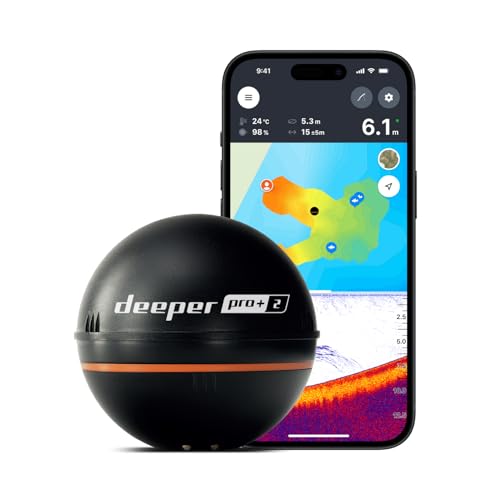
Deeper PRO+ 2 Castable Fish Finder
Best for kayak anglers who don't want to drill or wire anything
Deeper PRO+ 2 Castable Fish Finder
Best for kayak anglers who don't want to drill or wire anything
What we like
- Casts up to 330 feet from the kayak — you can read structure outside your immediate position before paddling into it.
- Built-in GPS creates bathymetric maps tied to your actual GPS track, not just depth data without location context.
- Zero wiring, zero drilling, zero mounting hardware — clips to your fishing line and deploys in under 60 seconds.
- 15 scans per second with 0.5-inch target separation gives it genuine resolution that competes with mounted transom units.
What we don't
- App dependency means a dead phone kills your fish finder mid-session — battery management becomes part of your prep.
- Wi-Fi connectivity range drops in dense timber or canyon terrain where signal reflects off canyon walls.
- Real-time depth while paddling requires the unit to be in the water, not clipped to your boat — you cast to read, not trolling.
The Deeper PRO+ 2 solves the rigging problem entirely — if your kayak rotates between vehicles, destinations, and fishing partners, a unit that clips to your line and pairs to your phone is genuinely easier than any mounted alternative. The castable-ahead-of-position capability is something no transom unit can replicate.
This is the right call if you fish from a sit-on-top, a rental, or any setup where permanent mounting isn't practical. Skip it if you primarily want real-time depth tracking while paddling — a transom unit does that better.
Humminbird Helix 5 CHIRP GPS G3
Best for serious kayak anglers who want full chartplotter capability
Humminbird Helix 5 CHIRP GPS G3
Best for serious kayak anglers who want full chartplotter capability
What we like
- 5-inch widescreen display with side-by-side split views lets you run sonar and mapping simultaneously without shrinking either view.
- Humminbird Basemap covers 10,000+ US lakes out of the box — no additional chart purchases needed for most freshwater fishing.
- AutoChart Live builds live depth contour maps while you paddle, with vegetation and bottom hardness data layered in.
- Dual Spectrum CHIRP offers Wide Mode for coverage and Narrow Mode for detail — one sonar button switches between fish-finding strategies.
What we don't
- Heaviest and bulkiest unit on this list — adds real weight to a kayak where every pound affects handling.
- Premium price tier requires a dedicated mounting solution and battery — total outfitting cost adds $80-150 beyond the unit.
- AutoChart Live's real value shows up over multiple sessions — anglers who fish new water each week build maps faster than once-a-month regulars.
The Helix 5 is what you move to when the Striker 4 stops being enough — the 5-inch screen running split sonar and map view simultaneously is a qualitatively different fishing experience, especially when you're navigating unfamiliar water in low light. AutoChart Live turns a kayak paddle into a mapping session that builds real intelligence over time.
This is the right investment for anglers who fish the same lake system repeatedly and want to accumulate detailed map data. If you're a weekend-only angler hitting a new spot each trip, the Garmin Striker units give you 80% of the fish-finding benefit for half the price.
Lowrance Hook Reveal 5 SplitShot
Best value fish finder with DownScan and preloaded maps
Lowrance Hook Reveal 5 SplitShot
Best value fish finder with DownScan and preloaded maps
What we like
- Autotuning sonar adjusts sensitivity automatically as depth and bottom conditions change — one less setting to manage while paddling.
- Preloaded C-MAP US Inland mapping covers nearly 4,000 lakes right out of the box with no subscription or card required.
- FishReveal overlays CHIRP fish arches onto the DownScan image so fish and structure appear on a single combined view.
- SolarMAX display is genuinely usable in direct overhead sun, which eliminates the biggest usability complaint on cheaper screens.
What we don't
- No built-in lake map building — Genesis Live creates custom maps but requires a blank microSD card you'll need to buy separately.
- SplitShot transducer is kayak-capable but optimized for slower speeds — significant hull spray above 4 mph introduces noise.
- Keypad interface is function-first, not intuitive — expect 20-30 minutes with the manual before the menus feel natural.
The Hook Reveal 5 is the best argument for not buying the cheapest unit — you get DownScan imaging, preloaded lake maps, and a sun-readable display at a price that splits the difference between the Garmin Striker 4 and the Helix 5. FishReveal's combined view genuinely helps beginners identify what they're seeing on sonar faster.
This is the right pick if you want more capability than the Striker 4 but can't justify the Helix 5 price — and if you fish named lakes where preloaded C-MAP maps actually show your water. If you fish small ponds or streams not in C-MAP's database, the map advantage disappears.
What to Look For
Display brightness is the spec nobody talks about until they're squinting at a washed-out screen at noon. Look for SolarMAX or similarly rated sunlight-readable displays — anything under 800 nits becomes useless on open water in direct sun.
Transducer type determines what you can actually see below the hull. CHIRP sonar shows fish arches with better separation; DownScan or ClearVü adds a near-photographic structural view that tells you if fish are holding in weeds or on hard bottom.
GPS with preloaded lake maps saves real time on the water. Models without maps require you to build your own contours or navigate blind — fine for explorers, frustrating for anglers targeting known structure on tight tidal windows.
Who Should Skip This
If you fish moving rivers exclusively, a GPS chartplotter with lake maps adds cost you'll never use — a simple depth-and-temp unit does the same job for less. Ultralight kayak anglers counting every ounce may also want to skip the mounted units; a castable sonar under 3 oz clips to your rod and stays off the boat entirely.
What the Community Actually Uses
On r/kayakfishing, the most recurring advice is to pick a fish finder before you pick a mount — dozens of threads show anglers who bought a Garmin Striker and then discovered their kayak track system needed a $40 adapter to hold it. The sub also has a solid pinned post on transducer placement for different hull shapes worth reading before you drill anything.
Quick Picks — In Case You've Already Decided
Frequently Asked Questions
Can I use any fish finder on a kayak?
Most fish finders work on a kayak, but you need to verify mounting compatibility first. Transom-mount units need a flat surface or a track-mount adapter, and battery requirements vary — some need a 12V external battery that adds weight.
Do I need GPS on a kayak fish finder?
Not always, but it changes what you can do. GPS lets you mark productive spots and return to them precisely, navigate back to your launch in low visibility, and build contour maps over time. If you fish the same small pond every week, you can skip it.
What is CHIRP sonar and why does it matter for kayak fishing?
CHIRP sends a sweep of frequencies instead of a single pulse, which produces sharper fish arches and better target separation in shallow water. On a kayak where you're often fishing 5–30 feet of water, CHIRP makes a visible difference in what you can identify below the hull.
How do I power a fish finder on a kayak?
Most mounted units run on a 12V lithium battery in the 7–10Ah range, which fits in a small dry bag under the deck. Castable sonar units like the Deeper PRO+ 2 have a built-in rechargeable battery and need no external power at all.
Is a castable fish finder as good as a mounted one?
For reading structure and locating fish, a quality castable sonar is genuinely competitive with a mounted unit. Where it falls short is real-time depth tracking while you're paddling — you only get data when the unit is in the water and being reeled back.
Buying Guide
You need to match the finder to how your kayak is rigged. A castable sonar needs no mount and no wiring — perfect if you switch boats.
A transom-mounted unit with GPS is faster in the field but takes 20 minutes to install right. Pick based on how permanent your setup actually is.