The right fire pit doesn't smoke you out, rust by spring, or cost twice what it should—and there are five on the market right now that actually hold up. The best smokeless wood-burning option weighs just 20 lbs, and the top-rated propane pick puts out 58,000 BTU and is legal to use during most campfire bans.
| Photo |
Top Pick
|
Versatile

|
Budget
|
Best Value

|
Best for Reliability

|
|---|---|---|---|---|---|
| Product | Solo Stove Bonfire 2.0 | Outland Living Firebowl 893 Deluxe | TIKI Brand Patio Smokeless Fire Pit 25" | OutVue 36-Inch 3-in-1 Fire Pit | Sunnydaze Crossweave 36-Inch Fire Pit |
| Weight | 20 lbs | 13 lbs | Not listed | Not listed | 29 lbs |
| Diameter | 19.5 in | 19 in | 24.75 in | 36 in | 36 in |
| Fuel type | Wood | Propane | Wood | Wood | Wood |
| Smokeless | ✓ | ✓ | ✓ | ✗ | ✗ |
| Buy Now | Check Price → | Check Price → | Check Price → | Check Price → | Check Price → |
Quick Tips
Season your wood before burning—wet wood is the number-one cause of excessive smoke regardless of fire pit design.
For propane pits, always use a CSA-certified model during campfire bans; non-certified pits are often prohibited even when gas-fueled.
Place a fire-resistant pad under any fire pit used on a deck, composite surface, or grass to prevent heat damage underneath.
Let the ash cool completely—at least 24 hours—before dumping it; coals can stay hot far longer than they appear.
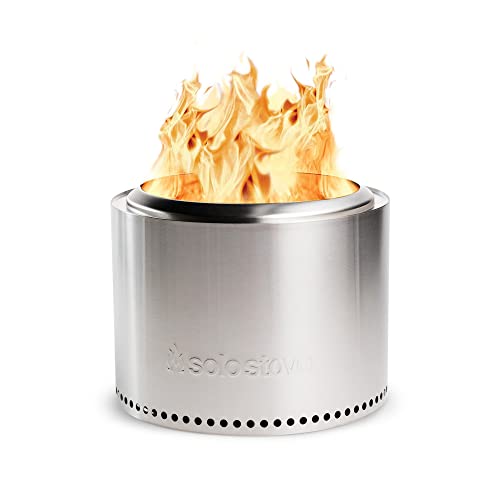
Solo Stove Bonfire 2.0
Best for smoke-free backyard fires with 4–6 people
Solo Stove Bonfire 2.0
Best for smoke-free backyard fires with 4–6 people
What we like
- Double-wall 360° airflow design produces dramatically less smoke than traditional fire pits—most nights nearly smoke-free with dry hardwood.
- 304 stainless steel construction resists rust and holds up through years of outdoor use without coating failures.
- Removable ash pan makes post-fire cleanup a two-minute job instead of a production.
- Portable enough to take camping or to the beach with the included carry case.
What we don't
- Premium price puts it out of reach for buyers who just want an occasional backyard fire.
- High walls direct heat upward, which means less radiant warmth at seated height in cold weather.
- Requires dry, seasoned hardwood to deliver on the smokeless promise—wet wood defeats the design.
If you've ever moved your chair five times to dodge smoke and still smelled like a campfire the next morning, the Bonfire 2.0 fixes that—its patented double-wall airflow pulls cool air through the base and preheats it before it hits the flame, burning off most of the smoke-producing particles before they ever reach you. This is the pick for backyard regulars who want a fire multiple nights a week without the smell, the eye-burn, or the ash clouds—but it's overkill for someone who lights a fire twice a summer.
Outland Living Firebowl 893 Deluxe
Best for campfire-ban areas and zero-setup evenings
Outland Living Firebowl 893 Deluxe
Best for campfire-ban areas and zero-setup evenings
What we like
- CSA-certified for use during most campfire bans—the only legal open flame option at many campsites half the year.
- 58,000 BTU output delivers real warmth for a small group, not just ambiance.
- Comes complete with cover, carry kit, 10-ft hose, and lava rocks—nothing extra to buy to get started.
- No ash, no chopping wood, no cleanup—turn the knob and you have a fire in under a minute.
What we don't
- Propane tank not included and burns through a 20-lb tank in roughly 4–8 hours depending on flame setting.
- No wood-fire sound or smell—some people find propane flames feel less like the real thing.
- Steel construction with enamel finish can show rust over time if left outside without the cover.
This is the fire pit that works when wood fires are banned, when you forgot to buy firewood, or when you just want a fire going in under two minutes without any effort. At under $120 all-in with cover and carry kit, it's also the most practical value in this category for campers and overlanders who run into fire restrictions regularly.
Skip it if the crackle and smell of real wood is non-negotiable for you—propane gives you heat and glow, not campfire nostalgia.
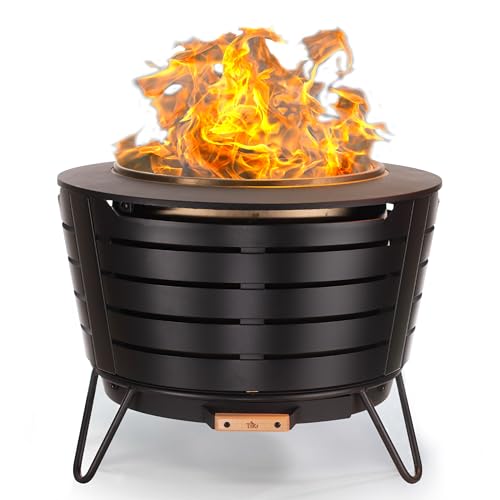
TIKI Patio Smokeless Fire Pit 25-Inch
Best for patio and deck setups with style-conscious buyers
TIKI Patio Smokeless Fire Pit 25-Inch
Best for patio and deck setups with style-conscious buyers
What we like
- Patented internal airflow system reduces smoke noticeably compared to traditional fire pits—works well for patio use where smoke drifts into living spaces.
- 16-gauge stainless steel with weatherproof powder-coated finish holds its look season after season.
- Removable ash pan and included cover make maintenance simple for frequent backyard use.
- Compatible with TIKI Wood Packs for near-instant ignition without kindling or starter fluid.
What we don't
- Doesn't reach the near-zero smoke levels of the Solo Stove on the same wood—a meaningful gap for side-by-side comparison.
- TIKI Wood Packs burn only about 30 minutes per pack, so extended evenings require traditional firewood.
- Weight spec not listed on product page—worth checking before purchasing for portability use.
The TIKI sits in an interesting middle ground: it's more stylish and patio-appropriate than the utilitarian Solo Stove, with a 4-foot heat radius that actually warms a seated group, and enough smoke reduction to keep your neighbors (and your sinuses) happy when there's no wind. It's the right pick for someone building a permanent backyard setup who wants something that looks intentional, not just functional.
Choose the Solo Stove instead if maximizing smokeless performance is the priority—and skip this one entirely if you mainly need campsite portability.
OutVue 36-Inch 3-in-1 Fire Pit
Best for groups who want to cook over the fire
OutVue 36-Inch 3-in-1 Fire Pit
Best for groups who want to cook over the fire
What we like
- Three functions in one: bonfire pit, BBQ grill with two height-adjustable swivel grates, and lidded round table for 6–8 people.
- 36-inch diameter is genuinely large enough for a group to gather around without crowding.
- Geometric cutout design catches firelight and throws interesting shadows—looks far more expensive than it is.
- Complete kit includes lid, poker, two cooking grates, and waterproof cover at a sub-$110 price point.
What we don't
- No smokeless technology—traditional wood-burning with all the smoke that comes with it.
- Assembly takes around 20 minutes and requires attention to the instructions; overtightening screws early causes fit problems.
- Weight spec not listed; the 36-inch steel frame is not designed for frequent portability.
If you want to actually cook over your fire—burgers, foil packets, anything that needs real flames and adjustable height—this is the pick the others don't offer. At under $110 for a 36-inch pit with two swivel grills, a lid that converts to a table, and a waterproof cover, the value is hard to argue with for a group backyard setup.
This isn't for smoke-sensitive environments or anyone who hates cleanup—it's a full-size traditional wood-burner that earns its price by doing three things instead of one.
Sunnydaze Crossweave 36-Inch Fire Pit
Best budget fire pit for backyard bonfire nights
Sunnydaze Crossweave 36-Inch Fire Pit
Best budget fire pit for backyard bonfire nights
What we like
- Full 36-inch diameter with a 31-inch bowl seats 6–8 people comfortably at an entry-level price point.
- Decorative crossweave cutout pattern glows at night and looks notably better than plain steel bowls in this price range.
- Comes with spark screen, cover, and poker—the complete kit without buying anything extra.
- Lightweight at 29 lbs with an outer ring for easy repositioning in the yard.
What we don't
- 24-gauge steel is thinner than premium options—heat and moisture exposure over time can affect longevity without protective treatment.
- Spark screen lid fit has been noted as inconsistent in some reviews—may need adjustment out of the box.
- No smokeless technology; expect a traditional campfire smoke experience.
For under $80 with a 36-inch bowl, a decorative cutout design that actually looks good at night, and everything included to light a fire tonight—the Sunnydaze Crossweave delivers exactly what it promises. It's not built to last a decade of hard use, but treated with a protective coating after the first season and stored with the cover, it's a solid four or five years of regular bonfire nights.
Step up to the OutVue if you want to cook over the fire, or to the Solo Stove if smoke is the problem you're actually trying to solve.
What to Look For
Fuel type is the first decision, and it shapes everything else. Wood-burning pits give you the real campfire experience but require dry, seasoned logs and ash cleanup after every burn.
Smokeless technology (double-wall airflow design) dramatically reduces eye-burning smoke but only works well with dry hardwood—wet wood defeats the engineering. Propane models sacrifice the crackle for instant-on convenience, zero ash, and legal operation during most campfire bans.
Size and portability determine whether a pit fits your actual life. A 19–20-inch pit travels easily and works for 2–4 people; anything 30 inches or larger suits group gatherings but stays home.
Who Should Skip This
If you want ambiance without the maintenance—no ash cleanup, no hauling firewood, no smoke—a propane fire table is a better fit than any of these. Renters in apartments or condos with no private outdoor space should also skip; even propane pits need open-air clearance that most shared spaces won't allow.
What the Community Actually Uses
On r/CampingGear, smokeless fire pits dominate the discussion—Solo Stove vs. TIKI vs.
every clone that's appeared in the last two years. The recurring advice from experienced campers: don't cheap out on wood, because a $400 smokeless pit still billows if you burn green logs.
Propane pits get a separate loyal following in r/overlanding, where campfire bans make gas the only legal option for half the year.
Quick Picks — In Case You've Already Decided
Frequently Asked Questions
Are smokeless fire pits actually smokeless?
Not completely—'low smoke' is more accurate. The double-wall design creates secondary combustion that burns off most smoke particles, but you'll still see some smoke during startup and when using wet or softwood. Dry hardwood like oak or hickory gets closest to truly smokeless.
Can I use a fire pit on my wood deck?
Only with a heat-resistant fire pit mat underneath and adequate clearance on all sides. Propane pits with stands run coolest on the bottom. Wood-burning pits on decks carry real risk—always check the manufacturer's deck-use guidance before you light up.
How much propane does a fire pit use?
A 58,000 BTU propane fire pit burns through a standard 20-lb tank in roughly 4–8 hours depending on flame height. Running it low extends burn time significantly. A spare tank on hand is smart for longer evenings.
What's the best wood to burn in a fire pit?
Seasoned hardwoods—oak, hickory, maple, and birch—burn hotter, longer, and with far less smoke than softwoods or green wood. Split logs ignite faster than rounds. Avoid treated lumber, pallets, or anything with paint or chemicals.
Can fire pits be used during campfire bans?
Only CSA-certified propane fire pits are typically allowed during most campfire bans—and even then, local rules vary. Always check current restrictions for your specific area before assuming any fire pit is permitted.
Buying Guide
Start with fuel type—wood burning costs nothing per use but requires dry wood and cleanup; propane is instant and smokeless but needs a tank. Then size: solo or couple means 19–20 inches, groups need 30-plus.
Check whether you want portability or a permanent backyard piece. Smokeless tech costs more upfront but saves your eyes and clothes every single session.