The best cycling computers don't need GPS — they start instantly, last a year on a single battery, and show you every stat that actually matters on a ride. The five picks below range from $15 to $65, weigh under 35g, and none of them make you wait for a satellite lock before you can roll.
| Photo |
Top Pick

|
Versatile
|
Budget

|
Best Value

|
Best for Reliability

|
|---|---|---|---|---|---|
| Product | CatEye Padrone Wireless Bike Computer | CatEye Padrone Digital Bluetooth Cycling Computer | CatEye Velo 7 Wired Bike Computer | Sigma BC 5.16 Wired Bicycle Computer | Sigma BC 14.16 STS Wireless Cycling Computer |
| Weight | 35g | 37g | 30g | 25g | 38g |
| Display | Oversized single-line | 3-row, 4 data fields | Single-row, 7 functions | Compact vertical, 5 functions | Dot-matrix full-text |
| Waterproof | ✓ | ✓ | ✓ | ✓ | ✓ |
| Sensor type | Wireless | Bluetooth wireless | Wired | Wired | Wireless (STS encoded) |
| Buy Now | Check Price → | Check Price → | Check Price → | Check Price → | Check Price → |
Quick Tips
Set your wheel circumference manually — tire labeling and actual rolling circumference differ by up to 15mm, which compounds into significant mileage error over long rides.Mount the sensor magnet within 5mm of the sensor face; anything beyond 8mm causes missed pulses and erratic speed readings.If you run multiple bikes, buy a second sensor and bracket rather than swapping one unit — most no-GPS computers are cheap enough to double up.Auto start/stop stops the clock when you pause, but the odometer keeps rolling if you push the bike — remember to flip it face-down in your bag if you want a clean ride log.
CatEye Padrone Wireless Bike Computer
Best for daily riders who want big numbers and no fuss
CatEye Padrone Wireless Bike Computer
Best for daily riders who want big numbers and no fuss
What we like
- Oversized digit display is the easiest to read at speed of any computer in this price range.
- FlexTight tool-free mount clicks on and off the bracket in seconds — no screwdriver needed.
- Auto start/stop is reliable and doesn't require any pairing or app setup.
- CatEye's ClickTec single-button interface means you never have to look twice to find the right control.
What we don't
- No cadence or calorie tracking — purely speed and distance metrics.
- Wireless range is 70cm, so it's front-wheel only and sensor position matters.
- No backlight, so night riding requires a separate light source aimed at the display.
You mount this in five minutes, roll out, and the screen shows you exactly what you need — current speed in a font large enough to read in your peripheral vision without dropping your gaze to the bars. This is the right pick if you commute daily or ride a few times a week and want something that just works every single time.
Skip it if you track cadence or want calorie data.
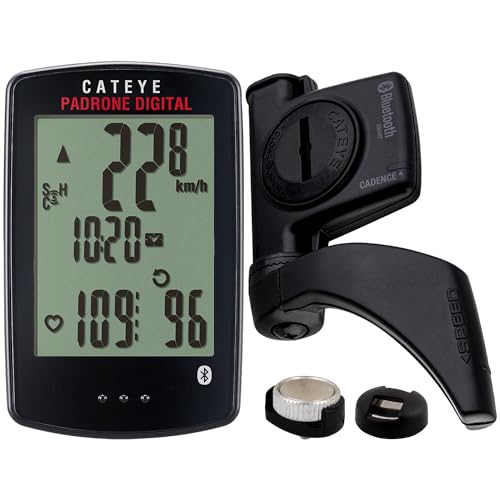
CatEye Padrone Digital Bluetooth Cycling Computer
Best for riders who want cadence without GPS
CatEye Padrone Digital Bluetooth Cycling Computer
Best for riders who want cadence without GPS
What we like
- Pairs with cadence and heart rate sensors via Bluetooth, so you get structured training data without paying for GPS.
- Three-row display shows four data fields simultaneously — no button-mashing to find your average speed.
- Compatible with Strava and TrainingPeaks through the CatEye Cycling app after your ride.
- IPX8 rated — fully submersion-resistant, not just splash-proof.
What we don't
- Sensors sold separately, so real-world cost is higher than the unit price suggests.
- Bluetooth sync to the app requires sliding the unit off the mount — slightly awkward workflow.
- Bluetooth signal range is shorter than ANT+, which can cause occasional dropout with third-party sensors.
If you want to track cadence and upload rides to Strava but can't justify the price of a GPS head unit, this is the exact gap the Padrone Digital fills — it connects to Bluetooth speed, cadence, and heart rate sensors and logs everything cleanly. Best suited to road or gravel cyclists doing fitness riding or structured intervals who don't need navigation.
Skip it if you ride routes you don't already know by heart.
CatEye Velo 7 Wired Bike Computer
Best entry-level wired computer for beginners
CatEye Velo 7 Wired Bike Computer
Best entry-level wired computer for beginners
What we like
- Three-year battery life on a single CR2032 — install it and genuinely forget about it.
- Wired sensor means zero signal interference, zero pairing, zero dropout on any ride.
- Pre-programmed tire sizes make setup a 90-second job even for first-time users.
- At under $20, it's the lowest-risk entry into tracking your rides with a dedicated computer.
What we don't
- Wired cable requires routing along the fork, which takes more time to install cleanly than wireless.
- Only one wheel size stored, so swapping between bikes means reprogramming the unit.
- No backlight and no calorie tracking — purely essential functions only.
This is the computer for the rider who wants one thing: accurate speed and distance, every ride, with no maintenance and no setup ritual. The wired connection is immune to the interference issues that occasionally affect cheap wireless units.
Perfect for new cyclists, indoor trainer use, or a kids' bike where cost and durability matter more than features. Not the right call if you want wireless clean lines or cadence data.
Sigma BC 5.16 Wired Bicycle Computer
Best minimal wired computer for clean builds
Sigma BC 5.16 Wired Bicycle Computer
Best minimal wired computer for clean builds
What we like
- IPX8 waterproof rating — actually submersion-tested, not just splash-rated like most budget units.
- Single-button operation with autoscroll makes it usable with winter gloves on.
- Slimmer housing than most competitors, which sits lower on the stem for a cleaner cockpit look.
- Five-year manufacturer's warranty is unusually strong for a sub-$30 computer.
What we don't
- Only 5 functions — no calorie tracking, no pace arrow, no cadence support of any kind.
- Vertical orientation takes a ride or two to get used to if you're coming from a horizontal display.
- Wire routing on the fork adds setup time and looks less clean than wireless alternatives.
German-made, genuinely submersion-proof, and stripped to exactly five functions — Sigma built this for the rider who wants the facts and nothing else cluttering the display. The slim vertical housing fits neatly on a stem without dominating the cockpit.
Choose this if you want the most minimal, cleanest-looking wired option available and don't need cadence or calorie data. Pass if you want auto-scroll or a pace arrow to pace your effort.
Sigma BC 14.16 STS Wireless Bicycle Computer
Best for cyclists who climb and want altitude data
Sigma BC 14.16 STS Wireless Bicycle Computer
Best for cyclists who climb and want altitude data
What we like
- Barometric altimeter tracks elevation gain, current gradient, and altitude profile — no GPS needed for climb data.
- Sigma's digitally encoded STS wireless transmission resists interference better than standard RF sensors.
- Two-bike programmable with automatic bike recognition — sensor signals switch the display automatically.
- Android NFC data sync via the Sigma Link app lets you download ride history without USB cables.
What we don't
- Setup process is more involved than CatEye — altitude calibration and NFC pairing have a learning curve.
- NFC sync is Android only; iPhone users can't access the data download feature.
- Sensor mounting arm can feel fragile if you frequently remove and reinstall your wheel.
If you ride hilly routes and want to know your current gradient and total climb for the day without buying a GPS unit, the BC 14.16 STS is the only product in this category that delivers that data cleanly at this price. The barometric altimeter is accurate and updates in real time.
This is the pick for road cyclists who train on hills, commuters who want monthly ride stats, or anyone running two bikes who wants automatic switching between profiles. Skip it if flat routes are all you ride.
What to Look For
Wired vs. wireless matters more than it sounds.
Wired sensors never drop signal and last years on a coin cell, but the cable adds installation time and a clean-looking fork is harder to achieve. Display readability varies wildly between units at the same price.
Larger digit height and strong contrast matter more than backlight brightness — most backlit screens wash out in direct sun anyway. IPX8 is better than IPX7, but both ratings handle rain fine.
The real concern is water sitting inside the battery compartment after a wet commute — check that the cover seal is rubber-gasketed, not just a friction fit.
Who Should Skip This
If you ride trails where knowing your exact climb rate or recording a GPX file matters to you, a no-GPS computer will leave you frustrated. Cyclists who do structured training with power data, or anyone who regularly gets lost and needs turn-by-turn routing, should spend more on a GPS unit instead.
What the Community Actually Uses
On r/cycling, the no-GPS camp is vocal and consistent: the most upvoted takes push back hard on GPS dependency for commuters and casual riders. The recurring argument is that a computer that fires up instantly every single morning without a 45-second satellite search is worth more in daily use than mapping features most riders access once a month.
Quick Picks — In Case You've Already Decided
CatEye Padrone Digital Bluetooth Cycling Computer
Check Price on AmazonFrequently Asked Questions
Do cycling computers without GPS track distance accurately?
Yes — they measure distance using wheel circumference and rotation count, which is actually more accurate than GPS over short distances. GPS can drift by 2–5% on tight turns or under tree cover; a wheel sensor doesn't.
How long do batteries last in non-GPS bike computers?
Most wired and basic wireless units last 1–3 years on a single CR2032 coin cell at one hour of daily use. That's because they have no GPS chip drawing continuous power. GPS units typically last 15–25 hours per charge.
Can I use a no-GPS computer on a mountain bike?
Absolutely. The main consideration is waterproofing — look for IPX7 or IPX8 — and sensor clearance on suspension forks. Wired sensors get more flex stress on full-suspension frames, so wireless is generally easier on MTBs.
Will a cycling computer without GPS work on an indoor trainer?
Most wired and wireless units work fine on a trainer if you mount the speed sensor to the rear wheel and position the magnet correctly. The computer sees wheel rotation regardless of whether you're actually moving down the road.
What's the difference between wired and wireless no-GPS computers?
Wired sensors are immune to signal interference and typically cheaper, but the cable must be routed cleanly along the fork. Wireless sensors are cleaner to install and easier to move between bikes, but cost a few dollars more and use a separate battery.
Buying Guide
You want a computer that starts the moment you move and doesn't drain dead mid-ride. Look for auto start/stop, IPX7 or better waterproofing, and a display you can read through sunglasses.
Wired beats wireless on reliability; wireless beats wired on clean cable routing. Battery life over speed pairing matters most for daily riders.