A camping stove that dies in the wind or takes 20 minutes to boil isn't a stove — it's dead weight. All five picks here hit under $100, with boil times starting at 100 seconds and verified Amazon listings so you're not guessing.
| Photo |
Top Pick

|
Versatile

|
Budget

|
Best Value
|
Best for Reliability
|
|---|---|---|---|---|---|
| Product | Coleman Triton 2-Burner Propane Stove | Jetboil Flash Camping Stove Cooking System | Fire-Maple Fixed Star 1 Stove System | SOTO WindMaster Backpacking Stove with 4Flex | Gas One GS-3400P Dual Fuel Camping Stove |
| Fuel | Propane | Isobutane | Isobutane | Isobutane | Butane or Propane |
| Weight | 11 lbs | 13.1 oz | 18 oz | 3 oz | 2.4 lbs |
| Seasons | 3-season | 3-season | 3-season | 3-season | 3-season |
| Boil time | ~3.5 min/L | 100 sec/L | ~3 min/L | ~2.5 min/L | ~5 min/L |
| Buy Now | Check Price → | Check Price → | Check Price → | Check Price → | Check Price → |
Quick Tips
Test your igniter at home before any trip — piezo igniters fail in cold and wet; always pack a backup lighter.
For backpacking stoves, position the canister out of direct wind and use your body as a natural windbreak.
Cold temperatures reduce canister pressure — warm the fuel canister in your sleeping bag on cold mornings for a stronger flame.
Two-burner propane stoves lose efficiency in temps below 20F — switch to a pressure-regulated canister stove for winter camping.
Coleman Triton 2-Burner Propane Stove
Best for car campers who cook real meals
Coleman Triton 2-Burner Propane Stove
Best for car campers who cook real meals
What we like
- 22,000 BTU total output across two independently adjustable burners handles two pans at full heat simultaneously.
- Wind Block Shields are built into the lid — no separate windscreen to lose or forget.
- PerfectFlow pressure control keeps flame steady even as the canister empties or temperatures drop.
- Cooking surface fits a 10-inch and 12-inch pan at the same time, which is rare under $100.
What we don't
- At 11 lbs it stays in the car — not an option for any trip involving hiking.
- One hour runtime on high with a single 16.4 oz propane cylinder means you go through fuel fast at basecamp.
- No igniter on the base model — you'll need a match or lighter every time.
When wind kills your flame mid-boil at a car campsite, the problem is usually a stove with inadequate shielding — the Coleman Triton solves that with built-in Wind Block Shields and 22,000 BTU across two burners that hold steady even in a stiff breeze. This is the stove for car campers and overlanders who cook actual meals — scrambled eggs on one burner, coffee on the other, before anyone else in camp is awake.
If you're hiking in or counting grams, stop here and look at the backpacking options below.
Jetboil Flash Camping Stove Cooking System
Best for solo backpackers who want water fast
Jetboil Flash Camping Stove Cooking System
Best for solo backpackers who want water fast
What we like
- 100-second boil time for 1 liter is genuinely the fastest system in this category — lab-tested and field-confirmed.
- FluxRing heat exchanger wraps around the pot base so almost no BTU is wasted to the air around it.
- All components — stove, cup, stabilizer — nest into a single 1L package that packs in seconds.
- Thermochromatic heat indicator changes color when water is ready so you never stand there guessing.
What we don't
- The 1L FluxRing cup is the only vessel that works with the FluxRing burner — you're committed to that pot size.
- Simmering is possible but finicky — this is optimized for boiling water, not precise cooking.
- Nudges over $100 at full retail price, though it regularly lands in the $90-95 range with common discounts.
The Jetboil Flash fixes the exact problem a stove under wind pressure creates — instead of relying on raw BTU fighting the open air, the FluxRing system wraps heat around the pot base so efficiency stays near 80% even in moving air. You get boiling water in under two minutes with less fuel consumed.
Buy this if you're a solo hiker or backpacker who makes coffee and rehydrates meals — it's purpose-built for that loop and nothing else. If you want to cook with a real pan or feed more than one person, the Coleman above is a better fit.
Fire-Maple Fixed Star 1 Backpacking Stove System
Best for fuel efficiency on multi-day trips
Fire-Maple Fixed Star 1 Backpacking Stove System
Best for fuel efficiency on multi-day trips
What we like
- Heat exchange base boils water up to 30% faster than traditional canister stoves while using less fuel per liter.
- Everything — stove, pot, canister — nests into the 1L aluminum pot in one compact package.
- Hard anodized aluminum pot with locking stainless handle is genuinely durable compared to plastic-handled competitors.
- Piezo igniter is built in so you never need to carry a separate lighter as a backup.
What we don't
- Not compatible with Coleman fuel canisters — you need isobutane/propane blend canisters specifically.
- The 1L pot size is limiting for cooking anything beyond boiling water or a single dehydrated meal.
- Wind shield is partial — manufacturer recommends a separate windscreen in exposed conditions.
Where the Jetboil is pure speed, the Fire-Maple Fixed Star 1 is about fuel economy over the full trip — the HX base makes each canister last noticeably longer, which matters when you're resupplying every 4-5 days on a longer route. It's $20-30 cheaper than the Jetboil with comparable boil performance in calm conditions.
Pick this if you're on a budget, hate buying canisters constantly, or want a reliable all-in-one system for 3-season backpacking. Move to the Jetboil if you want the fastest possible boil time or the SOTO below if wind is your main problem.
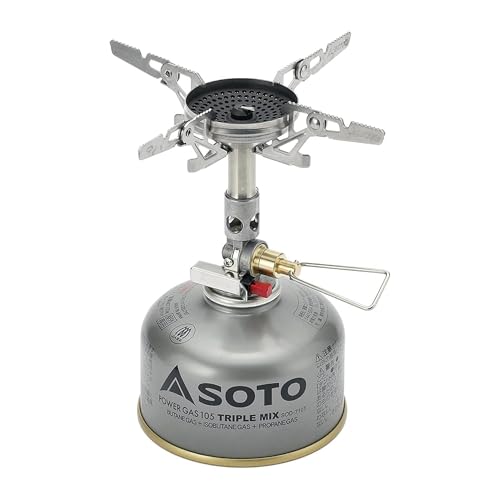
SOTO WindMaster Stove with 4Flex
Best for exposed ridges and windy campsites
SOTO WindMaster Stove with 4Flex
Best for exposed ridges and windy campsites
What we like
- Mortar-shaped burner head creates built-in wind resistance — no separate windscreen needed in conditions up to strong gusts.
- 67-gram stove body is one of the lightest canister stoves with genuine pressure regulation at any price.
- Micro-regulator delivers consistent output down to cold temperatures and low canister levels without flame drop-off.
- 4Flex pot support included handles larger pots — flexibility most ultralight stoves skip.
What we don't
- Stove only — no pot included, so you're spending more once you add a pot to the total kit cost.
- 3-prong TriFlex support (sold separately) is needed for smaller pots; 4Flex can be unstable with very narrow cups.
- 11,000 BTU is strong but not the highest output here — the Coleman Triton doubles it for car camping needs.
Every other stove on this list loses performance in real wind. The SOTO WindMaster doesn't — the concave burner design physically blocks side airflow from breaking the flame, and the micro-regulator maintains pressure even as the canister cools down in cold camps.
At 2.3 oz for the stove body, it adds almost nothing to a pack. This is the buy if you camp at altitude, on exposed ridgelines, or anywhere a normal stove would struggle to hold a flame.
Skip it if you want a complete cooking system — you'll need to budget for a separate pot.
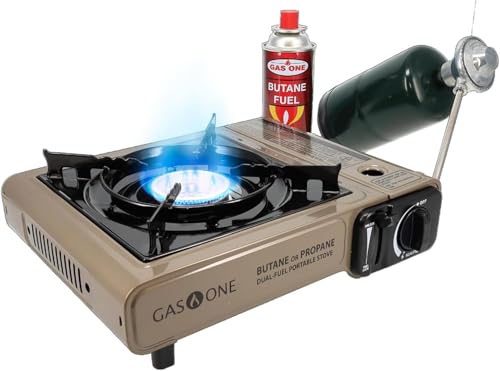
Gas One GS-3400P Dual Fuel Camping Stove
Best for overlanders and emergency prep
Gas One GS-3400P Dual Fuel Camping Stove
Best for overlanders and emergency prep
What we like
- Accepts both standard butane cartridges and 16.4 oz propane cylinders — propane adapter regulator included in the box.
- Piezo igniter works reliably across fuel types so you're not fumbling with matches when setup matters.
- Built-in pressure sensor ejects the butane cartridge automatically if irregular pressure is detected — a real safety feature.
- Carrying case included makes this genuinely portable for overlanding, tailgating, and power-outage cooking at home.
What we don't
- Single burner only — slow for group meals and can't run two things at once.
- Boil times are slower than integrated canister systems — expect 5+ minutes per liter in real conditions.
- Performance drops noticeably in cold weather on butane — switch to propane below 40F for reliable output.
The GS-3400P costs less than any other stove here and accepts two fuel types — butane when you can find it cheap at an Asian grocery or outdoor shop, propane when that's all that's available at a gas station in the middle of nowhere. That dual-fuel flexibility is genuinely useful on overlanding trips where resupply is unpredictable.
Buy this if you want a cheap, packable stove that works in a pinch — for the car, the truck camper, or the emergency kit. If fast boil times and backpacking weight matter to you, spend the extra $30-40 and step up to the Fire-Maple above.
What to Look For
Boil time is the number that matters most — look for under 4 minutes per liter in real conditions, not lab conditions. A stove rated at 10,000 BTU that takes 8 minutes to boil outdoors loses to a 3,000 BTU stove with integrated wind protection every time.
Fuel type determines everything about your logistics. Propane cylinders are everywhere and cheap but heavy; isobutane canisters are lighter and better in cold weather but harder to find in small towns.
Weight only matters if you're carrying it. Car campers can ignore weight entirely and prioritize cooking surface size; backpackers should aim for a stove system under 14 ounces including the pot.
Who Should Skip This
If you're cooking for a group of four or more at a basecamp every night, you'll outgrow every stove on this list within a trip. The two-burner options here top out at 22,000 BTU — fine for two people but slow for a family-sized pot of pasta.
You're also not the right fit for this list if you're winter mountaineering at altitude, where you need a pressure-regulated remote-canister stove that goes well above $100.
What the Community Actually Uses
On r/CampingGear, the stove debates never really end — but the consistent advice from experienced campers is to buy for your actual trip type, not your fantasy trip type. Most threads recommend having two stoves: a two-burner propane setup that lives in the car, and a lightweight canister stove for when you're actually hiking in.
That combination costs under $150 total with picks from this list.
Quick Picks — In Case You've Already Decided
Frequently Asked Questions
What fuel does a camping stove under $100 use?
Most options in this price range run on isobutane canisters, standard propane cylinders, or both. Isobutane is better in cold weather and lighter to carry; propane is cheaper and sold at more stores. The Gas One GS-3400P on this list accepts both, which makes it unusually flexible.
Can I use a camping stove in wind?
Yes, but performance drops sharply on most stoves without wind protection. The SOTO WindMaster uses a mortar-shaped burner head that actively resists side wind — it's the best option here for exposed ridges or breezy campsites. For other stoves, use your body or a reflective windscreen as a shield.
How long does a fuel canister last with a backpacking stove?
A 100g canister lasts roughly 45-60 minutes of burn time on most canister stoves. For a solo tripper boiling 2 cups twice a day, that's 3-4 days of cooking. Integrated systems like the Jetboil Flash and Fire-Maple Fixed Star 1 use fuel more efficiently and stretch that further.
What is the lightest camping stove under $100?
The SOTO WindMaster stove body weighs 67 grams — 2.3 oz — making it one of the lightest high-performance canister stoves available at any price. The Fire-Maple Fixed Star 1 system weighs 18 oz total including the 1L pot, which is competitive for an all-in-one cooking system.
Is the Coleman Triton good for car camping?
Yes — it's one of the most reliable two-burner propane stoves at any price. The 22,000 BTU output handles two pans simultaneously, the wind guards are effective, and the nickel-chrome grates clean up easily. It's overkill for backpacking but exactly right for a car camping kitchen.
Buying Guide
Choose based on how you camp. Car campers want two burners and wind guards.
Backpackers need weight under 14 oz and a canister system. Overlanders should look at dual-fuel flexibility.
Wind performance varies wildly by design — budget stoves skip the windscreen engineering you actually need in the field.