Overlanders already know the real enemy isn't bad weather — it's a stove that quits on you at 9,000 feet with wind coming sideways and everyone waiting on dinner. The five stoves here deliver 20,000 to 40,000 BTUs, weigh between 7 and 12 pounds, and all run on standard propane so you can fuel up at any truck stop.
| Photo |
Top Pick

|
Versatile
|
Budget
|
Best Value

|
Best for Reliability
|
|---|---|---|---|---|---|
| Product | Camp Chef Everest 2X Two-Burner Stove | Jetboil Genesis Basecamp Stove System | Camp Chef Mountaineer 2-Burner Camp Stove | Primus Kinjia 2-Burner Camp Stove | Coleman Classic 2-Burner Propane Camping Stove |
| Output | 40,000 BTU (2x 20K) | 20,000 BTU (2x 10K) | 40,000 BTU (2x 20K) | 20,400 BTU (2x 10,200 BTU) | 22,000 BTU (2x 11K) |
| Weight | 12 lbs | 7.5 lbs | 9.4 lbs | 8.2 lbs | 10 lbs |
| Ignition | Matchless | Lever igniter | Matchless | Manual (lighter required) | Manual (lighter required) |
| Windscreen | ✓ | ✓ | ✓ | ✓ | ✓ |
| Buy Now | Check Price → | Check Price → | Check Price → | Check Price → | Check Price → |
Quick Tips
Carry a 5-lb or 20-lb refillable propane tank instead of 1-lb cylinders — you'll burn through small cans fast on multi-day trips.
Level your stove before cooking; most overlanding stoves tip on uneven ground and cast iron pans slide off fast.
After dusty runs, blow out the burner ports with compressed air — clogged jets are the number one cause of yellow flames and poor performance.
A silicone trivet costs $5 and doubles as a pot holder and lid stand — skip hauling a bulky cooking kit around it.
Camp Chef Everest 2X 2-Burner Camping Stove
Best for high-output overlanding with standard propane
Camp Chef Everest 2X 2-Burner Camping Stove
Best for high-output overlanding with standard propane
What we like
- Dual 20,000 BTU burners deliver serious heat that holds up in cold, high-elevation conditions.
- Folding lid doubles as a three-sided windscreen so you're not hunting for a separate shield.
- Matchless ignition fires first try even in wet weather without needing a lighter.
- Latches like a suitcase and fits cleanly into most drawer systems and gear boxes.
What we don't
- At 12 lbs it is one of the heavier compact stoves in this class.
- Cooking surface is smaller than Camp Chef's Explorer-series stoves, limiting pan size options.
- Drip tray is shallow and overflows quickly during high-output cooking sessions.
When your campsite is at 8,000 feet and the wind picked up an hour ago, you need a stove that doesn't negotiate — the Everest 2X delivers 40,000 BTU across two burners and a windscreen that's part of the lid, not an afterthought you left in the truck. This is the right call for overlanders who want one stove that handles everything from coffee at 6am to a full group dinner at dark.
If you're solo and want something lighter or more compact, the Mountaineer below will suit you better.
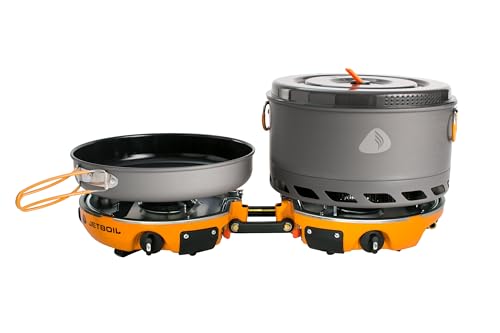
Jetboil Genesis Basecamp Stove System
Best for precision cooking and all-in-one storage
Jetboil Genesis Basecamp Stove System
Best for precision cooking and all-in-one storage
What we like
- Entire system — stove, 5L pot, and fry pan — nests into itself and fits in one compact travel bag.
- Regulated burners maintain consistent flame from a full tank down to nearly empty, unlike unregulated stoves.
- Four full turns of flame control per burner make simmering and low-heat cooking genuinely precise.
- JetLink port lets you daisy-chain a second burner accessory for expanded cooking capacity.
What we don't
- 10,000 BTU per burner is lower output than the Everest 2X — not ideal for boiling large pots fast.
- Proprietary cookware design means the FluxRing pot performs best but limits your pan options.
- Premium price puts it at the top of this category without matching the BTU of its competition.
The Genesis earns its price in scenarios where everything else becomes a mess of loose gear — the stove, 5L pot, and fry pan all nest together and drop into a single bag that fits neatly in any vehicle storage setup. Choose this if you cook real meals and care about precision — simmering sauces, rehydrating proteins, dialing exact heat.
If you just need maximum BTU to boil water for a crowd fast, the Everest 2X beats it on pure power.
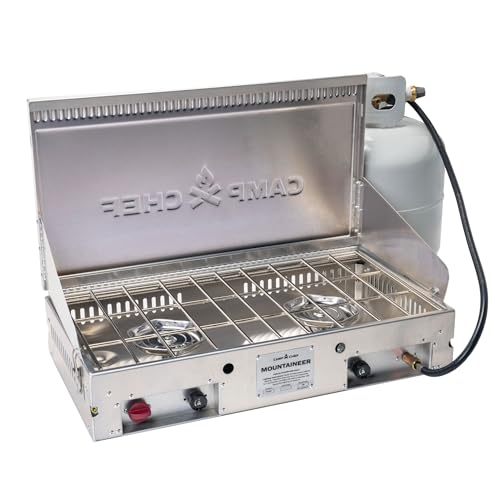
Camp Chef Mountaineer 2-Burner Camp Stove
Best for solo overlanders who want full power in a lighter package
Camp Chef Mountaineer 2-Burner Camp Stove
Best for solo overlanders who want full power in a lighter package
What we like
- Full aluminum construction sheds rust and weight while staying durable enough for truck-based travel.
- Delivers the same 40,000 BTU as the Everest 2X at roughly 2.5 lbs lighter.
- Includes a 5-ft hose and regulator, so you can connect directly to a 20-lb tank out of the box.
- Three-sided windscreen holds stable in gusty conditions that would kill unshielded burners.
What we don't
- Cooking surface area is smaller than the Everest 2X, making two large pans a tight fit.
- Aluminum body dents more easily than steel competitors if it gets banged around in cargo.
- No drip tray means oil and food residue go straight onto the burners and require more cleanup.
The Mountaineer solves the problem most solo overlanders run into: the powerful stoves are too heavy and the lightweight ones aren't powerful enough. You get the same 40,000 BTU as Camp Chef's flagship at a lower weight and a lower price — in a package explicitly designed for overlanding and rafting.
If you're cooking for two or less and storage space is tight, this is the one. Groups that need to run two full-size skillets simultaneously should step up to the Everest 2X instead.
Primus Kinjia 2-Burner Camp Stove
Best for overlanders who also want to look good doing it
Primus Kinjia 2-Burner Camp Stove
Best for overlanders who also want to look good doing it
What we like
- Stainless steel drip tray and removable pot supports make cleanup much faster than competitors without trays.
- Wood-trimmed handle locks the stove closed during travel without any additional hardware.
- Dual burners with independent temperature control handle a simmering sauce and rolling boil simultaneously.
- Spring-action locking mechanism keeps the regulator secure during transit without needing tape or straps.
What we don't
- No built-in igniter means you need a lighter or matches — an easy thing to forget at camp.
- 10,200 BTU per burner is lower output than Camp Chef options, so high-elevation performance suffers.
- European design sizing means it is narrower than US competitors and may not fit large American pots.
The Kinjia is a Primus stove, which means it is engineered in Sweden and built to a higher finish quality than most stoves in this price range — the wood trim, stainless drip tray, and spring-lock all reflect a level of detail the Camp Chef and Coleman options skip. Choose this if aesthetics and cleanup ease matter to you and you aren't regularly cooking at extreme altitude.
If you need raw power for cold-weather basecamp cooking, step up to one of the 40,000 BTU options instead.
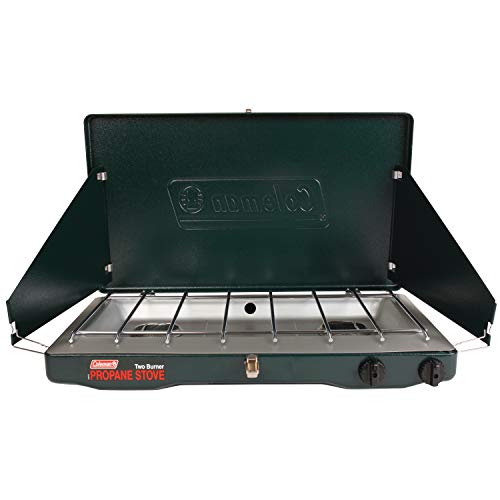
Coleman Classic 2-Burner Propane Stove
Best budget pick for new overlanders testing the setup
Coleman Classic 2-Burner Propane Stove
Best budget pick for new overlanders testing the setup
What we like
- Sub-$60 price point makes it the easiest entry into proper camp cooking without gambling on quality.
- Runs on standard 1-lb propane cylinders or a bulk tank with an adapter, giving you flexibility at any fuel stop.
- PerfectFlow pressure regulator maintains consistent output even as the propane cylinder cools and pressure drops.
- Wind guards on both sides have protected Coleman burners in decades of campsite use across every climate.
What we don't
- Requires a lighter or match to ignite — no built-in igniter at this price point.
- Drip tray is small and spills over quickly during heavy cooking sessions.
- Steel construction is heavier than aluminum competitors and can surface rust if stored wet.
Before you spend $150 on a Jetboil or $120 on a Primus, the Coleman Classic is the stove to figure out whether camp cooking is actually part of your overlanding life. It's not the most powerful or the lightest, but it is reliable, cheap to replace, and runs on propane you can grab at any gas station.
This is also the right call if your rig is already packed and weight matters less than cost. Once you know what you actually need from a camp stove, you'll have a much clearer picture of which upgrade is worth it.
What to Look For
Output matters most in cold temps and at elevation, where propane pressure drops and boil times double. A stove with at least 20,000 BTU per burner keeps performance consistent above 7,000 feet.
Windscreen design separates good trail stoves from great ones. A three-sided folding lid-as-windscreen is the most practical setup for overlanders cooking in exposed campsites.
Size and storage have to match your rig. A stove that won't fit in your drawer system or cargo box is useless no matter how well it cooks.
Who Should Skip This
If you're doing true backcountry hiking and carrying everything on your back, none of these stoves are right for you — look at canister-top backpacking stoves instead. These are all designed for vehicle-based travel where weight and pack size are less critical than output and durability.
What the Community Actually Uses
On r/overlanding, the consensus is pretty clear: get more BTUs than you think you need and never trust cheap wind guards. Camp Chef and Jetboil come up constantly in 'what stove do you run' threads, and the recurring complaint about budget options is always wind performance — not price.
Quick Picks — In Case You've Already Decided
Frequently Asked Questions
Can I use my overlanding stove at high altitude?
Yes, but performance drops as elevation rises because propane pressure decreases in cold air. Stoves with pressure regulators like the Jetboil Genesis handle altitude better than unregulated burners. Expect longer boil times above 8,000 feet regardless of stove.
Is it safe to use a propane stove inside my vehicle or tent?
No. All propane stoves produce carbon monoxide and must be used outdoors with adequate ventilation. Never cook inside an enclosed cab, tent, or canopy without significant airflow.
What size propane tank should I carry for overlanding?
A 5-lb refillable tank is a solid baseline for solo or duo trips up to a week. For groups or longer expeditions, a 20-lb tank connected via hose adapter gives you much more run time and is cheaper per BTU than 1-lb cylinders.
Do overlanding stoves work in the rain?
The stoves themselves handle light rain fine, but most windscreens are not waterproof covers — moisture can get into burner ports. Cook under an awning when possible and dry out burner ports before storage to prevent corrosion and clogging.
What is the difference between a tabletop and a freestanding overlanding stove?
Tabletop stoves sit on a surface like your tailgate or a camp table and are more compact for storage. Freestanding stoves have legs and give you more cooking height and stability on uneven ground. Most overlanders prefer tabletop stoves paired with a dedicated camp table.
Buying Guide
For overlanding, you want a stove that fits your rig's storage, connects to a standard 1-lb or full-size propane tank, and won't flame out in wind. Two burners let you cook two things at once.
Matchless ignition saves you when your lighter is buried. Windscreens are non-negotiable — they're the difference between boiling water and burning fuel.