The right solo stove turns a frustrating 12-minute wait into hot coffee in under two minutes regardless of wind. Five options do that reliably under $150 — and the lightest one weighs less than a AA battery.
| Photo |
Top Pick

|
Versatile

|
Budget

|
Best Value
|
Best for Reliability

|
|---|---|---|---|---|---|
| Product | MSR PocketRocket 2 Ultralight Camping and Backpacking Stove | MSR WindBurner Personal Stove System | Jetboil Flash Camping Stove Cooking System | SOTO WindMaster Backpacking Stove with 4Flex | BRS-3000T Ultralight Titanium Backpacking Stove |
| Fuel | Isobutane-propane canister | Isobutane-propane canister | Isobutane-propane canister | Isobutane-propane canister | Isobutane-propane canister |
| Weight | 2.6 oz (73g) | 14.7 oz (417g) with pot | 13.1 oz (371g) with cup | 2.3 oz (67g) | 0.88 oz (25g) |
| Seasons | 3-season | 4-season | 3-season | 4-season | 3-season |
| Boil time | 3.5 min per liter | 2.5 min per liter | 100 seconds per liter | 3.2 min per liter | 3 min per liter |
| Buy Now | Check Price → | Check Price → | Check Price → | Check Price → | Check Price → |
Quick Tips
Store your fuel canister upright in a warm pocket for 10 minutes before lighting in cold weather — output drops fast when the canister gets cold.
Cup your hand around a windscreen made from aluminum foil if you forgot yours — even a loose tent stake used as a windbreak cuts boil time significantly.
Check canister weight before you pack out: a 100g canister runs about 45 minutes at full blast, which is roughly 12-15 boils for a solo trip.
Screw your stove onto the canister before putting on your pack — checking the valve seal at camp beats dealing with a gas leak mid-hike.
MSR PocketRocket 2 Ultralight Backpacking Stove
Best for solo backpackers who want a proven, packable stove
MSR PocketRocket 2 Ultralight Backpacking Stove
Best for solo backpackers who want a proven, packable stove
What we like
- Folds down to 2x2x3 inches and disappears into any pack pocket.
- Flame adjusts smoothly from a rolling boil to a controlled simmer — rare at this price.
- Works with any standard EN417 canister, so you can resupply anywhere outdoor gear is sold.
- Trusted by alpinists for decades — the reliability record on this stove is genuinely exceptional.
What we don't
- No built-in igniter, so you need a lighter or matches every time.
- Wind performance drops significantly without a separate windscreen.
- Pot supports are narrow — large pots wobble more than they should.
Wind is where most solo stoves fail you, and the PocketRocket 2 is honest about that trade-off — it is not a wind stove, but it is the most reliable, lightest, and most packable all-purpose stove at this price point by a significant margin. This is the right call if you camp in sheltered spots, use a stuff sack as a wind block, or just want the stove that has worked for hundreds of thousands of backpackers without drama.
Skip it if you regularly cook exposed on ridgelines or in coastal wind.
MSR WindBurner Personal Windproof Camping Stove System
Best for wind-exposed cooking where speed and fuel efficiency matter
MSR WindBurner Personal Windproof Camping Stove System
Best for wind-exposed cooking where speed and fuel efficiency matter
What we like
- Radiant burner with 100% primary air combustion is genuinely impervious to wind — it works where other stoves quit.
- Integrated 1.0L pot with heat exchanger makes it 25-30% more fuel efficient than a bare canister stove.
- Pressure regulator delivers consistent output even as the canister empties or temperature drops below freezing.
- Everything nests inside the pot with a 110g fuel canister, so there are zero loose parts to lose.
What we don't
- The integrated system locks you into MSR's pot ecosystem — you can't use it as a freestanding burner.
- At 14.7 oz all-in, it is heavier than most open-burner stoves at the same output.
- No simmer control — it is engineered for boiling water, not precision cooking.
You lose time and fuel every time wind steals heat from an open burner, and the WindBurner solves that problem completely with an enclosed radiant design that performs the same at 30mph gusts as it does in a dead calm. This is the right stove if you do alpine camping, exposed ridge camps, or shoulder-season trips where cold canisters kill output.
If you mostly car camp in trees or only need hot water for coffee, the price premium over the PocketRocket 2 is hard to justify.
Jetboil Flash Camping and Backpacking Stove Cooking System
Best for solo campers who want hot water in under two minutes with no setup
Jetboil Flash Camping and Backpacking Stove Cooking System
Best for solo campers who want hot water in under two minutes with no setup
What we like
- Boils one liter in 100 seconds — measurably the fastest in this roundup under real-world conditions.
- Push-button igniter means you never fumble for a lighter at 5am before coffee.
- Color-change heat indicator on the cozy tells you exactly when the water is ready without lifting the lid.
- All components nest inside the 1.0L cup, making it one of the most packable integrated systems available.
What we don't
- Simmer control is limited — it is built for boiling, not cooking actual food.
- Integrated system means you can only use the Jetboil cup and compatible Jetboil pots.
- At 13.1 oz, it weighs more than a bare stove-and-pot combo at equivalent volume.
The Jetboil Flash removes every friction point from the morning routine: one click to ignite, watch the indicator change color, pour your coffee — and you are done in under two minutes before your tent is even packed. This is the stove for solo campers who live on freeze-dried meals, instant coffee, and ramen — and want zero decision-making at 6am.
If you want to actually cook with a real pot or simmer a sauce, the Flash will frustrate you.
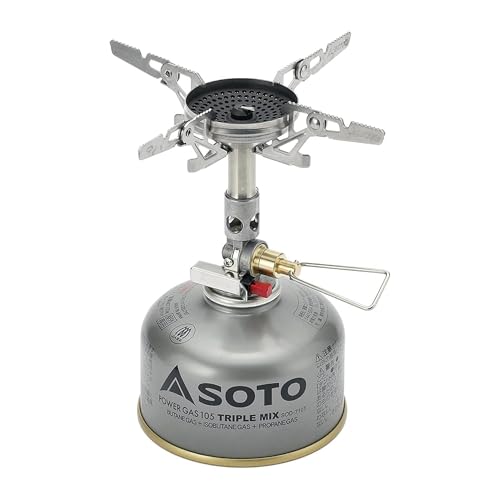
SOTO WindMaster Backpacking Stove with 4Flex
Best for ultralight hikers who camp in wind and need simmer control
SOTO WindMaster Backpacking Stove with 4Flex
Best for ultralight hikers who camp in wind and need simmer control
What we like
- Micro regulator valve maintains consistent output in cold weather and as the canister empties — a rare feature at this weight.
- Performs reliably in wind without an external windscreen, unlike most open-burner canister stoves.
- At 2.3 oz, it sits between the BRS-3000T and PocketRocket 2 in weight while delivering meaningfully better wind and cold performance.
- The included 4Flex pot support handles large pots that would wobble on a three-legged stove.
What we don't
- No built-in igniter — you need a lighter, which adds a small but real point of failure.
- The micro-burner head is small and requires careful pot centering for even heat on wider pots.
- Higher price than the PocketRocket 2 for what looks like a similar stove to non-technical buyers.
The SOTO WindMaster is the stove that outperforms its weight class — a 2.3 oz burner that handles cold canisters and gusting wind well enough that experienced ultralight hikers regularly choose it over stoves twice its weight. This is the right pick if you want a sub-3 oz stove that you can actually use above treeline or on late-season trips without babying it.
Skip it if you want push-button ignition or an all-in-one cooking system.
BRS Outdoor BRS-3000T Ultralight Titanium Camping Stove
Best for ultralight backpackers who just need water to boil and nothing else
BRS Outdoor BRS-3000T Ultralight Titanium Camping Stove
Best for ultralight backpackers who just need water to boil and nothing else
What we like
- At 25 grams, it is lighter than a AA battery and takes up less space than a poker chip.
- Boils a liter in about 3 minutes in calm conditions — identical real-world performance to stoves costing 10x as much when sheltered.
- Works with any EN417 canister and nests inside a 750ml pot with a 110g canister, fitting the whole cook kit in one fist.
- Titanium alloy construction is corrosion-resistant and has proven far more durable than its price suggests over years of use.
What we don't
- No wind resistance whatsoever — even mild breezes cut output dramatically and require a windscreen.
- No igniter, no simmer control, no cold-weather regulator — it is a valve and a burner head, nothing more.
- Pot supports are narrow and unstable with anything larger than a 750ml pot.
There is nothing clever about the BRS-3000T — it is a titanium valve and three legs, and it costs almost nothing, and in a sheltered spot it boils water just as fast as stoves that cost 10 times as much. This is the right pick for ultralight hikers who already have a windscreen, camp below treeline, and want to cut pack weight to the bone.
Skip it if you camp exposed, hike in cold weather, or need a stove to actually cook rather than just boil.
What to Look For
Weight matters more on day three than day one. For solo trips under three nights, anything under 4 oz is fine — for longer pushes, target 2 oz or less.
Boil time specs are tested in a lab with no wind. Real-world times run 30-60% longer unless you have wind protection built in or add a windscreen.
Integrated systems cost more but save fuel over time. If you're going out more than four nights a season, the fuel savings on a WindBurner or Jetboil-style stove pay back the price gap.
Who Should Skip This
If you're cooking for two or more people regularly, a solo stove's small pot support and narrow heat spread will frustrate you — step up to a two-person system like the MSR WindBurner Duo instead. Car campers who want to actually cook (not just boil water) will also find canister stoves limiting — a small propane burner gives you more control and doesn't care about ambient temperature.
What the Community Actually Uses
On r/ultralight, the BRS-3000T comes up in nearly every 'shakedown list' thread as the default budget pick — members there treat it as a given. The bigger debates are between the SOTO WindMaster and the MSR PocketRocket 2 for gram-counters who still want reliability in wind.
If you check r/CampingGear, the Jetboil Flash dominates beginner recommendations because its all-in-one design removes every decision from the morning routine.
Quick Picks — In Case You've Already Decided
MSR PocketRocket 2 Ultralight Camping and Backpacking Stove
Check Price on AmazonFrequently Asked Questions
Do I need a windscreen for a canister stove?
For most canister stoves, yes — wind is the single biggest killer of boil performance. Never wrap a windscreen fully around an integrated canister stove like the Jetboil though, as it can cause the canister to overheat. Stoves with built-in wind resistance like the SOTO WindMaster or MSR WindBurner handle it without one.
How much fuel do I need for a solo weekend trip?
A standard 100g canister covers roughly 12-15 boils for a solo camper. For a 2-night trip with two boils per day (breakfast and dinner), one canister is enough with margin. Bring two for longer trips or cold weather use.
Can I use any canister with these stoves?
All five stoves use the standard EN417 threaded canister — brands like MSR IsoPro, JetPower, and Snow Peak all work. Avoid mixing a canister rated for a different burner system; the threads are universal but always check before your trip.
Is it worth spending over $100 on a solo stove?
If you camp more than a few times a year, yes. Stoves above $80 typically offer better wind resistance, more consistent cold-weather output, or integrated systems that save fuel. The BRS-3000T proves you can spend almost nothing and still boil water — but it has real limits in wind and cold.
What is the lightest solo backpacking stove available?
The BRS-3000T at 0.88 oz (25g) is the benchmark for ultralight canister stoves. The SOTO WindMaster comes close at 2.3 oz but adds meaningful wind resistance. If minimum weight is the only goal, the BRS wins — just pack a windscreen.
Buying Guide
You want a stove that lights first try, boils fast, and fits inside your pot. For solo use, a 2700W to 3200W output covers everything from coffee to freeze-dried meals.
Canister stoves are the right call for 95% of solo campers — lighter, cleaner, and no priming fuss. Wind resistance is where cheap stoves fail you.