Every ounce on a loaded bike is a decision you live with on the climbs, and a stove that weighs more than your meal is the wrong call. The MSR PocketRocket 2 weighs 2.6 oz, boils a liter in 3.5 minutes, and packs into a space smaller than your thumb.
| Photo |
Top Pick

|
Versatile

|
Budget
|
Best Value

|
Best for Reliability

|
|---|---|---|---|---|---|
| Product | MSR PocketRocket 2 Ultralight Camping and Backpacking Stove | BRS-3000T Ultralight Titanium Backpacking Stove | SOTO WindMaster Backpacking Stove with 4Flex | Jetboil Flash Camping Stove Cooking System | Fire-Maple FMS-116T Portable Titanium Backpacking Stove |
| Fuel | Isobutane-propane | Isobutane-propane | Isobutane-propane | Isobutane-propane | Isobutane-propane |
| Weight | 2.6 oz (74g) | 0.9 oz (25g) | 2.3 oz (67g) | 13.1 oz (371g) | 1.7 oz (48g) |
| Boil time | 3.5 min/liter | 3 min/liter | 2.5 min/liter | 1.7 min/liter | 3.5 min/liter |
| Windscreen | ✓ | ✗ | ✓ | ✓ | ✗ |
| Buy Now | Check Price → | Check Price → | Check Price → | Check Price → | Check Price → |
Quick Tips
Nest your canister inside your pot to save pack space — 110g canisters fit inside most 750ml titanium pots with a bare-burner stove attached
Wind kills canister stoves faster than cold does — if your route is exposed, prioritize a stove with a built-in windshield or regulator over raw weight savings
Buy fuel at the last bike shop before your remote section, not the first one after — small canisters are easier to source in outdoor towns than gas station-adjacent convenience stores
Integrated systems like the Jetboil are heavier but eliminate the pot purchase — factor total system weight, not just stove weight, when comparing options
MSR PocketRocket 2 Ultralight Camping and Backpacking Stove
Best for bikepackers who want a proven, trail-tested burner
MSR PocketRocket 2 Ultralight Camping and Backpacking Stove
Best for bikepackers who want a proven, trail-tested burner
What we like
- At 2.6 oz it disappears in a kit bag and nests easily inside a 750ml pot with a 110g canister
- Serrated pot supports grip titanium pots securely even on uneven ground after a long day of riding
- Adjustable flame goes from a roiling boil to a genuine simmer for actual cooking, not just rehydration
- Built-in windscreen baffles handle the light-to-moderate crosswinds that are routine on exposed ridge routes
What we don't
- Struggles in sustained heavy wind without an additional freestanding windscreen
- No piezo igniter — you need a lighter or matches, which is one more thing to pack
- Higher price than the BRS-3000T for what is functionally a similar bare-burner design
The PocketRocket 2 is the stove most bikepackers end up on after trying something lighter or cheaper and coming back — it boils reliably, packs small, and the serrated supports actually grip a pot on rough ground after a long descent. This is for the rider who wants a set-it-and-forget-it canister stove with enough simmer control to cook a real meal at camp, not just pour boiling water into a bag.
If you're going gram-obsessive and only ever boil water, the BRS below will save you 60 grams.
BRS Outdoor BRS-3000T Ultra-Light Titanium Alloy Camping Gas Stove
Best for riders counting every gram in their kit
BRS Outdoor BRS-3000T Ultra-Light Titanium Alloy Camping Gas Stove
Best for riders counting every gram in their kit
What we like
- At 25g it is genuinely the lightest functional canister stove available — a full ounce lighter than the PocketRocket 2
- Boils a liter in around 3 minutes in calm conditions, which is faster than most stoves at this price
- Palm-sized when folded and comes with a bright green carry pouch that won't vanish inside a frame bag
- Under $25 makes it a low-stakes add to any kit or a cheap backup stove for longer expeditions
What we don't
- Zero wind resistance — any real breeze extends boil times dramatically and burns through fuel fast
- Pot supports are narrow and can feel unstable with wider-bottomed pots or heavier cooksets
- No flame regulation beyond basic on/off, making it unsuitable for anything beyond boiling water
If your route is sheltered and your cooking style is pour-boiling-water-into-a-bag, the BRS-3000T is the only stove argument that makes sense at this weight and price — it genuinely works, and at 25g you will never feel it in your kit. This is not the stove for exposed ridgelines, alpine passes, or anyone who wants to cook more than instant meals.
Wind turns it from a 3-minute boil into a 12-minute fuel drain. Buy it for protected campsites or as a backup, not as your sole cooking system on exposed routes.
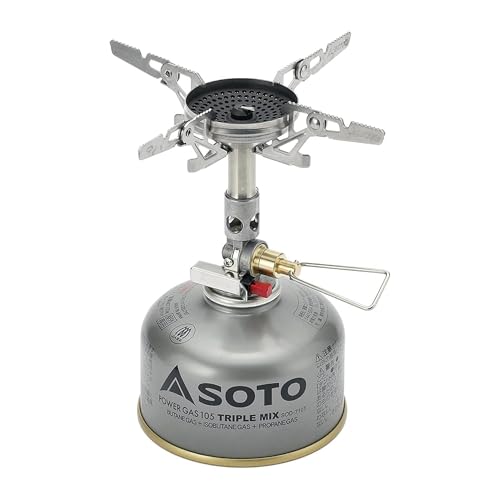
SOTO WindMaster Backpacking Stove with 4Flex
Best for exposed mountain and coastal bikepacking routes
SOTO WindMaster Backpacking Stove with 4Flex
Best for exposed mountain and coastal bikepacking routes
What we like
- Micro-regulator valve maintains consistent output in wind and cold — the boil time barely changes between calm and gusty conditions
- At 2.3 oz it is lighter than the PocketRocket 2 and significantly more wind-resistant
- Included 4Flex pot support handles larger cookware, which matters if you carry a wider pot for group meals
- Boils 2 cups of water in under 2.5 minutes in strong wind — the fastest wind-resistant stove in this category
What we don't
- Higher price point than the PocketRocket 2 for most route conditions where the wind difference won't matter
- The micro-regulator is not compatible with 100% propane — isobutane-propane mix only
- 4Flex adds bulk to packing compared to a bare-burner stove without the support
If your route includes alpine passes, ridge traverses, or coastal sections where wind is a given rather than an exception, the SOTO WindMaster is the stove that keeps boiling when everything else stutters — its regulator is the real differentiator, not just the windscreen design. This is for the rider who has been burned by a simpler stove on an exposed campsite and doesn't want to repeat it.
If your routes are mostly forested and sheltered, the PocketRocket 2 gets you 90% of the performance at half the price.
Jetboil Flash Camping Stove Cooking System
Best for riders who want one piece of kit instead of three
Jetboil Flash Camping Stove Cooking System
Best for riders who want one piece of kit instead of three
What we like
- Boils a liter in under 100 seconds — the fastest system in this roundup by a full 90 seconds
- Stove, pot, lid, and fuel stabilizer all pack into one self-contained unit — zero loose parts to track down in a frame bag
- Push-button igniter means no lighter or matches required — one less item to manage on a loaded bike
- Thermochromatic heat indicator on the cozy tells you exactly when water is ready without guessing
What we don't
- At 13.1 oz it is the heaviest option here by a wide margin — the system weight is 5x the PocketRocket 2
- The integrated 1L cup limits cookware versatility — you are locked into Jetboil's ecosystem for accessories
- Higher price than any bare-burner option in this roundup
The Flash is not the lightest option but it is the fastest and the most packable as a complete system — every component nests into the cup, nothing rattles loose in a handlebar bag, and you go from stop to boiling coffee in under two minutes without hunting for a lighter. This is for the bikepacker who resupplies regularly, prioritizes convenience over weight savings, and doesn't want to also buy a pot, lid, and igniter separately.
If you're going ultralight, the PocketRocket 2 and a titanium pot weigh less combined.
Fire-Maple FMS-116T Portable Titanium Backpacking Stove
Best for ultralight riders who want titanium without the BRS price
Fire-Maple FMS-116T Portable Titanium Backpacking Stove
Best for ultralight riders who want titanium without the BRS price
What we like
- Titanium construction at 48g hits the sweet spot between the BRS-3000T's fragility and the PocketRocket 2's extra weight
- Wider burner head distributes flame more evenly across the pot base than pinpoint micro-stoves — better for cooking actual food
- Broad 4.3-inch pot support span handles a wider range of cookware than the narrow arms on the BRS
- Priced well below MSR for a titanium build that has logged thousands of miles on long-distance trails
What we don't
- No igniter — manual lighting required with a lighter or fire starter
- No wind resistance — performs poorly on exposed campsites without a separate windscreen
- Boil time is slower than the BRS-3000T in calm conditions despite being almost twice the weight
The FMS-116T sits between the BRS-3000T and the PocketRocket 2 in almost every way — more stable than the BRS, lighter than the MSR, and titanium throughout for a price closer to the budget end than the premium. This is for the experienced bikepacker who already has a windscreen, doesn't need an igniter, and wants a wider flame for cooking rather than just boiling water.
If you're new to this and want something that just works without gear knowledge, start with the PocketRocket 2.
What to Look For
Weight is the starting point, but packability is what actually matters on a bike. A stove that nests inside your cook pot saves a full stuff sack and keeps your frame bag organized.
Wind performance separates stoves on bikepacking routes more than any spec sheet suggests. Exposed ridgelines, alpine passes, and coastal roads punish open-flame burners without windscreens — a micro-regulator or built-in baffle is worth the extra half-ounce.
Fuel availability determines your route flexibility. Isobutane-propane canisters are easy to find at outdoor retailers in most trail towns; if you're heading somewhere remote for more than three nights, carry a backup or know where your resupply is before you leave.
Who Should Skip This
If you are bikepacking with a group of three or more and need to boil multiple liters per meal, a solo canister stove is not the right tool — look at a multi-burner setup or a larger integrated system. Riders doing purely road touring who stop at towns every night will get more value from a backpacking stove with real simmer control for cooking actual meals rather than just boiling water.
What the Community Actually Uses
On r/bikepacking, fuel sourcing and stove weight come up constantly — the community consensus leans hard toward canister systems over alcohol for reliability on longer routes, with the BRS-3000T and MSR PocketRocket 2 appearing in almost every stove thread as the two-end benchmark. Worth reading before your first multi-day route.
Quick Picks — In Case You've Already Decided
MSR PocketRocket 2 Ultralight Camping and Backpacking Stove
Check Price on AmazonFrequently Asked Questions
Can I bring a canister stove on a bikepacking trip internationally?
Fuel canisters cannot be carried on planes — you need to source them at your destination. Most outdoor retailers and camping shops in Europe, Japan, and Australia stock standard isobutane-propane canisters, but verify ahead of time for remote destinations.
What size fuel canister is best for a 3-4 day bikepacking route?
A 110g canister is typically enough for one person boiling water twice daily over 3-4 days. Carry a 230g canister if you plan to cook actual meals or travel in colder temps where fuel efficiency drops.
Is an alcohol stove a better choice for bikepacking than canister?
Alcohol stoves are lighter and the fuel is easier to find globally, but they are significantly slower to boil, perform poorly in cold or wind, and require more user management. Most bikepackers doing multi-day routes prefer canister for reliability.
Does a bikepacking stove need to be windproof?
Not windproof, but wind-resistant makes a real difference on exposed routes. A stove with a micro-regulator or built-in baffle like the SOTO WindMaster will outperform an open burner in the conditions you actually encounter on mountain passes and ridge trails.
What is the lightest viable canister stove for bikepacking?
The BRS-3000T at 0.9 oz is the lightest canister option widely available, but it has no wind resistance. The MSR PocketRocket 2 at 2.6 oz is the lightest stove that performs reliably across real-world conditions including light wind.
Buying Guide
You need a stove that fits your frame bag, runs on fuel you can source mid-route, and boils fast after a four-hour leg. Canister stoves beat alcohol for reliability and speed.
Weight matters but wind resistance matters more. Under 3 oz is the target.
Integrated systems save time; bare burners save grams.