Side sleepers don't need a softer pad — they need a wider, thicker one with enough stability that they stay centered all night. The picks below start at $35 and go up to $220, and every one was chosen specifically for shoulder and hip clearance, not just raw comfort scores.
| Photo |
Top Pick

|
Versatile

|
Budget
|
Best Value

|
Best for Reliability

|
|---|---|---|---|---|---|
| Product | NEMO Tensor Insulated Sleeping Pad (Regular Wide) | Big Agnes Rapide SL Insulated Sleeping Pad | Therm-a-Rest NeoAir XLite Sleeping Pad (Regular Wide) | Klymit Static V2 Inflatable Sleeping Pad | Therm-a-Rest Trail Scout Self-Inflating Sleeping Pad |
| Width | 25 in | 20 in | 25 in | 23 in | 20 in |
| Weight | 16 oz | 18 oz | 14 oz | 16 oz | 24 oz |
| R value | 3.5 | 4.2 | 4.2 | 1.3 | 3.1 |
| Thickness | 3 in | 3.5 in | 2.5 in | 2.5 in | 1 in |
| Buy Now | Check Price → | Check Price → | Check Price → | Check Price → | Check Price → |
Quick Tips
Go wide first: a 25-inch pad gives side sleepers the shoulder room a standard 20-inch pad never will — size up before you upgrade price.
Inflate slightly softer than you think you need — a pad that's 80% full cradles your hip instead of fighting it.
Test your pad on a hard floor at home before your first trip; hip pressure issues show up in 20 minutes on tile.
If you run cold, pair any pad under R-3.5 with a thin closed-cell foam layer underneath — it adds insulation without bulk.
NEMO Tensor Insulated Sleeping Pad (Regular Wide)
Best for side sleepers who want backpack-friendly thickness without giving up warmth
NEMO Tensor Insulated Sleeping Pad (Regular Wide)
Best for side sleepers who want backpack-friendly thickness without giving up warmth
What we like
- Spaceframe baffles resist the waterbed effect so you stay centered when you shift position at night.
- 25-inch wide surface gives shoulder and hip clearance that standard 20-inch pads can't match.
- Thermal Mirror film reflects body heat, adding warmth without extra weight or insulation bulk.
- Vortex pump sack inflates the pad in under 60 seconds without blowing moisture into the baffles.
What we don't
- The 2022 model had early reports of air leaks — verify you're getting a current production unit.
- At $170-$200 it's one of the pricier picks in the category.
- Slightly louder than foam pads when you shift position, though much quieter than older NEMO designs.
The Tensor Insulated Wide is the pad that comes up every time someone on a camping forum complains that their hips still hurt despite spending money on gear. The Spaceframe baffles don't compress under lateral load the way standard tube-style baffles do, which means when you roll onto your side the pad pushes back instead of flattening under your hip.
This is the right pick if you're backpacking three seasons and need a pad that earns its weight in actual hip clearance. If you're car camping and don't care about packed size, the Therm-a-Rest Trail Scout below costs a third as much and works fine on soft ground.
Big Agnes Rapide SL Insulated Sleeping Pad
Best for side sleepers who want a quilted feel and PrimaLoft warmth in one lightweight package
Big Agnes Rapide SL Insulated Sleeping Pad
Best for side sleepers who want a quilted feel and PrimaLoft warmth in one lightweight package
What we like
- 3.5-inch thick profile delivers more hip clearance than most pads in this weight class.
- Quilted top surface stops you from sliding around at night, which matters when you're on a slope.
- PrimaLoft Silver insulation paired with heat-reflective film gives it a genuine 4.2 R-value at low weight.
- Offset I-Beam construction cradles the body laterally without the springy instability of straight-tube pads.
What we don't
- The regular 20-inch width is narrow for broad-shouldered side sleepers — upgrade to the Wide Regular if shoulder clearance is your priority.
- Pricier than the Klymit and Trail Scout options without being meaningfully lighter.
- A few users report the valve requires a firm press to seat fully after deflation.
The Rapide SL is the thickest pad in this roundup at 3.5 inches, and that extra half-inch of loft is what separates a good hip clearance from a great one on hard ground. The quilted top also solves a real problem for side sleepers who shift during the night — it grips your sleeping bag instead of sending you sliding toward the tent wall.
This is the better pick if you run cold and want a pad that doubles as shoulder-season insurance. If you're over six feet or broad-shouldered, skip the regular and go straight to the Wide Regular variant — the 20-inch standard is functional but tight.
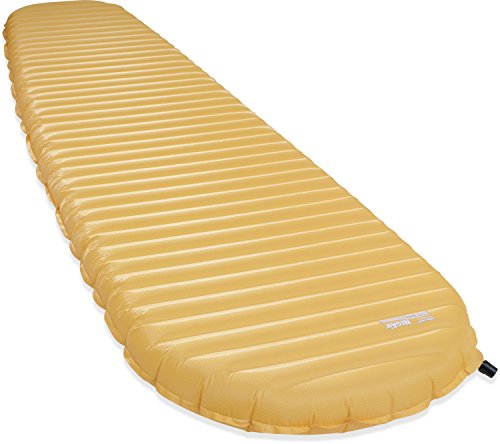
Therm-a-Rest NeoAir XLite Sleeping Pad (Regular Wide)
Best for ultralight backpackers who side sleep and refuse to carry extra weight for comfort
Therm-a-Rest NeoAir XLite Sleeping Pad (Regular Wide)
Best for ultralight backpackers who side sleep and refuse to carry extra weight for comfort
What we like
- At 14 ounces in the Wide, it's one of the lightest warm-weather side-sleeper pads on the market.
- ThermaCapture technology traps radiant heat to deliver a 4.2 R-value in a truly packable profile.
- 25-inch width gives the shoulder and hip clearance that narrow backpacking pads can't match.
- WingLock valve inflates three times faster than standard valves and deflates completely in seconds.
What we don't
- 2.5-inch thickness is the minimum for side sleeping — heavy or broad-shouldered campers may want more loft.
- The crinkling sound of ThermaCapture film is noticeably louder than foam or baffle-style pads.
- At this price point, durability expectations are high — carry the patch kit.
The XLite Wide is what ultralight backpackers reach for when they've accepted that a narrow 20-inch pad is destroying their sleep and something has to change. The 25-inch width is the fix — same class-leading weight, same packable profile, just enough extra real estate to keep your shoulder on the pad all night.
The right person for this pad is logging miles all day and needs the lightest warm pad that still works on their side. If packed size isn't a constraint, the NEMO Tensor or Big Agnes Rapide give more loft for similar money.
Klymit Static V2 Inflatable Sleeping Pad
Best for car campers and weekend warriors who side sleep and don't want to spend $180
Klymit Static V2 Inflatable Sleeping Pad
Best for car campers and weekend warriors who side sleep and don't want to spend $180
What we like
- V-chamber body-mapping design cradles the torso and limits air movement, reducing the waterbed bounce that wakes side sleepers up.
- Dynamic side rails keep you centered on the pad when you shift — a feature you'd expect at twice the price.
- Inflates in 10-15 breaths with no pump required, and the push valve deflates it in under 30 seconds.
- At $55-$80 it's the easiest way to test whether a structured air pad solves your hip pain before committing to a $180 option.
What we don't
- R-value of 1.3 makes this a warm-weather or car camping pad only — not suitable for cold ground.
- 23-inch width is an improvement over 20-inch standard pads but still narrower than the 25-inch Wide options.
- The V-chamber design leaves gaps at the shoulder where heat can escape on colder nights.
The Static V2 is what you buy when you're not sure whether the problem is your pad or something else. The V-chamber design actually addresses the specific mechanics of side sleeping — the body-mapped shape keeps your hip from sinking through to the ground the same way tube-baffled pads don't.
At $55-$80 it's a real test, not a throwaway compromise. This is a car camping and fair-weather backpacking pad.
If you're camping below 50 degrees Fahrenheit with any regularity, the 1.3 R-value isn't enough and you'll want to step up to an insulated option.
Therm-a-Rest Trail Scout Self-Inflating Sleeping Pad
Best for car campers and beginners who want a no-fuss self-inflating pad that actually works
Therm-a-Rest Trail Scout Self-Inflating Sleeping Pad
Best for car campers and beginners who want a no-fuss self-inflating pad that actually works
What we like
- Self-inflates when you open the valve — no pump, no breath inflation, just unroll it and let it expand.
- 3.1 R-value means it handles genuine three-season ground temperatures despite its entry-level price.
- Foam core provides consistent support that doesn't shift when you roll — unlike pure air pads at this price point.
- Made in the USA with the same fundamental construction as Therm-a-Rest's more expensive Trail Pro line.
What we don't
- At 1 inch thick it's below the 3-inch minimum for comfortable side sleeping — best suited for soft ground or as a car-camping pad.
- 24 ounces is heavier than inflatable options at similar price points, which limits its appeal for backpacking.
- 20-inch width offers no shoulder clearance advantage over a standard foam mat.
The Trail Scout earns its place here for one specific type of camper: the car camper or family setup where the ground is soft, the pitch is short, and the budget is firm. The self-inflating foam core gives it real structure that cheap air pads don't have, and 3.1 R-value is better than most pads at this price.
Be direct about the limitation: 1 inch of thickness is not enough for side sleeping on hard or rocky ground. This pad works on a tent footprint over dirt or pine needles.
On compacted or stony ground, step up to one of the inflatable options above.
What to Look For
Thickness is the single biggest factor for side sleepers. You want at least 3 inches of loft so your hip clears the ground when you're lying on your side.
Anything under 2.5 inches and you'll feel the ground by 2am. Width matters more than most guides admit.
A standard 20-inch pad forces side sleepers to hang their shoulder or knee off the edge. A 25-inch wide pad solves this entirely without changing anything else about your sleep setup.
Baffle or chamber design determines how stable the pad feels when you roll. Structured baffles — like NEMO's Spaceframe or Big Agnes's I-Beam — resist the waterbed effect and keep you centered.
Unstructured air pads can feel fine lying still and terrible the moment you move.
Who Should Skip This
If you sleep exclusively on your back and pack ultralight, you don't need a wide pad — a standard 20-inch mummy-cut pad weighs less and packs smaller for the same warmth. These picks are optimized for hip and shoulder clearance, not minimum weight.
Stomach sleepers can also skip most of these — they tend to need a firmer, thinner surface than what works for side sleepers.
What the Community Actually Uses
On r/CampingGear and r/ultralight, side sleeper pad recommendations come up constantly — and the consensus is almost always the same: go wider before you go more expensive. The NEMO Tensor Wide and Therm-a-Rest NeoAir XLite Wide get cited more than any other options for people who've tried narrow pads and kept waking up in pain.
Quick Picks — In Case You've Already Decided
Frequently Asked Questions
What R-value do side sleepers need for three-season camping?
An R-value of 3.5 to 4.5 covers most three-season conditions down to around freezing. Side sleepers lose more heat through hip and shoulder contact than back sleepers, so erring toward 4.0 or higher is smart if you camp in shoulder seasons.
Is a self-inflating pad or an air pad better for side sleepers?
Air pads with structured baffles outperform self-inflating foam pads for side sleepers because you can tune the firmness and they offer significantly more loft at lower weight. Self-inflating pads are more durable but rarely get above 1.5 to 2 inches thick, which isn't enough hip clearance for most side sleepers.
Do I really need a wide pad if I'm not a big person?
Yes — width is about shoulder-to-hip span in a lateral position, not body size. Even a 130-pound side sleeper will hang a shoulder off a 20-inch pad. The 25-inch wide size is the most common recommendation on gear forums regardless of body weight.
How thick does a sleeping pad need to be for side sleeping?
Three inches is the practical minimum for most side sleepers. At 2.5 inches you may be fine on softer ground but will feel hard earth by morning on rocky or compacted sites. Pads at 3.5 inches and above provide consistent hip clearance across surface types.
Can I use a sleeping pad designed for back sleepers as a side sleeper?
You can, but you'll likely wake up stiff or sore. Pads designed for back sleepers prioritize even support across the spine, not lateral clearance at the hip and shoulder. The difference is most obvious after the first hour of sleep when the ground pressure compounds.
Buying Guide
You need a pad that keeps your hips from bottoming out and your shoulders from rolling off the edge. Look for at least 3 inches of thickness, a width of 25 inches or more, and structured baffles or chambers that hold their shape when you shift position.
R-value matters for cold ground, not just cold air.