Wind-killed stoves are not a gear problem — they are a selection problem, and every stove on this list was chosen specifically because it holds output when AT ridge conditions try to snuff it. The five picks below span 25g to 15.3oz and $15 to $130, covering every AT hiker from UL gram-counters to section hikers who want hot food, not just boiled water.
| Photo |
Top Pick

|
Versatile
|
Budget

|
Best Value

|
Best for Reliability

|
|---|---|---|---|---|---|
| Product | MSR WindBurner Personal Stove System | SOTO WindMaster Backpacking Stove with 4Flex | MSR PocketRocket 2 Ultralight Camping and Backpacking Stove | MSR PocketRocket Deluxe Stove | BRS-3000T Ultralight Titanium Backpacking Stove |
| Fuel | Isobutane-propane | Isobutane-propane | Isobutane-propane | Isobutane-propane | Isobutane-propane |
| Weight | 15.3 oz (system) | 2.3 oz (stove only) | 2.6 oz | 2.9 oz | 0.9 oz |
| Seasons | 3-4 season | 3-4 season | 3 season | 3-4 season | 3 season |
| Boil time | 2.5 min/L | Under 2.5 min/L | 3.5 min/L | 3.5 min/L | 3-4 min/L |
| Buy Now | Check Price → | Check Price → | Check Price → | Check Price → | Check Price → |
Quick Tips
Shake your canister before lighting — a near-empty canister with no pressure regulator loses significant output and boils much slower in cold temps.
Carry your canister inside your sleeping bag overnight on cold sections like the Whites — warm fuel produces a stronger, more consistent flame.
Resupply towns like Waynesboro, Hanover, and Gorham all carry isobutane canisters — ship specialty fuel ahead to places with less certain supply.
Cup your hands around the windscreen gap and use terrain as a natural block — even a boulder or your pack deflects enough wind to cut boil time significantly.
MSR WindBurner Personal Stove System
Best for exposed ridges and foul-weather hiking
MSR WindBurner Personal Stove System
Best for exposed ridges and foul-weather hiking
What we like
- Fully enclosed radiant burner is designed to work in the kind of sustained wind you hit on AT ridgelines — flame stays lit where open burners die.
- Integrated pressure regulator maintains consistent output even as your canister empties or temps drop overnight.
- The 1.0L pot, stove, and fuel canister all nest inside each other — one object goes in your pack, nothing rattles.
- Lock-down pot-to-stove connection prevents tipping on uneven tent platforms or rocky campsites.
What we don't
- At 15.3 oz for the full system it is the heaviest pick on this list — gram-counters will feel that over 2,200 miles.
- Simmering control is limited compared to open-burner stoves — it boils fast but cooking actual food takes patience.
- The integrated system only works with WindBurner cookware — you cannot use your existing titanium pot with it.
When AT wind is killing your flame mid-cook, the WindBurner's enclosed radiant burner simply removes the variable — it is not wind-resistant, it is windproof by design, and that is a different thing entirely. This is the pick if you are section-hiking exposed terrain in the Whites, Smokies, or Southern highlands where weather can flip fast and you need hot food reliably.
If you are a gram-counter doing a full thru, the system weight may push you toward a lighter open-burner option instead.
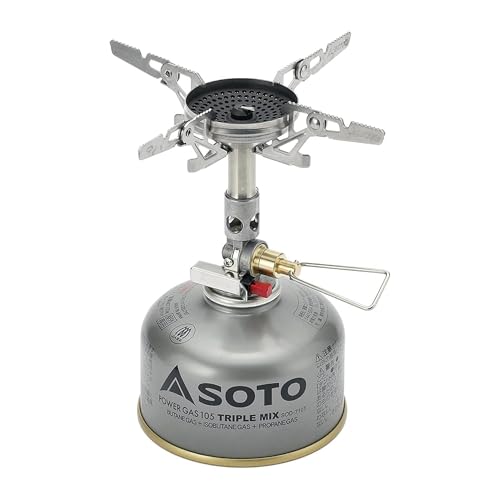
SOTO WindMaster Stove with 4Flex
Best for hikers who want wind protection without system lock-in
SOTO WindMaster Stove with 4Flex
Best for hikers who want wind protection without system lock-in
What we like
- Built-in micro regulator holds output steady in wind and cold — it performs closer to an integrated system than a standard open burner.
- At 2.3 oz the stove-only weight competes with the BRS but with actual wind resistance built into the burner design.
- 4Flex pot support handles larger pots and is far more stable than the BRS on uneven surfaces.
- Works with any standard isobutane canister and any pot you already own — no system lock-in.
What we don't
- More expensive than a basic open-burner canister stove for what is still an exposed-flame design.
- The stealth igniter is functional but more fragile than MSR's Piezo — carry a backup lighter.
- Does not perform as cleanly in sustained 25+ mph wind as the WindBurner's fully enclosed system.
The WindMaster sits exactly between the BRS's no-frills weight savings and the WindBurner's total system approach — it gives you real wind protection from its burner geometry and regulator without forcing you into proprietary cookware. Choose this if you already have a titanium pot you love and want a stove that handles AT conditions without committing to a heavier integrated system.
Skip it if you are routinely cooking in sustained high winds above treeline — the WindBurner wins that scenario.
MSR PocketRocket 2 Ultralight Stove
Best for thru-hikers in calmer terrain and lower elevations
MSR PocketRocket 2 Ultralight Stove
Best for thru-hikers in calmer terrain and lower elevations
What we like
- At 2.6 oz it is genuinely light enough to disappear into any cook kit without adding meaningful pack weight over 2,200 miles.
- Isobutane canisters for this stove are available in almost every trail town outfitter from Springer to Katahdin.
- Precise simmer control lets you cook actual food — ramen, oatmeal, instant mashed potatoes — not just boil water.
- Folded pot supports stabilize most lightweight titanium and aluminum pots without rattling loose on rough terrain.
What we don't
- No pressure regulator means boil time degrades noticeably as the canister empties or temps drop below 40 degrees.
- Without a windscreen, exposed ridgeline cooking is frustrating — the flame moves around significantly in wind.
- Igniter is not built in — you need a lighter or matches every single time, which adds a dependency in wet conditions.
The PocketRocket 2 is the most popular AT canister stove for a reason — it is light, reliable, well-supported at resupply points, and handles 80% of AT conditions without any issue. It belongs in your kit if you are a NOBO thru-hiker doing three-season miles and you know how to use terrain as a windbreak.
If you plan to hit the White Mountains late in the season or camp on exposed ridges regularly, step up to a regulated option — but for most of the AT, this stove just works.
MSR PocketRocket Deluxe Ultralight Stove
Best for hikers who want PocketRocket performance in all conditions
MSR PocketRocket Deluxe Ultralight Stove
Best for hikers who want PocketRocket performance in all conditions
What we like
- Pressure regulator keeps boil times consistent as canisters empty and temps drop — the exact scenario where the standard PocketRocket 2 slows down.
- Built-in Piezo igniter lights with a push — no fumbling for a lighter in rain or cold at the end of a long day.
- Broader burner head distributes heat more evenly and holds better in moderate wind than the standard PocketRocket 2.
- Only 0.3 oz heavier than the PocketRocket 2 — the regulation and igniter upgrades add almost nothing to pack weight.
What we don't
- Still an open burner — sustained AT ridgeline wind above 20 mph will test its limits without a windscreen.
- Some Piezo igniters have failed early in field reports — always carry backup fire-starting capability.
- Costs roughly $20 more than the standard PocketRocket 2 for features most three-season AT hikers may not need.
The PocketRocket Deluxe is what you buy when the standard PocketRocket 2 is the right category of stove but you want it to perform on the cold mornings in the Smokies or the late-season push through the Whites without slowing down. The regulator and built-in igniter are genuinely useful upgrades, not marketing noise — if you are already spending $45 on the standard version, the extra $20 for all-conditions output and a lighter you never have to find is hard to argue against.
BRS BRS-3000T Ultralight Titanium Stove
Best for gram-counters who accept the trade-offs
BRS BRS-3000T Ultralight Titanium Stove
Best for gram-counters who accept the trade-offs
What we like
- At 25g it is the lightest canister stove available at any price — a cook kit built around this and a titanium pot can come in under 4 oz total.
- Price is low enough that you can buy two and keep a backup without thinking twice about the cost.
- Folds into a package small enough to sit inside a 750ml titanium pot with the canister — the entire cook kit disappears into a single small cylinder.
- Standard EN417 threading means it works with the same isobutane canisters every other stove on this list uses.
What we don't
- No windscreen, no pressure regulator, no igniter — it is a burner head and nothing else, and wind exposes that immediately.
- Pot supports are narrow and can be unstable with larger pots — sized for 650-750ml titanium mugs, not full-size pots.
- No regulation means performance drops noticeably with low or cold canisters — plan around that in the Whites.
If you have done the research and already decided to go ultralight with your cook kit, the BRS-3000T makes the financial and weight math easy — it costs almost nothing and weighs almost nothing, and in calm conditions it boils water just fine. Buy this if you are a committed gram-counter who already knows how to use terrain as a windscreen and carries a backup lighter without being told.
Skip it if you are still figuring out AT stove strategy — the $40 step up to the PocketRocket 2 buys you meaningful reliability you will appreciate on day 60.
What to Look For
Wind resistance is the single most important spec for AT hiking, not raw BTU output. An unregulated stove rated at 10,000 BTU can lose 50% of that output in a 15 mph headwind without a proper windscreen or integrated enclosure.
Pressure regulators matter most on cold nights and when canisters are below half full. Without one, your coffee at mile 1,900 in the White Mountains may take twice as long to boil as it did in Georgia.
Weight compounds over 2,200 miles in a way it does not on a weekend trip. Every ounce you save on a stove is an ounce you keep across every single mile — even a 3 oz difference adds up to real fatigue by Katahdin.
Who Should Skip This
If you are section-hiking car-to-car on flat terrain in summer with no wind exposure and cooking full meals, an integrated windproof system may be overkill — a basic canister stove and windscreen will do. Alcohol stove users who have already committed to that fuel system should not switch mid-thru-hike; canister availability in trail towns makes these picks ideal specifically for canister users.
What the Community Actually Uses
On r/AppalachianTrail, stove debates are a perennial fixture — the consensus leans hard toward lightweight integrated systems for thru-hikers and open burners with windscreens for section hikers doing warmer-season miles. Search 'stove NOBO' in that sub and you will find hundreds of real-world data points from hikers who just finished specific sections.
Quick Picks — In Case You've Already Decided
Frequently Asked Questions
Can you resupply isobutane canisters along the Appalachian Trail?
Yes — most trail towns with outfitters or outdoor stores carry 100g and 230g isobutane canisters. Major resupply points like Damascus, Waynesboro, Hanover, and Gorham are reliable. More remote sections may require mailing canisters ahead in a bounce box.
Are alcohol stoves better than canister stoves for the AT?
Alcohol stoves are lighter and simpler, but they underperform badly in wind and cold — two conditions common on the AT above 4,000 feet. Most experienced thru-hikers who start with alcohol stoves switch to canister before finishing. Canister stoves are the more reliable all-weather choice.
How long does a 100g canister last on the AT?
A 100g canister typically boils roughly 10-12 liters of water in calm conditions — about 4-6 days of use for a solo hiker doing two boils per day. Wind, cold temps, and altitude all reduce that. Most AT hikers carry a 100g canister for short sections and 230g for longer carries.
Do you need a windscreen on the Appalachian Trail?
For open-burner stoves like the PocketRocket 2, yes — a lightweight foil windscreen is worth the few grams. Integrated systems like the MSR WindBurner and Jetboil Flash have built-in wind protection and do not need a separate screen.
What is the lightest canister stove option for AT thru-hiking?
The BRS-3000T at 25g is the lightest canister stove available on a mass-market level. It works well in mild conditions but needs a windscreen and does not have a pressure regulator. Ultralight thru-hikers often pair it with a titanium pot to keep their cook kit under 4oz total.
Buying Guide
You need a stove that performs in wind, weighs almost nothing, and runs on canisters you can resupply at trail towns every few days. Integrated systems boil faster and waste less fuel.
Open-burner stoves save weight but need a windscreen. Pressure-regulated stoves hold output as your canister empties — critical on a cold morning at elevation.