At altitude, a standard canister stove loses up to 30% of its output before you've even set a pot on it — the pressure regulation is what separates stoves that still work from ones that just glow. The five stoves below all use regulated burners rated for high altitude, weigh under 16 oz with pot, and are verified on Amazon.
| Photo |
Top Pick

|
Versatile
|
Budget

|
Best Value

|
Best for Reliability

|
|---|---|---|---|---|---|
| Product | MSR WindBurner Personal Stove System | SOTO WindMaster Backpacking Stove with 4Flex | MSR PocketRocket Deluxe Stove | Jetboil MicroMo Cooking System | Fire-Maple Fixed Star 1 Stove System |
| Fuel | Isobutane-propane | Isobutane-propane | Isobutane-propane | Isobutane-propane | Isobutane-propane |
| Weight | 14.9 oz (system) | 2.3 oz (stove only) | 2.9 oz (stove only) | 8.8 oz (system) | 18 oz (system) |
| Boil time | 4.5 min per liter | 2.5 min per 16 oz | 3.5 min per liter | 2.5 min per liter | Approx 3.5 min per liter |
| Pressure regulated | ✓ | ✓ | ✓ | ✓ | ✗ |
| Buy Now | Check Price → | Check Price → | Check Price → | Check Price → | Check Price → |
Quick Tips
Warm your fuel canister in a jacket pocket for 10 minutes before cooking — cold canisters at altitude lose pressure fast and regulated stoves perform far better starting warm.
Use a windscreen or set your pot between two rocks at altitude; even regulated stoves lose efficiency when a gust hits the flame directly.
Isobutane-propane blends outperform pure butane above 10,000 feet — check the canister label before you buy fuel, not at the trailhead.
If your stove simmers unevenly at altitude, it's usually a partially clogged jet — carry a stove tool or thin wire to clear it; it takes 10 seconds and saves your trip.
MSR WindBurner Personal Stove System
Best for exposed ridgelines and consistent boils in brutal wind
MSR WindBurner Personal Stove System
Best for exposed ridgelines and consistent boils in brutal wind
What we like
- Radiant burner with full enclosure blocks wind completely — no windscreen required at any altitude.
- Pressure regulator maintains consistent output even as the canister cools in cold alpine conditions.
- All-in-one nesting system means zero loose parts rattling around a pack on a long approach.
- Boil-to-simmer control dial lets you actually cook real food, not just boil water.
What we don't
- Only compatible with MSR WindBurner cookware — you can't use your existing pot.
- At 14.9 oz the system is heavier than open-burner competitors with a separate pot.
- Simmering is possible but requires patience — the enclosed design makes low heat less intuitive to dial in.
When you're on an exposed ridge at 12,000 feet with a 20 mph crosswind, every other stove on this list needs shelter — the WindBurner doesn't. The enclosed radiant burner acts as its own windscreen, and the pressure regulator keeps output steady even when your canister is freezing against the rock.
This is the stove for alpinists, peak baggers, and anyone whose kitchen is consistently above treeline. If you're cooking at a sheltered basecamp and want something lighter, keep reading — but if conditions are genuinely hostile, nothing here beats this.
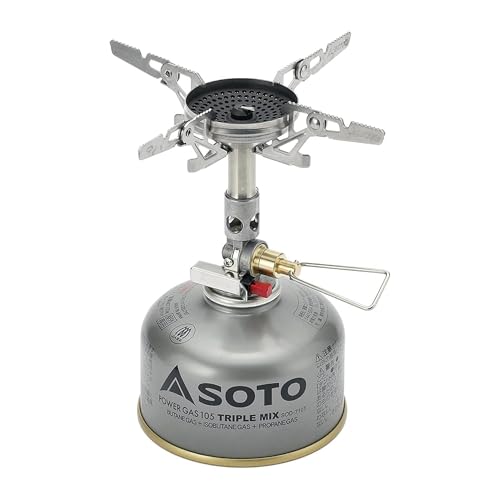
SOTO WindMaster Stove with 4Flex
Best for ultralight backpackers who refuse to sacrifice wind resistance
SOTO WindMaster Stove with 4Flex
Best for ultralight backpackers who refuse to sacrifice wind resistance
What we like
- At 2.3 oz it is one of the lightest regulated canister stoves available anywhere.
- Concave burner head creates a natural wind-channeling effect that outperforms most open burners at altitude.
- Micro-regulator valve maintains consistent output as the canister empties or cools.
- Bundles with the 4Flex pot support so you can run larger pots without stability issues.
What we don't
- Pot sold separately — you need to add pot weight when comparing against integrated systems.
- The small burner head is not ideal for wide-base pots; heat distribution is narrower than the WindBurner.
- Stealth igniter can occasionally need a second strike in very cold conditions below 15 degrees Fahrenheit.
This is the stove gram-counters actually use at altitude — a 2.3 oz regulated burner that handles crosswinds far better than it has any right to given how tiny it is. The concave burner concentrates flame and the micro-regulator keeps it consistent as the air thins, which is the exact combination you need above 10,000 feet.
Choose the WindMaster if you're counting every ounce and pairing it with your own titanium pot. Choose the WindBurner if you're willing to carry more weight for a fully enclosed system in extreme conditions.
MSR PocketRocket Deluxe Stove
Best for backpackers who want to simmer real meals at elevation
MSR PocketRocket Deluxe Stove
Best for backpackers who want to simmer real meals at elevation
What we like
- Broad burner head distributes heat evenly across wider pots — you can actually cook, not just boil.
- Pressure regulator keeps performance consistent in cold temps and low-pressure altitude conditions.
- Built-in piezo igniter is protected inside the burner body so it survives pack abuse without cracking.
- Serrated pot supports grip pots securely even on uneven alpine terrain.
What we don't
- Open burner design requires a windscreen or sheltered position to hit rated boil times above treeline.
- At 2.9 oz it is marginally heavier than the SOTO WindMaster without offering the same wind resistance.
- Pot and windscreen sold separately, so the budget-in price climbs once you're fully equipped.
If 'boil water fast and get it done' is your entire cooking plan, the WindBurner or Jetboil Flash covers you. But if you want to actually simmer a sauce or rehydrate something without burning the bottom, the PocketRocket Deluxe's broad burner head is the right tool — it was built for real cooking, not just fast water.
This stove suits three-season summit trips where you're cooking actual meals and can find or build wind shelter. Skip it for truly exposed ridgeline conditions where you need an enclosed system.
Jetboil MicroMo Cooking System
Best for ultralight gram-counters who also want precision simmer control
Jetboil MicroMo Cooking System
Best for ultralight gram-counters who also want precision simmer control
What we like
- Jetboil's lightest integrated system at 8.8 oz — includes 0.8L pot, so that's the complete kitchen weight.
- FluxRing technology transfers heat so efficiently it uses roughly half the fuel of traditional stoves.
- Regulated to perform consistently down to 20 degrees Fahrenheit, covering most alpine camping temperatures.
- Four-turn simmer valve gives real incremental control between light simmer and full boil.
What we don't
- 0.8-liter pot is tight for anything beyond solo use — cooking for two requires two rounds.
- Lacks the full wind enclosure of the WindBurner, so it needs some shelter above treeline in gusty conditions.
- More expensive than the SOTO WindMaster for comparable regulated performance in a slightly heavier package.
The MicroMo lands in a unique spot: it's an integrated system with genuine simmer control, which most all-in-one stoves skip in favor of raw boil speed. At altitude, that regulator keeps output steady in cold air, and the FluxRing efficiency means your canister lasts longer when resupply is not an option.
This is the stove for solo fastpackers who want a regulated, efficient, complete system without the WindBurner's bulk — and who need actual simmer control because they're cooking, not just rehydrating.
Fire-Maple Fixed Star 1 Stove System
Best budget pick for first high-altitude backpacking trip
Fire-Maple Fixed Star 1 Stove System
Best budget pick for first high-altitude backpacking trip
What we like
- Heat exchanger base reduces boil time by up to 30% compared to traditional stoves without one.
- Fully integrated 1-liter system with pot, stove, and electric ignition all-in-one at a fraction of Jetboil pricing.
- Hard anodized aluminum pot with locking handle is genuinely durable and not a cheap feeling piece of kit.
- Full system fits in a pack pocket — nothing rattles or requires separate packing.
What we don't
- No pressure regulator means performance drops more noticeably as altitude increases and canister cools.
- At 18 oz it is the heaviest system on this list — noticeable on long approaches.
- Wind performance is weaker than all other options here; needs a sheltered spot or windscreen above treeline.
If you're heading into your first high-altitude trip and aren't ready to spend $120 on a stove, the Fixed Star 1 gets you most of the way there at half the price. The heat exchanger base genuinely helps at altitude by pulling more heat out of the fuel, and the integrated system means you're not sourcing a separate pot.
This is the right pick for moderate elevation trips — say, 8,000-10,000 feet — where conditions aren't extreme. If you're regularly camping above 11,000 feet in wind, save up for a regulated system; this one will work but will frustrate you in tough conditions.
What to Look For
A pressure regulator is the single most important feature for high altitude use. Without one, output drops as the canister cools and air pressure falls — your stove will still light, but it will take twice as long to boil and burn through fuel faster.
Wind resistance separates a ridge-line stove from a campsite stove. Enclosed systems like the WindBurner or Jetboil trap heat around the pot; open burners need a windscreen or a sheltered spot to get anywhere near their rated boil times.
System weight includes the pot, not just the burner head. A 2.9 oz stove head paired with a 12 oz pot is not a light setup — compare complete system weights and make sure the pot capacity matches your trip style before you buy.
Who Should Skip This
Skip this entire category if you're car camping at low elevation — a standard canister stove will do the job at less cost. Also skip integrated systems if you cook for more than two people; the 1.0-liter and 0.8-liter pots in most of these kits are tight for groups.
If you're mountaineering above 18,000 feet, liquid fuel stoves like the MSR WhisperLite handle extreme altitude better than canister systems, which can struggle at very high elevations regardless of regulation.
What the Community Actually Uses
On r/ultralight, regulated canister stoves get debated constantly — the consensus leans toward the SOTO WindMaster for pure gram-counting and the MSR WindBurner for anyone who prioritizes reliability over weight. The thread that settled it for most people compared boil times on video at 11,000 feet in wind; the difference between regulated and unregulated was nearly 8 minutes per liter.
Quick Picks — In Case You've Already Decided
Frequently Asked Questions
Do canister stoves work at high altitude?
Yes, but performance drops without a pressure regulator. At 10,000+ feet, air pressure is lower and canisters cool faster, causing unregulated stoves to lose output quickly. A regulated burner compensates for this and keeps boil times consistent.
What fuel is best for high altitude camping stoves?
Isobutane-propane blends are the standard choice for altitude. Pure butane starts struggling around 32 degrees Fahrenheit and performs poorly in cold, thin air. Look for canisters labeled with an isobutane-propane mix, not pure butane.
How much does altitude affect boil time?
Water boils at a lower temperature at altitude, which sounds helpful but isn't — the air pressure drop slows flame output significantly on unregulated stoves. At 14,000 feet, expect 30-50% longer boil times from an unregulated stove compared to sea level.
Is the Jetboil Flash good for high altitude?
The Flash is fast at moderate altitude but lacks a pressure regulator, which means performance degrades more noticeably in cold conditions and above 10,000 feet compared to regulated systems like the WindBurner or SOTO WindMaster. It remains a strong choice for lower elevations.
Can I use a windscreen with a canister stove?
Only around the pot, never fully enclosing the canister — a full windscreen traps heat around the canister and can cause it to over-pressurize dangerously. Most integrated systems handle wind internally, so external windscreens are mainly for open-burner stoves like the PocketRocket Deluxe.
Buying Guide
You need a pressure-regulated burner — full stop. Regulation keeps output consistent as the canister cools and air thins.
After that, look at wind resistance: enclosed systems beat open burners above treeline every time. Weight matters on the approach, but not as much as the boil time that actually happens at 12,000 feet.