Picking your first kayak is not complicated once you filter for the two things that actually matter on calm water: primary stability and weight. Every kayak on this list weighs under 42 lbs, tracks straight without fighting you, and costs well under $1,000.
| Photo |
Top Pick

|
Versatile

|
Budget
|
Best Value

|
Best for Reliability

|
|---|---|---|---|---|---|
| Product | Pelican Argo 100X Recreational Sit-In Kayak 10 ft | Sun Dolphin Aruba 10 SS Sit-In Kayak 10 ft | INTEX 68305EP Challenger K1 Inflatable Kayak Set | Oru Kayak Foldable Kayak Inlet 9 ft 8 in | Perception Flash 9.5 Sit Inside Kayak |
| Length | 10 ft | 10 ft | 9 ft | 9 ft 8 in | 9 ft 6 in |
| Weight | 36 lbs | 40 lbs | 27 lbs | 20 lbs | 41 lbs |
| Capacity | 275 lbs | 250 lbs | 220 lbs | 275 lbs | 325 lbs |
| Hull type | Sit-in | Sit-in | Inflatable sit-in | Folding sit-in | Sit-in |
| Buy Now | Check Price → | Check Price → | Check Price → | Check Price → | Check Price → |
Quick Tips
Always wet-test before buying if a local outfitter offers demos — stability feels different in person than on spec sheets.
A kayak paddle sized wrong for your height will exhaust you inside an hour; measure your torso and the kayak width together.
For flat lakes under 3 miles, a 9-10 ft recreational hull is plenty — longer boats are faster but harder to turn and store.
Inflate your PFD habit before your skills — wear it every single session as a beginner, even on glassy water.
Pelican Argo 100X Recreational Sit-In Kayak 10 ft
Best for beginners who want a proper hardshell that lasts
Pelican Argo 100X Recreational Sit-In Kayak 10 ft
Best for beginners who want a proper hardshell that lasts
What we like
- Twin-arched multi-chine hull gives flat-bottom stability without feeling sluggish to steer.
- At 36 lbs it is one of the lightest hardshell 10-footers on the market — a real one-person carry.
- Ergoform padded backrest and adjustable footrests make 2-3 hour lake sessions genuinely comfortable.
- Ram-X high-density polyethylene is nearly indestructible against dock edges and rocky shores.
What we don't
- Does not include a paddle — budget an extra $40-60 for a basic aluminum shaft.
- The front storage hatch is small; longer day bags will not fit through it.
- Not ideal once you want to move beyond flatwater, as the wide hull slows you on open crossings.
The Argo 100X is built for the exact situation most beginners are in: calm lake, no experience, wants something that feels like a real kayak and will not be replaced in two seasons. At 36 lbs it loads onto a car roof without a second person, and the flat-bottomed hull keeps you locked in on glassy water even when you stop paddling to look around.
This is for you if you are paddling lakes and slow rivers and want a boat you can grow with for three or four years. If you want to go faster or venture into light coastal water by next summer, you will eventually outgrow it — but for year one it is the correct pick.
Sun Dolphin Aruba 10 SS Sit-In Kayak 10 ft
Best for budget-conscious buyers who want a proven starter
Sun Dolphin Aruba 10 SS Sit-In Kayak 10 ft
Best for budget-conscious buyers who want a proven starter
What we like
- Consistently under $300 — the most affordable hardshell 10-footer from a name brand with real US support.
- Fortiflex high-density polyethylene hull is impact resistant and holds up to beach launches and dock bumps.
- Portable Accessory Carrier (PAC) clips to the stern and doubles storage without modifying the boat.
- Adjustable padded seatback and thigh pads make it far more comfortable than its price suggests.
What we don't
- Tracks less crisply in a crosswind than the Pelican — expect more correction strokes on open water.
- Seat padding wears out faster than higher-end competitors; some paddlers add an aftermarket seat cushion.
- At 40 lbs it is heavier than expected for its size, which matters on longer portages.
The Aruba 10 has been the entry point for more first-time kayakers than almost anything else sold in the US, and the reason is simple: it is cheap enough to buy without overthinking it and stable enough to not scare you off the water. The wide, flat bottom forgives bad weight distribution when you are still figuring out how to sit still.
Buy this if your budget tops out under $300 and you want a USA-made boat from a brand with actual customer support. Skip it if you are over 220 lbs with gear — you will be riding low in the water and the boat will feel sluggish.
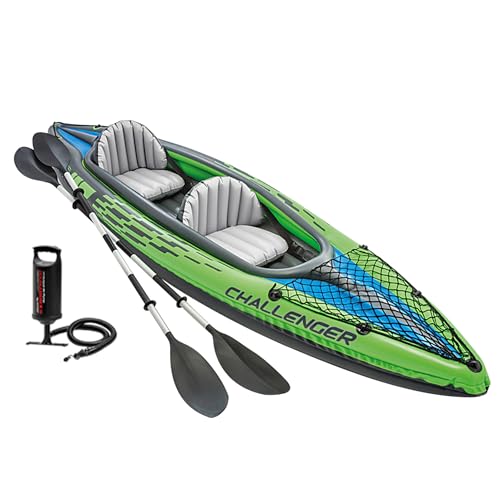
INTEX 68305EP Challenger K1 Inflatable Kayak Set
Best for beginners with no storage space or roof rack
INTEX 68305EP Challenger K1 Inflatable Kayak Set
Best for beginners with no storage space or roof rack
What we like
- Deflates and packs into a carry bag that fits in a car trunk — no roof rack, no garage space required.
- Includes paddle and pump in the box — you can be on the water the same day it arrives.
- High-buoyancy side chambers make it extremely hard to fully capsize on flat, calm water.
- US Coast Guard certified and TUV approved — actual safety credentials for an $80-100 boat.
What we don't
- Vinyl construction is slower and less precise than a hardshell — noticeable in any kind of headwind.
- The removable skeg helps tracking but still requires more correction strokes than a rigid hull.
- Not built for multi-season heavy use; vinyl is susceptible to UV degradation if stored outside.
If you live in an apartment, drive a sedan, or are not sure kayaking will stick as a hobby, this is the logical starting point. You get everything in one box, it weighs 27 lbs, and you never need to figure out how to strap something to your roof.
This is for someone who wants to try real kayaking on a lake without a $400 commitment or a storage problem. Once you know the sport is for you, upgrade to a hardshell — but this will show you whether it is.
Oru Kayak Foldable Kayak Inlet 9 ft 8 in
Best for paddlers who want portability without sacrificing feel
Oru Kayak Foldable Kayak Inlet 9 ft 8 in
Best for paddlers who want portability without sacrificing feel
What we like
- Folds from box to boat in under 5 minutes with no tools — genuinely faster than carrying a hardshell to the water.
- At 20 lbs it is lighter than most hardshell 10-footers despite being rigid once assembled.
- 5 mm double-layer polypropylene hull behaves like a real hardshell on calm water — no spongy flex underfoot.
- Fits in any car trunk or even carries as oversized luggage — a genuine travel kayak.
What we don't
- The price premium over hardshells is steep and hard to justify if you have storage and a vehicle with roof space.
- Large open cockpit is great for getting in and out but offers less thigh bracing than a traditional sit-in design.
- The origami fold requires learning a specific sequence; the first two or three assembles take longer than advertised.
The Inlet solves the problem that stops most urban or apartment-based beginners from kayaking at all: where do you put the boat? This folds into a box that lives in a closet, opens in minutes, and paddles like a proper hardshell on flat lakes and calm bays. This is for the beginner who has already decided kayaking is happening but has a small car, no garage, and no patience for a roof rack system.
If you have a truck and a garage, buy the Pelican and save $400.
Perception Flash 9.5 Sit Inside Kayak
Best for beginners who also want to fish from day one
Perception Flash 9.5 Sit Inside Kayak
Best for beginners who also want to fish from day one
What we like
- Two molded-in rod holders mean you paddle and fish without adding aftermarket accessories your first season.
- 325 lb capacity is the highest on this list — accommodates larger paddlers or extra gear without riding low.
- Multi-function dash keeps small items at hand level so you are not digging through a rear hatch while drifting.
- Designed and made in the USA — Perception has been building recreational kayaks for over 40 years.
What we don't
- At 41 lbs it is the heaviest kayak on this list; a car-topping solo requires a good loading technique.
- Rod holders are molded flush — they do not accommodate oversized rod handles without adapters.
- Not the fastest hull for pure paddling days; the extra width prioritizes stability over glide efficiency.
Most beginner kayaks make you choose between learning to paddle and getting into fishing — the Flash 9.5 skips that choice. The two molded rod holders, forward dash, and high weight capacity mean you can fish a calm pond on your very first trip without retrofitting anything.
This is for the beginner who already knows they want to fish, not just paddle — and does not want to buy a second boat six months in. If fishing is not your plan, the Pelican Argo gives you a lighter, cheaper, cleaner paddling experience.
What to Look For
Look for a minimum beam width of 28 inches for your first kayak. Anything narrower and primary stability disappears the moment you reach for your water bottle.
Sit-in vs sit-on-top matters more than most beginners expect. Sit-in kayaks keep you drier and track better; sit-on-tops let you fall off and climb back on easily.
Weight capacity should be at least 50 lbs over your body weight with gear. Underestimating this makes the kayak feel tippy and sluggish at the waterline.
Who Should Skip This
Skip this list if you plan to paddle anything beyond Class I water in your first season. Recreational kayaks with wide, flat hulls are tuned for stability on calm lakes and slow rivers — they struggle in current, chop, or wind.
If your local water has regular wind-driven waves or you want to do multi-day touring, step up to a dedicated touring kayak with a longer waterline from day one.
What the Community Actually Uses
On r/kayaking, the most common beginner regret is buying too narrow too fast. The thread consensus consistently lands on 28-inch-plus hulls for year-one paddlers, and both the Pelican Argo and Sun Dolphin Aruba lines get named more often than anything else in the under-$500 bracket.
Quick Picks — In Case You've Already Decided
Frequently Asked Questions
What length kayak is best for a complete beginner?
For calm lakes and ponds, a 9 to 10-foot kayak is the sweet spot for beginners. It is maneuverable enough to turn easily, light enough to carry solo, and stable enough that you stay focused on paddling instead of balance.
Is a sit-in or sit-on-top kayak better for beginners?
Sit-on-top kayaks are generally more forgiving because you can self-rescue easily if you flip. Sit-in kayaks stay drier and track better in light wind. For warm-weather, calm-water beginners either works — sit-on-top wins for total ease of entry and exit.
Do I need to buy a paddle separately?
Most entry-level recreational kayaks come bundled with a paddle. Check the listing carefully — some like the Intex Challenger K1 include one, while hardshell kayaks like the Pelican Argo typically do not. Budget an extra $40-80 for a decent aluminum paddle if yours does not.
Can a beginner use an inflatable kayak on a lake?
Yes, inflatable kayaks like the Intex Challenger K1 are specifically designed for calm lakes and mild rivers. They are slower than hardshells and less precise, but they are nearly impossible to tip and require no roof rack or storage space.
How do I transport a kayak without a truck?
A foam block kit strapped to any car roof works for hardshells under 50 lbs. Inflatable kayaks deflate into a bag that fits in a trunk. For heavier hardshells, a J-rack or saddle roof system is more secure and worth the $80-150 investment.
Buying Guide
On calm water you need width over speed. Look for a hull at least 28 inches wide — it keeps you upright when you shift your weight.
Sit-in kayaks stay drier, sit-on-tops are easier to remount. Weight matters more than you think: if you cannot carry it 50 yards alone, you will stop using it.