Picking a first kayak doesn't have to feel like a research project — the stable, beginner-friendly options have gotten genuinely good, and the difference between a frustrating first paddle and a great one comes down to hull design and seat comfort. Five kayaks under $1,000 cover every scenario from flat-water lake days to light river exploring, with the widest starting at 28.5 inches — enough that tipping feels like a non-issue.
| Photo |
Top Pick

|
Versatile

|
Budget

|
Best Value

|
Best for Reliability
|
|---|---|---|---|---|---|
| Product | Wilderness Systems Aspire 105 | Pelican Argo 100X Recreational Sit-In Kayak 10 ft | Lifetime Tamarack Angler 100 Fishing Kayak | Perception Conduit 13 | INTEX 68305EP Challenger K1 Inflatable Kayak Set |
| Length | 10'6" | 10' | 10' | 13' | 9' |
| Weight | 48 lbs | 36 lbs | 52 lbs | 55 lbs | 27.2 lbs |
| Capacity | 275 lbs | 275 lbs | 275 lbs | 300 lbs | 220 lbs |
| Hull type | Sit-inside | Sit-inside | Sit-on-top | Sit-inside | Inflatable sit-in |
| Buy Now | Check Price → | Check Price → | Check Price → | Check Price → | Check Price → |
Quick Tips
Always test stability by rocking side-to-side at the put-in before paddling out — a kayak that feels twitchy on shore will feel worse mid-lake.
Inflate inflatable kayaks to the maximum PSI listed on the label — under-inflation is the single biggest cause of poor tracking and wobbly feel.
Adjust foot pegs before you leave the bank, not on the water — proper leg position is what makes your paddle strokes actually efficient.
If you're buying a sit-on-top, get a kayak leash for your paddle — the current will take it faster than you can swim.
Wilderness Systems Aspire 105
Best for beginners who want to keep paddling for years
Wilderness Systems Aspire 105
Best for beginners who want to keep paddling for years
What we like
- Phase 3 AirPro seat is genuinely comfortable for 3+ hour paddles — adjustable lumbar, mesh back, 3D foam base.
- Retractable TruTrak skeg snaps down from the cockpit to lock in straight tracking on open water.
- Dual-lock hinged rear hatch keeps gear completely dry — not just splash-resistant, actually dry.
- Wide 28.5-inch beam gives a stable, confident feel even in light chop without feeling sluggish.
What we don't
- At $650-750 it's the priciest option on this list — harder to justify for casual once-a-summer use.
- 48 lbs is manageable but heavier than budget options — you'll want a kayak cart for longer carry distances.
- Seat adjustment system has a learning curve; takes a few paddles to dial in perfectly.
If you're going to paddle more than twice a year, this is the one to buy — the seat alone is worth the price difference over every cheaper option, and the adjustable skeg means you're not fighting wind and current on every stroke. This is for the beginner who doesn't want to buy twice.
If you genuinely only want to float around once in a while, save the money and go simpler — but if you think this might become a regular thing, the Aspire 105 is the one you'll still be happy with in year three.
Pelican Argo 100X
Best lightweight sit-in for casual lake days
Pelican Argo 100X
Best lightweight sit-in for casual lake days
What we like
- 36 lbs makes this one of the lightest hard-shell recreational kayaks at this price — one person can load it solo.
- Twin-arched multi-chine hull is engineered for stability first, making it genuinely forgiving for brand-new paddlers.
- RAM-X material absorbs impacts without cracking — dragging it up a gravel launch won't leave marks.
- Ergoadjustable padded backrest with seat cushion is comfortable for sessions up to 90 minutes.
What we don't
- 10-foot length limits top speed — longer paddles on big lakes require noticeably more effort per mile than a 13-footer.
- No skeg or rudder means you'll be doing more corrective strokes in crosswinds than you'd like.
- Storage is limited to a front hatch and rear bungee — not the right boat for day-trip gear.
The Pelican Argo 100X is the easiest first kayak to own — it's light enough to handle solo, stable enough that your first hour on the water is fun rather than stressful, and the price doesn't sting if you paddle it twice and realize kayaking isn't your thing. Best for someone who wants a real hard-shell kayak without a truck or heavy lifting.
If you're planning long distances or big lakes, step up to the 13-footer — but for a local pond or slow river, the Argo 100X covers everything you need.
Lifetime Tamarack Angler 100
Best sit-on-top for beginners who want to fish
Lifetime Tamarack Angler 100
Best sit-on-top for beginners who want to fish
What we like
- Flat-bottom hull with deep tracking channels is one of the most stable SOT designs available under $400.
- Two flush-mount rod holders and a top-mount rod holder built in — no add-ons needed to start fishing.
- Blow-molded HDPE construction is UV-protected and impact-resistant — built to sit outside year-round.
- Padded seat back and seat cushion included, with multiple footrest positions to fit different heights.
What we don't
- 52 lbs is noticeably heavier than the Pelican — you'll feel the difference on long carry-ins to the water.
- No dry storage hatches standard — anything electronic needs a dry bag.
- Slower in a straight line than a sit-in at the same length due to wider, flatter hull design.
If you're a first-time paddler who also wants to fish, this is the only option on this list that doesn't require you to rig up a single accessory before your first trip — the rod holders are already there, the seat is padded, and the flat bottom means you can reach down to unhook a fish without the kayak trying to flip. Skip this one if fishing isn't part of the plan — the extra weight and open deck aren't worth it for pure paddling.
But if you're buying a kayak specifically to get to fishing spots, the Tamarack does it at the right price.
Perception Conduit 13
Best for beginners who want to cover real distance
Perception Conduit 13
Best for beginners who want to cover real distance
What we like
- 13-foot hull tracks noticeably straighter than 10-foot designs — fewer correction strokes, more forward momentum.
- Front and rear sealed dry storage compartments keep gear completely dry — usable for day-trip essentials.
- Roto-molded one-piece construction has no seams to crack or leak — one of the most durable hulls at this price.
- Adjustable backrest and leg lift make it one of the more comfortable seats in its class for longer paddles.
What we don't
- 55 lbs and 13 feet makes it the hardest to transport and store on this list — you need a roof rack system.
- Tracks straight but turns slower than a 10-footer — not ideal for winding rivers with tight bends.
- No skeg or rudder despite the longer hull — crosswind paddling requires more skill than you'd expect.
The Conduit 13 is the fastest option for beginners on this list — the extra three feet of hull means you glide between strokes instead of stalling, which makes longer paddles less exhausting and more enjoyable once you get the hang of it. This is the right pick if your local water is a bigger lake or a long stretch of slow river.
If storage is tight or you're loading it onto a car solo, the 13-foot length becomes a daily friction point — in that case the 10-foot options are more practical.
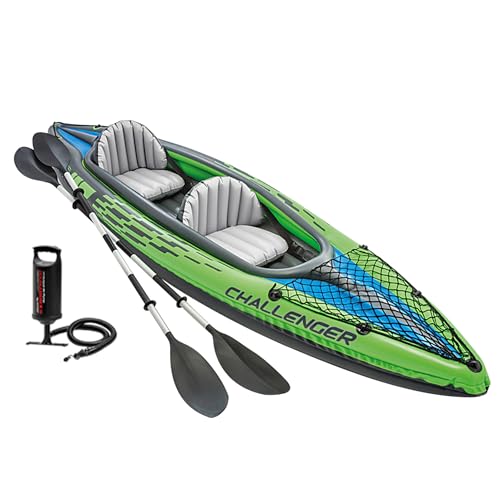
Intex Challenger K1 Inflatable Kayak
Best for beginners with no storage or roof rack
Intex Challenger K1 Inflatable Kayak
Best for beginners with no storage or roof rack
What we like
- Packs into a carry bag the size of a large backpack — fits in any trunk, no roof rack required.
- SuperStrong PVC construction is resistant to abrasion and UV — holds up better than budget inflatables from lesser brands.
- Removable skeg provides real directional control — the difference between frustrating spinning and actual forward movement.
- At under $130 it's the lowest-friction way to find out whether you'll actually use a kayak before spending more.
What we don't
- 220 lb weight capacity is the lowest on this list — taller or heavier paddlers should look at a hard-shell instead.
- Tracking and glide can't match a hard-shell hull at the same length — you'll work harder for the same speed.
- Setup takes 10-15 minutes and the included pump is slow — factor that into your launch-day time.
The Intex Challenger K1 makes the most sense for one specific person: someone who lives in an apartment, doesn't own a car with a roof rack, or genuinely isn't sure if they'll paddle more than three times this year. It won't perform like a hard-shell — but it will get you on the water, and it packs into a bag that fits under a bed.
If you try this and like it, upgrade to a hard-shell next season. If you're already sure you'll paddle regularly, skip this one and start with the Pelican — you'll spend less money long-term.
What to Look For
Hull width is the most important spec for a beginner kayak — anything 28 inches or wider gives you the primary stability to relax and actually enjoy paddling instead of bracing. Length affects speed and tracking: a 10-foot kayak is easier to turn and store, while a 13-footer tracks straighter on open water with less effort.
Seat quality separates a fun two-hour paddle from a miserable one. Look for adjustable backrests with real lumbar support — foam-padded buckets are worth paying extra for.
Weight capacity isn't just about your body weight — add your gear, water, and anything else you'll bring. Buying a 275 lb capacity kayak when you weigh 220 lbs is cutting it close; aim for at least 50 lbs of headroom.
Who Should Skip This
Skip this category entirely if you're planning to paddle Class III whitewater or open ocean — none of these recreational kayaks are designed for moving water with significant rapids or coastal chop. If your goal is fast touring or multi-day river trips, a properly fitted sea kayak or touring model is the better investment from day one.
These five are built for calm lakes, ponds, and slow-moving rivers.
What the Community Actually Uses
On r/kayaking, the most repeated advice for first-time buyers is to paddle before you buy if at all possible — most paddling clubs and outfitters will let you rent the model you're considering for a half-day. The thread on beginner recommendations almost always flags the same mistake: buying an inflatable because it's cheap and then being frustrated by how it handles compared to a hard-shell.
Budget for the right boat upfront.
Quick Picks — In Case You've Already Decided
Pelican Argo 100X Recreational Sit-In Kayak 10 ft
Check Price on AmazonFrequently Asked Questions
What's the difference between a sit-on-top and a sit-inside kayak for beginners?
Sit-on-tops are easier to get in and out of, self-drain if you flip, and are more forgiving for first-timers in warm water. Sit-insides keep you drier, are faster in a straight line, and perform better in cooler conditions. Most beginners on lakes start with a sit-on-top.
Do I need any experience to buy a recreational kayak?
No — recreational kayaks at this level are designed for zero experience. A wide, flat hull means you can sit upright and paddle without formal instruction. Taking a 1-hour beginner lesson still cuts your frustration significantly.
How do I transport a kayak without a truck or trailer?
A foam block roof rack system works for most sedans and SUVs and costs under $40. You'll also need two cam straps and bow/stern tie-downs. Inflatable kayaks pack into a duffel and fit in any trunk.
Is a 10-foot or 13-foot kayak better for a beginner?
Ten-foot kayaks are easier to turn, lighter to carry, and simpler to store — they're the right call for small lakes and casual use. A 13-footer tracks straighter and covers ground faster, which matters if you're paddling larger bodies of water or doing distances over two miles.
What safety gear do I need before I paddle?
A properly fitting PFD (personal flotation device) is the non-negotiable — it's required by law on most waterways. Add a whistle, a paddle leash, and a waterproof bag for your phone. A bilge pump is worth having in a sit-inside kayak.
Buying Guide
You need a flat-bottomed hull for primary stability — that's what keeps you upright on your first paddle without constant correction. Width matters more than length at this stage.
Sit-on-tops are easier to get in and out of; sit-ins keep you drier. Buy for the water you'll actually paddle, not your aspirations.